• العربية
  • فارسی
Brand
  • Iran Insight
  • Politics
  • Economy
  • Analysis
  • Special Report
  • Opinion
  • Podcast
  • Iran Insight
  • Politics
  • Economy
  • Analysis
  • Special Report
  • Opinion
  • Podcast
  • Theme
  • Language
    • العربية
    • فارسی
  • Iran Insight
  • Politics
  • Economy
  • Analysis
  • Special Report
  • Opinion
  • Podcast
All rights reserved for Volant Media UK Limited
volant media logo

Azerbaijan Denies Deal With Armenian Separatists To Open Roads
Iran International Newsroom
Sep 10, 2023, 19:22 GMT+1Updated: 17:48 GMT+1
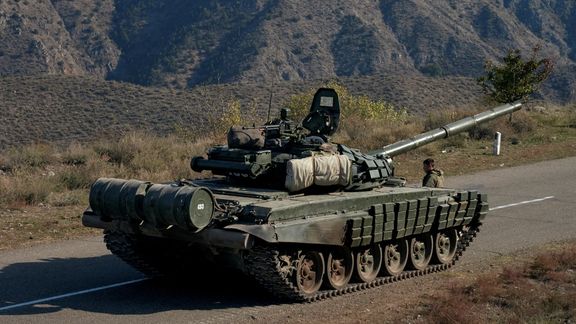
A service member of the Russian peacekeeping troops stands next to a tank near the border with Armenia, following the signing of a deal to end the military conflict between Azerbaijan and ethnic Armenian forces, in the region of Nagorno-Karabakh, November 10, 2020.

Azerbaijan has denied that Baku had reached a deal with the breakaway province of Nagorno-Karabakh to simultaneously reopen roads to Azerbaijan and Armenia.

Hikmet Hajiev, a foreign policy advisor to Azerbaijani President Ilham Aliyev, said on the platform X, formerly known as Twitter that Baku had offered to simultaneously reopen the roads but that what he called the "illegal regime" in Karabakh had refused.

Earlier reports had said Baku and separatist ethnic Armenians in the disputed region had agreed to reopen two transport routes to the breakaway region, including the key Lachin corridor after weeks of a blockade that put the Armenian enclave in a humanitarian crisis. It was initially reported by Armenia's Armenpress state news agency Saturday and later confirmed by Baku but apparently it did not hold.

The separatist in Karabakh had announced that they would let in aid shipments from Baku-held territory for the first time in decades, and in return Azerbaijan would end blockade of road links to Armenia. It would be the first direct transport link between Azeri government-held territory and the province, which broke free of Baku's rule in the 1990s. It was reported that the move was driven by "severe humanitarian problems" in the blockaded region.

The United States is "deeply concerned about the rapidly deteriorating humanitarian situation" in Azerbaijan's breakaway region of Nagorno-Karabakh, Secretary of State Antony Blinken said on Sunday.

An ethnic Armenian soldier looks through binoculars as he stands at fighting positions near the village of Taghavard in the region of Nagorno-Karabakh, January 11, 2021.
100%
An ethnic Armenian soldier looks through binoculars as he stands at fighting positions near the village of Taghavard in the region of Nagorno-Karabakh, January 11, 2021.

Karabakh is recognized globally as part of Azerbaijan but controlled by its population of around 120,000 ethnic Armenians since the 1993 war that coincided with the breakup of the Soviet Union. Azerbaijan recaptured large swathes of land in a second major war in 2020, and for the past nine months has restricted its access to Armenia through the Lachin corridor.

The road has been cut off apart for urgent medical cases, leading to severe shortages of food, fuel, and medicine as well as rationing of bread. To justify the blockade, Azerbaijan accused Armenia of using the corridor to smuggle weapons, and of rejecting an offer to reopen the road simultaneously with another route into Karabakh.

The cancelled deal was announced on a day Karabakh's parliament chose Samvel Shahramanyan -- a military officer and former head of the territory's security service -- as the new president of its self-proclaimed independent republic.

Samvel Shahramanyan, who was elected by the local parliament as the new president of Azerbaijan's breakaway region of Nagorno-Karabakh, attends the inauguration ceremony at the National Assembly of the Republic of Artsakh, in Stepanakert in the region of Nagorno-Karabakh, September 10, 2023.
100%
Samvel Shahramanyan, who was elected by the local parliament as the new president of Azerbaijan's breakaway region of Nagorno-Karabakh, attends the inauguration ceremony at the National Assembly of the Republic of Artsakh, in Stepanakert in the region of Nagorno-Karabakh, September 10, 2023.

Azerbaijan, as well as its allies Ukraine and Turkey, condemned the election as illegal, amid days of escalating tensions that saw both Baku and Yerevan building up military forces along the line of contact in Nagorno-Karabakh and the Armenian-Azerbaijan border. The European Union said it did not recognize the election, but that Karabakh residents should "consolidate around the de facto leadership" in talks with Baku.

Azerbaijan said on Saturday that Armenian forces had fired on its troops overnight, and that Azerbaijan army units took "retaliatory measures". Armenia denied the incident. However, during the past several days, footage has emerged of escalated military movements.

Tensions intensified earlier in the month after the Armenian Defense Ministry announced that it will hold a joint war game with NATO forces from September 11-20, dubbed Eagle Partner 2023, aimed at increasing the level of interoperability of units participating in international peacekeeping missions. The joint drill with the United States forces can be construed as Armenia leaning towards the West to secure support in case of a military conflict.

Traditionally, Baku has a close relationship with Turkey while Armenia leaned on Russia and Iran, both against any border changes between the two longtime rivals. However, Yerevan is now seeking wider international support and is distancing itself from Moscow, perhaps because Russia is engrossed in its invasion of Ukraine as well as its warming ties with Turkey and Azerbaijan. Russia sent peacekeepers to the area and promised to keep the Lachin corridor open as part of a peace deal that ended the 2020 war.

Armenia's Prime Minister Nikol Pashinyan recently complained that Moscow failed to live up to its assurances, and that exclusive dependence on Russia does not serve Armenia's security well anymore, a statement that Moscow described as "public rhetoric bordering on rudeness".

On Saturday, Pashinyan held phone conversations with the leaders of France, Germany, Iran and Georgia, and with US Secretary of State Antony Blinken. Azerbaijan also said its foreign minister discussed the situation with a senior US State Department official, Yuri Kim.

Amid simmering tensions, Iranian sources on social media have claimed that Tehran has sent a serious warning to Baku not to launch an attack. A channel close to Iran’s Revolutionary Guards published videos of Iranian armored vehicles in the vicinity of Aras River, which borders Armenia.

Meanwhile, according to unconfirmed reports, Turkish Foreign Minister Hakan Fidan has warned Iran against intervening in Azerbaijan. “If Iran takes action against Azerbaijan, the Turkish Army will be quick to respond,”a telegram channel cited the Turkish diplomat.

Israeli television channel i24 claims that “Iran has been making every effort in recent weeks to fuel revanchist sentiments in Armenia, and acting on it by mediating arms purchases from India and demonstrating military support.” The media outlet cited unnamed Russian sources as saying that “Tehran may, in coordination with Yerevan, introduce its armed forces into the Armenian territory, as it has been one of the channels for the transfer of military equipment to Russia since the beginning of the conflict in Ukraine.”

The Islamic Republic of Iran has previously cautioned against any alterations to the political geography of the Caucasus region and the adjustment of international borders. Iran declared that if either side seeks to change the geopolitical landscape of the Caucasus or international borders in the Karabakh region, Iran will set aside its neutrality and respond directly.


Most Viewed

Iran negotiators ordered to return after internal rift over Islamabad talks
1
EXCLUSIVE

Iran negotiators ordered to return after internal rift over Islamabad talks

2
ANALYSIS

US blockade enters murky phase as tankers spoof signals and buyers hesitate

3
ANALYSIS

Why the $100 billion Hormuz toll revenue is a myth

4

US tightens financial squeeze on Iran, warns banks over oil money flows

5
ANALYSIS

US blockade targets Iran oil boom amid regional disruption

Banner
Banner

Spotlight

  • Hardliners push Hormuz ‘red line’ as US blockade tests Iran’s leverage
    INSIGHT

    Hardliners push Hormuz ‘red line’ as US blockade tests Iran’s leverage

  • Ideology may be fading in Iran, but not in Kashmir's ‘Mini Iran'
    INSIGHT

    Ideology may be fading in Iran, but not in Kashmir's ‘Mini Iran'

  • War damage amounts to $3,000 per Iranian, with blockade set to add to losses
    INSIGHT

    War damage amounts to $3,000 per Iranian, with blockade set to add to losses

  • Why the $100 billion Hormuz toll revenue is a myth
    ANALYSIS

    Why the $100 billion Hormuz toll revenue is a myth

  • US blockade targets Iran oil boom amid regional disruption
    ANALYSIS

    US blockade targets Iran oil boom amid regional disruption

  • Iran's digital economy battered by prolonged blackout
    INSIGHT

    Iran's digital economy battered by prolonged blackout

•
•
•

More Stories

Iran-Linked Terror Suspect Charged With Unlawful Escape

Sep 10, 2023, 19:22 GMT+1

British police have charged an ex-soldier with alleged ties to Iran with unlawfully escaping from custody following a four-day manhunt in West London.

Daniel Khalife, a 21-year-old former soldier accused of passing information to the Islamic Republic, had absconded from Wandsworth prison on Monday morning by strapping himself to the underside of a food delivery truck.

He was recaptured in west London on Saturday while cycling alongside a canal.

"A man who was arrested after escaping from HMP Wandsworth has been charged," the Metropolitan Police said. "Daniel Abed Khalife, 21, will appear in custody at Westminster Magistrates’ Court on Monday, 11 September."

Khalife, who was discharged from the British army in May, was charged with escaping "contrary to common law" while being remanded in custody. He had been held pending trial on offences relating to terrorism and the Official Secrets Act.

He is accused of eliciting or trying to elicit information likely to be useful to a person preparing an act of terrorism while he was based at barracks in central England in 2021, and staging a bomb hoax by placing three canisters with wires on a desk.

He had also been charged with obtaining information which might be "directly or indirectly useful to an enemy". The BBC has reported he was accused of gathering intelligence for Iran.

Daniel Abed Khalife embarked on his military career in 2019, stationed at MoD Stafford, also known as Beacon Barracks, prior to his disappearance on January 2. The incident was linked to an alleged bomb hoax. Subsequent court proceedings at Westminster Magistrates' Court unveiled allegations of Khalife planting mock explosive devices with the intent of inducing fear.

(With reporting by Reuters)

Family Of Swede Detained In Iran Calls For International Support

Sep 10, 2023, 16:03 GMT+1

The family of a Swedish EU employee detained in Iran has urged the international community to help secure his release.

"The family, friends, and supporters of Johan are calling for urgent international attention to secure his immediate release and safe return to Europe," Johan Floderus' family wrote on a website dedicated to his release, on his 33rd birthday, on Sunday.

The European Union's top diplomat Josep Borrell said on Tuesday that Floderus' case had been raised repeatedly with authorities in the Islamic Republic.

His family said Floderus was being held more than 500 days for alleged spying without formal charges at Tehran's Evin prison, where political prisoners and many detainees facing security charges, including Iranians with dual nationality, are jailed.

His family said Floderus had travelled throughout the Middle East to study languages, explore historic sites and to support humanitarian cooperation projects in Iran on behalf of the EU, and was arrested in April 2022 before leaving the country.

"His needs for adequate food rations, outside walks, medical checkups and much more are not respected (in jail)," they said, adding that he had been denied "communicating" with Sweden's embassy in Tehran, except a few consular visits.

They said that starting in February 2023 Floderus was restricted to making short phone calls once a month. "He had to go on hunger strike to be allowed to make several of these calls, which have to be in English and monitored."

(With reporting by Reuters)

Iran, US On Verge Of Prisoner Swap Under Qatar-Mediated Deal – Reuters

Sep 10, 2023, 15:52 GMT+1

The following is an Insight article published by Reuters, September 10, 2023, reprinted with no changes. Authors: Hafezi and Andrew Mills

--------------------------------------------------------------------------------

When $6 billion of unfrozen Iranian funds are wired to banks in Qatar as early as next week, it will trigger a carefully choreographed sequence that will see as many as five detained US dual nationals leave Iran and a similar number of Iranian prisoners held in the US fly home, according to eight Iranian and other sources familiar with the negotiations who spoke to Reuters.

As a first step, Iran on Aug. 10 released four US citizens from Tehran’s Evin prison into house arrest, where they joined a fifth, who was already under house arrest. Later that day US Secretary of State Antony Blinken called the move the first step of a process that would lead to their return home.

They include businessmen Siamak Namazi, 51, and Emad Sharqi, 59, as well as environmentalist Morad Tahbaz, 67, who also holds British nationality, the US administration has said. The Tahbaz and Shargi families did not respond to requests for comment. A lawyer for the Namazi family declined to comment.

The identities of the fourth and fifth Americans, one of whom according to two sources is a woman, have not been disclosed. Reuters couldn't establish which Iranian prisoners, in turn, would be swapped by the US.

British-Iranian environmentalist Morad Tahbaz, Tara Tahbaz, Vida Tahbaz, Teymoor Tahbaz and Roxanne Tahbaz pose in this file picture obtained from social media.
100%
British-Iranian environmentalist Morad Tahbaz, Tara Tahbaz, Vida Tahbaz, Teymoor Tahbaz and Roxanne Tahbaz pose in this file picture obtained from social media.

At the centre of the negotiations that forged this deal between the superpower which Iran brands the "Great Satan”, and the Islamic Republic which Washington calls a state sponsor of terrorism is the tiny but hugely rich state of Qatar.

Doha hosted at least eight rounds of talks involving Iranian and US negotiators sitting in separate hotels speaking via shuttle diplomacy, a source briefed on the discussions said, with the earlier sessions focused mainly on the thorny nuclear issue and the later ones on the prisoner releases.

Doha will implement a financial arrangement under which it will pay banking fees and monitor how Iran spends the unfrozen cash to ensure no money is spent on items under US sanctions, and the prisoners will transit Qatar when they are swapped, according to three of the sources.

"Iran initially wanted direct access to the funds but in the end agreed to having access via Qatar," said a senior diplomat. "Iran will purchase food and medicine and Qatar will pay directly."

Reuters pieced together this account of previously unreported details about the extent of Qatari mediation of the secret talks, how the deal unfolded and the expediency that motivated both parties to clinch the prisoner swap deal. Reuters interviewed four Iranian officials, two US sources, a senior Western diplomat, a Persian Gulf government adviser and the person familiar with the negotiations.

All of the sources requested anonymity because of the sensitivity of a deal which hasn’t been fully implemented.

A State Department spokesperson said the US was not ready to announce the exact timing of the prisoner release. The Department also declined to discuss the details of what the spokesperson termed "an ongoing and highly sensitive negotiation.”

Qatari Assistant Foreign Minister for Regional Affairs Mohammed bin Abdulaziz bin Saleh Al Khulaifi meets the Deputy Foreign Minister for Political Affairs of the Islamic Republic of Iran Ali Bagheri-Kani, in Tehran, December 26, 2022.
100%
Qatari Assistant Foreign Minister for Regional Affairs Mohammed bin Abdulaziz bin Saleh Al Khulaifi meets the Deputy Foreign Minister for Political Affairs of the Islamic Republic of Iran Ali Bagheri-Kani, in Tehran, December 26, 2022.

‘YOU CAN BUILD TRUST’

The US administration has not commented on the timing of the funds transfer. However, on Sept 5, South Korean foreign minister Park Jin said efforts were under way to transfer Iran's funds.

"The US-Iran relationship is not one characterized by trust. We judge Iran by its actions, nothing else," the State Department spokesperson added.

Washington consented to the movement of Iranian funds from South Korea to restricted accounts held by financial institutions in Qatar, but no money is going to Iran directly, the spokesperson added.

Qatar’s Ministry of Foreign Affairs did not respond to Reuters' request for comment on the details of negotiations, Qatar’s role in the talks or the terms of the final agreement.

Iran’s foreign ministry and its UN mission did not respond to detailed questions regarding this story.

The sources' account of the negotiation shows how the deal sidestepped the main US-Iran dispute over Iran's nuclear aims, culminating in a rare moment of cooperation between the long-time adversaries, at odds on a host of issues from Iran's nuclear program to the US military presence in the Persian Gulf.

Ties between the US and Iran have been at boiling point since Donald Trump quit a nuclear deal with Iran as US president in 2018. Reaching another nuclear deal has gained little traction since then, as President Joe Biden prepares for the 2024 US election.

The State Department spokesperson also said there had been no change in Washington's overall approach to Iran, "which continues to be focused on deterrence, pressure and diplomacy."

Once the funds are transferred, they will be held in restricted accounts in Qatar, and the US will have oversight as to how and when these funds are used, the State Department spokesperson added.

The potential transfer has drawn Republican criticism that Biden, a Democrat, is in effect paying ransom for US citizens. But Blinken told reporters on Aug 10 the deal does not mean that Iran would be getting any sanctions relief, explaining that Washington would continue to push back "resolutely against Iran’s destabilising activities in the region".

The Qatari-led mediation gained momentum in June 2023, said the source briefed on the discussions, adding at least eight rounds of talks were held since March 2022, with earlier rounds devoted mainly to the nuclear issue and later ones to prisoners.

"They all realised that nuclear (negotiation) is a dead end and shifted focus to prisoners. Prisoners is more simple. It’s easy to get and you can build trust," he said. "This is when things got serious again."

Governor of Qatar Central Bank (QCB) Sheikh Bandar bin Mohammed bin Saoud Al-Thani meets with the Governor of the Central Bank of the Islamic Republic of Iran Mohammad Reza Farzin, in Doha, Qatar, June 14, 2023.
100%
Governor of Qatar Central Bank (QCB) Sheikh Bandar bin Mohammed bin Saoud Al-Thani meets with the Governor of the Central Bank of the Islamic Republic of Iran Mohammad Reza Farzin, in Doha, Qatar, June 14, 2023.

PRISONERS EXPECTED TO TRANSIT QATAR

The Iranian, diplomatic and regional sources said that once the money reaches Qatar from South Korea via Switzerland, Qatari officials will instruct Tehran and Washington to proceed with the releases under the terms of a document signed by both sides and Qatar in late July or early August. Reuters has not seen the document.

The transfer to banks in Qatar is expected to conclude as early as next week if all goes to plan, the source briefed on the talks said. Reuters was unable to identify the banks involved.

“American prisoners will fly to Qatar from Tehran and Iranian prisoners will fly from the US to Qatar, and then be transferred to Iran,” the source briefed on the talks told Reuters.

According to two Iranian insiders, the source briefed on the negotiations and the senior Western diplomat, the talks' most complex part was arranging a mechanism to ensure transparency in the money transfer and respect for US sanctions. The $6 billion in Iranian assets – the proceeds of oil sales – were frozen under sweeping US oil and financial sanctions against Iran. Then president Trump in 2018 reimposed the sanctions when he pulled Washington out of a deal under which Iran had restricted its nuclear program.

Issues discussed included how to ensure Iran only spent the money on humanitarian goods and securing guarantees from Qatar on its monitoring of the process.

"To salvage the negotiations from collapse, Qatar pledged to cover the banking fees for the funds' transfer from Seoul to Switzerland, and subsequently to Qatari banks, while also taking on the responsibility of expense oversight," an Iranian insider briefed about the talks told Reuters.

The central bank governors of Iran and Qatar met in Doha on June 14 to discuss the funds transfer, a second Iranian insider and the source briefed on the talks said.

The Central Bank of Iran and the Qatar central bank declined to comment .

The talks were led by US Special Envoy for Iran Robert Malley -- now on unpaid leave because his security clearance is under review -- and by US Deputy Special Envoy Abram Paley and Iran's chief nuclear negotiator, Ali Bagheri Kani, said one Iranian official, two sources briefed on the negotiations and the Western diplomat.

Mehdi Safari, Iran’s deputy foreign minister for economic affairs, joined the Iranian delegation at two meetings in Qatar for talks on the funds transfer, one senior Iranian diplomat told Reuters. Qatari Minister of State at the Foreign Ministry Mohammed Al-Khulaifi was the go-between mediator.

Malley declined to comment. Paley, Kani and Al Khulaifi could not be reached directly for comment.

Russia Attacks Kyiv With Large Number Of Iranian Drones

Sep 10, 2023, 08:08 GMT+1

Russia used 32 Iranian-made kamikaze drones to attack Ukraine’s capital Kyiv early on Sunday, in one of the biggest such air raids in recent months.

Blasts were ringing out across the Ukrainian capital and its region for almost two hours and drone debris falling on several of the city's central districts, Ukrainian officials said.

Ukraine's Land Forces said that the country's air defence systems destroyed 25 out of 32 Russia-launched Iran-made Shahed drones, most of which targeted Kyiv and the Kyiv region.

Reuters witnesses heard at least five blasts across Kyiv, and Ukrainian media footage showed a number of cars damaged.

"Drones came onto the capital in groups and from different directions," Serhiy Popko, head of Kyiv's city military administration, said on the Telegram messaging app.

Iran has supplied hundreds of the killer drones to Russia since mid-2022, while denying any role in the war. Western allies have imposed sanctions on many individuals and entities involved in the supply of the weapon but have not increased overall sanctions on Iran. In a highly controversial move, the Biden administration in August released $6 billion of Iran’s frozen funds in South Korea in a hostage deal.

Kyiv Mayor Vitali Klitschko said that one person was injured in the historic Podil neighborhood, and a fire broke out near one of the city's parks.

Debris from downed drones fell on the Darnytskyi, Solomianskyi, Shevchenkivskyi, Sviatoshynskyi and Podil districts, Klitschko and the city's military administration said.

In the Shevchenkivskyi district, drone debris sparked a fire in an apartment, which was quickly extinguished. There were no immediate reports of injuries, Popko said on the Telegram messaging app.

With reporting by Reuters

CFR's Invitation To Iran's President Shocks Many Iranian Americans

Sep 9, 2023, 20:48 GMT+1
•
Iran International Newsroom

In an unexpected move, the Council on Foreign Relations (CFR) has invited Iran’s President, accused of gross human rights violations, for a meeting this month.

Although no announcement could be found on CFR’s website, a member of the Council, Iranian Jewish well-known writer Roya Hakakian wrote a post on X sharing information that she was invited to the meeting but turned down the invitation. Iran International wrote to the Council on Foreign Relations asking for clarification but has not received a response at the time of this publication.

The date of the meeting is not clear, but Raisi will attend the United Nation’s annual General Assembly taking place in New York City from September 18-26.

Hakakian replied to the invitation saying, “Thank you for this invitation, which, I'm afraid, I must decline. While I am an absolutist when it comes to the value of dialogue, I see the presence of Ebrahim Raisi at the Council on Foreign Relations as a political baptism for a man who has been implicated in countless crimes…”

Raisi, a hardline cleric, who is fully loyal to Iran’s authoritarian rule Ali Khamenei, was elected president in June 2021, in a vote that excluded all the main candidates by a decision of the Guardian Council, a constitutional body composed of Khamenei supporters which reviews candidate credentials. The review is an opaque process and reasons for rejecting a candidate are never transparent.

Iranian American writer Roya Hakakian. Undated
100%
Iranian American writer Roya Hakakian

Before becoming a president by Khamenei’s anointment, Raisi spent almost four decades in the Islamic Republic’s notorious “Judiciary”, also controlled by Khamenei since the early 1990s. It was there in 1988 when he was appointed to a small and secret “death commission” that decided to execute thousands of political prisoners serving their sentences.

In an interview with CBS’ 60 Minutes last September Raisi did not deny his involvement.

Young men and women belonging to opposition groups, some violent, were summarily tried without due process and up to 5,000 were killed in prisons.

“Dialogue is reserved for those with whom we have disagreements. For criminals like Raisi, the only venue for conversation must be a court of law,” Hakakian wrote to CFR.

But Hakakian and many other Iranian Americans are furious not just for Raisi’s culpability in one crime in 1988, but also for his role and responsibility as President during the Women, Life, Freedom protests that rocked Iran after Mahsa Amini’s death in hijab police custody last year.

As young people came into the streets to demand answers for her death, security forces armed with shotguns and military grade weapons began shooting them, a behavior that occurred repeatedly for months. The real death toll has not been announced but human rights groups have estimated that more than 500 civilians were killed, hundreds seriously injured and around 22,000 arrested. After hasty trials without due process, seven people were hanged and several face execution and the death penalty.

Raisi and his government have repeatedly said that the protests were riots instigated by the United States and have not held any law enforcement agent of official responsible. In December, he vowed “no mercy” in dealing with the protesters.

“As a proud naturalized American citizen, I cannot help but think that providing such a storied platform to such a man will be legitimizing him, and it is, therefore, an insult to the memory of the protestors who were, and are, fighting for democracy, and it is, therefore, profoundly unamerican,” Hakakian told the Council on Foreign Relations.