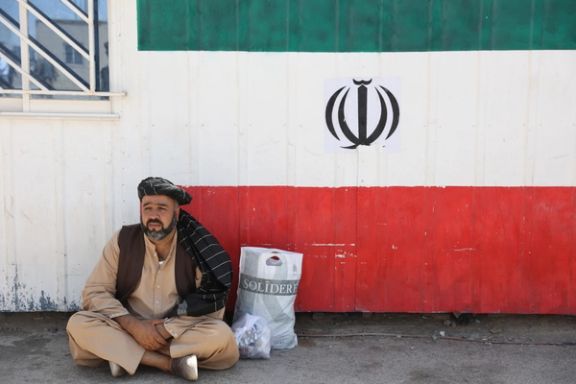
An Afghan man sits at the Dowqarun border crossing between Iran and Afghanistan, Razavi Khorasan Province, Iran August 29, 2021.
Media in Tehran are increasingly sounding alarms about the rapid growth of the Afghan population in Iran, which is estimated to be between five to ten million now.
The conservative Jomhuri Eslami reported last week that unofficial statistics indicate that last fall out of 300 babies born at the hospital of Kavar, a small town near Shiraz, capital of southern Fars province, 297 belonged to Afghan families.
According to the newspaper, which is one of the Islamic Republic’s oldest, the latest statistics also show that the number of Afghans in the province has risen to 357,000 from 121,000 since the Taliban took over the Afghan government in August 2021.
Officials say hundreds of Afghans are entering Iran daily from the eastern borders. Less than one million Afghans in Iran have refugee status, and most of the rest are illegal immigrants.
“Security officials must concerned that the presence of so many foreign nationals will entail many threats [to national security],” Jomhuri Eslami wrote. Iranian authorities and some media usually refer to Afghan immigrants and refugees as “foreign nationals.”
Afghan nationals stand at the Dowqarun border crossing between Iran and Afghanistan, Razavi Khorasan Province, Iran August 29, 2021.
The article, extensively republished by other newspapers and websites, also referred to the involvement of two Afghan national in an attack on Shahcheragh shrine and mausoleum in Shiraz on October 26, 2022. Both men were publicly hanged on July 8.
In an unattributed commentary in July, Aftab News, a news website close to former President Hassan Rouhani and the moderate conservative Moderation and Development Party, also warned about what appears to be a massive increase in the number of Afghans in Iran and claimed that authorities are actively encouraging the growth of the Afghan population.
Aftab News alleged that factors such as a lack of control at eastern borders of the country, issuing thousands of tourist visas daily when applicants do not intend to return to their home country, automatic renewal of tourist, pilgrimage and other types of visas, elimination or reduction of cash fines for illegal entry and stay, indicate “targeted planning” by the authorities.
This may refer to some hardliner media openly promoting acceptance of more Afghans in Iran to increase the country’s population as a solution to the falling birth rate among Iranians when the Revolutionary Guards (IRGC)linked Tasnim news agency suggested in 2022.
“Acceptance of immigrants can be one of the key solutions to overcome the problem of [dwindling] population and workforce given the drop in the fertility rate in the country,” Tasnim said in an unattributed commentary entitled “Iran Forced to Accept Immigration of Foreign [Nationals] to Resolve Its [Dwindling] Population Problem” on May 19, 2020.
“The closeness of beliefs and culture of neighboring countries, particularly Afghanistan, has provided an extraordinary opportunity to Iran in this regard,” the commentary said, presumably with an eye to accepting more Afghan Hazaras who are Shiites like Iranians.
Hazaras make up the biggest ethnic group among Afghan immigrants to Iran followed by Sunni Tajiks, Pashtuns and Uzbeks.
Supreme Leader Ali Khamenei has repeatedly stressed that the country’s population should rise to at least 150 million, presumably to strengthen the only Shiite-ruled Muslim state.
Faraz Daily, an online newspaper, reported last week that there are now transportation companies that move commercial consignments and belongings of Afghan household to Tehran within a week from Kabul and Herat.
This, the newspaper argued “has been causing concerns in Iran because the illegal residence of these immigrants, in the absence of laws and policies to regulate their presence, will lead to numerous political, social and even security challenges,” Faraz Daily wrote.
With one in three Iranians living in absolute poverty, a renowned economist has said authorities are using statistics in a power struggle instead of solving the problem.
Farshad Momeni, a professor at a Tehran university, highlighted the distressing reality of widespread poverty, as per recent official data analysis but warns that some government officials are misusing and manipulating the data in the name of justice.
“This has given rise to a situation where individuals assert their ability to eradicate absolute poverty within 14 days, while others escalate these assertions, leading to a disconcerting competition among segments of the power structure to outdo one another with baseless statements,” he said.
He also pointed to a dramatic decline in middle-income levels over recent years, which has narrowed the gap between those living above and below the poverty threshold.
In Iran, the "poverty line" signifies the income threshold necessary to meet a household's essential needs, with incomes falling below this mark labeled as "absolute poverty." Iranian authorities report that the poverty line for Tehran residents stands at around 300,000,000 rials (approximately $600) per month, which is three times the country's minimum wage.
However, figures alone are not enough to grasp the complexities of the poverty landscape, Momeni said. He argued that it is essential to grasp the dynamics of development to appreciate the precarious position of the middle-income class and reiterated that using the stark statistics to gain popularity in government would do little to help the actual problem.
In a society grappling with these challenging realities, the economist's candid and sobering analysis serves as a wake-up call, emphasizing the urgent need for comprehensive and informed policy responses to address the multifaceted issue of poverty in Iran.
An exclusive report by the IranWire website reveals that undercover judicial officials posed as referees for international boxing events to report back to the regime.
Citing information from an intelligence source within the Ministry of Sports and Youth, IranWire disclosed that Abolfazl Ameri Shahrabi, the Deputy Prosecutor of Arak, and Majid Abbaszadeh, a member of the intelligence organization of the Joint Chiefs of Staff, were sent abroad to boxing event under the guise of international referees.
According to the report, Ameri Shahrabi's involvement in the world of boxing dates back to his participation in the national boxing team's camps between 1995 and 1998. He transitioned into refereeing the sport during the early 2010s. The report further revealed ongoing discussions about the potential transfer of Ameri Shahrabi to Tehran to assume a new position in one of Tehran's sensitive judicial centers.
Ameri Shahrabi is the same judicial official who filed charges against Sadrollah Fazeli Zarei and Yousef Mehrdad, who were executed in May 2023on accusations of blasphemy and insulting religious and Islamic sanctities on social media.
On a related note, Majid Abbaszadeh, a boxing referee and a member of the intelligence protection organization of the Joint Chiefs of Staff of the Armed Forces, assumed the position of the head of the Tehran Boxing Association in July of this year.
This disclosure of the overseas travels of these two individuals with judicial and intelligence affiliations to European and American countries comes at a time when Western nations have imposed sanctions on numerous officials of the Islamic Republic.
A Swedish citizen, part of the EU diplomatic corps, has been covertly detained in Iran for over 500 days as part of Iran's hostage diplomacy, reports The New York Times.
Johan Floderus, 33, who worked for the European Union's diplomatic corps, was arrested at Tehran airport in April 2022 as he prepared to depart the country after what was described as a private tourist trip with friends.
In July 2022, the Iranian government released a statement announcing that it had apprehended a Swedish national for espionage who was being held in Evin prison, however they did not disclose any further details.
The New York Times spoke to six individuals with first-hand knowledge of the case, who all confirmed that Floderus’ had nothing to do with any espionage claims.
The Swedish Ministry for Foreign Affairs said it would not comment on the details of the case, citing a need for secrecy. “A Swedish citizen — a man in his 30s — was detained in Iran in April 2022,” its press department said in a recent email. “The Ministry for Foreign Affairs and the Embassy of Sweden in Tehran are working on the case intensively.”
“We understand that there is interest in this matter, but in our assessment, it would complicate the handling of the case if the ministry were to publicly discuss its actions,” it added.
Floderus was detained when EU diplomats were hard at workto broker a nuclear deal between Iran and the United States. Two top EU foreign policy officials visited Tehran in mid-2022, while they kept his detention hidden from the public and European institutions. It is not clear to what extent the fact that one of their employees was held hostage impacted their mediating role.
Hannah Neuman, a German member of the European Parliament commented on the case on social media saying that parliament should have been informed about Floderus’ arrest, as well as attempts to secure his release and the impact on JCPOA negotiations.
She directly criticized the EU's policy of keeping Floderus’ arrest and detainment a secret as it may impact attempts to revive nuclear diplomacy. Others called for a policy re-think. “A serious recalibration of policy is needed,” said Kasra Aarabi, an academic, who took to social media to comment on the case. He further demanded the proscription of the IRGC and consolidated international action against the Iranian regime.
The European External Action Service, the diplomatic service for which Floderus works confirmed that they have been following the case very closely and that his arrest “underlines the very concerning tendency of Iranians to use EU nationals or Iranian dual nationals as pawns for political reasons." However, neither Swedish nor EU authorities have publicly discussed the situation, citing the need for confidentiality.
“This case has also to be seen in the context of the growing number of arbitrary detentions involving EU citizens,” added Nabila Massrali, a spokeswoman for the EU bloc’s diplomatic body. “We have used and will continue to use every opportunity to raise the issue with the Iranian authorities to obtain the release of all arbitrarily detained EU citizens.”
The arrest of Floderus follows a pattern of Iran detaining dual nationals and foreigners on dubious charges to use them as bargaining chips for prisoner exchanges or to extract concessions and funds.
A recent deal saw five American prisoners being released in return for freeing up $6bn of frozen Iranian funds in South Korea, which puts an approximate price of $1.2bn per head.
Relations between Iran and Sweden have soured recently, notably with the sentencing of a former senior Iranian judicial official, Hamid Nouri, to life in prison in Sweden for war crimes committed in Iran. Iran has escalated pressure on Sweden in response.
A cascade of centrifuges enriching uranium in an Iranian underground facility
Iran's stock of uranium enriched to up to 60 percent purity, close to weapons grade, continues to grow, the UN nuclear watchdog said on Monday in a report.
In reports to diplomats of countries forming the board of directors of the International Atomic Energy Agency (IAEA), the watchdog’s experts also said there has been no progress in talks with Tehran on sensitive issues such as explaining uranium traces at undeclared sites. The head of Iran’s nuclear agency has claimed repeatedly in recent months that the IAEA’s questions have been “satisfactorily” addressed regarding to the undeclared sites use more than two decades ago.
According to one of the confidential quarterly reports to member states seen by Reuters and other media, the IAEA said Iran's stockpile of uranium enriched to up to 60-percent purity, close to the roughly 90% of weapons grade, continued to increase albeit at a slower pace, despite some of it having been diluted.
"The (IAEA) Director General (Rafael Grossi) regrets that there has been no progress in resolving the outstanding safeguards issues in this reporting period," one report said, referring to Iran's failure to credibly explain the origin of uranium particles found at two undeclared sites.
The reports, sent to IAEA member states ahead of a quarterly meeting of the IAEA's 35-nation Board of Governors next week, also said that after limited progress on re-installing IAEA surveillance cameras in the previous quarter, there had since been none, further raising tensions with Western powers.
IAEA Director Rafael Grossi speaking on June 5, 2023
Iran and the IAEA announced an agreement in March on re-installing surveillance cameras introduced under a deal with major powers in 2015 but removed at Iran's behest last year. Only a fraction of the cameras and other monitoring devices the IAEA wanted to set up have been installed. But US officials have already acknowledged, according to Bloomberg that they have reduced enforcement of sanctions that has led to a doubling of Iran's oil exports since mid 2022.
Adding to the issues likely to cause tension with the West, Iran's stock of uranium enriched to up to 60 percent grew by an estimated 7.5 kg to 121.6 kg, the report said, even though 6.4 kg of it was diluted with uranium enriched to a lower level.
Iran's production of uranium enriched to up 60 percent has slowed to around 3 kg a month from about 9 kg a month previously, a senior diplomat said.
Other diplomats have said the slowdown could be part of so-called "de-escalation" efforts between Iran and the United States also involving Iranian funds frozen abroad and US prisoners held in Iran, though US Secretary of State Anthony Blinken has denied the issues are linked.
"Of course, Iran claims (the slowdown in enrichment to up to 60%) as a positive, but more HEU (highly enriched uranium) is still more HEU," one Western diplomat said.
CAMERAS WITHOUT FOOTAGE
Iran's stock of uranium enriched to 60 percent is now almost three times the roughly 42 kg that by the IAEA's definition is theoretically enough, if enriched further, to produce a nuclear bomb. Experts add, however, that some uranium would be lost in the process. Iran denies wanting to produce nuclear weapons.
The IAEA continues to have regular access to Iran's declared nuclear facilities and its core nuclear activities under long-standing agreements that predate the 2015 nuclear deal, but the 2015 deal added monitoring to areas such as the production of parts for centrifuges, machines that enrich uranium.
Even where IAEA monitoring equipment has been re-installed, such as at a site in Isfahan, it does not have access to the footage that its cameras record since that was not included in the March agreement it negotiated with Iran.
One of Monday's reports spelled out that problem.
"The Director General reiterates that for Agency cameras to be effective, including those installed at Esfahan, the Agency needs access to the data they record."
Iranian President Ebrahim Raisi during a press conference in Tehran
The Iranian government’s debt surged by 61% during the last budgetary cycle, amid a severe economic crisis, as reported by Parliament’s Research Center on Sunday.
The huge jump occurred during the first full year of Ebrahim Raisi’s presidency, dominated by hardliners, who insisted on continuing their anti-Western foreign policy and claiming that economic sanctions imposed on Iran can be defeated. The period spans from March 22, 2022, to March 21, 2023, or the Iranian calendar year 1401.
The annual borrowing total reached nearly $50 billion, representing 30 percent of the yearly GDP. This level of borrowing is unprecedented and indicates an increase in money printing by the government, which is likely to result in further inflation, since the borrowing was entirely from domestic state or quasi-governmental banks. In turn, these banks face huge debts and an unstable financial situation. Therefore, when the government borrows from these institutions, they have to turn to the Central Bank of Iran for liquidity and the central bank has to print more money.
To provide context, Turkey's total government debt is equivalent to 31 percent of its annual GDP, whereas in Iran's case, one year's borrowing alone has reached the same level.
An employee of Iran’s Central Bank checking the quality of newly printed banknotes
This development poses the question about Iran’s increased oil exports in 2022 and 2023, which should have provided financial resources to the government and forestalled more borrowing. During the period in question Iran sold around 1.2 million barrels of oil daily, mostly to China, and with high prices in 2022 it should have brought in at least $26 billion even if sold the oil at the discounted price of $60 per barrel.
Around $11 billion is provided at deeply discounted exchange rates to importers of food, medicine and animal feed. This means that around $5 billion is “wasted” on indirect subsidies. That still leaves around $20 billion for other government expenses, including 15 percent as share of the National Oil Company.
This is basically half of what the government needs from oil exports in order to balance its budget, and it explains why it was forced to borrow more, or to be precise, to print more money. But $20 billion in 2022 was probably more than the government had earned from oil exports in previous years since 2018, when the United States imposed sanctions on Iran’s oil exports.
One explanation about why the government fell into more borrowing in 2022-2023 could be that national reserves dwindled after repeated withdrawals since 2018. A report in August indicated that in the past decade Iran withdrew $140 billion from its National Development Fund, mostly since 2018, leaving an estimated small amount of $10 billion.
Oil exports are said to have increased in recent months reaching 1.5 million and in August surging to around 1.9 million barrels a day, as the United States relaxed its enforcement of sanctions to try to reach a nuclear deal with Tehran.
However, it is not clear how much discount Iran is offering Chinese importers to compete with discounted oil from Russia. In recent days, media in Tehran estimatedthat the government could be selling its oil for as little as $30 per barrel, given a statement by a top official that it was able to earn just half of what it expected from March to August of this year.
Annual inflation is already hovering at around 50 percent and the national currency has fallen by 50 percent in one year to 500,000 rials per one US dollar. The coming months will show if the higher borrowing will lead to even higher inflation.