• العربية
  • فارسی
Brand
  • Iran Insight
  • Politics
  • Economy
  • Analysis
  • Special Report
  • Opinion
  • Podcast
  • Iran Insight
  • Politics
  • Economy
  • Analysis
  • Special Report
  • Opinion
  • Podcast
  • Theme
  • Language
    • العربية
    • فارسی
  • Iran Insight
  • Politics
  • Economy
  • Analysis
  • Special Report
  • Opinion
  • Podcast
All rights reserved for Volant Media UK Limited
volant media logo

Iranian Politicians Discuss Upcoming Elections With Resentment
Iran International Newsroom
Sep 4, 2023, 08:11 GMT+1Updated: 17:51 GMT+1
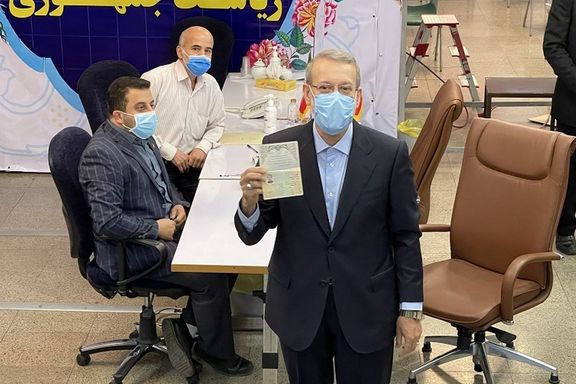
Former parliamentary Speaker Ali Larijani after he registered to run for presidency in the 2021 elections

Some of Iran's high-profile politicians have spoken about the upcoming parliamentary elections in March 2024, albeit with a tone marked by bitterness. 

Former parliamentary Speaker Ali Larijani made it clear in an interview with centrist website Entekhab that he is not going to run for parliament (Majles) in March. However, he said that he will explain his reasons for not taking part in the election at a later date.

Larijani's aides had said earlier that although he is not going to run himself, he will present a list of likeminded candidates including his brother-in-law, outspoken moderate conservative former lawmaker Ali Motahari who at times has even criticized Supreme Leader Ali Khamenei's policies. 

Larijani who still harbors hard feelings about his disqualification in the 2021 Presidential election, criticized the current ultraconservative-dominated parliament and teasingly called its hardliner members "wheeling-dealing revolutionaries."

"They claim to be revolutionaries and they want to win all the positions in the government," Larijani said. He added that this group's presence in the Iranian politics dates back to the early days after the 1979 Islamic revolution. "They have always tried to create a bipolar situation and attempted to kick their political rivals out of the scene," he said. 

Former parliamentary Speaker Ali Larijani and Supreme Leader Ali Khamenei   (undated)
100%
Former parliamentary Speaker Ali Larijani and Supreme Leader Ali Khamenei

Larijani once again talked about his idea of political purification adding that this is a policy hardliners are advancing in order to ensure that others are excluded political competition and participation. 

This purging, he said, will belittle the revolution and will inevitably lead to the disintegration and fragmentation of the nation. 

However, Larijani charged that hardliners are furthering the idea of political purification to secure their personal and factional interests. They do not believe that positions of power should be held by individuals who have the right talent and capability for those posts. 

Meanwhile, Khabar Online reported last week that Former President Mahmoud Ahmadinejad is also going to present a list of candidates for the Majles elections. However, according to the website, although Ahmadinejad and his aides will actively take part in presenting the list, their main objective is to secure a foothold for the 2025 Presidential election, when Ahmadinejad is hoping to have a political comeback. 

For the Majles, Khabar Online wrote that Ahmadinejad's team may independently present a list of candidates for all the constituencies although they might decide at one point to come up with a shared list of candidates with one of the major conservative camps. 

Like Larijani, Ahmadinejad has also tasted the bitter disqualification by Khamenei's Guardian Council in previous presidential elections. If they are ever allowed to run again, that would mean that Khamenei is desperate to have a high-turnout election. 

In another development, conservative heavyweight Mohammad Reza Bahonar, who has repeatedly spoken with the media, warning about a low turnout, has once again lashed out at current lawmakers for their inefficiency, which he said has disappointed Iranian voters.

Bahonar, who like Larijani and Ahmadinejad, is a member of the expediency Council, said in an interview with Khabar Online that Khamenei usually issued an occasional warning about previous parliaments' performance, but he has warned the current parliament several times about various legislative matters. 

Bahonar said that he has told Speaker Mohammad Bagher Ghalibaf that one of the main weaknesses of the current Majles is that it does not have a powerful minority faction. The lawmakers think they have no rivals and challenges ahead of them, and that they can do whatever they like. 

Nonetheless, the Majles and the government are in a state of denial about almost everything. Vice President Mohammad Hosseini told the press on Friday that the previous government should be blamed for the low turnouts in recent elections, without presenting any evidence.


Most Viewed

Ghalibaf defends Iran-US talks amid hardline backlash
1
INSIGHT

Ghalibaf defends Iran-US talks amid hardline backlash

2
VOICES FROM IRAN

Bread shortages, soaring prices strain households in Iran, residents say

3
ANALYSIS

From instability to influence: Pakistan’s pivotal role in US-Iran diplomacy

4
ANALYSIS

100 days on: why Iran’s January protests spread across social classes

5

War-hit homeowners feel abandoned as Iran’s reconstruction aid fades

Banner
Banner

Spotlight

  • Is Iran entering its Gorbachev moment?
    INSIGHT

    Is Iran entering its Gorbachev moment?

  • Iran crackdown reaches cemeteries as graves of slain protesters defaced
    EXCLUSIVE

    Iran crackdown reaches cemeteries as graves of slain protesters defaced

  • Iran diplomacy wobbles as factions compete to avoid looking soft on US
    INSIGHT

    Iran diplomacy wobbles as factions compete to avoid looking soft on US

  • The politics of pink: how Iran uses cuteness to rebrand violence
    ANALYSIS

    The politics of pink: how Iran uses cuteness to rebrand violence

  • Bread shortages, soaring prices strain households in Iran, residents say
    VOICES FROM IRAN

    Bread shortages, soaring prices strain households in Iran, residents say

  • Ghalibaf defends Iran-US talks amid hardline backlash
    INSIGHT

    Ghalibaf defends Iran-US talks amid hardline backlash

•
•
•

More Stories

Homeownership Impossible In Tehran As Quality Of Life Drops

Sep 3, 2023, 23:28 GMT+1
•
Iran International Newsroom

Owning a home in the Iranian capital Tehran has become virtually impossible while the key indicators of the quality of life are also in decline. 

Iran's leading economic daily Donyaye Eqtesad (World of Economy) published an article Saturday listing a plethora of problems facing the residents of the capital. 

The average time people needed to save money to be able to buy a residence in Tehran has increased to a staggering 112 years, from about 22 years in 2005. According to Donyaye Eqtesad, the period of time for those born since late 1990s -- the so-called generation Z -- is now estimated to be 200 years.

Economist Hassan Mansour told Iran International that the Housing Affordability Index is about four to 10 years in England, where housing prices are among the most expensive in the world. “This means there is no hope for Iranians to own a home,” he noted.

Last week, Mohsen Pirhadi, the vice-chairman of the parliamentary committee for Iran’s Seventh National Development Plan, said the government plans to reduce the timespan to 12 years in the next development plan. Despite launching seven development plans since the 1980s, to continue building infrastructure, establishing key industries, and expanding public services and education, which were fast expanding during the monarchy, Iran still remains classified as a developing country, with an average economic growth rate of only 2.5 percent during the Islamic Republic.

A view from the capital Tehran   (file photo)
100%
A view from the capital Tehran

Donyaye Eqtesad released the new data after Tehran's city council members held a meeting with officials of the municipality and experts to mull over a comprehensive plan for the capital, comparing the current indicators about the city with those of 2005. Three major indicators of "quality of life" in Tehran have significantly deteriorated since then, with affordable housing, air pollution and urban decay being the main issues.  

Amir Mansouri, a professor at the Faculty of Architecture at the University of Tehran, said during the meeting that "We live in a city where half of the population is in danger of devastating earthquakes, the price per square meter of housing exceeds 600 million rials (approximately $1,300), and ordinary people can no longer afford to buy a home in this city, even renting a place in some neighborhoods has become impossible.” The monthly minimum take-home pay (without benefits) is around $120.

Earlier reports in mid-2022 indicated that there was a more than 300 percent rise in rents in Tehran in a matter of three years. And figures released in December 2021, some six months after Ebrahim Raisi took office as President indicated that food and housing expenses had risen between 300 to 740 percent during the preceding six years while wages went up by around only 270 percent during the same period. A prominent economist, Hossein Raghfar, said earlier this year that high rents in Tehran have pushed many tenants to the less expensive margins of the capital where a new social sub-class is taking shape, with some people having chosen to live in makeshift houses built on some of Tehran's rooftops.

According to a report by reformist daily Shargh earlier this week, the Iranian government has exerted pressure on real estate advertising platforms to keep property prices hidden. The newspaper also noted that for the past eight months, the government has refrained from disclosing housing market data on the official portals of the Iranian Statistical Center and the Central Bank. 

Mansouri added that the residents of the capital are exposed to polluted air for more than 200 days a year. Tehran has been logged as the most polluted city in the world for at least several days per year. The capital’s pollution is mainly blamed on poor government policies, desertification and low water levels, as well as climate change that has intensified sandstorms. 

Moreover, the usage of highly polluting diesel and mazut fuels in power plants -- instead of natural gas -- jumped in Iran in 2021 on top of increases in previous years. Mazut -- commonly called waste oil -- is a heavy, low quality fuel oil, only used when the facilities to blend or break it down into more conventional petrochemicals such as diesel are not available.

Iran has the world’s second largest natural gas deposits but is unable to boost production because it lacks capital and Western technology. It needs to invest $40 billion in modernizing and expanding its gas fields, but most are in the Persian Gulf and need Western technology. Due to its anti-West foreign policy and an expanding nuclear program, Iran is under US sanctions and cannot borrow money or technology from the West.

Israeli-Iranian Flick Depicts Regime’s Ban On Competing With Israelis

Sep 3, 2023, 19:11 GMT+1

A movie about the Islamic Republic’s pressures on Iranian athletes not to face Israeli competitors is the first production co-directed by Iranian and Israeli filmmakers.

The film, which premiered at the Venice Film Festival, had to be shot in secret to prevent possible interference by Tehran, directors Zar Amir Ebrahimi and Guy Nattiv told Reuters on Sunday.

"Tatami", a tense thriller centered on a world judo championship, received a standing ovation during its premier at the weekend. The film takes place over the course of the single day of competition as an Iranian judoka champion, played by Farsi-speaking US actress Arienne Mandi, is ordered to fake an injury to avoid a possible match-up with an Israeli competitor, a scenario that has happened to several Iranian athletes in real life.

Amir Ebrahimi and Nattiv shot the movie in Georgia, a country Iranians can easily visit. They stayed in separate hotels, spoke English and did not let on that they were making such a politically charged film.

"I knew there are many Iranians there, so we were trying to keep it calm and secret," said Amir Ebrahimi, who is an award-winning actress who fled Iran in 2008.

Iran does not recognize Israel's right to exist and has forced athletes into intentionally losing matches, forfeiting games, or claiming injuries to evade encounters with Israeli competitors.

banned its athletes from competing against Israelis in an incident that inspired "Tatami", the International Judo Federation in 2021 gave Iran a four-year ban for pressuring one of its fighters not to face an Israeli.

Last week, a weightlifter was banned from the sport for life after posing for a photograph with an Israeli at the World Master Championships in Poland.

Over the past few years, approximately 30 Iranian athletes have defected from national teams and sought asylum in foreign nations.

Iraqi Forces Deploy As Iran-Backed Militias Attack Kurds In Kirkuk

Sep 3, 2023, 18:15 GMT+1

Iraqi security forces deployed in the northern city of Kirkuk on Sunday as Iran-backed militias have killed several Kurds and continue to threaten more attacks.

According to police and security sources, four Kurds were shot dead and 15 people were wounded during the clashes in the city, controlled by the Iraqi government and home to diverse groups of people including Kurds, Turkmens, and Arabs.

Amir Shwani, a spokesman for Kirkuk police, said in a statement that a curfew had been lifted and vehicles were moving normally in the city on Sunday, but security forces had deployed additional troops to "prevent violence and protect civilians."

The city has been a point of contention, witnessing disputes between Kurdish forces and the Iraqi government. Iranian-backed militias have recently escalated aggression in the region, firing rockets to target gas fields on the road to Sulaymaniyah, a large city in the Kurdistan autonomous region about 100 kilometers west of Kirkuk.

Flames and smoke rise from oil wells inside the Bai Hassan oilfield, which was attacked by militants, close to the northern Iraqi city of Kirkuk, Iraq, May 5, 2021.
100%
Flames and smoke rise from oil wells inside the Bai Hassan oilfield, which was attacked by militants, close to the northern Iraqi city of Kirkuk, Iraq, May 5, 2021.

The clashes followed days of tensions over a building in Kirkuk that was once the headquarters for the Kurdistan Democratic Party (KDP) but was used by the Iraqi army as a base since 2017. Iraq's federal supreme court issued an urgent ruling on Sunday obliging the government to delay procedures regarding the handover of the building to the KDP.

Kirkuk, an oil-rich province in northern Iraq along the fault lines between the Kurdish autonomous region and areas controlled by Iraq's Shiite-dominated central government, has been the focus of some of the country's worst post-Islamic State violence. Arab residents and minority groups, who say they suffered under Kurdish rule, have protested the KDP's return to the city.

“Dozens of protesters, mainly members of the Iran-backed Asaib Ahl al-Haq militia and their supporters, have set up tents near the JOC headquarters since Sunday evening in protest to the potential return of the KDP. They have blocked access to the highway and vowed to continue their demonstration until [Prime Minister Shia al-Sudani retracts his decision,” Rudaw Kurdish news agency reported reported.

Similar clashes are also happening between Kurdish-led forces and groups of Islamic militias and tribes in eastern Syria. The violence has killed 49 fighters from both sides and eight civilians, according to the Syrian Observatory for Human Rights war monitor.

The involvement of the pro-Iran militias also has another dimension. Late in August, Iran and Iraq formalized an agreement to dismantle Iranian Kurdish dissident factions stationed in the northern reaches of Iraq and relocate them from their bases.

Nasser Kanaani, spokesperson for Iran's Foreign Ministry, said the Iraqi government had undertaken the commitment "to disarm the armed terrorist groups stationed in Iraq's territory by September 19, and subsequently, evacuate and transfer them from their military bases to camps designated by the Iraqi government."

Historically, Iran has intermittently executed targeted operations against the Kurdistan Democratic Party in Iran (KDPI) and other Iranian Kurdish dissident elements operating within Iraq's semi-autonomous Kurdish region, adjacent to Iran's borders.

Various Iranian dissident factions in Iraq have aligned their allegiances with the two principal Iraqi Kurdish parties: the Kurdistan Democratic Party, headquartered in Erbil, and the Patriotic Union of Kurdistan party, with its stronghold in Suleimaniyah.

IRGC Deputy Says Mass Pilgrimage To Iraq Is To Defend Hijab And Khamenei

Sep 3, 2023, 15:33 GMT+1

A senior Revolutionary Guard commander has said that the main message of the Arbaeen pilgrimage to Iraq is defending hijab and the Supreme Leader.

Gen. Mohammad-Reza Naghdi, the coordinating deputy to IRGC commander Hossein Salami, made the remarks during an event about the Arbaeen Shiite ceremony that the Islamic Republic regime views the event as a show of influence in the region.

Naghdi said promoting the pilgrimage on media is in line with the regime’s efforts to emphasize on the principles of Velayat-e Faghih – another term for the rule of the Supreme Leader – and observance of hijab.

The uprising last September has made it increasingly difficult for the clerical regime to enforce the mandatory Islamic dress code, and has damaged the legitimacy of Supreme Leader Ali Khamenei.

The rule of Islamic jurist gives a cleric such as Ali Khamenei extraordinary powers including the power to overrule all elected bodies and officials and hence, people’s choice. As a system of governance, Velayat-e Faqih has underpinned the way the Iranian regime has operated since the country’s 1979 Islamic Revolution. At its most basic, the theory -- advocated by some Shiite thinkers -- justifies the rule of the clergy over the state.

Despite numerous incentives to encourage the pilgrimage, including providing free medical services and rest stops along the way, free internet on the road and inside Iraq, offering interest-free loans and granting 200,000 Iraqi dinars ($153) to pilgrims, the number of Iranians willing to undertake the Arbaeen Shiite pilgrimage is in decline.

Media In Tehran Raise Questions About Oil Exports And Revenues

Sep 3, 2023, 12:55 GMT+1
•
Iran International Newsroom

Some media outlets in Iran are discussing apparent contradictions between estimated volume of oil exports and the income the government has secured.

Foreign sources monitoring Iran’s oil shipments estimated in August that daily exports reached close to two million barrels per day, after climbing to one million in 2022 and 1.5 million earlier this year. A Reuters survey published August 31 showed that OPEC’s oil output rose in August as Iranian supply jumped to its highest since 2018, despite ongoing cuts by Saudi Arabia and other members of the wider OPEC+ alliance to support the market.

However, the head of Iran’s Planning and Budget Organization, Davoud Manzoor, said in late August that only half of the government’s projected income form oil exports has materialized since the beginning of the current Iranian calendar year on March 22. He also claimed that the oil was sold at around $60 per barrel. 

Given the fact that in this period the government was expecting to earn around $13 billion from oil exports, the Fararu website in Tehran argued that Manzoor’s statement means the government earned only $6.5 billion.

the head of Iran’s Planning and Budget Organization, Davoud Manzoor (undated)
100%
the head of Iran’s Planning and Budget Organization, Davoud Manzoor

Apart from uncertainty about the real volume of Iran’s oil exports, another puzzle preoccupies the media. How much discount Iran provides to buyers of its oil. Perhaps that discount should explain why the government has earned only half of the expected oil revenues.

If an average daily 1.5 million barrels of oil was sold since March at $60 a barrel, the government should have earned $13.5 billion, EcoIran and Fararu websites point out. Therefore, either the volume of exports was lower, or the Islamic Republic offered deeper discounts amid US sanctions on its oil exports and banking transactions.

This leads to the belief that Iran is offering its oil at closer to $30 a barrel, while Russia, which is also under sanctions, sells its crude at around $60, and Tehran must compete with its ally to attract Chinese buyers.

The $30 price estimate comes from an average daily export of 1.5 million barrels, that industry sources have been reporting in recent months. At that price, Iran could earn $6.75 billion in five months since March, which is close to what Manzoor, the head of the Budget organization announced as government oil revenues in this period.

There is also the possibility that China pays more for the oil on paper, but actually remits much less in cash and the rest in barter. There are also middlemen who facilitate the illicit oil shipments and launder the payments for Iran amid banking sanctions. These activities could also take a big chunk out of the revenues.

Tankers carrying Iranian oil usually engage in ship-to-ship transfers in Asian waters to hide the origin of the shipments before it reaches China.

A substantial part of these hard currencies is sold at a subsidized rate to importers of essential goods, such as food and animal feed. While one US dollar fetches 500,000 rials on the open market, the government provides the hard currency at 285,000 rials for imports of food and medicine.

Since the United States exited the JCPOA nuclear accord and imposed the sanctions in 2018, Iran has been selling its oil in clandestine methods to China. Export volumes and prices are a state secret, and all figures are estimates by industry observers and occasional bits and pieces of information from government officials.