• العربية
  • فارسی
Brand
  • Iran Insight
  • Politics
  • Economy
  • Analysis
  • Special Report
  • Opinion
  • Podcast
  • Iran Insight
  • Politics
  • Economy
  • Analysis
  • Special Report
  • Opinion
  • Podcast
  • Theme
  • Language
    • العربية
    • فارسی
  • Iran Insight
  • Politics
  • Economy
  • Analysis
  • Special Report
  • Opinion
  • Podcast
All rights reserved for Volant Media UK Limited
volant media logo

Iran's 'Sacred' City Shuts Cafes, Restaurants In Morality Crackdown
Iran International Newsroom
Aug 4, 2023, 12:47 GMT+1Updated: 18:04 GMT+1
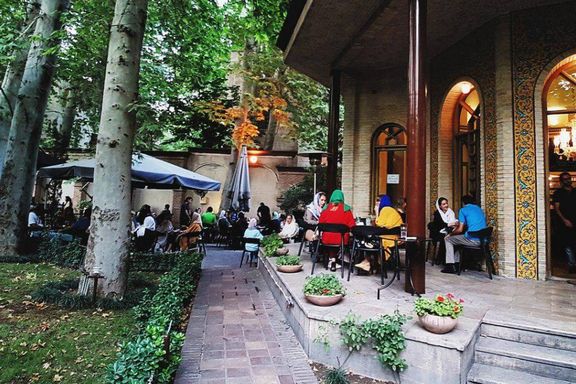
An open-air café in Tehran

The Iranian city of Mashhad, known for its religious significance, is closing outdoor spaces in at least 110 restaurants and coffee shops in a morality crackdown.

In an unexplainable move, the cafes have been branded centers of 'nightlife' in a bid to stop people from gathering and crack down on social activities, ordered by the Provincial Chastity and Hijab Headquarters, though they play no music, and have to close before midnight.

However, as women are increasingly going out without the mandatory headscarf, the regime is doing its utmost to crack down on all social activity to punish the masses as it continues to lose its hijab war against an increasingly rebellious public.

So vast is the crackdown on citizens, social media users have reported unofficial curfews in other parts of Iran, including streetlights in the capital, Tehran, being turned off from 8pm, raising concerns about public safety during the evening hours. Additionally, some cafes in Tehran have been compelled to close before 8pm, and only a handful of restaurants remain open at night.

According to the semi-official ISNA news agency, the municipality of Mashhad initiated the plan to close the outdoor space of cafes and restaurants from August 1. Out of the 270 affected units scattered across various districts in Mashhad, at least 110 have already closed their outdoor areas.

The Chief Justice of Khorasan, back in July, clarified that the Prosecutor's Office was not responsible for sealing the spaces in front of these facilities. It remains uncertain whether these provincial bodies have the legal authority to enforce such approvals.

The move has faced mass criticism, with many expressing concerns about its impact on businesses and the daily lives of the city's residents, and not least, yet more hypocrisy that the rules apply differently to the regime's insiders to those ordinary citizens trying to live their lives. The crackdown comes while elites from the regime continue to have parties around the country both indoors and outdoors, as well as reveling in foreign countries.

Iranian youths playing a boardgame at a café
100%
Iranian youths playing a boardgame at a café

Meanwhile, Hasan Amirian, the head of the Mashhad Restaurants Association, revealed on Thursday that during peak hours, around noon, the electricity supply of 80% of restaurants in Mashhad is being cut off, exacerbating the challenges faced by restaurant owners.

This recent crackdown on nightlife is not an isolated incident. In May, the Tehran municipality unilaterally demolished eight cafes in the Ekbatan town market in western Tehran without prior notification. Reports suggested that the demolition was a response to protests by residents during the Woman, Life, Freedom movement, aiming to deter further dissent.

The resistance to night activities in the Islamic Republic is not a new phenomenon. Authorities have consistently opposed the nightlife culture for ordinary Iranians, deeming it incongruent with religious values and detrimental to citizens' well-being. Javan, a newspaper affiliated with the IRGC, has recently written about the “psychological damage caused by nightlife”, citing religious guidelines as a basis for their opposition.

As the regime continues to push its propaganda, its psychologists quoted by Javan argue that nightlife “adversely affects citizens' mental health by deviating from what God has decided for us and asked us to do.” Pro-regime sociologists have also commented, asserting that nightlife conflicts with the societal working patterns and have implicitly called for shops to close at 7.30pm. Some even propose limiting television broadcasting of engaging programs beyond 9pm to encourage earlier sleeping habits as the regime bid to control the public begins to spill into people's homes and private lives.


Most Viewed

Ideology may be fading in Iran, but not in Kashmir's ‘Mini Iran'
1
INSIGHT

Ideology may be fading in Iran, but not in Kashmir's ‘Mini Iran'

2
INSIGHT

Hardliners push Hormuz ‘red line’ as US blockade tests Iran’s leverage

3
VOICES FROM IRAN

Hope and anger in Iran as fragile ceasefire persists

4

Iran International says it won’t be silenced after London arson attack

5

US sanctions oil network tied to Iranian tycoon Shamkhani

Banner
Banner

Spotlight

  • Hardliners push Hormuz ‘red line’ as US blockade tests Iran’s leverage
    INSIGHT

    Hardliners push Hormuz ‘red line’ as US blockade tests Iran’s leverage

  • Ideology may be fading in Iran, but not in Kashmir's ‘Mini Iran'
    INSIGHT

    Ideology may be fading in Iran, but not in Kashmir's ‘Mini Iran'

  • War damage amounts to $3,000 per Iranian, with blockade set to add to losses
    INSIGHT

    War damage amounts to $3,000 per Iranian, with blockade set to add to losses

  • Why the $100 billion Hormuz toll revenue is a myth
    ANALYSIS

    Why the $100 billion Hormuz toll revenue is a myth

  • US blockade targets Iran oil boom amid regional disruption
    ANALYSIS

    US blockade targets Iran oil boom amid regional disruption

  • Iran's digital economy battered by prolonged blackout
    INSIGHT

    Iran's digital economy battered by prolonged blackout

Tweet unavailable

•
•
•

More Stories

Iran Drinking Water Crisis Hits Tabriz, Third Day Without Water

Aug 4, 2023, 11:47 GMT+1

Drinking water supply in large areas of Tabriz, Iran's Northwestern city, has been cut off for three consecutive days.

Residents have endured complete water cuts or limited access to low-pressure water during specific hours as temperatures soar as high as 37 degrees celsius in the East Azarbaijan Province. According to local media, the extensive water shortage was not preceded by any notification.

Mohammad Khani, CEO of East Azarbaijan Water and Sewerage Company, attributed the water cut to a sudden 20% surge in consumption due to the recent countrywide heatwave.

Pictures published by social media users of Nahand Dam, a vital water supply source for Tabriz, illustrates its alarming depletion compared to previous years.

The water crisis is not isolated to Tabriz, with widespread cuts in many other areas of East Azarbaijan province, particularly in dozens of villages. People in Jigheh village, for example, have been left with water for only 20 minutes every 72 hours, prompting them to dig wells in search of springs or other water sources.

This situation mirrors similar water shortages experienced in other Iranian cities. Zahedan endured several days of drinking water cuts in July, while Ahvaz faced similar challenges in various areas.

Even smaller towns across different provinces have been hit by drinking water cuts such as Divandarreh in Kordestan province causing residents to take to the streets to protest on Monday, resulting in injuries from tear gas fired by authorities to disperse the crowd.

Iran Seeks UN Help To ‘Disarm’ Iraqi Kurdish Parties

Aug 4, 2023, 10:24 GMT+1

Iran's ambassador to Baghdad called for the assistance of the United Nations in “disarming Kurdish opposition parties” operating in Iraq.

In a Thursday meeting with Jeanine Hennis-Plasschaert, the Special Representative of the Secretary-General for Iraq and Head of the United Nations Assistance Mission for Iraq, Mohammad Kazem Al-e-Sadegh highlighted the activities of Kurdish parties opposing the Islamic Republic in the Kurdistan Region.

According to the IRNA state news agency, Al-e-Sadegh claimed that the UN's cooperation is necessary to counter the “threat” posed by these parties who are openly leading calls to overthrow the regime and are blamed for much of the unrest the country has witnessed since September.

Iran has previously urged both the Iraqi government and the Kurdistan Regional Government to disarm the Kurdish parties based in the Kurdistan Region. Iran's officials have warned that failing to comply with this demand would lead to military action against these parties' camps within Iraqi territory.

Last year, a security agreement was signed between Iran's former secretary of the Supreme National Security Council, Ali Shamkhani, and his Iraqi counterpart, with a significant portion dedicated to the disarmament of Iranian opposition parties in the Kurdistan region of Iraq.

Iran's Revolutionary Guards have conducted missile and drone attacks against Iranian Kurdish groups based in northern Iraq, a reaction to the Iranian Kurdish parties allegedly instigating protests, triggered by the death of Mahsa Amini, an Iranian Kurdish woman, while in the custody of the morality police.

The Kurdish parties involved, such as Komala and the Kurdistan Democratic Party of Iran (KDPI), generally advocate for Kurdish autonomy within a federal Iran.

Millions Receive Text Message In Iran To Run In Elections

Aug 4, 2023, 07:50 GMT+1
•
Iran International Newsroom

Amid expectations of a low turnout, Iran's regime has sent messages to millions of Iranians encouraging them to run in the upcoming parliamentary election. 

The message, sent via SMS by the election taskforce of the Interior Ministry, has called on all potential candidates to register in the ministry’s website from August 7 to 15 to be considered for the legislative elections scheduled to take place on 1 March 2024. 

Many politicians and pundits in recent weeks have been speaking of an expected low turnout after the experience of the past two elections when many relatively moderate candidates were barred from running. Some argue that voters do not see a reason to go to the polls if they have a limited choice. Many citizens are also angry at the hardliners in charge after their brutal repression of last year's protests.

Reformist commentator and seasoned journalist Abbas Abdi expressed his astonishment with a tweet, saying that the regime used to oppose “the high number of candidates; Now, they are sending millions of text messages urging people to run in the election.”

His quip was a reference to remarks by made in previous years by members of the conservative camp as well as the Guardian Council, who argued that due to "flaws" in the electoral laws in Iran, a large number of people can register and run as candidates in parliamentary and presidential elections.

A cleric at the office to register the candidates for the previous round of Iran’s parliamentary elections in the city of Mashhad, December 2019
100%
A cleric at the office to register the candidates for the previous round of Iran’s parliamentary elections in the city of Mashhad, December 2019

The role of the Guardian Council, a constitutional watchdog has become highly controversial after it disqualified hundreds of relatively moderate candidates in the 2020 parliamentary vote and again key leading figures in the 2021 presidential race. As a result, hardliners established total control of the legislature and are dominating all positions in the presidential administration.

Mahmoud Sadeghi, a former member of parliament and reformist activist, only posted a screenshot of the message with a caption that ironically read “No comment.”

Mohammad Sohofi, a deputy culture minister for press affairs under reformist president Mohammad Khatami, referred to the interior ministry’s text messages and said he was disqualified for the parliamentary election in 2016. With a sarcastic tone, he announced that he no longer intends to run. 

The SMS seems to be a publicity stunt to feign a free political environment because politicians who may be capable of influencing the turnout – such as former Parliament Speaker Ali Larijani – cannot be invited to run with a short undirected message. The moderate conservative was the most prominent individual disqualified by the Guardian Council in 2021. 

Former Iranian parliament speaker Ali Larijani
100%
Former Iranian parliament speaker Ali Larijani

During the past several weeks, many politicians have voiced concern that barring reformist and non-conservative candidates will lead to a low turnout and lackluster elections next year. Amid concerns about Paydari party's attempts to manipulate the upcoming parliamentary elections, reformists say that the hardliner group also aims to extend its "purification" project to the Assembly of Experts (AoE), the constitutional body that would select the next Supreme Leader.

The purification project, referring to hardliners monopolizing government institutions, began with the presidential and parliamentary elections in 2021 and 2020, when relatively moderate candidates were barred from competing. Now there are suspicions that hardliners plan to repeat the same tactic in 2024, to make sure that all the members of the parliament come from the same political faction and appoint their men to the Assembly of experts. 

Iranians wait at the office to register the candidates for the previous round of Iran’s parliamentary elections in the city of BandarAbbas, December 2019
100%
Iranians wait at the office to register the candidates for the previous round of Iran’s parliamentary elections in the city of BandarAbbas, December 2019

Some officials, including former interior minister and deputy intelligence minister Mostafa Pourmohammadi, are also deeply concerned about the adverse impact of the country's dire economic situation on many voters who are simply dissatisfied with all regime politicians.

Referring to Supreme Leader Ali Khamenei's call for a high-turnout election in March 2024, Pourmohammadi said in an interview with IRGC-linked Javan newspaper on Saturday that voters cannot be forced to go to the polls. He said, "People will vote if they are happy about the current situation and have high hopes about the future." 

Iran Calls On The West To End Arms Supplies To Ukraine

Aug 3, 2023, 23:25 GMT+1

Iran’s Foreign Minister Hossein Amir-Abdollahian on Thursday called for halting Western supply of weapons to Ukraine, saying it will lead to more death and damages.

He made his comment at a joint news conference with his Pakistani counterpart Bilawal Bhutto Zardari in the capital, Islamabad.

Amir-Abdollahian arrived in Pakistan on a three-day visit the previous day.

Iran, which has been an ally of Russia in Syria and has been delivering killer drones to Moscow to use in Ukraine, has in the past claimed neutrality in the conflict.

At the news conference, Amir-Abdollahian said, “On Ukraine, we have said this all the time that we believe war is not the way and not the solution.”

A view shows marine station building destroyed during a Russian drone strike on Izmail, Odesa region, Ukraine August 2, 2023.
100%
A view shows marine station building destroyed during a Russian drone strike on Izmail, Odesa region, Ukraine August 2, 2023.

However, the government media in Tehran has displayed clear support for Russia and the government or Islamic Republic officials have never condemned Moscow's attacks on civilians. So far, Russia has used hundreds of Iranian-made drones against Ukrainian civilian and infrastructure targets.

"We believe that it is a source of great concern that the United States and some Western countries keep arming Ukraine," he added.

Ukraine says that without the ability to defend itself against Russian aggression there will be no peace but instead loss of its independence and total subjugation to Russia. Many in the West believe that if Moscow is allowed to conquer Ukraine it will continue its aggression against other European countries.

The United States and its NATO allies have warned Iran not to continue its arms supplies to Russia and have imposed a series of sanctions on Tehran.

Pakistan has called for resolving the issue of Ukraine through dialogue since last year, without directly condemning the Russian invasion.

Both foreign ministers also spoke on economic relations between the two countries during the conference.

Amir-Abdollahian said both Pakistan and Iran "remain committed and determined" to move "away from borders that are mostly characterized by security concerns and issues" and more towards making them what he called "borders of economy and trade that can serve the interest of the two countries at the national level.”

Iran is under US nuclear and other sanctions restricting its oil exports and international banking, which has isolated the country from the international financial system. Pakistan is also in a difficult economic situation.

Iran also has serious issues with the Taliban in Afghanistan and may be hoping for Pakistani assistance in that regard.

Pakistan’s foreign minister Bilawal Bhutto Zardari said that “The five-year trade cooperation plan between Pakistan and Iran 2023 to 2028, which inter ally sets a bilateral trade target of US 5 billion dollars prioritizes removing impediments on bilateral trade, finalization of the free trade agreement, and the establishment of institutional linkages between our respective private sectors”.

With reporting by AP


US Could Offer Troops To Commercial Ships In Strait Of Hormuz

Aug 3, 2023, 20:21 GMT+1

Amid attempts by Iran to hijack ships in international waters, the US may soon offer to put armed sailors and Marines on commercial ships traveling through the Strait of Hormuz, two American officials said.

The Pentagon last month sent additional F-35 and F-16 fighter jets along with a warship to the Middle East in a bid to monitor key waterways in the region following Iran's seizure and harassment of commercial shipping vessels.

After taking a commercial tanker last month, Tehran said it had an order from an Iranian court to seize a tanker in Persian Gulf waters. The Strait of Hormuz is between Iran and Oman.

In May, the White House announced that the Biden administration would be making moves in the region, but at the time did not say what they would include.

One US official, speaking on the condition of anonymity, said the military had already been training some Marines in the Middle East to be on the vessels.

But the official said it would ultimately be up to commercial vessels whether to request troops for parts of a journey that were particularly dangerous in the Strait of Hormuz.

In July, the US Navy intervened to prevent Iran from seizing two commercial tankers in the Gulf of Oman.

Since 2019, there have been a series of attacks on shipping in Persian Gulf waters at times of tension between the United States and Iran.

About a fifth of the world's crude oil and oil products passes through the Strait of Hormuz.

With the 2015 Iran nuclear deal effectively dead, Iran's relations with the West have deteriorated over the last year, leading Washington and its allies to look for ways to de-escalate tensions and a way to revive some kind of nuclear limits.

Report by Reuters