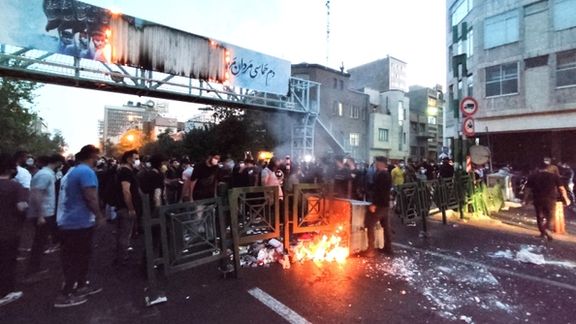
People light a fire during a protest in Tehran several days after the death of Mahsa Amini, September 21, 2022
The commander of Iran’s Revolutionary Guard has said the solution to “enemy’s sedition” on the anniversary of last year’s extensive protests is “preemption.”
As the anniversary of anti-government protests approaches in September, Iranian officials are becoming more apprehensive about renewed unrest, and they double-down on their conspiracy theories about foreign plots to destabilize the regime.
In an address to a conference of Basij paramilitary officials in Tehran, Gen, Hossein Salami claimed that the “enemy” suffered a crushing defeat during last year’s protests, which he called “riots” and added that they will fail in inciting a sedition given the Islamic Republic’s “preparedness and vigilance”. He insisted that “The solution to [such plots] is prevention,” he added.
“The Basij [militia] and the IRGC were present on the scene in last year’s massive sedition -- with resourcefulness, perseverance, high degree of self-confidence and great hope, standing beside the people and defeating the enemy by exposing their plots,” he said.
Hossein Salami, the commander of Iran’s Revolutionary Guard
The protests were sparked by the death of 22-year-old Mahsa (Jina) Amini in the custody of morality police in mid-September and lasted for months. Amini had been arrested for “improper hijab” and died in hospital because of fatal head injuries she had sustained at the time of her arrest.
Security forces and the Basij militia of the IRGC cracked down on protesters heavy-handedly, killing more than 500 citizens, many children, and arresting more than 20,000. Hundreds were left were permanent physical disabilities, such as losing one or both eyes as security forces fired shotgun ‘bird shots’ at protesters from close range.
Protests gradually subsided after several months but defiance of hijab rules as a form of civil disobedience has forced the government to try to stop the anti-compulsory hijab movement by taking various measures.
Iran's Supreme Leader Ali Khamenei has always attributed popular protests and uprisings to “enemy plots” and has often named the United States, Israel and Britain as the major culprits with European powers giving them assistance in attempts to incite “sedition” to destabilize and destroy the Islamic Republic.
“The events that took place these past few weeks were not merely street riots. They were detailed plots. The enemy initiated hybrid warfare [against the Islamic Republic],” Khamenei saidin a speech on November 2, 2022, about the ongoing protests that had engulfed the country.
“The enemy, namely the United States, the Zionist regime, some insidious and malicious European powers, and some groups, entered the scene with all that was in their power,” he added while vowing again to take revenge for the US targeted killing of Qods Force commander Qassem Soleimani in Baghdad on January 3, 2020.
Salami described last year’s protests as “the most severe, most dangerous, most serious, most unequal and most massive global battle” against the Islamic Republic. Indeed, observers agree that the unrest was the most serious challenge the clerical regime faced since it seized power in the 1979 revolution.
Thousands of women are now walking around, commuting, shopping, and jogging unveiled even in many smaller and more conservative regions of the country.
The government and judiciary have also proposed a bill to the parliament that if approved will impose heavy cash fines and other punishments including ban on social media use and leaving the country on ordinary citizens and celebrities, as well as shutting businesses for violations of hijab rules.
Clashes in Agh-Darreh village in Takab, West Azarbaijan province
The IRGC surrounded a village in Iran’s West Azarbaijan province after clashes erupted between civilians and security forces.
Violence broke out after residents of Agh-Darreh village in Takab had protested the arrest of family members in front of the governorate of Takab city. In what is believed to have been a case of excessive force, police and security forces turned violent, causing the IRGC to send troops to surround the village.
Hengaw Human Rights Organization reported that the situation escalated with over 50 Kurdish citizens being arrested and more than 10 people sustaining injuries. Furthermore, dozens of other citizens have sought refuge in the surrounding mountains, fearing arrest.
The majority of Iran's 10 million Kurds live in the western parts of the country, which has been subject to consistent suppression from security forces in the wake of Kurdish-Iranian Mahsa Amini's death in morality police custody. It has been the scene of numerous violent protests and even more brutal crackdowns by the regime with hundreds believed to have been killed in state-sanctioned violence.
The area's residents were also protesting a lack of jobs at the local gold mine, with the villagers among some of Iran's poorest citizens. Despite promises of employment from provincial authorities, the situation remains unresolved and the economic situation worsening.
Iranian clerics at Jamkaran Mosque in the outskirts of the city of Qom
Iranians are outraged by the regime’s hypocrisy after recent sex scandals surrounding a “morality” watchdog official and a cleric have been revealed.
In the past three weeks, Radio Gilan, a Telegram channel run by Payman Behboudi, a Germany-based journalist, has released three different videos that have raised a storm on Persian social media.
In the first video, a male City Council member of Bandar Anzali in the northern province of Gilan, was seen smoking opium and masturbating. The second video showed an official engaging in sex with a young man, and the third, released two days ago, shows a cleric engaged in sex with the husband of his wife’s sister. Radio Gilan has also published several screenshots of a sex chat between the cleric, Mehdi Haghshenas, and his brother-in-law.
Iranian cleric Mehdi Haghshenas (2nd left) and Reza Seqati, the former director of Iran's Ministry of Culture and Islamic Guidance in Gilan province, during a meeting
The scandals of clerics and regime officials to many is a reminder of a famous 13th century verse by the nationally revered Hafez Shirazi who said clerics “shine” when they preach at the pulpit but when in private, they commit the same sins they tell the people to shun, an Iranian observer who asked not to be named told Iran International.
“Corruption has become institutionalized in the system and loyalty has turned into a commodity that can be bought and sold. But this is not the main problem: Value paradigms have been all lost too. What they preach to people is no longer credible to anyone anymore, even to many of their diehard supporters,” he added.
Haghshenas whose sex chats and video of sex with his brother-in-law has raised a storm on social media was appointed as the secretary of Gilan headquarters of the state organization for amr-e be marouf, that is, calling others to enjoin what is good and forbid them from doing what is wrong.
The official in charge of promoting Islamic values held the position until a journalist filed a complaint against him with the Special Court for Clergy and presented his sex chats, which the court apparently found authentic, as evidence.
Radio Gilan claims that Ayatollah Rasoul Falahati, Supreme Leader Ali Khamenei’s representative in the province, helped sweep the case under the carpet so Haghshenas was removed from his position without further punishments.
In December 2017, Vida Movahed, a young woman, removed her white headscarf, put it on a stick and climbed on top of a utility box on a busy Tehran street waving the stick. She was immediately arrested and held for a month for “injuring” the feelings of the society by her “immoral action”. A photo of her protest action went viral on social media and sparked a movement against compulsory hijab that came to be known as White Wednesdays.
Haghshenas staged a protest against Movahed’s “immorality” holding a banner that said, “I Am a Revolutionary” while standing on a pedestal on the street to mimic Movahed’s action.
Vida Movahed (top) and Mehdi Haghshenas
Iran’s sharia-based penal code prescribes a death sentence for penetrative same-sex relations between adult men. Non-penetrative sexual acts are punished with lashes until the fourth offense, when they are punished with death. The sentence has been carried out in several cases including in November 2005 when the Islamic Republic publicly hung two men, Mokhtar N. (24) and Ali A. (25), in Gorgan in northern Iran.
Sexual acts between women, which are defined differently, are punished with lashes until the fourth offense, when they are also punished with death.
“These abuses have created an atmosphere of terror for lesbians, gays, bisexuals and transgender people throughout Iran,” said Jessica Stern, a research with the Lesbian, Gay, Bisexual and Transgender Rights Program at Human Rights Watch at the time of the execution of the two young men.
At least 147 students from 43 universities were barred from studying during the Iranian uprising, according to a recent study.
Following the Woman, Life, Freedom protests, the Committee to Follow Up on the Status of Detainees launched a special project to document and monitor repressive actions within the country's universities. It is the first such initiative to have officially gathered information on students who were expelled or faced bans from studying for several semesters.
The many disciplinary actions had not been made public until now, though the numbers are only the tip of the iceberg, the true extent believed to be far higher than those made public.
The regime's security forces sought to control the wave of protests which began in September after the death in police custody of Mahsa Amini, by targeting universities, assaulting students, carrying out kidnappings and arrests in campuses across the country.
In May, Iran International reported that eight students had been deprived of education for up to two years or exiled to other cities as punishment for protesting a wave of chemical attacks in Iran's universities and schools which lasted several months.
In April, Iran’s Student Union Council claimed that more than 430 students had been suspended or expelled following the recent protests across the country “through an illegal process,” as reported by Iran Internationalat the time.
At the time, US-based Human Rights Activists News Agency (HRANA) said 637 students from 144 universities had been arrested since mid-September. Other sources which have put the number at well over 700.
The official report claims the most common disciplinary measures include "one-semester suspension," affecting 64 protesting students, followed by "two-semester suspension," which impacted 52 students.
Tabriz University of Medical Sciences, Tehran University, and Allameh Tabatabai are among the universities with the highest number of disciplinary orders against their students, the report claims.
Protesters in the city of Divandarreh, Kordesran province
On Monday night, Iranian security forces used tear gas to disperse a protest in Divandarreh.
The demonstration was in response to several days of water cuts that have left residents without access to drinking water. According to reports from Hengaw human rights organization, at least four protesters were injured during the crackdown.
The protest emerged after a group of people from the Kurdish city took to the streets to voice their frustration over the continuous water shortages.
Videos of the protests circulating online depict the security forces firing tear gas in an attempt to confront the demonstrators.
Divandarreh has been grappling with frequent and widespread drinking water cuts for several weeks. Initially, the city's water company attributed the issue to a broken water transmission line and repeatedly promised to repair and restore the water supply. However, each time the repair was announced, the water cuts persisted, causing immense frustration among residents.
The worsening water crisis in Iran, believed to be exacerbated by global climate change and compounded by the inefficiencies of the Islamic Republic's management, has raised concerns among experts about potential social and political crises.
The crisis reflects a larger issue in Iran, as water reservoirs across the country have reached an all-time low, prompting local media and officials to warn about imminent nationwide water rationing.
Politicians in Iran voice concern that barring reformist and non-conservative candidates will lead to a low turnout and lackluster parliamentary elections next year.
Some officials including former interior minister and deputy intelligence minister Mostafa Pourmohammadi are also deeply concerned about the adverse impact of the country's dire economic situation on many voters who are simply dissatisfied with all regime politicians.
Pourmohammadi has said that the people are disgruntled, and this could lead to voter apathy as Iranian conservatives have been grudgingly acknowledging that the economic crisis gripping Iran for the past five years has worsened under hardliner president Ebrahim Raisi and as a result the regime’s legitimacy might suffer.
Referring to Supreme Leader Ali Khamenei's call for a high-turnout election in March 2024, Pourmohammadi said in an interview with IRGC-linked Javan newspaper on Saturday that voters cannot be forced to go to the polls. The interview was widely carried by other news media in Iran including Didban website.
He said, "People will vote if they are happy about the current situation and have high hopes about the future." Meanwhile he blamed various state organizations for popular dissatisfaction, but specifically singled out the presidential administration.
Mostafa Pourmohammadi, a former deputy intelligence minister of Iran
Pourmohammadi added that promises made by state officials and later forgotten, have deeply annoyed Iranians. He further added that the government and the ruling clerics should correct their behavior and stop blaming foreign enemies for the problems they have created themselves and failed to solve.
Pourmohammadi, a conservative cleric himself, maintained that young Iranians have distanced themselves from the ruling class. Conservative politicians and political parties should understand that winning a low turnout election is in fact a failure and will lead to further loss of trust between the people and the Iranian rulers.
The former minister also called for allowing “moderates” to run in the elections. Meanwhile referring to some reformist figures who have called for boycotting the elections if they are not allowed to run, Pourmohammadi advised them to avoid confrontational rhetoric. He also called on conservatives not to attack those who have talked about boycotting the elections. "Let us stress on our common points instead," he said.
The role of the Guardian Council, a constitutional watchdog has become highly controversial after it disqualified hundreds of relatively moderate candidates in the 2020 parliamentary vote and again key leading figures in the 2021 presidential election. As a result, hardliners established total control of the legislature and are dominating all positions in the presidential administration.
Former Guardian Council Spokesman Abbas Ali Kadkhodai
In another development, former Guardian Council Spokesman Abbas Ali Kadkhodai who is still a leading member of the Council has said that "When a candidate is disqualified by the Guardian Council, the reason(s) for his or her disqualification should be given to them in a confidential manner." But, many disqualified candidates have said they never received a clear explanation. Most served in important posts in the past and could not understand why they were barred from running.
Referring to the changes made to the Election Law recently, many Iranian politicians including former lawmaker Mahmoud Sadeghi have said that the changes have given the Guardian Council a more influential role in elections. He said based on the amendment made to the Election Law, the Guardian Council's supervision continues until the endorsement of new MPs credentials. Meanwhile, the Guardian Council is now represented in the State and local Security Council meetings about the elections.