• العربية
  • فارسی
Brand
  • Iran Insight
  • Politics
  • Economy
  • Analysis
  • Special Report
  • Opinion
  • Podcast
  • Iran Insight
  • Politics
  • Economy
  • Analysis
  • Special Report
  • Opinion
  • Podcast
  • Theme
  • Language
    • العربية
    • فارسی
  • Iran Insight
  • Politics
  • Economy
  • Analysis
  • Special Report
  • Opinion
  • Podcast
All rights reserved for Volant Media UK Limited
volant media logo

Iranian Lawmaker Warns Hijab Crackdown Can Endanger The Regime
Iran International Newsroom
Jul 24, 2023, 11:49 GMT+1Updated: 17:35 GMT+1
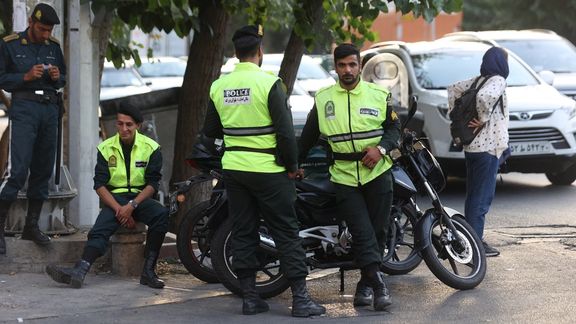
Iran's police forces stand on a street during the revival of morality police in Tehran, Iran, July 16, 2023.

Hijab police patrols in Iran can lead to the overthrow of the regime, a lawmaker said Sunday as he criticized the government’s zeal to harass women in the streets.

“The revival of the hijab patrols, under any label and by different methods will erode public trust,” Jalil Rahimi Jahanabadi, a member of parliament’s national security committee, told local media Sunday.

At the same time, the Islamic Republic’s parliament has expanded a proposed hijab bill from 15 to 70 articles, another lawmaker announced Sunday. 

Anti-regime protests that began last September changed the mood of women who were more or less abiding by the clerical government’s compulsory hijab rules. For months now, thousands of women in cities are simply ignoring the requirement to cover their heads with long scarves and dress according to the government requirements.

Authorities who faced the most serious challenge to their rule in 44 years, backed down from confronting these women, fearing renewed protests. But this month they decided to re-deploy the morality or hijab police in the streets and immediately street confrontations began.

Jahanabadi said that the hijab crackdown is an insult to the people and will lead to more emigration of educated and professional groups from the country. Hijab police patrols will also create public fear and will agitate the people and turn to a new challenge for the Islamic Republic.

Jalil Rahimi Jahanabadi, a member of parliament’s national security committee (undated)
100%
Jalil Rahimi Jahanabadi, a member of parliament’s national security committee

Other politicians and pundits have also warned that hijab crackdown can lead to new anti-regime protests, similar to when the killing of Mahsa Amini in September last year sparked unexpected nationwide protests. Although the unrest was triggered by an incident over hijab, but the underlying driving force was overall frustration with repression in general and economic hardship.

Jahanabadi did refer to the “deeply wounded” populace, that daily hears about “embezzlement, corruption and nepotism,” and also has to put up with an obligatory Islamic dress code. He implied in his remarks that those who continue to annoy and anger the people should know that they are sowing the seeds of “regime change.”

Hardliners, however, having the backing of Supreme Leader Ali Khamenei are determined to force women to back down. One explanation is that they want to subdue any dissent ahead of the protest anniversary in September. 

Women and young people is what the regime fears most. Reports on Saturday said that security officials want to make sure the universities are pacified before September.

“The enemy has not given up. They’ve said that universities are the first place where new riots should begin,” the official in charge of Supreme Leader Ali Khamenei’s representatives in universities across the country, Mostafa Rostami, said at a gathering Friday.

In advocating for preventive measures, Rostami said, “They will completely be defeated if they can’t do something on the anniversary of last year’s riots.”

Although by killing more than 500 protesters and detaining more than 20,000 security and intelligence forces were able to stop street protests earlier this year, they are aware that the potential for another flare-up is real. The hijab crackdown now is some sort of tactic preferring to attack rather than be on the defensive.

At the same time, activists both inside Iran and abroad have been discussing on social media the importance of the protest anniversary to show the regime that the movement is alive and strong.


Most Viewed

100 days after carnage: Iran economy reels from war, inflation, unemployment
1
INSIGHT

100 days after carnage: Iran economy reels from war, inflation, unemployment

2
INSIGHT

Ghalibaf defends Iran-US talks amid hardline backlash

3
INSIGHT

A nation in limbo: 100 days after the massacre, has the world moved on?

4
ANALYSIS

From instability to influence: Pakistan’s pivotal role in US-Iran diplomacy

5
ANALYSIS

100 days on: why Iran’s January protests spread across social classes

Banner
Banner

Spotlight

  • War-hit homeowners feel abandoned as Iran’s reconstruction aid fades

    War-hit homeowners feel abandoned as Iran’s reconstruction aid fades

  • 100 days on: the anatomy of Iran’s January crackdown
    INSIGHT

    100 days on: the anatomy of Iran’s January crackdown

  • Ghalibaf defends Iran-US talks amid hardline backlash
    INSIGHT

    Ghalibaf defends Iran-US talks amid hardline backlash

  • 100 days on: why Iran’s January protests spread across social classes
    ANALYSIS

    100 days on: why Iran’s January protests spread across social classes

  • From instability to influence: Pakistan’s pivotal role in US-Iran diplomacy
    ANALYSIS

    From instability to influence: Pakistan’s pivotal role in US-Iran diplomacy

  • A nation in limbo: 100 days after the massacre, has the world moved on?
    INSIGHT

    A nation in limbo: 100 days after the massacre, has the world moved on?

•
•
•

More Stories

Australian-Iranian Activist Reveals Regime Intimidation

Jul 24, 2023, 10:57 GMT+1

In a shocking revelation, an Australian-Iranian woman has exposed alarming harassment on Australian soil by a suspected regime agent.

The series of terrifying incidents took place in December, leaving the 28-year-old activist fearing for her safety and demanding recognition and protection from the Australian government.

The distressing ordeal began when Tina Kordrostami noticed a heavily tattooed man following her through Drummoyne on her way home to Dee Why. The situation escalated further when the man brazenly climbed into her car while she briefly stopped at a Sydney petrol station late at night.

Consequently, Kordrostami's father started receiving threats against her life, and she found herself under surveillance, with unidentified men taking photographs of her during rallies and public events.

In response to such alarming reports, several Australian-Iranians have broken their silence, highlighting how the Iranian regime monitors their activities in Australia. This has raised concerns among the community, who are now demanding protection from the Australian government.

Senator Chandler, who led a Senate inquiry into human rights abuses late last year, expressed her concern over the harassment of Australian citizens and the lack of action taken by relevant authorities.

“There are individuals in the community that are concerned they're being targeted. And they're reporting that to the relevant authorities, but they're worried those concerns aren't being taken seriously,” Senator Chandler stated.

The Iranian Islamic Revolutionary Guard Corps (IRGC) has conducted operations across a wide range of countries beyond the Middle East including the UK, where it targeted the Iran International staff and forced the offices to relocate to the US after British authorities failed to protect the team.


'Defiance To Hijab Shattered Regime’s Authority,' Says Jailed Activist

Jul 23, 2023, 19:49 GMT+1
•
Iran International Newsroom

Iranian rights activist Narges Mohammadi says women’s defiance to the mandatory hijab has shattered the authority of Iran’s oppressive religious regime. 

In a letter sent out from Tehran’s Evin prison, she noted that the compulsory hijab is a ploy devised by the religious and anti-women government to exert "control over women" and "remove" them from the public life. 

Her remarks came in reaction to the return of the notorious hijab or ‘morality’ police, which had vanished from the streets following nationwide protests sparked by the death of Mahsa Amini in the custody of hijab patrols last September. 

Mohammadi stated that the world now witnesses the power of women's resistance, which has elevated them in Iranian society to a position never seen since the establishment of the Islamic Republic in 1979. “

“Iranian women have achieved power and a historical position in their struggle to create revolutionary and peaceful changes,” Mohammadi said.

The fight against compulsory hijab is “a matter of freedom and liberation from tyranny, an issue of justice against oppression, a means to achieve peace, democracy, and human rights, and breaking free from violence and discrimination."

An Iranian woman without mandatory hijab on a street in Tehran (July 2023)
100%
An Iranian woman without mandatory hijab on a street in Tehran (July 2023)

Highlighting the regime’s "inability" to confront Iranian women who are fighting for their basic rights, she said, "The terrified regime is engaged in a fierce struggle to prevent its collapse, but it is clear that it has no hope of succeeding."

A lawyer often defending dissidents, Mohammadi has been imprisoned several times over the past two decades for her work fighting for human rights. She is the vice-president of the Defenders of Human Rights Association, the Chair of the executive board of the Peace Council of Iran, and a member of "Step-by-Step Abolition of Execution" campaign.

She was freed from Evin Prison in September 2020 after serving more than five years on trumped up charges, without due process of law. She was arrested again on November 16, 2021, released for a short time and one year later was detained again. Currently, she is serving a total sentence of 9 years and 8 months, along with 154 lashes and additional penalties in Evin Prison. She has also been denied access to medical care amid deteriorating health and was deprived for long periods of any contact with her husband and children who live abroad.

Iranian women walk on a street during the revival of morality police in Tehran, Iran, July 16, 2023.
100%
Iranian women walk on a street during the revival of morality police in Tehran, Iran, July 16, 2023.

The return of morality police patrols’ has immediately led to online uproar as well as a few bouts of street protests, the biggest of which broke out in the northern city of Rasht.

As the anniversary of the Mahsa Movement in September approaches, the regime is worried about the possibility of unrest in universities spilling over to the streets.

“The enemy has not given up. They’ve said that universities are the first place where new riots should begin,” the official in charge of Supreme Leader Ali Khamenei’s representatives in universities across the country, Mostafa Rostami, said at a gathering. 

People on social media have reacted to the resurgence of hijab patrols, saying if Iranians do not pour into the streets on Amini's death anniversary, the regime will further tighten the noose. 

Iran’s former president Mohammad Khatami also warned that the return of morality police may lead to the regime's overthrow by itself and social collapse. “It seems that the danger of self-overthrow, which has been talked about many times, stands out more than ever with the return of morality police."

Top officials of the regime refuse to take responsibility due to “concern over the upcoming elections," according to Tehran's leading reformist daily, Etemad. President Ebrahim Raisi's aides have advised him against implementing any plan that could provoke people until after the next presidential election in 2025 to secure his re-election. 

Iranian 'Hanging Judge' Under Treatment In Germany

Jul 23, 2023, 18:27 GMT+1

One of the judges involved in the summary trial and execution of thousands of Iranian prisoners in the 1980s has been under treatment in a hospital in German city of Hanover. 

According to German media outlet Presseportal, Hossein-Ali Nayeri was admitted to a private neurosurgical clinic -- the International Neuroscience Institute (INI) -- headed by Madjid Samii, a prominent Iranian-born neurosurgeon.

Nayeri, a cleric, judge and chief adviser to Iran’s judiciary, was one of the main figures in the "death committee" responsible for the mass execution of political prisoners in Iran in 1988. President Ebrahim Raisi was also a key member of this committee. 

On July 7, Volker Beck, the president of the German-Israeli Society, notified Germany’s Federal Public Prosecutor, the Foreign Office, and the Federal Interior Ministry about Nayeri’s stay, urging them to initiate criminal prosecution measures against him.

While people are murdered and tortured to death in Iranian prisons, those responsible for the human rights violations travel to Germany with impunity, he said, stating, “This must come to an end.” He also referred to another Iranian judge -- Mahmoud Hashemi Shahroudi – who was treated in the same clinic in Hanover in 2018. 

In July 2022, Nayeri defended the massacre in an interview with the Islamic Republic Documents Center, a government entity that collects the history of the 1979 revolution and more than four decades of rule by the Islamic Republic in Iran.

He tried to justify and explain away the killing of thousands of political prisoners, saying, “The country was in a critical state. If Khomeini [the Islamic Republic's first leader] did not stand firm... perhaps the regime would have not been able to survive.”

‘Cease Arbitrary Detentions’ Of Iranians, Says US State Department

Jul 23, 2023, 11:55 GMT+1
•
Benjamin Weinthal

Iran systematically summons, interrogates and often detains family members of dissidents, who are either themselves in prison, killed during protests or fled abroad.

A group of prominent Iranian human rights activists and dissidents issued a public letter and petition, urging Javaid Rehman, the UN’s Special Rapporteur on Human Rights in Iran, to secure the release of recently imprisoned political activists’ and journalists’ family members in Iran.

The letter titled “Condemning the Iranian Government’s Detainment of Political Activists’ and Journalists’ Family Members, and Discrimination Based on Ethnicity and Gender” was published in July in English and Persian. 

When asked about the letter, a spokesperson for the US State Department told Iran International, “We are aware of this case and will continue to monitor its developments. We once again call on Iranian authorities to cease the arbitrary detentions. Iranian authorities have repeatedly violated Iranians’ human rights and punished them for exercising their fundamental freedoms. “

Javaid Rehman, the UN’s Special Rapporteur on Human Rights in Iran (undated)
100%
Javaid Rehman, the UN’s Special Rapporteur on Human Rights in Iran

The US spokesperson added “While charges in this case have not been announced, sham trials and executions are key components of the regime’s attempt to suppress any form of dissent.The United States continues to coordinate with allies and partners to hold Iranian authorities accountable for their human rights abuses.”

The letter noted that in early July, “news emerged of the arrest of Saman Pashai[sic]. Pashai, a Kurdish citizen and the world’s third-ranked junior wrestling champion is Sardar Pashaei's brother, a former World Wrestling Champion and national team coach. Sardar Pashai had notably spoken out against the Islamic Republic since the death sentence of Navid Afkari, a former wrestling champion in Iran and a protester against the regime.”

The letter continued: “On September 23, 2022, Latifeh Pashai (Layla Saghezi), a women’s rights activist and Sardar Pashaei’s sister, was detained and interrogated about her brother’s activities. Security agents had previously summoned and questioned Sardar Pashaei’s parents.”

Sardar Pashaei told Iran International that“By arresting my younger brother, who is a professor and a wrestling champion, the authoritarian Islamic regime is sending my family and me a message: ‘Be quiet. Don’t criticize the regime. Don’t create problems.’”

Sardar Pashaei, former World Wrestling Champion and national team coach
100%
Sardar Pashaei, former World Wrestling Champion and national team coach


He continued that “The government's ploys to silence us, either by holding our loved ones hostage or sending its mercenaries to kill us, will not help them keep power. Iranian authorities are now using arrests and in some cases the death penalty as a tool of political repression—but we have a message for the regime: We will not give up our fight for freedom.”

According to the letter, on “June 18, 2023, agents from the Iranian Ministry of Intelligence blocked the entryway to Iranshahr in the Sistan and Baluchistan province. They subsequently arrested Amer Dadafarin, the 18-year-old son of Fariba Baluch, and Mohammad Mollazehi, the 25-year-old brother of the same, both relatives of the Baluch human rights activist. Their whereabouts remain undisclosed.“

Speaking from Britain on WhatsApp with Iran International, Fariba Baluch said “They arrested my son and brother for nothing. Just for my activities.” Baluch is an outspoken critic of the Iranian regime’s repression of people in Baluchestan.

Iranian regime security forces murdered more than 100 people in Zahedan, the provincial capital of Iran’s Sistan-Baluchistan, in the autumn of 2022 in what has become known as “Bloody Friday.”

Baluch spoke in April in the European Parliament and said: “Over 20 of those killed in the protests were children under 18. Baloch were killed, wounded, arrested and suppressed more violently than anywhere else in Iran.”

She added “Being a woman on one hand and a Baluch on the other hand, means systematic and double discrimination against them, as the women of Balochestan not only suffer from the religious government policies, but also local social/cultural oppressions more than any other region in Iran.”

The public letter was authored by Lily Pourzand, women and gender issues professional; Parvaneh Hosseini, lecturer and civil activist; Moein Khazaeli, lawyer; Samaneh Savadi, gender equality activist; Hamed Farmand, children’s rights activist; and Nasim Mogharab (Sahra), women’s rights activist.

When asked about the letter, a spokesman for United Nations Security General António Guterres referred Iran International to Ravina Shamdasani, a UN Human Rights Spokesperson for Rehman, the UN’s Special Rapporteur on Human Rights in Iran Affairs.Shamdasani did not immediately respond.

Iran International reached out to the International Olympic Committee and United World Wrestling. Hualan Jiang, a representative for the IOC, referred Iran International to the IOC press office. The IOC declined to comment. Iran International also contacted Human Rights Watch and HRW’s Director of Global Initiatives, Minky Worden, who deals with the persecution of athletes. A HRW spokesperson wrote, “We regret to inform you that we are unable to meet your deadline due to the availability of our experts. Apologies for the inconvenience this has caused, but we hope to be more accommodating of future requests. We wish the best of luck with your reporting and hope to hear from you in the future.” 

Iran International offered to extend the filing of its article to HRW to secure a comment. HRW and Worden declined to comment. Critics argue that HRW failed to intervene prior to the execution of Navid Afkari. On the day that Iran’s regime hanged Afkari, HRW issued a statement.

Video Showing Cleric Beating Elderly Woman Goes Viral In Iran

Jul 23, 2023, 09:21 GMT+1

A video showing a cleric in Iran assaulting and beating an elderly woman in a property dispute has gone viral on social media, prompting officials to respond.

Local judicial authorities have announced that the clergyman's case will be referred to the provincial court for clerics. However, they also tried to emphasize that the incident resulted from a family dispute over property.

The sharing of such videos on social media is a sensitive issue for Iran's clerical regime, as many Iranians resent the power the clergy have wielded in the past 44 years since the establishment of the Islamic Republic. In recent protests since last September, there have been numerous instances of young people verbally assaulting clerics or expressing their dissatisfaction with them. In many instances young people filmed how they tossed the turban of clerics in the streets.

A judicial official in Gilan Province, where the incident occurred, has threatened to pursue those who filmed the cleric attacking the woman and promised to prosecute them.

The measures or punishment that the clerical court will decide upon are not clear, as proceedings in these courts are kept secret. Clerical courts operate independently of the Judiciary administration and function outside the legal framework.

In addition to this, another scandal that emerged earlier in the week is still causing reverberations among Iranians. A video surfaced showing an official and staunch regime loyalist responsible for enforcing hijab regulations, engaging in a sexual act with a young man. He has been fired from his job, and authorities state that he is under investigation.