• العربية
  • فارسی
Brand
  • Iran Insight
  • Politics
  • Economy
  • Analysis
  • Special Report
  • Opinion
  • Podcast
  • Iran Insight
  • Politics
  • Economy
  • Analysis
  • Special Report
  • Opinion
  • Podcast
  • Theme
  • Language
    • العربية
    • فارسی
  • Iran Insight
  • Politics
  • Economy
  • Analysis
  • Special Report
  • Opinion
  • Podcast
All rights reserved for Volant Media UK Limited
volant media logo

Standby Judges In Iran's Morality Police Patrol Vans

Maryam Sinaiee
Maryam Sinaiee

Iran International

Jul 18, 2023, 12:33 GMT+1Updated: 18:15 GMT+1
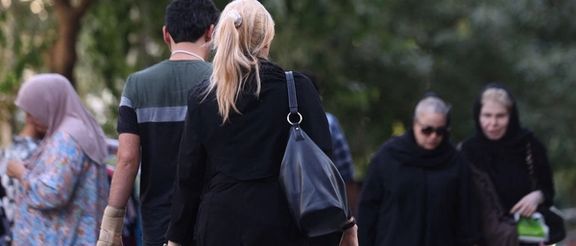
An Iranian woman without the mandatory hijab in Tehran

Rights activists and lawyers fear the presence of standby judges in morality police vans that made a reappearance in the streets of Tehran Sunday.

Speaking to Dideban-e Iran news website Monday, lawyer and women’s rights activist Shima Ghoosheh said the new move smacks of wartime measures.

“We can’t send a judge to make a ruling there and then and carry out the law. This is in opposition with all of the principles of human rights, rights of defendants, due process and logical principles that any rational person abides by,” she said.

“I’m not sure if they even have as many judges as they have patrol vans, or if they can hold field courts inside these vans. We don’t even have something as a field court [in Iranian laws],” she said.

Lawyer and women’s rights activist Shima Ghoosheh (Undated)
100%
Lawyer and women’s rights activist Shima Ghoosheh

The Revolutionary Guards (IRGC) linked Tasnim news agency reported the news of the standby judges, in place to decide whether women who have refused to abide by the compulsory hijab rules on the streets should be detained or could be released with only a verbal warning. 

Iran's hijab police street patrols have again appeared in the streets of Tehran and some other larger cities after months of laying low, for the fear of igniting another round of anti-regime protests. But their comeback has once again roused fear and hatred on Iran’s streets.

The death of a young Kurd, Mahsa (Jina) Amini, in the custody of morality police in September, sparked nationwide protests that lasted several months. The 22-year-old had received fatal blows to the head at the time of her arrest.

Hundreds were killed and thousands were arrested by security forces during the protests which somehow subsided after around four months. Since then, however, many women have chosen to disobey the rules of compulsory hijab and also as a means of demonstrating their opposition to the regime.

Former reformist lawmaker, Fatemeh Rakei, said the reappearance of the morality police defies logic, given the controversy which ensued following the death of young Amini. She called the body an “illegal entity” in an article she penned in the Etemad newspaper.

Rakei who has always worn the hijab, also pointed out that many Iranian citizens, including women who wear the hijab by choice, as well as religious men, are opposed to forcing the hijab and religion on people and warned that the return of morality police patrol could cause tension amid ever worsening economic hardships once again.

The mass wave of hijab refusal has left the regime at a loss. In spite of brutal crackdowns, women continue to walk in public places uncovered, in defiance of the mandatory rules which have been in place since the Islamic Republic was declared in 1979.

Hardliners have been using a language of both threats and supplication about the ever-increasing defiance. Speaking at an event Monday, IRGC Commander Hossein Salami continued to push the morality argument, associating uncovered women with the likes of prostitutes and ‘loose women’. 

“When Islam spreads in neighborhoods, hijab and chastity will too. And our virtuous and pure women who have come under the enemy’s propaganda, will return [to abide with the compulsory hijab rules],” he said.


Most Viewed

State media slam Araghchi's Hormuz tweet, say it let Trump claim victory
1

State media slam Araghchi's Hormuz tweet, say it let Trump claim victory

2

Iran International says it won’t be silenced after London arson attack

3
INSIGHT

How Tehran bends its own red lines to boost state rallies

4
VOICES FROM IRAN

Hope and anger in Iran as fragile ceasefire persists

5

Iran halts petrochemical exports to supply domestic market

Banner
Banner

Spotlight

  • Too early to tell who is winning Iran war, experts say
    PODCAST

    Too early to tell who is winning Iran war, experts say

  • How Tehran bends its own red lines to boost state rallies
    INSIGHT

    How Tehran bends its own red lines to boost state rallies

  • Iran blackout cripples freelancer, small business incomes
    VOICES FROM IRAN

    Iran blackout cripples freelancer, small business incomes

  • Ideology may be fading in Iran, but not in Kashmir's ‘Mini Iran'
    INSIGHT

    Ideology may be fading in Iran, but not in Kashmir's ‘Mini Iran'

  • US blockade enters murky phase as tankers spoof signals and buyers hesitate
    ANALYSIS

    US blockade enters murky phase as tankers spoof signals and buyers hesitate

  • Why the $100 billion Hormuz toll revenue is a myth
    ANALYSIS

    Why the $100 billion Hormuz toll revenue is a myth

•
•
•

More Stories

Ex-President Warns Of Overthrow After Return Of Morality Police

Jul 18, 2023, 09:36 GMT+1

Iran’s former president has warned that the return of morality police to streets may lead to the regime's “overthrow by itself and social collapse”.

In a meeting with his advisors, Mohammad Khatami said: "It seems that the danger of self-overthrow, which has been talked about many times, stands out more than ever with the return of morality police."

The ‘morality’ police in Iran have returned to the streets of Tehran and other cities ahead of the first anniversary of Mahsa Amini's death in police custody last September, which triggered mass unrest in its wake.

The spokesman of Iran’s Police announced Sunday that special patrols are now deployed to deal with the continued wave of hijab rebels. Saeed Montazerolmahdi said those who "still insist on breaking the norms" will be dealt with.

On Monday, Khatami, who was president for eight years, said he was surprised by the "imprudence of the key officials" of the Islamic Republic because such “wrong methods will make the society more tense than before.”

Meanwhile, Tasnim news agency, affiliated to the Revolutionary Guard, said the decision to enforce the mandatory hijab by police was ordered by President Ebrahim Raisi, Interior Minister Ahmed Vahidi, and the judiciary. "The police are forced to execute this plan along with all their other duties," wrote Tasnim.

A video which went viral on Saturday showed Tehran's morality police arresting a teenage girl without compulsory hijab in the Gisha neighborhood.

Iranian Regime Refuses To Understand People's Problems, Say Critics

Jul 17, 2023, 18:47 GMT+1
•
Iran International Newsroom

Some Iranian analysts and politicians continue criticizing the ruling establishment, within the limits of controlled media, for the country’s multiple crises.

However last week, prominent economist Mehdi Pazouki told Didban Iran website that government officials have humiliated the nation in the name of their revolutionary approach. Pazouki said, in an unprecedented and daring statement, "One of Khomeini's mistakes was allowing clerics to intervene in the country's social and executive affairs." 

He was referring to the founder of the Islamic Republic, Ayatollah Ruhollah Khomeini who after the 1979 revolution gradually expelled independent-minded people from the government and increasingly relied on clerics that he knew had no experience in running a country.

Pazouki added that Iranian clerics can do their biggest service to Islam by migrating back to the seminaries. He further criticized officials for their lack of discipline in foreign relations and administrative affairs and said that as a result of government policies, banking in Iran lags behind other countries by at least 40 years. 

Ahmad Alirezabeigi, a member of the Iranian parliament who is known for disclosing a major bribery case involving at least 75 other lawmakers and a former Industry Minister, accused officials of evading their responsibility and adding insult to injury by making statements that blame the people for the government's shortcomings. 

MP Ahmad Alirezabeigi (undated)
100%
MP Ahmad Alirezabeigi

He further accused state officials of mismanaging resources and failing to provide the conditions for the minimum means of livelihood. Alirezabeigi added that government policies stifle investments and make the economy more dependent on state enterprises.

While the country is suffering from energy and water shortage, the government creates obstacles for investment in these areas. It wants to do everything by itself but is incapable of completing any project. 

This approach will inevitably lead to capital flight from the country, and add to public discontent. 

Criticizing the government's economic policies, economist Pazouki highlighted the fact that Iran’s currency has lost its value 12-fold in five years, bringing inflation and misery to the people. He argued that government foreign and domestic policies have stifled an export-oriented economy.

Economist Mehdi Pazouki (undated)
100%
Economist Mehdi Pazouki

As a result, the government is spending more than its income leading to a huge budget deficit. "The main problem is in our governance. Our economy is hostage to our pending political decisions," he said, adding that although there are so many capable individuals in Iran, most current officials are much less qualified than former statesmen."

As an example, he said: "Just compare the current foreign minister to his predecessor, and you will find out that we have gone back by at least 40 years. 

Expounding on the causes of Iran's rising inflation, Pazouki said: "Last year, Iraq sold $120 billion of oil while Iran's oil export was less than a quarter of that, and we still have not repatriated the money for the oil we have sold." He added: "We are likely to have even more problems if we refuse to come to terms with the world and follow a reasonable foreign policy," referring to the nuclear dispute with the West and crippling US sanctions.

In another developing, offering a way out of the problem, political commentator Abbas Abdi suggested that the government should find out about the true public mood and what ordinary people say.

“Send your agents to mingle with the people on the buses, subways, in the bazaar and shopping centers to talk with citizens and record what they say about their problems and needs.” 

Abdi likened the perception of officials about the problems of ordinary folks to the elephant in the darkroom analogy in which everyone has a different perception of the elephant. Abdi suggested: "Turn the lights on and see the elephant!"

US Concerned Over Morality Police Comeback

Jul 17, 2023, 17:10 GMT+1

The US Deputy Special Envoy for Iran expressed concern that the morality police are again cracking down to enforce mandatory hijab.

"It seems the regime has learned nothing from the protests. Women and girls everywhere should be allowed to wear whatever they want," tweeted Abram Paley on Monday.

The office of the US Special Envoy for Iran showed its first signs of life following days of media storm about circumstances surrounding the former envoy’s dismissal on Friday.

The official twitter account of the mission said: “The Office of the Special Envoy for Iran and the entire team at the State Department remain engaged in implementing our policy on Iran.” The account had been inactive since early June, about a month before Rob Malley’s suspension was announced.

The ‘morality’ police in Iran have returned to the streets of Tehran and other cities ahead of the first anniversary of Mahsa Amini's death in police custody last September, which triggered mass unrest in its wake.

A video which went viral on Saturday showed Tehran's morality police arresting a teenage girl without compulsory hijab in the Gisha neighborhood.


Ex-Iran National Team Footballer Honored For Regime Loyalty

Jul 17, 2023, 14:45 GMT+1

A pro-regime athlete who called for suppression of protests has been appointed as CEO of a famous football club in Iran.

Nima Nakisa, a former goalkeeper of the Iranian national football team, was introduced as the new CEO of Zob-e Ahan football club in Esfahan.

He was one of the few athletes who called the protesters against the murder of Mahsa Amini as "separatists" in November last year and demanded the security forces to repress demonstrators.

Following his comments, countless Iranians on social media slammed his statements, but regime supporters defended Nakisa, citing his doctorate level education as a reason for his authority.

Nakisa did not hold any position as a coach or manager until the nationwide protests began. Some critics say he has been rewarded for standing by the government.

This comes as Iran's security agencies earlier ordered the officials of Persepolis football club in Tehran to remove Karim Bagheri, the team's assistant coach, for his support of protests. Other players have suffered pay cuts, travel bans and social media blackouts for supporting the protests.

Bagheri also threw his weight behind his peer Ali Karimi, who is now one of the prominent opposition leaders, saying “Ali Karimi is neither a traitor nor a defector, but an honorable patriot… What have you done for these people except talking nonsense and insulting their heroes?”


Fury Over Mass Medical Board Sackings In Iran

Jul 17, 2023, 13:24 GMT+1
•
Maryam Sinaiee

Iran’s Association of Medical Academic Societies has warned against the recent forced retirement and sacking of over 100 doctors from residency admissions boards amidst a major national health crisis.

Speaking to reformist Ham-Mihan newspaper Sunday, Dr Babak Zamani, a member of the Medical Council of Iran’s board of directors, said most of the doctors who were forced to retire or sacked from the boards were among those who had signed statements supporting protests since September.

During the protests doctors and nurses condemned the use of ambulances by security forces for transporting detainees and their use of shotgun ‘birdshots’ that blinded or caused serious eye injuries among hundreds of protesters. They have also said more recently that they could not abide by some authorities’ demands recently to refuse services to women who defy hijab rules.

Security forces also attacked doctors and others with tear gas and shotgun 'birdshots' to disperse them during protests. A young doctor, Parisa Bahmani, was shot dead by security forces.

Dr Zamani also warned that the replacement of top academics forced to quit would be very difficult due to extensive emigration of medical staff in the past few years.

Babak Zamani, a member of the Medical Council of Iran’s board of directors (undated)
100%
Babak Zamani, a member of the Medical Council of Iran’s board of directors

Dr Ali Tajernia, another member of the board of directors of the Association of Medical Academic Societies told Ham-Mihan newspaper that he suspects the Supreme Council of Cultural Revolution may have been behind the plan. “It seems that they are after some sort of cultural revolution again,” he said.

Signatories of the statement challenging the move, who are among the most prominent academics in the country, suggested that there is an orchestrated plan to eliminate prominent doctors from residency admissions boards and urged the Medical Council of Iran and the media not to remain silent about these developments.

It comes amidst revelations that the country’s health sector is 60,000 personnel short across all fields.

The Medical Council of Iran, a recognized trade union for Iranian medical doctors, is responsible for licensing and regulating the medical profession. It has nearly 300,000 registered members who elect the president of the council. Like many other semi-independent organizations and trade unions, the government often tries to control the council and influence its elections.

In late October, the Medical Council prepared a statement condemning the government for undue pressure on the medical community during the protests and intended to publicly read the statement outside its headquarters in Tehran on October 26.

Security forces who were present in the area, however, attacked doctors and others with tear gas and shotgun 'birdshots' to disperse them and prevent the reading of the statement. A young doctor, Parisa Bahmani, was shot dead by security forces. 

Videos posted on social media showed protesters chanting "Death to Khamenei" and against clerical rule near the Medical Council building. Two days earlier, a gathering around the medical association of Shiraz, capital of southern Fars Province, had similarly been attacked with tear gas.