• العربية
  • فارسی
Brand
  • Iran Insight
  • Politics
  • Economy
  • Analysis
  • Special Report
  • Opinion
  • Podcast
  • Iran Insight
  • Politics
  • Economy
  • Analysis
  • Special Report
  • Opinion
  • Podcast
  • Theme
  • Language
    • العربية
    • فارسی
  • Iran Insight
  • Politics
  • Economy
  • Analysis
  • Special Report
  • Opinion
  • Podcast
All rights reserved for Volant Media UK Limited
volant media logo

EU Warns Iran Over Arms Supplies To Russia
Iran International Newsroom
Jul 5, 2023, 09:11 GMT+1Updated: 17:42 GMT+1
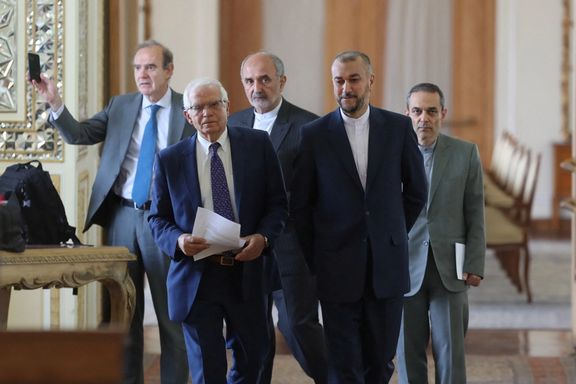
EU's Josep Borrell with Hossein Amir-Abdollahian in Tehran in June 2022

Iran’s military cooperation with Russia is “unacceptable,” EU’s foreign policy chief Josep Borrell told the Iranian foreign minister in a phone call on Tuesday.

Borrell tweeted that while speaking about the need to continue dialogue on the JCPOA nuclear deal, he told foreign minister Hossein Amir-Abdollahian that “military cooperation with Russia is unacceptable” and “EU detainees must be freed and human rights respected.”

The European Union, European countries and the United State have been warning Iran against supplying weapons to Russia, since its Shahed Kamikaze drones were deployed by Moscow last year against civilian and military targets in Ukraine. So far, Russia has launched hundreds of these loitering munitions, mostly against infrastructure and centers of population.

In the meantime, France, the United Kingdom and Germany told Iran last week that they plan to retain EU ballistic missile sanctions against Iran set to expire in October, along with a UN ban that was part of the JCPOA deal in 2015. 

This signaled that the three countries, signatories of the JCPOA, will technically violate the agreement, which Tehran has already breached with high-level uranium enrichment since 2021.

Iranian government media were silent about the phone conversation Wednesday morning, but the foreign ministry issued two statements, one in Persian and another in English, which were quite different, written for separate audiences.

However, both versions omitted any reference to Borrell’s warning about military cooperation with Russia, and simply mentioned “developments in Ukraine.”

“The Islamic Republic of Iran has always been a supporter of peace and stability in the world, including Ukraine, and in this context, it believes that stopping the war is only possible through political initiatives,” the statement in English quoted Amir-Abdollahian as telling Borrell. 

This is hardly the assurance the Europeans seek as they worry about Iranian ballistic missiles finding their way to Russia after October and used against Ukraine, or if the conflict expands beyond the current battlefield.

Tehran’s strategy seems aiming to maintain a certain level of diplomatic interaction with Europe to prevent further sanctions, while strengthening its burgeoning ties with Russia, especially weapons supplies.

British envoy to the United Nations, Barbara Woodward expressed concern Monday that Iran has three times the minimum amount of highly enriched uranium needed to build a nuclear weapon.

Speaking to Iran International’s Maryam Rahmati Woodward said that the regime’s “stockpiles are high, and Iran’s ability to enrich uranium is also very high.”

Woodward is the president of the Security Council in July said, “We'll have a discussion in the Council on the sixth of July on Iran, looking at the Security Council resolution 2231.” The resolution she referred to endorsed the 2015 Iran nuclear agreement, the JCPOA and designated arms limitations on Iran, which might have been violated by drone supplies to Russia.

Referring to the possible reactions by the Islamic Republic in case the UK, France and Germany retain ballistic missile sanctions set to expire in October, Woodward said the situation is causing a lot of concern and that the UK is working closely with France and Germany and the EU on the question of what to do next.

She emphasized that Iran is in “flagrant breach” of resolution 2231, “not least also the way in which it is selling UAVs to Russia for the war in Ukraine.” 

“There's quite a lot of concern there and we’ll have a chance to discuss it on the sixth of July,” she added.

Most Viewed

US blockade enters murky phase as tankers spoof signals and buyers hesitate
1
ANALYSIS

US blockade enters murky phase as tankers spoof signals and buyers hesitate

2
INSIGHT

Ideology may be fading in Iran, but not in Kashmir's ‘Mini Iran'

3
INSIGHT

Hardliners push Hormuz ‘red line’ as US blockade tests Iran’s leverage

4
VOICES FROM IRAN

Hope and anger in Iran as fragile ceasefire persists

5

US sanctions oil network tied to Iranian tycoon Shamkhani

Banner
Banner

Spotlight

  • Hardliners push Hormuz ‘red line’ as US blockade tests Iran’s leverage
    INSIGHT

    Hardliners push Hormuz ‘red line’ as US blockade tests Iran’s leverage

  • Ideology may be fading in Iran, but not in Kashmir's ‘Mini Iran'
    INSIGHT

    Ideology may be fading in Iran, but not in Kashmir's ‘Mini Iran'

  • War damage amounts to $3,000 per Iranian, with blockade set to add to losses
    INSIGHT

    War damage amounts to $3,000 per Iranian, with blockade set to add to losses

  • Why the $100 billion Hormuz toll revenue is a myth
    ANALYSIS

    Why the $100 billion Hormuz toll revenue is a myth

  • US blockade targets Iran oil boom amid regional disruption
    ANALYSIS

    US blockade targets Iran oil boom amid regional disruption

  • Iran's digital economy battered by prolonged blackout
    INSIGHT

    Iran's digital economy battered by prolonged blackout

•
•
•

More Stories

Iran Plans To Offer Treated Wastewater In Trade Exchange

Jul 5, 2023, 07:27 GMT+1
•
Iran International Newsroom

Strapped for both cash and water, the Iranian government plans to offer treated wastewater in the energy exchange market.

Mohsen Ardakani, the head of Tehran's water and sewage management, said plans would begin in the coming months but did not elaborate on the mechanism of trade or how the wastewater will be distributed to buyers and consumers.

Dozens of developed countries treat almost all domestic sewage and deliver the treated water to agricultural and industrial sectors. However, the nominal capacity of Iran’s sewage treatment plants is only 5.8 million cubic meters per day, which means that if all of them work at full capacity all year long, they are only able to turn 2.1 billion cubic meters of sewage into treated wastewater, which is less than a quarter of the country’s household water consumption. This means most of the clean water consumed is not treated to be recycled.

Moreover, a quarter of drinking water in the domestic sector is wasted through the distribution and transmission process due to the country's worn-out network. However, according to Ardakani, there are 35 laboratories in Tehran that test water, claiming the distributed water is on par with national and global standards.

A wastewater treatment plant in Iran  (file photo)
100%
A wastewater treatment plant in Iran

All these factors on the backdrop of a drought and low precipitation in the country have led to a severe water crisis in Iran, with regular water cuts and rationing in several cities as well as the capital.

Rainfall in Tehran has decreased by five percent compared to the previous year, and currently the volume of water reserves in dams is down by 40 percent compared to last Iranian year (ended on March 19).

Earlier this week, Mehdi Zare, Professor of the International Research Institute of Seismology, said within the past 25 years almost 25 million Iranians have been displaced amid water scarcity worries. “There are about 12 million marginalized people in Iran, and almost 10 million of this population are directly facing problems caused by the water crisis,” he added. 

Water issues have been the main topic of President Ebrahim Raisi’s visits to Iranian provinces in recent months, taking him to Sistan-Baluchestan, Kerman and Khuzestan provinces that have very little clean water and temperature as high as 51 degrees (about 124 in Fahrenheit).

Iranian Energy Minister Ali-Akbar Mehrabian, who was accompanying Raisi in his trip to the central province of Kerman, said last week that at least 10,000 villages in Iran are without drinking water, with about 670 people in Kerman province facing “serious” water scarcity.

Last month, the water was also out in the capital Tehran for several days with tankers distributing water to residents.

In January, CEO of Iran Water and Wastewater Company, Atabak Jafari, issued a warning saying that 270 cities and towns are suffering from acute water shortage as water levels at dams have dropped to critically low levels. 

As drought persists across Iran, more underground water is exploited for irrigation, depleting natural reservoirs formed during thousands of years. Old and unregulated irrigation methods, as well as an aging urban water distribution infrastructure compound the shortage. 

An inefficient agricultural sector, overgrazing of rangelands and forests, aggressive over-extraction of groundwater resources, and the regime’s mismanagement are among the main causes of water bankruptcy in Iran.

In recent years, massive protests have occurred in several cities against government mismanagement of water resources, harmful dam building, and politically motivated diversion of rivers that have devastated agriculture and drinking water sources in many areas.

Zayandeh-Roud river (file photo)
100%
Zayandeh-Roud river

In July 2021, water protests erupted in several cities in the oil-rich Khuzestan province that ended with the forceful intervention of police and the Revolutionary Guards. More than ten people were killed and hundreds detained during the protests that lasted a week. 

In November of the same year, thousands protested in Esfahan over lack of water for agriculture where the iconic Zayandeh-Roud river has turned into a dry bed over the past few years. The protests soon turned into anti-government unrest.

Head of Esfahan’s crisis management headquarters said Monday that trees along the Zayandeh-Roud river – which starts in the Zagros Mountains are withering out of season.

Putin’s Aide Meets Iran’s Security Chief In Tehran

Jul 4, 2023, 22:01 GMT+1

Russian President Vladimir Putin’s special assistant met Iran's Secretary of the Supreme National Security Council (SNSC) in Tehran on Tuesday. 

In his third trip to the Islamic Republic this year, Igor Levitin, who is also Russia’s State Council Secretary, met with Ali-Akbar Ahmadian, the new SNSC secretary, as well as Foreign Minister Hossein Amir-Abdollahian. 

During the meeting, Ahmadian stressed the need to speed up the implementation of bilateral agreement, including the project to complete the North-South Transport Corridor and memorandums of understanding (MoUs) in the field of oil and gas.

Russia last year pledged to invest tens of billions of dollars in joint energy projects, but similar deals were made in the past without any progress in implementation.

“Expanding relations with neighbors is a strategic policy and the main agenda of the Islamic Republic,” Ahmadian said. 

According to the readout of the meeting in Iranian media, they also talked about the agreement on the construction of the Rasht-Astara railway, a strategic transport corridor that connects the existing railways of the two countries and Azerbaijan. 

During his meeting with Amir-Abdollahian, Vladimir Putin’s aide also congratulated the Islamic Republic on its full membership in the Shanghai Cooperation Organization, announced earlier in the day. 

Igor Levitin, the Russian President Vladimir Putin’s special assistant, during a meeting with Iranian Foreign Minister Hossein Amir-Abdollahian in Tehran on July 4, 2023
100%
Igor Levitin, the Russian President Vladimir Putin’s special assistant, during a meeting with Iranian Foreign Minister Hossein Amir-Abdollahian in Tehran on July 4, 2023

The Biden Iran Gamble: Between War And Diplomacy

Jul 4, 2023, 21:11 GMT+1
•
Hossein Aghaie Joobani

Tensions between Iran and the West are reaching new heights as the fate of nuclear talks hangs in the balance, and missile restrictions are expiring in October. 

Multiple reports have been indicating that ‘secret’ talks are underway between Iranian and western officials over the possibility of reaching an “informal, unwritten agreement” or a "political ceasefire" between the two sides.

Iran, for its part, has confirmed that it held indirect talks with the US in Oman. However, these talks have yet to yield concrete results while Iran’s nuclear crisis remains dangerously unresolved, fueling a ripple effect across the region, forcing new alliances with the likes of the Persian Gulf states and new threats from Israel. 

According to the IAEA, Iran’s total stockpile of enriched uranium continues to grow and is now 23 times the limits imposed by the 2015 deal, also known as the JCPOA. Accordingly, Iran remains a “nuclear threshold state” since it is in the possession of means to “produce enough material for a nuclear bomb in 12 days.”

The ministers of foreign affairs of France, Germany, the European Union, Iran, the United Kingdom and the United States as well as Chinese and Russian diplomats announcing the framework for a comprehensive agreement on the Iranian nuclear program (Lausanne, April 2, 2015)
100%
The ministers of foreign affairs of France, Germany, the European Union, Iran, the United Kingdom and the United States as well as Chinese and Russian diplomats announcing the framework for a comprehensive agreement on the Iranian nuclear program (Lausanne, April 2, 2015)

The Islamic Republic regime continues to suffer from a crisis of legitimacy, at least internally, as a direct consequence of the bloody crackdown of an unprecedented popular uprising in September 2022, which was triggered by the death in custody of Mahsa (Zhina) Amini. 

Therefore, the Islamic Republic’s recent policy of regional détente (i.e., with Saudi Arabia) and its proclivity for negotiations with the US over its nuclear program can be viewed as a Russian-style deception tactic (maskirovka) aimed at confusing and outfoxing its ‘western enemies’ while minimizing the negative international backlash against its inhumane behavior at home and its destabilizing activities abroad, namely in Ukraine.

In a worrying sign of growing tensions between Iran and the West, the UN sanctions on Iran’s ballistic missiles program will be lifted on October 18 as per the JCPOA’s so-called “sunset-clauses”. The expiration of the UNSCR 2231’s missile restrictions on Iran means, at least on paper, that in less than four months, the Islamic Republic regime can legally supply deadlier drones and ballistic missiles to Russia for its ongoing military aggression in Ukraine. The situation for the Biden administration is not irredeemable but could not be worse. 

Not only has Iran’s nuclear program reached a point of no return (at least theoretically), the specter of Iran’s possible provision of ballistic missiles to Russia for use in its war against Ukraine, is looming large.

Had the Biden administration adopted a serious and meaningful deterrence strategy vis-à-vis Iran before the Russian invasion of Ukraine, an undesirable status-quo of today could have been prevented in the first place or it could have, at least, been managed in a much more timely, less costly, and effective manner. 

For so long, the Biden administration and European powers hesitate to activate the “snapback” mechanism of UN Security Council Resolution 2231 against Iran, fearing that such a move could dissuade Tehran from engaging in nuclear talks and/or prompt the regime to opt for a dangerous nuclear escalation.

The reality is that absent a meaningful deterrence strategy vis-à-vis Iran, the West has in fact created a catch-22 situation from which it cannot escape without sustaining relatively high costs. 

Simply put, if “snapback” is activated, Iran is likely to resort to regional and nuclear escalation. Conversely, if the mechanism is not activated, the clerics would rejoice in their notion of “western capitulation” to Tehran, and use every opportunity to threaten the west with more weaponry for Russia in Ukraine war while enjoying the status of a “nuclear threshold state.” 

Drones are seen at a site at an undisclosed location in Iran, in this handout image obtained on April 20, 2023.
100%
Drones are seen at a site at an undisclosed location in Iran, in this handout image obtained on April 20, 2023.

More than 16 months into the Ukraine war, Tehran continues to transfer kamikaze drones, including Shahed 136s to Russia in spite of EU/US sanctions on Iranian entities involved in the drone industry.

The threats posed by the Islamic Republic are hybrid in nature, in the sense that they encompass a wide variety of threats such as nuclear, drones, ballistic missiles, cyber and overseas terror operations against dissidents. 

Effective and enduring deterrence against these hybrid threats requires the Biden administration to avoid short-term remedies that seek only to kick the Iranian nuclear can down the road. The US should, instead, adopt a comprehensive and all-encompassing strategy vis-à-vis Iran. Putting off solving Iran’s nuclear crisis is not the solution.

It was thanks to the Ukraine war that European countries became aware of some of the oft-ignored threats of the Islamic Republic beyond its borders.

Imagine a future war between the US and China over Taiwan and Europeans at the horns of a dilemma to choose between the US (their biggest military ally) and China (their biggest economic partner). Imagine the worst-case-scenario whereby Iran-made drones would fly over some European cities in support of China and as a leverage against the United States.

While Putin’s Russia is seen as the West’s foremost threat, the United States and European powers should not underestimate the hybrid threats of the Islamic Republic regime.

Opinions expressed in the analysis are not necessarily the views of Iran International

IRGC-Affiliated Media Hail Martyr Of Terror Attack In Israel

Jul 4, 2023, 18:57 GMT+1

Media affiliated with Iran’s Revolutionary Guards are lauding a car-ramming and stabbing attack against civilians in central Tel Aviv as a “martyrdom operation".

IRGC-affiliated Tasnim news agency published a video and several photos of the incident and praised the 20-year-old Palestinian assailant who was shot dead by an armed civilian as a “martyr". Hamas' official channels hailed him as their operative. 

The Palestinian from the West Bank, rammed a pickup truck into pedestrians in Tel Aviv and then went on a stabbing rampage, chasing people knife in hand and wounding eight people on Tuesday.

Hamas claimed the assassin, who entered Israel on a medical permit, struck in Israel's commercial capital in retaliation for the ongoing military raid in the flashpoint West Bank town of Jenin, in which 10 Palestinians have been killed during clashes. 

In a statement, Hamas described the attack as a “heroic operation” and “an act of self-defense in the face of the ongoing Zionist massacre in Jenin, the crimes of displacement, killing and destruction executed by occupation forces."

Israel sent drones to strike targets in a militant stronghold in Jenin early Monday and deployed hundreds of troops in the area. The attack set off a gunbattle lasting into the morning. Israeli forces have remained inside the Jenin refugee camp.

The incursion took place two days after the Islamic Jihad's Secretary-General Ziyad al-Nakhala said that anti-Israeli actions in the West Bank reflect Iranian Supreme Leader’s directives.


Iranian Man Killed Following Fight Over Price Of Chicken

Jul 4, 2023, 18:05 GMT+1

A man was killed in Iran on Monday following a quarrel between a customer and a salesman over the price of chicken as soaring food prices cause chaos across society. 

According to the police in Chalus, the murderer was arrested at the scene. He had attacked the salesman with a knife, and he succumbed to his wounds on the way to the hospital. 

The price of chicken has soared across Iran in recent weeks, hitting about 1,000,000 rials – or about $2. An ordinary worker in Iran makes about $5 a day.

In a similar fight in January, another man was killed over the price of meat products. 

Unable to control the inflation and the rising prices, the government usually announces maximum prices for food stuff and goods, but the official figures are so unreal that businesses ignore them and trade with the real market value, leading to conflicts between customers and sales staff.

In recent years, various reports have been published about the increase in the price of meat, and the decrease in consumption of high-protein foods in Iran.

The government of Ebrahim Raisi has promised to deliver meat and chicken to the people at an "approved price", but the government has made many similar promises in the past though failed to deliver.