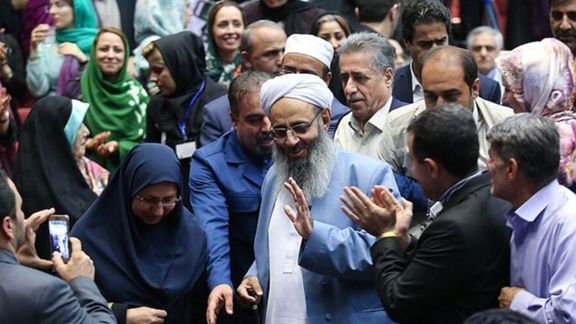
Iran’s religious intellectuals or modernists have expressed support for a top Sunni cleric who has come under pressure from the government for his fiery sermons.
“We believe that given the absence of liberalism and courage among Shia clerics, [the Sunni] Mowlavi Abdolhamid must receive all-encompassing support from Iranians in Iran and abroad,” a statement released Saturday by fifteen prominent political, academic and media figures said.
Security forces during the week arrested several people close to Mowlavi Abdolhamid, the outspoken leader of the Sunnis in Sistan-Baluchestan, including his grandson. The regime has been pressuring him to put an end to criticism of the government in his very popular Friday sermons in Zahedan, the capital of the southeastern province.
Abdolhamid’s sermons which make headlines almost every Friday have been followed by anti-government protests since what has come to be known as the Bloody Friday of Zahedan.
Mowlavi Abdolhamid, the top religious leader of Iran's largely Sunni Baluch population
On September 30, 2022, security forces opened fire on civilian anti-government protesters killing more than 93 protesters including children and onlookers in Zahedan after Friday prayers.
This week’s Friday prayers in Zahedan were for the first time since then led by Mowlavi Abdul Ghani Badri, the interim Friday imam of Zahedan. Abdolhamid who had delivered a sermon the previous day for the Muslim holiday of Eid al-Adha, asked worshippers to march silently instead of the usual protests and chanting.
The religious intellectuals praised Sunni clerics who, particularly in the predominantly Sunni provinces of Kordestan and Sistan-Baluchestan, who have turned into “symbols of resistance and endurance of the Mahsa Movement.”
Philosopher and theoretician Soroush Dabbagh (Abdolkarim Soroush)
Signatories of the statement underlined that in addition to democracy and social justice, establishment of a government in Iran in which religion and state are separate is necessary. The intellectuals included philosopher and theoretician Soroush Dabbagh (Abdolkarim Soroush), female Islamic scholar Sedigheh Vasmaghi, former cleric Hassan Yousefi Eshkevari, historian Hashem Aghajari, Muslim scholar Mohammad Javad Akbarin, and commentator and journalist Reza Alijani.
Speaking to Iran International TV, Turkey-based political science researcher Meysam Badamchi who is among the signatories of the statement said Abdolhamid is now speaking not only about the wishes and demands of Sunnis but also those of other Iranians when he criticizes the government.
Former cleric Hassan Yousefi Eshkevari
The signatories – who come from a Shia background themselves -- wanted to defend the rights of Mowlavi Abdolhamid as a Sunni cleric and the right of the people of Iran to criticize the government at a time when the Shia clerical establishment has chosen to remain silent about violation of people’s rights, he said.
“Religious Intellectual” refers to a number of political groups and public figures who believe in separation of religion and state and respect freedom of choice. Unlike theoreticians of the Islamic Republic, they consider religion a personal matter rather than the source of laws that regulate politics, economy and society.
They do not believe in the rule of Islamic jurist (Velayat-e Faghih (Wilayat al-Faqih) or Supreme Leader) which gives a cleric such as Ali Khamenei extraordinary powers including the power to overrule all elected bodies and officials and hence, people’s choice.
As a system of governance, Velayat-e Faqih has underpinned the way the Iranian regime has operated since the country’s 1979 Islamic Revolution. At its most basic, the theory, advocated by some Shia thinkers, justifies the rule of the clergy over the state.
Religious intellectuals have usually joined forces with reformists to create alliances against conservatives and hardliners (often collectively referred to as Principlists) at the times of elections.
Religious intellectualism has a long history in Iran and the Islamic Republic. Philosophers and theologists such as Abdolkarim Soroush, Mohsen Kadivar, Mohammad Mojtahed-Shabestari and politicians such as Mehdi Bazargan, the first prime minister of the Islamic Republic, have defined the tenants of religious intellectualism over the past few decades.
The non-religious opposition generally looks at religious modernists with caution, given their desire to completely severe ties between politics and religion.
An Iranian member of parliament has warned about a looming crisis triggered by medicine shortage, saying that nearly 200 medications are not available.
Mohammad-Ali Mohseni-Bandpey, a member of the parliament's health committee warned in an interview with ILNA news website on Saturday that if a solution is not found, the issue may turn into a social, political, economic, and health crisis.
He said the government's huge debts to the social security organization and the organization's debts to hospitals, as well as the lack of sufficient drug production in the country are the most important factors contributing to the crisis.
During the past years, the authorities attributed medicine shortages in the country to the US sanctions, claiming that the sanctions targeted ordinary people. However, import of humanitarian items, including medicine, is exempt from US embargoes. In fact, Iran has been purchasing around two billion dollars' worth of medicines and raw materials annually for producing drugs from Europe and India.
The Foundation for the Defense of Democracies had previously written in a report that corruption, not sanctions, is causing medicine shortages in Iran.
While European countries had launched the INSTEX mechanism with the permission of the US to export humanitarian items to Iran, they discontinued it in March of last year because of Iran's unwillingness to use this mechanism.
In a joint statementin March, Germany and France said the Iranian leadership has chosen to act against the interests of its people by refusing to cooperate in the export of medicine and other life-saving goods.
Bandpey further noted that in a meeting held last week, the ministers of labor, health, intelligence and the representatives of the Central Bank, as well as the Revolutionary Guard acknowledged that if a solution is not found, this issue may turn into a big problem.
He also referred to the 180-million-dollar debt of the social security organization to hospitals and the government's “ten times larger” debt to this organization, saying that there is a shortage of medicine even in the emergency rooms of hospitals and people have to look for medicines outside the hospital, meaning in the black market.
He underlined that the country cannot produce enough drugs, because the cost of the medicines is more than government mandated prices. Iran's economy is mostly controlled by the government, especially imports of goods, which needs foreign currencies.
Earlier this year, Bandpey said the pharmaceutical companies are moving to other countries as there are "serious hurdles” to their activities.
In January an official of Iran’s drug importers union, Mojtaba Bourbour, challenged government officials’ claims about self-sufficiency in production of medicines and said not only up to 90 percent of raw material is imported from countries such as China and India, but also some medicines are imported from China but sold under Iranian labels.
Hardliners, many IRGC officers pack Iran's current parliament. July 12, 2020
New developments in In Iran's reformist and conservative camps are indicative of a new momentum in the country's political dynamics ahead of March 2024 elections.
Ultraconservatives, who dominate the current parliament and the government, are ready to go out of their way to ensure their continued supremacy in the political landscape.
The Reformist Front, an umbrella organization of several parties and groups elected Azar Mansouri as the Front's leader last week to replace aging political heavyweight Behzad Nabavi who led the front during the past two years. Mansouri was the front's spokesperson during this period.
However, based on the experience of the last two elections in 2020 and 2021, an electoral watchdog controlled by Supreme Leader Ali Khamenei will determine who can become a candidate. In the 2020 parliamentary vote hundreds of reformist candidates were disqualified, allowing hardliners to dominate the parliament.
Ms. Mansouri took part in a meeting with former President Mohammad Khatami, who is considered the undeclared leader of Iran's reform movement although his recent stances indicate that he is not too eager to risk big changes in the current governing system.
According to Etemad Online, at the meeting Khatami endorsed Mansouri's qualifications as the leader of Iran's Reform Front and insisted on its independence. He said the power and capabilities of the Reform Front depends on its members' strengths and capabilities.
Azar Mansouri with former president Mohammad Khatami in June 2023
Khatami called on the front's leaders to do their best to ensure its cohesion, while also benefitting from the views of experts outside the front. He added that the front's views should reflect the collective opinion of its members.
At the meeting, Mansouri said that Khatami is the Reform Front's focal point and that all of the reformists agree on his key role.
Meanwhile, according to conservative website Nameh News, Mohammad Ali Namazi, a member of the Centrist Executives of Construction Party (EoC), which is a part of the Reform Front, has said that the Reform Front would have been more successful if its members elected EoC leader Hossein Marashi as its chairman.
However, he added that Mansouri's election as the Reform Front's leader does not mean that the views of her party, the Unity of Nation Party will determine the underlying policies of the front. Ms. Mansouri will have only one vote in determining those policies.
He said a majority of the front's member wanted Nabavi to be elected as the leader, but the aging politician was not interested in the position.
Meanwhile, Namazi made it clear that he is aware that the conservative-led Guardian Council that vets election candidates has already made its decisions about who are those who are allowed to run for the upcoming election.
At the same time changes in the leadership of the conservative camp indicated their strong interest in the upcoming election. In one of the latest developments, political heavyweight Mohammad Reza Bahonar joined SHANA [Persian acronym for the conservative alliance council of revolutionary forces]. Despite what the word "revolutionary" might indicate, the alliance consists of elderly politicians such as Bahonar and former Majles Speaker Gholam Ali Haddad Adel who have been active in Iran's domestic politics for more than four decades.
However, Expediency Council member Bahonar's move to the forefront of electioneering could mean that traditional conservatives are serious in trying to keep their position in the Iranian political landscape despite the power of ultraconservatives, most notably the Paydari Party, to win the lion's share of the seats in the next parliament.
Nonetheless, as Namazi noted, getting through the Guardian Council's net is not guaranteed for anyone unless Supreme Leader Ali Khamenei pulls the right strings for them.
Senator Bill Hagerty presenting a resolution on US Iran sanctions on June 22, 2023
US Senator Bill Hagerty (R-TN) has raised a series of questions about US envoy to Iran Robert Malley being on a long unpaid leave and remaining in his position.
Iran International first reported Thursday that Malley has long been absent from his job and his security clearance status was under review. The State Department after hours of delays finally admitted that Malley had been on leave. Quickly information emerged that on the same day his paid leave had turned into “unpaid leave.”
“When did the investigation that led to the suspension of Malley’s clearance begin?”, asked Sen Hagerty, and added, “When were Secretary of State Antony Blinken and President Joe Biden informed of it?”
Malley had been conspicuously absent from a Congressional briefing in May and the State Department had said that he was on personal leave due to the illness of a family member. The question raised by lawmakers is why the administration did not tell the truth to Congress about his security clearance issue.
Senator Hagerty further asked, “Why did they allow Malley to continue in his diplomatic role while under investigation?” He went further questioning Malley’s appointment in the first place, mentioning that his “contacts with Hamas and other extremist groups raised concern in the past.”
Hagerty last week introduced a bill to notify the administration that any sanctions relief for Iran must be submitted to Congress for review.
Given the fact that Malley was the US negotiator in nuclear talks with Iran and played a major role in shaping the Biden administration’s Iran policy, Sen Hagerty asked why the President created "such a powerful position for Malley" and refused to make it Senate-confirmed.
US Special Envoys normally require Senate confirmation. If they received earlier confirmation as ambassadors, administrations skip the process.
Iranian hardliners and some clerics continue demanding enforcement of hijab and issuing threats against celebrities and those who demand a more liberal lifestyle.
Repeating Supreme Leader Ali Khamenei’s decree that being unveiled is “both politically and religiously haram”, Ahmad Khatami, the ultra-hardliner Friday imam of Tehran, told a congregation gathering for special Eid ul-Adha prayers that those who are unveiled aim to weaken the pillars of family life and destroy peace of mind in the society.
“I’m telling those who are unveiled that their defiance of hijab will never become a norm, because it was, is and will be against norms,” Khatami said, complaining that some unveiled women on social media “attack those who wear it”.
“Discarding hijab is haram based on Sharia and also politically,” Khamenei declared in a speech in April. His declaration was a clear signal to officials and his loyalists to do anything it takes to re-establish control over women.
But in the past few months the regime has been struggling to enforce the hijab as successfully as it used to in previous years. Less force is being used in the streets against women due to the fear of igniting another round of anti-government protests.
An unheard of scene in Iran as a woman appears in public in normal attire
“It is unbearable that those who wear the hijab and their children are assaulted in the Islamic Republic,” Khatami said and urged the authorities to take legal action. “You, authorities who are in charge, [be aware] that assault on women who wear the hijab is a crime. What and who are you waiting for? [Are you waiting for them] to commit a crime and then apologize and say they are sorry for overreacting?”
It is not clear what the firebrand cleric was referring to. There have been no attacks against women for wearing the hijab. There have been argument and scuffles in the streets when religious women on government payrollhave stopped other women to scold them for ‘improper hijab.’
Other clerics and hardliners have also been making similar allegations against unveiled women whose number has been on the rise to the extent that being unveiled is becoming “the new norm” in some Iranian cities.
Pro-hijab enforcement rally outside the Iranian parliament June 27
A video circulating on social media of a pro-hijab rally in front of the parliament June 27, shows a cleric who demands stricter enforcement of hijab rules calling the anti-compulsory hijab women “promiscuous”. The cleric claims that unveiled women are only “a minority of two to three percent [of all women] who present themselves as the majority”.
“And how many participated in this rally? Maximum 30 people. No need for further explanation,” dissident journalist Ehsan Bodaghi in Tehran tweeted about the cleric’s claim.
Authorities have been making various threats against those who defy the hijab rules since mid-March when protests that had engulfed the country for over six months became less frequent.
Iran's Police Chief Ahmad Radan in June threatened government offices that do not deny services to unveiled womenwith repercussions as part of hijab enforcement. Authorities have also been putting pressure on businesses including cab companies to make them enforce such rules by denying services to unveiled women.
Earlier this month students at University of Art in Tehran who had staged a sit-in protesting draconian hijab laws were assaulted by a security official of the universityand several students were reportedly badly injured.
Despite Twitter and other social media being blocked by the Iranian government for all citizens, the country’s labor minister has now subscribed to Twitter Blue.
Twitter Blue is an opt-in, paid subscription that adds a blue checkmark to the account and offers early access to select features, like Edit Tweet.
Seyyed Solat Mortazavi, won a vote of confidence to become the Raisi administrations’ labor and social welfare minister in October 2022.
He replaced Hojjat Abdolmaleki who resigned in June 2022 under pressure from the media and the parliament as weeks of protests by pensioners and teachers across the country threatened political stability.
As protests in Iran began in mid-September 2022, the government blocked Instagram, the only international social media platform people were allowed to use.
Other platforms including Facebook and Twitter were banned after the 2009 presidential election and Telegram in the aftermath of the November 2019 protests.
Despite the bans, Iranian officials, including Supreme Leader Ali Khamenei are present on Twitter and some have more than one account on every platform. Ordinary Iranians also continue to use social media apps by paying for VPNs [Virtual Private Networks] that allow them to circumvent the ban. However, high-level officials have unrestricted internet access.
Social media has revolutionized the authoritarian information space in Iran. The government has lost its monopoly on information and desperately tries to control the Internet. Social media has become a town square where citizens gather to criticize and berate the clerical regime.