• العربية
  • فارسی
Brand
  • Iran Insight
  • Politics
  • Economy
  • Analysis
  • Special Report
  • Opinion
  • Podcast
  • Iran Insight
  • Politics
  • Economy
  • Analysis
  • Special Report
  • Opinion
  • Podcast
  • Theme
  • Language
    • العربية
    • فارسی
  • Iran Insight
  • Politics
  • Economy
  • Analysis
  • Special Report
  • Opinion
  • Podcast
All rights reserved for Volant Media UK Limited
volant media logo

Iranians Hold Antiregime Protests In Sunni-Majority Cities
Iran International Newsroom
Jun 23, 2023, 20:31 GMT+1Updated: 17:42 GMT+1
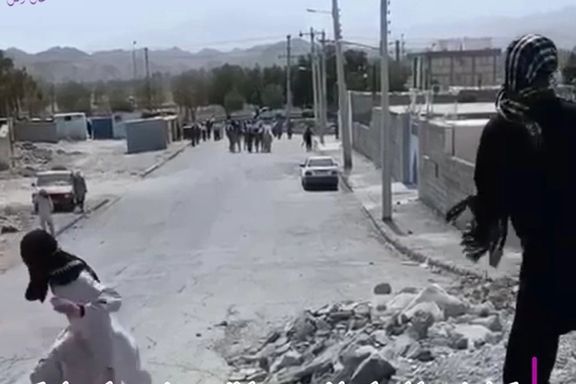
A protester throwing stones at security forces in the city of Rask in Sistan-Baluchsetan province on June 23, 2023

The people of Sistan-Baluchestan province from the Baluch Sunni minority in southeastern Iran held antiregime rallies on Friday with reports of sporadic clashes.

This Friday was the 38th consecutive week that people of the province held demonstrations against the government but the rallies were significantly larger following calls for protests by Sunni clerics and activist groups as the regime seems to have intensified its campaign against their religious leader Mowlavi Abdolhamid.

The prominent religious leader has been hammering the authorities in his weekly Friday sermons since September when nationwide protests erupted in the country.

People in the Sunni-majority cities of Iranshahr, Chabahar, Khash, Rask, Pishin, and Souran poured out into streets after Friday prayers, with videos showing residents hurling stones at the security forces in the neighborhoods of their towns.

According to the advocacy group Haalvsh, which reports on issues affecting the Baluch people in the predominantly Sunni province, security forces opened fire at the protesters who were chanting slogans in several of the cities.

The website also said that dozens of people have been arrested as the regime's plainclothes forces attacked the protesters and even raided their homes following the rallies.

Friday’s demonstrations were particularly large and fierce compared with previous weeks as reports emerged this week that the IRGC intelligence had assigned a hitman to poison and kill the vocal Sunni cleric of Zahedan.

Haalvsh reported on Monday that the security guards of Makki Mosque, in which Mowlavi Abdolhamid makes his sermons, arrested a man in the guise of a religious student who wanted to assassinate him.

Since September during ongoing protests following the death of 22-year-old Mahsa Amini in police custody, Mowlavi Abdolhamid has made fiery speeches against the heavy crackdown and killing of protesters, calling government actions "felony". He has also called for holding a referendum in Iran with the presence of international observers.

As usual the internet was shut down in Zahedan and several other cities in the region on June 23 but it did not stop people from showing up for the rallies or publishing footage from their protests and Abdolhamid’s sermons.

During his sermon this Friday, Abdolhamid slammed the regime over its suppression of those critical of the performance of the ruling power, even the officials and members of parliament.

Emphasizing that Iranians will never give up their demands for freedom and justice, the Sunni cleric said that the national interests of the people have been damaged by the decisions and actions of the "governments and officials of the country".

Highlighting that people from all walks of life are under pressure due to wrong decisions by regime officials, he said that he does not foresee a promising future for the country where challenges remain unresolved.

Iran’s Sunni leader Mowlavi Abdolhamid    (undated)
100%
Iran’s Sunni leader Mowlavi Abdolhamid

In order to improve the economy, capable people and efficient plans and mechanisms are needed, “and until these are not provided, the basic problems cannot be solved," he added.

Iran is struggling with a serious economic crisis partly due to US sanctions, but also because of its government-controlled system, lack of competition and widespread corruption.

In a tacit reference to the assassination attempt against him, Abdolhamid supported the legitimate political struggle to achieve freedom, justice and a healthy economy, saying that "We pursue the interests of the people and in this path, we accept any threat to our lives."


Most Viewed

Ghalibaf defends Iran-US talks amid hardline backlash
1
INSIGHT

Ghalibaf defends Iran-US talks amid hardline backlash

2
INSIGHT

100 days after carnage: Iran economy reels from war, inflation, unemployment

3
INSIGHT

A nation in limbo: 100 days after the massacre, has the world moved on?

4
ANALYSIS

From instability to influence: Pakistan’s pivotal role in US-Iran diplomacy

5
ANALYSIS

100 days on: why Iran’s January protests spread across social classes

Banner
Banner

Spotlight

  • War-hit homeowners feel abandoned as Iran’s reconstruction aid fades

    War-hit homeowners feel abandoned as Iran’s reconstruction aid fades

  • 100 days on: the anatomy of Iran’s January crackdown
    INSIGHT

    100 days on: the anatomy of Iran’s January crackdown

  • Ghalibaf defends Iran-US talks amid hardline backlash
    INSIGHT

    Ghalibaf defends Iran-US talks amid hardline backlash

  • 100 days on: why Iran’s January protests spread across social classes
    ANALYSIS

    100 days on: why Iran’s January protests spread across social classes

  • From instability to influence: Pakistan’s pivotal role in US-Iran diplomacy
    ANALYSIS

    From instability to influence: Pakistan’s pivotal role in US-Iran diplomacy

  • A nation in limbo: 100 days after the massacre, has the world moved on?
    INSIGHT

    A nation in limbo: 100 days after the massacre, has the world moved on?

Tweet unavailable

•
•
•

More Stories

Another Corruption Revelation Damages Iran’s Ruling Establishment

Jun 23, 2023, 15:29 GMT+1
•
Maryam Sinaiee

Iran's chief justice claimed he is battling corruption in government bodies without mentioning cases in entities under Supreme Leader Ali Khamenei’s control. 

In a televised interview aired by the state broadcaster IRIB Wednesday evening, Gholamreza Mohseni-Ejei said he and the organizations under his supervision would never shut their eyes to corruption and infringements of the law, and in some cases their actions have upset the government of President Ebrahim Raisi and caused complaints. 

No mention was made, by Ejei or the interviewer of corruption cases including a new scandal that involves the family of the head of the State Endowment Organization Mehdi Khamoushi, a Khamenei appointee. 

Critics often allege that IRIB interviews with top state officials are scripted, and interviewers always refrain from challenging the interviewees. 

Iran's chief justice Gholamreza Mohseni-Ejei talking to the head of state broadcaster IRIB, Peyman Jebelli, on June 21, 2023
100%
Iran's chief justice Gholamreza Mohseni-Ejei talking to the head of state broadcaster IRIB, Peyman Jebelli, on June 21, 2023

Hardliner whistle-blower Vahid Ashtari revealed in a series of tweets on June 18 that a 150-hectare piece of land endowed by a local family in Qazvin including a farm with 1,000 cattle has been rented out to Mona Chaychian, Khamoushi’s daughter-in-law, at a monthly rent of 10m rials (around $20 at current exchange rates). 

Ashtari who dubbed the case as “Daughter-in-Law Favoritism in Endowment Organization” pointed out in his tweets that young couples are unable to rent a basement in the outskirts of the city of Qazvin with the same amount of money as a point of comparison.

“The Endowments [Organization has officially turned into the back yard of corruption [-mongers],” he wrote.

The Organization has confirmed the deal but claimed that Khamoushi was not involved in it and threatened to sue the whistle-blower. 

Ashtari is a member of Edalat Khahan (Justice Seekers), a political group of mainly university students who are loyal to Iran's Supreme Leader Ali Khamenei and are also close to former nuclear negotiator Saeed Jalili who ran against Raisi. 

Gholam-Ali Jafarzadeh, an outspoken former lawmaker, said Wednesday he was barred from running in the previous parliamentary elections because he had been investigating allegations of corruption in the Endowment Organization. 

But no one is sure if there is a political agenda behind the revelations by the hardliner group. 

In April 2022, Ashtari’s revelations sparked the Layette-gate scandal that led to calls for the resignation of Speaker Mohammad-Bagher Ghalibaf and resurfacing of other alleged corruption cases against his family.

Ashtari revealed that Ghalibaf’s wife, daughter and son-in-law had returned from Turkey with massive extra luggage including a baby bed and stroller that formed part of the layette for his yet unborn grandchild. 

Critics accused Ghalibaf of hypocrisy for admonishing others for luxury and telling Iranians they should support domestically made products, and telling those who are suffering economic hardships to be patient, when his own family travels abroad to buy luxury products.

Some hardliners claimed that Jalili and the ultra-hardliner Paydari Front were behind the scandal. They also said these political rivals wanted to oust the speaker and takeover the Parliament's presidium. 

Ashtari has been sentenced to two years in prison and deprivation from media and social media activity for his role in “Layette Gate” but has apparently appealed the sentence. 

Iranian Americans Ask Congress To Subpoena US Envoy On Secret Talks

Jun 23, 2023, 13:28 GMT+1

As many US lawmakers pressure the Biden administration on Iran, more than 200 prominent Iranian Americans have asked Congress to subpoena President Biden's envoy.

In a letter to Rep. Michael McCaul, Chairman of the House Foreign Affairs Committee, the Iranian American activists asked him to subpoena US special envoy for Iran Robert Malley over his history of confidential engagements with high-ranking Islamic Republic regime officials with ill will towards the US, as well as his intent on pursuing a policy of appeasement in favor of the biggest state sponsor of terrorism.

“Mr. Malley’s conduct is not acceptable to us as Americans of Iranian origin, especially while we witness people inside Iran being slaughtered by the regime in the streets and tortured in prisons by the Islamic Revolutionary Guard Corps, a US-designated terrorist organization,” reads the letter.

Imploring McCaul to subpoena Malley to provide a rundown of what has been agreed upon with the regime, they added, “We consider access to and knowledge of this information to be unalienable right of the American people and our community.”

Some prominent signatories were; Reza Behrouz, physician and Professor at the University of Texas ; Yass Alizadeh, Assistant Professor of Persian language and literature at New York University; Atlanta-based attorney Sasan Nematbakhsh; DC-based legal scholar Shima Bozorgi; Amin Sophiamehr, philosophy instructor from Indiana University and Sara Eshaghi of the California-based group, “Action for Iran.”

The letter came as House Republicans are laying the groundwork to subpoena top Biden administration officials over clandestine efforts to secure a deal with Iran that would free up billions of dollars for the regime.

Iran Government Makes Rare Concession To Parliament Under Pressure

Jun 23, 2023, 06:47 GMT+1
•
Iran International Newsroom

Under immense pressure by more than 200 lawmakers, Interior Minister Ahmad Vahidi promised this week to fire his political deputy Mohammad-Reza Gholamreza.

Deputy Interior Minister for Political affairs who also chairs the ministry’s Election Supervisory Board for the upcoming parliamentary election in March, had issued a statement to bar lawmakers from intervening in executive affairs in their constituencies. 

The ministry's concern was mainly about interference with the election process by lawmakers who wish to be re-elected. Apart from the conflict of interest issue, another concern was undermining the prerogative of the executive branch.

More than 200 lawmakers tabled a motion Monday night to impeach the interior minister. This was a vehement threat, as calls for impeachment are usually signed by between 20 to 40 lawmakers. Vahidi was caught in a situation no minister would want to be in, particularly as Tuesday morning government ministers and President Ebrahim Raisi were going to the Majles to defend the nomination of a new agriculture minister.

Interior Minister Ahmad Vahidi (center) and his political deputy Mohammad-Reza Gholamreza (2nd right) during a ministry session  (undatd)
100%
Interior Minister Ahmad Vahidi (center) and his political deputy Mohammad-Reza Gholamreza (2nd right) during a ministry session

The social media rumor mill pointed out early in the morning that the President and the Interior Minister will have to step back, otherwise the lawmakers will impeach the interior minister and will not give their vote of confidence to the new agriculture minister. This was probably what played out in the corridors of power in Iran: Another tempest in the teacup as the man in the street cannot care less about a government that has messed up the economy and a parliament that cannot hold the government to answer.

The Interior minister overruled his deputy's order practically allowing lawmakers to interfere in the hiring and firing of local government officials in order to control the election process. But the lawmakers were still not happy. They demanded the removal of the deputy interior minister. They further threatened that they will go ahead with the interior minister's impeachment if his deputy was not removed from his post until Saturday, the beginning day of new week in Iran. 

According to reformist daily Shargh, some lawmakers such as Shahryar Haidari said that the statement issued by the deputy interior minister was an insult to lawmakers. Others also made equally angry remarks partly to show their clout to potential voters in the next election. They also demanded an apology from the Raisi administration.

Others accused the interior ministry of undermining Supreme Leader Ali Khamenei's order for cooperation between the Majles and the government. Nothing in Iranian political circles can be as damning as accusing someone of disobeying Khamenei. 

Etemad Online and other news sources in Iran pointed out that Vahidi's arrival at the Majles Tuesday morning caused an uproar among more than 200 of Iran's 290 lawmakers. Interestingly, they said they wanted to impeach Vahidi for his poor performance during the 2022 protests. Another interesting point was that although the Majles presidium usually objected to calls for impeachment, they were supportive of the angry lawmakers.

Tensions at the Iranian parliament over Deputy Interior Minister for Political Affairs Mohammad-Reza Gholamreza, who also chairs the ministry’s Election Supervisory Board for the upcoming parliamentary election (June 2023)
100%
Tensions at the Iranian parliament over Deputy Interior Minister for Political Affairs Mohammad-Reza Gholamreza, who also chairs the ministry’s Election Supervisory Board for the upcoming parliamentary election (June 2023)

After a closed-door session, Vahidi promised to fire his deputy, but this does not necessarily mean that Gholamreza will be dismissed. He is an IRGC general and enjoys support within the ranks of the corps. On the other hand, as far as the government is concerned, the MPs should not be emboldened beyond what they have achieved. 

By midday, the crisis appeared to be over. The lawmakers who have always been accused of being intimidated by the government shouted at Vahidi and restored their credibility in the eyes of their constituents. The government was happy to have won the lawmakers' vote of confidence for a new agriculture minister and Vahidi barely saved his pride by postponing his deputy's removal to a future date that may not happen. 

In the Iranian political circus, everyone is a winner until Khamenei's next speech when he chooses who is going to enjoy his support and who is going to be faced down.

Europeans ‘Disappointed’ With Failure To Topple Regime - Grandson Of Khomeini

Jun 22, 2023, 17:41 GMT+1

The grandson of the founder of the Islamic Republic Ruhollah Khomeini says European countries are now disappointed with the inability to topple of the regime.

“Those who seek to overthrow the Islamic Republic must be disappointed. Europeans behave differently when they see they cannot overthrow the Islamic Republic,” Hassan Khomeini claimed on Thursday.

Speaking at the mausoleum of his grandfather, Khomeini added that the decision of the judiciary chief and the proposal for the amnesty of prisoners last year was very helpful in “disappointing the enemies”.

Using the term “Enemies” is a favorite of Supreme Leader Ali Khamenei to refer to the United States, Israel, US allies in the region and in Europe.

“Anything that can be used to overcome internal conflicts… creates hope and guarantees the survival of the Islamic Republic.”

In February, Khamenei agreed to pardon some prisoners and reduce sentences for those arrested during anti-government protests in recent months.

In a letter judiciary chief Gholam-Hossein Mohseni Ejei sent to Khamenei young protesters were highlighted, with the caveat that they “were deceived by enemy propaganda,” and since then have expressed remorse.

However, human rights activists including Narges Mohammadi, slammed the Supreme Leader’s amnesty as a sham to feign compassion to the Western world.

In a letter written to the UN Human Rights Council in Geneva from inside Tehran’s notorious Evin Prison, she said the announcement reflects a “politics of the Islamic Republic [which] is based on lies”.

Khamenei Calls For Coordination Among Iranian Intelligence Outfits

Jun 22, 2023, 17:00 GMT+1

In a somewhat unexpected move, media in Tehran reported Thursday that a meeting was called between Iran's intelligence bodies, signaling possible discord.

The joint meeting of the Ministry of Intelligence and the Intelligence Organization of the IRGC was held June 16 in the religious city of Mashhad.

The session was opened with the message of the Supreme Leader Ali Khamenei who urged for more mutual understanding and synergy.

“Intelligence is one of the most important issues of the country, and one of our weaknesses in relation to intelligence systems is the lack of coordination,” read Khamenei’s message.

The meeting comes as a lack of coordination between the intelligence organizations has led to major cyber attacks from regime opposition groups. Repeated acts of sabotage attributed to Israel have also plagued the Iranian regime since July 2020.

Most recently, a hacktivist group broke into servers of the Iranian president’s office in late May and leaked troves of sensitive data, proving corruption, conflicts, and an ongoing nuclear expansion.

Intelligence Minister Esmail Khatib and the IRGC Commander Hossein Salami were among the speakers of Thursday's meeting, both underlining the necessity of better coordination.

The Secretary of the Supreme National Security Council Ali Akbar Ahmadian and the Interior Minister Ahmad Vahidi also called for a joint strategy.

It seems that there are deep rifts between the IRGC and the Ministry of Intelligence and Khamenei continues to heal the rifts but with over a dozen bodies involved in the country’s security, none of them want to lose its dominance.

However, multiple intelligence services were created during Khamenei's 34-year-old rule.





