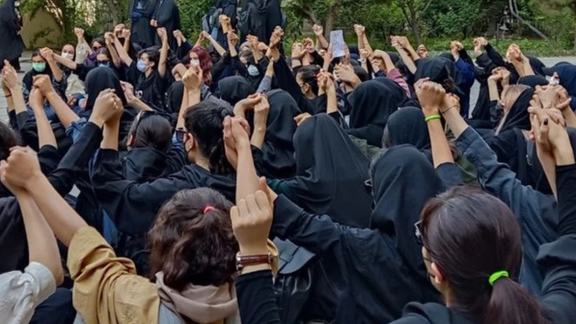
A protest by Iranian students at their university campus
Several students at Tehran’s College of Arts protesting stricter hijab rules were seriously injured in the early hours of Thursday by the head of campus security.
According to the popular Telegram channel of the National Student Unions Council, at about 2:30 am Thursday, Hamzeh Borzouei attacked a group of about fifty students who had begun a sit-in protest against new, stricter hijab rules and seriously injured several.
The Telegram channel said university authorities have still not allowed the students who began their sit-in on Wednesday afternoon to leave, and campus security has prevented anyone from bringing food or water to the students.
Students said on social media that Borzouei and other university officials made various threats against them including the threat of calling in the military to deal with them. Plainclothesmen and other security forces were already present in and outside the university in quite big numbers.
Students also said that security claimed they blocked food delivery to prevent poisoning that they could later be blamed for if students fell ill. Students also said the besieged protesters were not allowed to use the toilettes.
The new rules require girls to wear a pullover headscarf with stitched front (called maghna’e in Iran) which is like a nun’s coif, completely covering the head and the neck. Failing to comply, the university has announced, would result in suspension.
In the early 1980s wearing maghna’e became compulsory in all universities, government offices and even banks but its use gradually became obsolete in some more lenient establishments including the College of Arts.
The hijab required in the Islamic Republic consists of a long and loose tunic in muted colors worn over trousers with a similarly plain headscarf that covers all hair and shoulders. Authorities including Supreme Leader Ali Khamenei say wearing a long black veil (chador in Persian) that covers from head to toe is the ‘optimal hijab’.
In the past few years, the anti-compulsory hijab movement which took root with a social media campaign organized by US women’s rights activist Masih Alinejad in 2017, called White Wednesdays, has hugely grown. The movement has gained greater momentum since the death in custody of the 22-year-old Mahsa Amini in September 2022 and the protests that her death sparked.
Defiance of hijab has now turned into a form of civil disobedience. Many women who have been in a tug of war with the authorities for years are now adamant to be hijab free in public. They can be seen defiantly rejecting the head scarf everywhere, from restaurants to banks and parks where previously, they could not even enter without covering their head.
In recent months, authorities have increased pressure on students for hijab, presumably to stop the growth of the anti-compulsory hijab movement in universities across the country.
The National Student Unions Council said in April that 435 students had been suspended or expelled in universities nationwide, where they had staged many protests and sit-ins since the beginning of the Mahsa movement last year.
In recent months some political parties and dissidents in Iran, including the reformist Etehad-e Mellat Party and Zahra Rahnavard who has been under house arrest together with her husband Mir-Hossein Mousavi for thirteen years have demanded the abolition of the compulsory hijab laws.
The number of police surveillance cameras will be increased to crack down on the droves of women refusing to wear hijab.
Iran's police chief, Ahmad-Reza Radan, said Thursday that President Ebrahim Raisi has approved the necessary funds to install more cameras to continue the war against hijab rebellion.
“Four special task groups have been launched to tackle the hijab norm breaking. For instance, one of them is active on virtual space to identify those who remove hijab on social media.”
Last week, Radan threatened government offices that do not deny services to unveiled women with repercussions as part of ongoing hijab enforcement.
He also vowed that police will be surveilling Caspian Sea beaches in Mazandaran and Gilan provinces with special patrols and electronic surveillance to prevent violation of hijab laws.
Threats against unveiled women have increased with the arrival of summer which has always been a season for women to ignore the strict government dress code.
In July 2022, after weeks of harsher measures on the streets, President Ebrahim Raisi ordered all government entities to strictly implement a “chastity and hijab” law.
Not long after, the death of the 22-year-old Mahsa Amini in the custody of morality police fueled protests that spread throughout the country and have continued since September.
Since March hardliners have tried to put an end to women’s increasing defiance of the compulsory hijab and to reclaim the lost ground but to no avail.
One of the speakers at the Hijab of Afghan Immigrants conference in Iran (June 2023)
Afghan immigrants have been warned of deportation if caught flouting Iran's mandatory hijab laws.
Ali Akbar Zarei, the Director General of Foreign Nationals and Immigrant Affairs of Qom Province warned offenders will be stripped of "all social services" under a new enforcement program.
Speaking on the sidelines of a conference titled "Hijab of Afghan Immigrants" Zarei told Iran's state TV: “If they do not observe the hijab, it may lead to their deportation."
He also criticized the "inappropriate appearance" of young Afghan children in his speech at the conference.
"The sanctity of the holy city of Qom must be preserved by respecting hijab, and in case of non-compliance, legal means will be used."
During the nationwide protests in Iran last year some deported Afghans said the Iranian government had arrested dozens of their fellow countrymen on charges of participating in anti-regime protests.
Meanwhile, local officials of the Taliban in Herat told Radio Azadi, the Afghan Service of Radio Free Europe, that with the beginning of the protests in Iran, expelling Afghan immigrants from this country increased by 25%.
On October 13, Amnesty Internationalreported that twoAfghan teenagers were killed by the Iranian security forces.
On the other hand, the Wall Street Journal quoted some UN officialsin December as saying that about 360,000 Afghan nationals were expelled from Iran after the Taliban came to power.
Jamileh Alamolhoda, the wife of President Ebrahim Raisi during an interview with Venezuela’s teleSUR TV on June 13, 2023
The wife of President Ebrahim Raisi says it is an example of violence when women study and work like men.
In an interview with Venezuelan state TV, Jamileh Alamolhoda claimed that governments abuse women sexually or at the workplace in the name of freedom.
Alamolhoda, who is accompanying President Ebrahim Raisi on a tour of Latin America, made the remarks on Venezuela’s teleSUR TV as the first lady of Iran Tuesday night.
She claimed that women's rights organizations mostly focus on domestic violence while “the organized violence outside the family is much more important”.
"We want women to remain women. Why should we be like men? Why should we study, work or live like men? This is a form of violence," she said.
In response to a question about the state murder of Mahsa Amini, she alleged the world's attention to the death of the 22-year-old girl was a “fake media hype".
Iranian security forces have killed over 500 civilians, injured thousands and arrested 22,000 since September when anti-government protests began. One of the main slogans of the demonstrators was “Death to the Dictator (Khamenei)”.
"Unfortunately, by calling (Ali Khamenei) a dictator, they used a fake victory to disrespect our spiritual father and the leader of our revolution," the first lady claimed.
"He [Khamenei] has shown kindness and love to everyone, but the media called him a dictator."
Several students unveiling at their schoolyard in protest to mandatory hijab
During exams in Iran, school students were given questionnaires to probe religious, political and social beliefs.
Among the questions, one asks if people must obey the decisions by the government. The students had five options as “strongly agree, agree, no idea, disagree, and strongly disagree.”
“I am happy about living under the Islamic Republic in Iran”, “I have to obey all the rules although I might not agree with some of them” are among the other questions.The questionnaire also asked if they enjoy the “peace and safety” in Iran.
It is not clear what organization has conducted the probe, but the type of questions suggests the intelligence institutes are involved.
Following the death in custody of Mahsa Amini, schools were the hub of daily protests against the regime with teenagers and even elementary school students chanting slogans.
Thechemical attacks on schools raised eyebrows among many Iranians with countless ordinary citizens being suspicious of the regime’s involvement. However, the regime denied responsibility and even staged arrests of suspects after protests against the poisonings.
International reaction has demanded answers to the mystery poisonings including a spokesperson for the UN Human Rights Council in Geneva calling for a transparent investigation along with the White House, which demanded accountability for those responsible.
Water being delivered to residents of the capital Tehran by tanker trucks (June 2023)
Officials including minister Ali-Akbar Mehrabian on Wednesday claimed that outage of drinking water in Tehran has completely ended but evidence indicates otherwise.
Mehrabian said that water treatment facilities have resumed operations since Tuesday evening and are working at full capacity. “We are trying to raise the water pressure back to the normal level gradually,” he said. But videos on social media showed tankers distributing water to residents on Wednesday.
Drinking water outage which started in some districts of the capital Tehran Friday has impacted not only households but also many businesses, particularly restaurants. Beside regular household use, the outage has disrupted the use of cooling systems in houses when often near 40 degrees Celsius during the day at this time of the year.
Videos sent to Iran International TV by citizens indicate that outage or low pressure has continued in some of the areas of the capital. They also say water tankers are still distributing water in various neighborhoods.
The water outage started when torrential rains flooded rivers and caused extensive landslides in various areas of the country including around the capital where riverbeds were completely blocked by debris from the mountains.
Karaj, the capital of Alborz Province, which is a city of over 1.6 million only about 40 kilometers (25 miles) to the west of Tehran has also been affected by the outage.
Some citizen reports on social media indicate that the outage has continued in some areas of the city despite officials’ claims that it ended at midday Monday.
Many citizens have expressed anger on social media over lack of accountability by the water supply network officials who did not provide timely warnings to citizens and repeatedly claimed the outage would end within hours.
Water shortage has been threatening the Iranian capital of 10m for years. Causes include drought and the massive waste of water due to the dilapidation of the distribution infrastructures.
Iran has been suffering from drought for at least a decade and officials have been warning of a further decrease in precipitation. The volume of water in the five dams that supply Tehran, for instance, has consistently been going down in recent years.
Water being delivered to residents of the capital Tehran by tanker trucks (June 2023)
Mohammadreza Bakhtiari, the former CEO of Tehran Water and Sewerage Company, said in early April that about 20 percent of drinking water in Tehran, as much as 300,000 cubic meters, goes to waste before reaching households and businesses.
In recent years, massive protests have occurred in several cities against government mismanagement of water resources, harmful dam building, and politically motivated diversion of rivers that have devastated agriculture and drinking water sources in many areas.