• العربية
  • فارسی
Brand
  • Iran Insight
  • Politics
  • Economy
  • Analysis
  • Special Report
  • Opinion
  • Podcast
  • Iran Insight
  • Politics
  • Economy
  • Analysis
  • Special Report
  • Opinion
  • Podcast
  • Theme
  • Language
    • العربية
    • فارسی
  • Iran Insight
  • Politics
  • Economy
  • Analysis
  • Special Report
  • Opinion
  • Podcast
All rights reserved for Volant Media UK Limited
volant media logo

In Denial, Iran Coveting ‘Great Firewall Of China’
Iran International Newsroom
Jun 14, 2023, 17:53 GMT+1Updated: 17:39 GMT+1
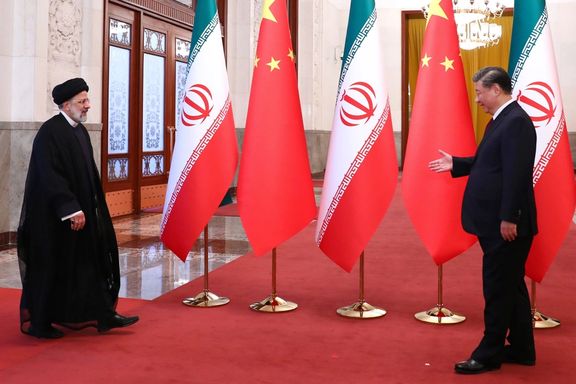
Iranian President Ebrahim Raisi meets Chinese President Xi Jinping during a welcoming ceremony in Beijing, China, February 14, 2023.

Iran says it is not following China’s model of internet access but in reality is inching towards a similar national network.

Minister of Information and Communications Technology Eisa Zarepour claimed Tuesday that modeling China is on the agenda but admitted that the ministry is not the main decision-making body in this regard.

China has its own local platforms and has done a special job on that,but Iran has its own development model, he said, adding: “Of course we are looking for cooperation and synergy with all countries, including China.”

Describing the internet in China as “not very favorable,” he noted that 95 percent of internet traffic in China is domestic. “The government does not intend to implement such a plan in Iran,” he said, quipping that the Islamic Republic’s cabinet members who had travelled there were surprised by the limitations by the lack of access to foreign websites.

Minister of Information and Communications Technology Eisa Zarepour (undated)
100%
Minister of Information and Communications Technology Eisa Zarepour

Zarepour’s remarks seem contradictory to earlier ones by the regime officials who have always envied the control that Beijing enjoys over the nation’s access to information.

Not all the Internet is available in China as sites belonging to Google, Facebook, Wikipedia companies as well as hundreds of other websites, apps, and video games, are censored or blocked, prompting people to use VPNs for access, inspiring the policy's colloquial nickname: the "Great Firewall of China." A Firewall is a network security device that monitors and filters traffic based on previously established policies.

Second only to China, Iran is on top of the list of countries that have put restrictions on the access of the internet to their people. There are also reports that the regime has started devising plans to give unrestricted internet access to authorities and a cherrypicked list of elites as well as foreign tourists, all of which have uncanny similarities to strategies taken by China.

Earlier in the year, President Ebrahim Raisi ordered the communications ministry to increase the ratio of domestic traffic, so that about 70 percent of the country's total Internet traffic would be from the Iranian national network within the next five years. It means only 30 percent of the online traffic in Iran can be used to access the global Internet.

Last week, Hossein Jalali, a member of the Cultural Committee of the Iranian parliament, urged the government to follow the example of China in setting up a national internet to prevent hackers from infiltrating the country’s infrastructural and governmental portals after major hacks have led to disastrous leaks of troves of confidential data.

Last year, Ali Yazdikhah, another MP, praised China’s “unique” experiences in this field and called for using such experiences in the establishment of a national internet – technically an intranet. The former head of Iran’s state broadcaster, Abdol-Ali Ali-Asgari, has also called for a national internet, famously saying that China has reduced the “American Internet” in the country and that Iran should have its own Internet. 

The former head of Iran’s state broadcaster, Abdol-Ali Ali-Asgari (undated)
100%
The former head of Iran’s state broadcaster, Abdol-Ali Ali-Asgari

Hundreds of Iran's government websites have been attacked in recent years by hacktivist groups or groups affiliated with other countries. The cyberattacks hiked particularly since last September, when “Women, Life, Liberty” protests engulfed the country after the death of 22-year-old Mahsa Amini in police custody.

In the most recent case, the hacktivist group ‘Uprising till Overthrow' claimed on May 29 that it breached 120 servers at the presidential office, about a month after the group breached into the Islamic Republic’s foreign ministry servers, disabling 210 sites and online services. Troves of confidential data have been leaked following the hacks.

The Iranian communications minister – who was sanctioned by the US for his role in limiting internet as part of the crackdown on popular protests -- also stated that the country’s Supreme Council of Cyberspace is in charge of decisions about the Internet access across Iran, highlighting that his ministry is only one the 27 members of this council.

Describing people's concerns about free access to the Internet as a result of the efforts by the "enemies," Zarepour claimed that no one wants to shut down or limit the Internet in the Islamic Republic.

In April, Zarepour himself said that considering the current situation, he is not in favor of unblocking social media platforms such as Telegram, WhatsApp, and Instagram. Playing down the impact of deliberate government internet outages in 2022 on businesses, Zarepoursaid in March that there is no accurate data regarding the damage from internet access restrictions despite reports of about $770 million in losses.



Most Viewed

Ideology may be fading in Iran, but not in Kashmir's ‘Mini Iran'
1
INSIGHT

Ideology may be fading in Iran, but not in Kashmir's ‘Mini Iran'

2
INSIGHT

Hardliners push Hormuz ‘red line’ as US blockade tests Iran’s leverage

3
VOICES FROM IRAN

Hope and anger in Iran as fragile ceasefire persists

4

Iran International says it won’t be silenced after London arson attack

5

US sanctions oil network tied to Iranian tycoon Shamkhani

Banner
Banner

Spotlight

  • Hardliners push Hormuz ‘red line’ as US blockade tests Iran’s leverage
    INSIGHT

    Hardliners push Hormuz ‘red line’ as US blockade tests Iran’s leverage

  • Ideology may be fading in Iran, but not in Kashmir's ‘Mini Iran'
    INSIGHT

    Ideology may be fading in Iran, but not in Kashmir's ‘Mini Iran'

  • War damage amounts to $3,000 per Iranian, with blockade set to add to losses
    INSIGHT

    War damage amounts to $3,000 per Iranian, with blockade set to add to losses

  • Why the $100 billion Hormuz toll revenue is a myth
    ANALYSIS

    Why the $100 billion Hormuz toll revenue is a myth

  • US blockade targets Iran oil boom amid regional disruption
    ANALYSIS

    US blockade targets Iran oil boom amid regional disruption

  • Iran's digital economy battered by prolonged blackout
    INSIGHT

    Iran's digital economy battered by prolonged blackout

•
•
•

More Stories

Outspoken Sunni Leader Under Travel Ban For Holy Pilgrimage

Jun 14, 2023, 17:08 GMT+1

The office of the outspoken Sunni leader of Iran’s Sistan and Baluchestan province says the Ministry of Intelligence has prevented him from attending Hajj pilgrimage.

Several regime officials have opposed Abdlohamid’s upcoming Hajj trip during the next Eid festival later this month, banning him from traveling to Mecca.

Officially known as Sheikh Abdolhamdid Esmailzehi, the Sunni cleric is widely popular because of his willingness to challenge Khamenei’s absolute authority. In addition the country's Sunni minority are heavily persecuted and the cleric has long been an advocate of minority rights, to the ire of the regime.

An audio file leaked by the hacktivist group Black Reward in December revealed that the Islamic Republic planned to tarnish Abdolhamid’s reputation to curb his influence.

In November, the outspoken Sunni Imam said women, ethnic and religious groups, and minorities have faced discrimination after the establishment of the Islamic Republic in 1979. He also called for an internationally monitored referendum in Iran saying by killing and suppression the government cannot push back a nation.

Abdolhamid also said earlier that officials of the country should be selected from the secular population, noting that not all Iranian people are "religious" and as such do not accept religious authority.

“Don't blame me for this view. Some may not accept religion, but the right policy is that if they have merit and conscience, they should be employed," he said.

Dissident Warns Iran’s Regime Of Defeat In ‘War Against Women’

Jun 14, 2023, 14:20 GMT+1
•
Maryam Sinaiee

Prominent female dissident Zahra Rahnavard has warned the clerical rulers that Iranian women will eventually defeat them in the war over compulsory hijab.

Advising the rulers of the Islamic Republic to once and for all put an end to the enforcement of hijab, Rahnavard who has been under house arrest together with her husband Mir-Hossein Mousavi for thirteen years, since February 2011, also called for the abolishment of existing hijab laws. 

Rahnavard, 78, was born into a family that did not particularly condone wearing the hijab. While studying art at Tehran University in the late 1960s, she became an advocate of wearing the hijab and even wrote several articles and books in its praise, both before and after the Islamic Revolution of 1979 when she became the first-ever female university chancellor in the country. 

“The rulers [of the Islamic Republic] have waged a close combat against Iranian women by devising and advertising the chastity and hijab bill,” she said in a new statement, adding that they must realize that they will be “the real losers” in their war against the Iranian nation and women.

Rahnavard was referring to a bill called “Supporting the Culture of Hijab and Chastity and Health of Society” jointly prepared by the notoriously hardliner judiciary and the government of President Ebrahim Raisi, who asked the parliament to put it on its agenda with double urgency. 

Zahra Rahnavard and Mir Hossein Mousavi in 2009
100%
Zahra Rahnavard and Mir Hossein Mousavi in 2009

She said in her statement that the bill includes a “revolting list of medieval beliefs, violations of citizens’ rights and women’s natural and humanistic freedoms,” arguing that those behind the bill are unable to understand how economic, ethnic and gender discriminations should be lifted and remedied. 

If the double urgency stature of the bill was approved, it would have been printed and distributed to lawmakers within six hours and debated within a maximum of two days. 

The bill’s urgency was put to vote Tuesday, but lawmakers only agreed to the single urgency of the draft law, which means it will be referred to relevant committees for examination. 

Women’s defiance of hijab rules is as old as the Islamic Republic itself, but it has escalated to new levels since the death of 22-year-old Mahsa (Jina) Amini in custody of morality police last September for “improper hijab” sparked nationwide protests.

The unrest gradually subsided after several months but defiance of hijab as a form of civil disobedience has increased and forced the authorities to try to stop the anti-compulsory hijab movement by resorting to various measures including new laws which center around cash fines.

Parliament speaker Mohammad-Bagher Ghalibaf (Qalibaf) said after the vote that giving the bill a single urgency did not indicate its insignificance and was only meant to provide more time for investigation. 

“We want to stop [moral] depravity with this law,” he said and argued that the proposed bill has only looked at the criminal aspect of the hijab issue but that it was more a “cultural, social, and Sharia issue” and “a factor in the identity of the Islamic Republic”. 

Soon after taking office in August 2021, and after weeks of harsher measures on the streets to enforce hijab rules by street patrols known as the ‘Hijab Police’, Raisi ordered all government entities to strictly implement the already existing “chastity and hijab” law.

The hijab required in the Islamic Republic consists of a long and loose dress in muted colors worn over trousers with a similarly plain headscarf that covers all hair and shoulders. Authorities including Supreme Leader Ali Khamenei say wearing a long black veil (chador in Persian) that covers from head to toe is the ‘optimal hijab’.

Iranian MP Says There Is No Need For Transparency

Jun 14, 2023, 13:46 GMT+1

In defense of Iran's secretive government, a fundamentalist member of Iranian parliament said transparency is not necessary and petty.

Mehrdad Veis-Karami said in a video published on social networks that "God, the Prophet, and the Qur'an were not after transparency, because people do not have the capacity."

The professor of Islamic studies said: “Many MPs entered the parliament with the promise of transparency, and now they have regretted their promises."

His statements come as the majority of government institutions have refused to publicly announce vital figures of the country's economy over recent years, including the state of debts and budget deficit, the amount of consumption of polluting fuels such as diesel fuel, oil export revenues, the details of long-term strategic partnership with China and the fate of embezzlement of billions of dollars.

In its annual report published in February last year, Transparency International said Iran ranks 147th among 180 countries in terms of the extent of financial corruption.

Lack of transparency is not only limited to economic and financial issues in Iran. A wide range of issues from the downing of the Ukrainian airliner by IRGC missiles to arbitrary arrests, and the number of victims in mass killings of popular protests were not announced transparently.


Iran Warns Citizens Against Being Recruited By Mossad

Jun 14, 2023, 12:03 GMT+1

Iran’s Ministry of Intelligence sent a blast text message across the country warning citizens against being recruited by Israeli Intelligence Agency Mossad.

“One of the most important tactics of Mossad in carrying out terrorist and criminal operations in Iran is to abuse the public awareness and people’s ignorance,” read the message.

“If someone asks you to buy a vehicle and leave it in a certain place by paying money, think that you might be abused in a Mossad terrorist act,” added the warning text.

Last year, Israel’s Mossad captured a senior IRGC official on Iranian soil and interrogated him about weapons shipments to Iran's proxies.

Iran International obtained video footage of the interrogation in which a man introducing himself as Yadollah Khedmati, deputy commander of the Revolutionary Guards (IRGC) Logistics, said he regrets his involvement in shipping weapons to Iran’s proxy groups in Syria, Iraq, Lebanon, and Yemen and urges other IRGC officials to avoid engagement in such activities.

Israel has allegedly carried out dozens of operations and assassinations inside Iran, including the assassination of Iran's top nuclear man and senior IRGC member Mohsen Fakhrizadeh in November 2020 for which it has never officially taken responsibility. Ex Mossad Chief Yossi Cohen in June 2021 strongly suggested Israel was behind attacks on Iranian nuclear facilities.

Referring to the theft of thousands of Iranian secret nuclear documents in February 2018 from a warehouse near Tehran, Cohen said more than 20 Mossad agents were involved in the operation. He said the agents were not Israelis, adding that all of them are alive and some of them have already left Iran.

Hezbollah Obstructs Parliament Vote In Lebanon's Presidential Election

Jun 14, 2023, 10:48 GMT+1

Lebanon slid deeper into crisis on Wednesday when Hezbollah and its allies thwarted a bid by their rivals to elect a top IMF official as president.

The failure by the parliament to vote sharpened sectarian tensions and underlined the dim hopes for reviving the crumbling state.

Four years since Lebanon slid into a financial meltdown that marks its worst crisis since the 1975-90 civil war, parliament failed for a 12th time to elect someone to fill the post reserved for a Maronite Christian under the country's sectarian system.

Lawmakers from the Iran-backed armed Shi'ite group Hezbollah and allies withdrew from the session to obstruct a bid by the main Christian parties to elect IMF official Jihad Azour.

The standoff has opened up a sectarian faultline, with one of Hezbollah's main Christian allies - Gebran Bassil - lining up behind the bid to elect Azour, alongside anti-Hezbollah Christian factions.

Azour, the IMF's Middle East Director and an ex-finance minister, won the support of 59 of parliament's 128 lawmakers in an initial vote, short of the two-thirds needed to win in the first round. Suleiman Frangieh, backed by Hezbollah and its allies, got 51 votes.

Hezbollah and its allies then withdrew, denying the two-thirds quorum required for a second round of voting in which a candidate can win with the support of 65 lawmakers.

It leaves Lebanon with no immediate prospect of filling the presidency, which has been vacant since the term of the Hezbollah-allied President Michel Aoun ended in October.

Hezbollah, which is designated as a terrorist group by the United States, has unleashed fierce rhetoric in their campaign against Azour, describing him as a candidate of confrontation.

Azour, 57, has said he wants to build national unity and implement reforms in the country.

Reporting by Reuters