• العربية
  • فارسی
Brand
  • Iran Insight
  • Politics
  • Economy
  • Analysis
  • Special Report
  • Opinion
  • Podcast
  • Iran Insight
  • Politics
  • Economy
  • Analysis
  • Special Report
  • Opinion
  • Podcast
  • Theme
  • Language
    • العربية
    • فارسی
  • Iran Insight
  • Politics
  • Economy
  • Analysis
  • Special Report
  • Opinion
  • Podcast
All rights reserved for Volant Media UK Limited
volant media logo

EU Slaps More Sanctions On Iran After G7 Warning
Iran International Newsroom
May 22, 2023, 15:45 GMT+1Updated: 17:39 GMT+1
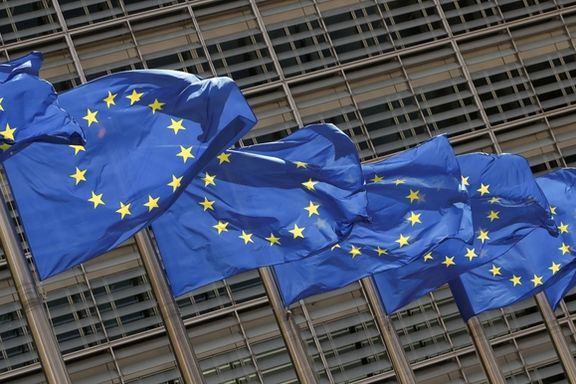
European Union flags flutter outside the EU Commission headquarters in Brussels, Belgium May 5, 2021.

The European Union on Monday imposed new sanctions on Iranian officials and entities for their role in the violent crackdown on popular protests.

The new package of sanctions targets five Iranians and two entities responsible for serious human rights violations in Iran, according to the European Council.

The Council listed the Revolutionary Guards’ Cooperative Foundation, which is the body responsible for managing the IRGC’s investments and funneling money into the regime’s repression machine.

The other IRGC entity that was blacklisted was its Student Basij Organization (SBO), which acts as the IRGC’s arm in enforcing hijab and cracking down protests on university campuses. “The SBO consists of the youngest and most radical members of the Basij," the EU said, adding that during raids on a number of university campuses -- including at Sharif University, Shahid Beheshti University and Amirkabir University -- security forces, including the SBO members, used live ammunition and opened fire on students.

IRGC’s Basij members cracking down on university students in Tehran  (2022)
100%
IRGC’s Basij members cracking down on university students in Tehran

Furthermore, the current commander of the Tehran Police Relief Unit of Iran’s Law Enforcement Forces (LEF), Salman Adinehvand, was added to the EU list because his unit “was directly responsible for the violent suppression of protests in Tehran in September and October 2022, during which dozens of protestors were killed by security forces using live ammunition.”

The secretary of Iran’s Supreme Council of Cyberspace (SCC), Mohammad-Amin Aghamiri, was blacklisted over the blockage of popular online news and communications platforms. The SCC, the centralized authority for policymaking in cyberspace, has also used digital technology to spy on and harass journalists and regime dissidents, the EU statement said.

Mohsen Nikvarz, the public prosecutor of Sirjan in Kerman Province, was sanctioned over the “Maryam Arvin case” -- a lawyer who was brutally arrested, gravely mistreated, and subsequently died for her activities in defense of protesters. He was also responsible for several arbitrary arrests of lawyers and death sentences in Sirjan during the 2019 protests.

Deputy Supervisor of Public Spaces of the Public Security Police Colonel Nader Moradi was put on the list for persecution and arrest of shop owners who closed their businesses and were planning on striking in protest of the death of Mahsa Amini.

The other sanctioned official was Iranian police spokesman Saeed Montazerolmahdi, who repeatedly downplayed nationwide schoolgirl poisonings by claiming the "majority" of those alleged were "not real". “His intimidating statements on monitoring, the closure of businesses and other public spaces, and the warning texts that are being sent by the authorities have a very significant repressive impact,” added the statement.

EU’s restrictive measures now apply to a total of 216 individuals and 37 entities. They consist of an asset freeze, a travel ban to the EU and a prohibition to make funds or economic resources available to those listed.

The G7 countries had already issued a tough statement in their summit in Japan on Saturday, calling on all countries to consider UN resolutions against Iranian arms transfers.

“We express our grave concern regarding Iran’s continued destabilizing activities, including the transfer of missiles, unmanned aerial vehicles (UAVs) and related technologies to state and non-state actors and proxy groups, in breach of UNSCRs including 2231 and 2216.”

The Iranian foreign ministry appeared jittery about the G7 statement. Its spokesman on Monday unleashed a barrage of criticism and accusations against “some members” of the group that he called “colonial” powers “who for decades have projected their policies of dominance over the world and especially in our region.”

Spokesman Nasser Kanaani flatly denied that Tehran has transferred armed drones to Moscow, despite overwhelming and clear material evidence. Russia has so far used hundreds of Iranian-made Shahed killer drones against Ukraine’s civilian targets.

G7 countries also expressed deep concern over Iran’s nuclear program that gallops forward with high levels of uranium enrichment.

“We reiterate our clear determination that Iran must never develop a nuclear weapon. We remain deeply concerned about Iran’s unabated escalation of its nuclear program, which has no credible civilian justification and brings it dangerously close to actual weapon-related activities,” the final communiqué said.

The G7 also accused the Islamic Republic of gross human rights violations, after unrelenting executions of dissidents and the killing of more than 500 people during protests in 2022 and jailing more than 20,000 people.

Iran’s unabated uranium enrichment, regional interventions that fuelled recent Israeli Palestinian fighting, and its provision of weapons for Russia can all add up and lead to an effort by the West to revive international sanctions against Tehran.


Most Viewed

Ghalibaf defends Iran-US talks amid hardline backlash
1
INSIGHT

Ghalibaf defends Iran-US talks amid hardline backlash

2
ANALYSIS

From instability to influence: Pakistan’s pivotal role in US-Iran diplomacy

3
ANALYSIS

100 days on: why Iran’s January protests spread across social classes

4

War-hit homeowners feel abandoned as Iran’s reconstruction aid fades

5

Iran says no decision yet on talks as Pakistan prepares to host US team

Banner
Banner

Spotlight

  • The politics of pink: how Iran uses cuteness to rebrand violence
    ANALYSIS

    The politics of pink: how Iran uses cuteness to rebrand violence

  • Bread shortages, soaring prices strain households in Iran, residents say
    VOICES FROM IRAN

    Bread shortages, soaring prices strain households in Iran, residents say

  • War-hit homeowners feel abandoned as Iran’s reconstruction aid fades

    War-hit homeowners feel abandoned as Iran’s reconstruction aid fades

  • 100 days on: the anatomy of Iran’s January crackdown
    INSIGHT

    100 days on: the anatomy of Iran’s January crackdown

  • Ghalibaf defends Iran-US talks amid hardline backlash
    INSIGHT

    Ghalibaf defends Iran-US talks amid hardline backlash

  • From instability to influence: Pakistan’s pivotal role in US-Iran diplomacy
    ANALYSIS

    From instability to influence: Pakistan’s pivotal role in US-Iran diplomacy

•
•
•

More Stories

Exiled Iranian Prince Blames State Terrorism For Killing Of Border Guards

May 22, 2023, 15:38 GMT+1

Iran’s exiled prince has blamed state "terrorism" for the killing of five border guards in the southeastern province of Sistan and Baluchestan on Saturday.

In a post on Twitter, Reza Pahlavi said: “I express my sincere sympathy with and condolences to the families of these murdered soldiers and strongly condemn this act of terrorism,” he added.

The border guards spotted a group of armed men near the border in Saravan, in the southeastern province of Sistan and Baluchestan. The five officers were killed in the ensuing confrontation with the “terrorist group” on Saturday night.

Two other guards were left seriously injured and are in a critical condition, it was also reported.

There is no information about the affiliation of the armed group, but several Baluch groups from the area are fighting an insurgency against the Islamic Republic.

The most prominent is Jaish al-Adl, which has often targeted Iran's military, especially the Islamic Revolutionary Guard Corps (IRGC).

In recent months, the situation in Sistan-Baluchistan has dramatically worsened. The area’s cities have become very tense, especially on Fridays, when residents come out to protest against the regime.

Iran Once Again Denies Supplying Killer Drones To Russia

May 22, 2023, 14:36 GMT+1

Iran has never supplied Russia with drones during the conflict in Ukraine, Tehran’s foreign ministry spokesman Nasser Kanaani said Monday.

Iran has denied sending armed drones to Russia after Moscow launched its invasion in February 2022, claiming that any shipments occurred before the war.

However, Russia has used hundreds of Iranian-made Shahed kamikaze drones since last September to attack Ukrainian infrastructure and civilian targets, with Kyiv reporting more supplies in December as Moscow’s stocks were used up.

Iran’s fresh denial came after the G7 group of countries holding a summit in Japan condemned Iran over the weekend for arming Moscow.

“Iran must stop supporting Russia’s war of aggression against Ukraine. In particular, we call upon Iran to cease transferring armed UAVs, which have been used to attack Ukraine’s critical infrastructure and kill Ukrainian civilians,” the G7 said in their final statement.

The United States, refusing to continue nuclear talks with Iran, has mentioned the issue of drone supplies to Russia as an impediment to reviving the 2015 JCPOA accord. Tehran facing a serious economic crisis needs to settle the issue with Washington to lift crippling economic sanctions.

Russia also uses the Iranian drones to overwhelm Ukraine’s air defenses during its missile attacks, and according to some experts as a means of depleting Kyiv’s supply of air defense missiles. However, the Ukrainian armed forces have become adept in shooting down the relatively slow-moving UAVs, often using anti-aircraft fire instead of more expensive missiles.


Iran Vows To Avenge Deaths Of Border Guards In Southeast

May 22, 2023, 12:25 GMT+1

Iran's police say the forces are determined to avenge the deaths of border guards killed in Sistan and Baluchestan Province.

At least five Iranian patrol officers died on Saturday in a clash with what the regime calls “terrorists” on the Pakistani border.

In his remarks at the funeral in Zahedan, Deputy Police Chief Qassem Rezaei warned the culprits that they would face a decisive and firm response.

However, Rezaei stressed that the longstanding relations between Iran, Pakistan, and Afghanistan should not be strained by the attack.

Iranian media reported that the border guards spotted a group of armed men near the border in Saravan, in the southeastern province of Sistan and Baluchestan.

The five officers were killed in the ensuing confrontation with the “terrorist group” on Saturday night.

Two other guards were left seriously injured and are in a critical condition.

In addition, the Iranian border police commander urged neighboring countries not to allow destabilizing activities on their soil.

Brigadier General Ahmad Ali Goudarzi said, "Our patience has limits."

There is no information about the affiliation of the armed group, but several Baluch groups from the area are fighting an insurgency against the Islamic Republic.

The most prominent is Jaish al-Adl, which has often targeted Iran's military, especially the Islamic Revolutionary Guard Corps (IRGC).

In recent months, the situation in Sistan-Baluchistan has dramatically worsened. The area’s cities have become very tense, especially on Fridays, when residents come out to protest against the regime.

There have been reports of numerous attacks on military and government forces in the province in the months since the death in custody of Mahsa Amini last year sparked nationwide protests.


EU To Sanction More IRGC Members

May 22, 2023, 11:20 GMT+1

The European Union's foreign ministers will discuss more sanctions against Iran during their meeting today (Monday).

German Foreign Minister Annalena Baerbock announced the decision, adding that more members of the Revolutionary Guard will be sanctioned.

In response to Iran's human rights violations, Baerbock told journalists, "We won't accept this."

On Friday, the European Union condemned Iran's execution of three men linked to protests sparked by Mahsa Amini's death last year.

“The EU urges the Iranian authorities to refrain from applying the death penalty and carrying out future executions,” EU foreign policy chief Josep Borrell’s office said in a statement.

According to the EU statement, Iranian officials must respect the "due process rights" of detained individuals and prevent them from being mistreated.

Additionally, it called on Iran to respect "the freedom of expression and peaceful assembly rights," which are enshrined in international law.

The Islamic Republic executed Majid Kazemi, Saeed Yaghoubi and Saleh Mirhashemi on Friday morning over trumped up charges after extracting forced confessions, in a case described as a travesty of justice. Human rights campaigners say they were tortured into confessions, and there was no reliable evidence against them.

Friday's executions brought to at least seven the number of protesters hanged since the beginning of the nationwide protests last September, which turned into one of the boldest challenges to the clerical rulers since the 1979 revolution.

Iranian authorities brutally suppressed protests that erupted in Tehran after the death in custody of Amini, a 22-year-old Iranian Kurd arrested in Tehran for allegedly violating the country's strict dress code.

Iran Faces A Huge Budget Deficit It Tries To Conceal

May 22, 2023, 11:01 GMT+1
•
Iran International Newsroom

A top Iranian budget official has revealed that President Ebrahim Raisi’s administration's faces a huge budget deficit this year, despite official assurances. 

Rahim Mombeini, the deputy head of Iran’s Planning and Budget Organization, whose boss was recently sacked by President Ebrahim Raisi, said Saturday that Iran’s budget deficit for the previous Iranian year –which ended on March 20 – was about 8,000 trillion rials (about $16 billion in today’s exchange rates). 

The figure is twice as much as the budget deficit of previous years, despite claims by Raisi administration officials who kept reassuring the nation that the budget did not have a deficit. 

According to Mombeini, the amount of the Iranian government debts has increased about 900-fold over the past decade to 30 quadrillion rials, or $60 billion. This would be as much as 850 million barrels, or two years’ worth of oil exports at normal market prices.

Rahim Mombeini, the deputy head of Iran’s Planning and Budget Organization (undated)
100%
Rahim Mombeini, the deputy head of Iran’s Planning and Budget Organization

 This amount of debt, which is equivalent to 31% of the GDP, includes government debts to banks, the Central Bank of Iran, pension and social security funds, public and private sector contractors, and bonds that have been issued in previous years. 

This colossal debt prompts the government to force the Central Bank to print money, leading to further inflation, which in turn forces the government to borrow more money, leading to a vicious circle.  

British-Iranian economist Mohammad Hashem Pesaran, a former professor at the Faculty of Economics at the University of Cambridge, has recently warned that the current unstoppable decline in the value of the national currency and haphazard policies of the government is very likely to trigger mass hyperinflation in Iran. 

The former head of the Planning and Budget Organization Masoud Mirkazemi, who was replaced in March, had reacted to reports about a deficit of 4,000 trillion rials, claiming that that those who say there is such a deficit are "wrong" and that "we do not have a deficit at all". Mirkazemi claimed that 93 percent of the budget was fulfilled in the previous Iranian year that ended on March 20. 

Iran’s currency rial has halved in value since early September and is now trading at more than 500,000 to the US dollar. This immediately translates into higher consumer prices, which have seen double digit annual increases since 2018 when the United States withdrew from the JCPOA nuclear deal and imposed sanctions. 

Last week, a news website in Iran quoted a central bank source as saying that inflation in the first Iranian month of the year (March 21-April 20) rose by 68.7 compared to the same period last year. 

If true, this would represent a nearly 20-percent jump compared to the inflation rate last reported by the government in early 2023. The Central Bank of Iran and the Statistical Center of Iran have not released figures on point-to-point inflation for the past two months, comparing prices to the same months in the past year. 

The period in question coincides with persisting low exchange rates for the rial. One year ago, the rial was trading at around 300,000 to the dollar, while in early May it dropped to as low as 550,000. 

Even though Iran has one of the world’s largest, and most untapped, sources of oil and gas, Iran would need oil priced at $351.7 a barrel to balance its budget next year, the International Monetary Fund (IMF) said in its latest report released late last month. The current price of Brent Crude, which is way higher than the OPEC basket, is about $70 per barrel. Add to this the handsome discount the regime has to give to buyers who risk US and international penalties to trade with heavily-sanctioned Iran. 

Another Iranian website compared the Islamic Republic’s economic situation to that of the Roman empire just before its collapse. The alarming comparison with the Roman Empire is not too far-fetched, as Iran faces a more immediate danger of rebellion by ever-impoverished masses. 

Although large-scale anti-regime protests in the fall of 2022 were driven by social and political oppression, but the current economic crisis was also making hopeless young people restive. Also, labor unrest began to rise in 2023, as workers’ real incomes declined.