• العربية
  • فارسی
Brand
  • Iran Insight
  • Politics
  • Economy
  • Analysis
  • Special Report
  • Opinion
  • Podcast
  • Iran Insight
  • Politics
  • Economy
  • Analysis
  • Special Report
  • Opinion
  • Podcast
  • Theme
  • Language
    • العربية
    • فارسی
  • Iran Insight
  • Politics
  • Economy
  • Analysis
  • Special Report
  • Opinion
  • Podcast
All rights reserved for Volant Media UK Limited
volant media logo

Politicians, Media Criticize Iran's Economic Decline Under Raisi
Iran International Newsroom
May 21, 2023, 21:27 GMT+1Updated: 17:30 GMT+1
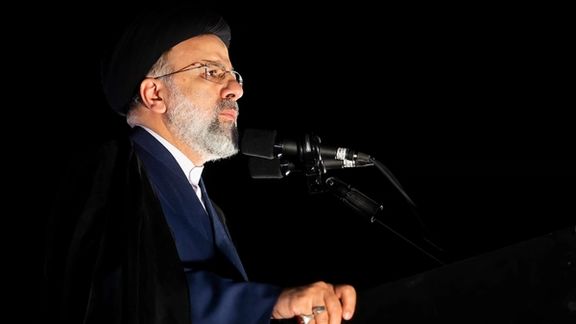
President Ebrahim Raisi

An Iranian lawmaker says President Ebrahim Raisi’s administration is incapable of controlling inflation although it had a far greater revenue than its predecessor.

The member of parliament’s national security, Shahryar Haidari, attributed the weakness to the Raisi administration's inefficiency. 

"While government revenues increased under President Raisi's government, it did not manage the resources as efficiently as the previous government [of President Hassan Rouhani] that had succeeded in controlling inflation to some extent…," Haidari said. 

However, he did not mention that the Rouhani administration had more access to the national foreign currency reserves although both governments are accused of wasting the national savings.

Lawmaker Shahryar Haidari (undated)
100%
Lawmaker Shahryar Haidari

Recent statements by officials revealed successive governments spent $140 billion of Iran’s National Development Fund in 15 years, with the Rouhani administration in power for eight years.

On the other hand, the current government's "better financial status" is based on claims by its officials about rising oil exports, while economists, politicians and the media have reiterated every now and then that, the government has not been able to repatriate the hard currency for selling the oil at a price discount of 30 to 40 percent. 

Haidari also praised the Rouhani administration for handling the negotiations over the revival of the 2015 nuclear deal more efficiently thanks to its capability and experience without undermining Iran's interests. Meanwhile he criticized the current government's diplomatic weakness. 

The lawmaker argued that although not all of the country's problems are linked to sanctions and JCPOA nuclear talks, yet the situation could improve by 70 percent if the negotiations reach positive results.

Ali Agha-Mohammadi, a member of Iran’s Expediency Discernment Council (undated)
100%
Ali Agha-Mohammadi, a member of Iran’s Expediency Discernment Council

In recent days, first, an adviser to Supreme Leader Khamenei, Ali Aghamohammadi, who is also a member of the Expediency Council admitted that the country's economic situation is far less than desirable and that as a result "at least 19.7 million Iranians are deprived of proper housing, employment, medical care, food and clothing."

Later, former Telecommunications Minister Mohammad Javad Azari Jahromi criticized the Raisi administration for failing to stand by its promises of mending social divides, halving the inflation rate and immediately solving problems with the country's investment market. He pointed out that Raisi has lost a lot of his over two million followers on Instagram.

Former Telecommunications Minister Mohammad Javad Azari (undated)
100%
Former Telecommunications Minister Mohammad Javad Azari

On Saturday, hardline daily Kayhan, whose editor is appointed by Supreme Leader Ali Khamenei and usually fully and unjustifiably defends the Raisi administration, shyly but openly criticized exiting economic conditions and wrote: "The people's economic situation has not improved under the new government. The cost of housing has continuously grown, and the price of essential commodities have increased, putting the people under pressure." 

The Kayhan reiterated that "prices in the market in Iran reflect a chaotic situation." The daily added that the Islamic Republic cannot tolerate rising popular dissatisfaction. The economic problems of low-income Iranians is part of the country's realities, and the Islamic Republic and the ideology of late Ayatollah Ruhollah Khomeini and Supreme Leader Khamenei call for improving the economic situation in the interest of low-income Iranians." However, the daily stopped short of suggesting how this can be done. 

The hardliner daily, as many other media outlets and public figures in Iran, steered away from pointing to US sanctions as the main reason for the economic crisis, and the need for an agreement with Washington.


Most Viewed

Ideology may be fading in Iran, but not in Kashmir's ‘Mini Iran'
1
INSIGHT

Ideology may be fading in Iran, but not in Kashmir's ‘Mini Iran'

2
INSIGHT

Hardliners push Hormuz ‘red line’ as US blockade tests Iran’s leverage

3
VOICES FROM IRAN

Hope and anger in Iran as fragile ceasefire persists

4

US sanctions oil network tied to Iranian tycoon Shamkhani

5

Iran International says it won’t be silenced after London arson attack

Banner
Banner

Spotlight

  • Hardliners push Hormuz ‘red line’ as US blockade tests Iran’s leverage
    INSIGHT

    Hardliners push Hormuz ‘red line’ as US blockade tests Iran’s leverage

  • Ideology may be fading in Iran, but not in Kashmir's ‘Mini Iran'
    INSIGHT

    Ideology may be fading in Iran, but not in Kashmir's ‘Mini Iran'

  • War damage amounts to $3,000 per Iranian, with blockade set to add to losses
    INSIGHT

    War damage amounts to $3,000 per Iranian, with blockade set to add to losses

  • Why the $100 billion Hormuz toll revenue is a myth
    ANALYSIS

    Why the $100 billion Hormuz toll revenue is a myth

  • US blockade targets Iran oil boom amid regional disruption
    ANALYSIS

    US blockade targets Iran oil boom amid regional disruption

  • Iran's digital economy battered by prolonged blackout
    INSIGHT

    Iran's digital economy battered by prolonged blackout

•
•
•

More Stories

Egg And Sperm Donation Requires Fatwa, Deems Minister

May 21, 2023, 16:16 GMT+1

Sperm and egg donation can only happen in Iran if allowed by a religious fatwa, the Islamic Republic health ministry has decreed.

Deputy Health Minister Saeed Karimi said Sunday that the issue of egg and sperm donation to help infertility is beset with both legal and Sharia complications.

He said that the ministry is trying to reach a consensus based on "various fatwas" to announce a legal directive.

But the regime’s stance will be a desperate blow for many families and couples struggling to have children.

Donating sperm and eggs with the aim of helping the fertility of those who need help for various reasons has been legal in many countries for many years.

Head of Iran’s Scientific Association of Women and Midwives, Azam Mousavi told Borna news agency in April: “Until now, no law, resolution or protocol has been drafted and approved regarding sperm donation in Iran; It means that donating sperm is not legal, nor illegal in the country.

"Most Shia scholars do not consider donating sperm as permissible.

“Only a few scholars approve it under the condition that the donor of the sperm is known so that the child attributed to him can enjoy the rights such as inheritance.”

According to Ali Khamenei's fatwa, "in the absence of haram conditions such as looking, touching, etc., a stranger's sperm can be used for fertilization with a woman's egg, but the husband of the woman who became pregnant using this method will not be the father of the born baby.”

Five Iranian Border Guards Killed In Sistan-Baluchestan Clash

May 21, 2023, 12:24 GMT+1

At least five Iranian patrol officers died on Saturday in a clash with what the regime calls “terrorists” on the Pakistani border.

Iranian media reports that the border guards spotted a group of armed men near the border in Saravan, in the southeastern province of Sistan and Baluchestan.

The five officers were killed in the ensuing confrontation with the “terrorist group” on Saturday night.

Two other guards were left seriously injured and are in a critical condition, it was also reported.

There is no information about the affiliation of the armed group, but several Baluch groups from the area are fighting an insurgency against the Islamic Republic.

The most prominent is Jaish al-Adl, which has often targeted Iran's military, especially the Islamic Revolutionary Guard Corps (IRGC).

Saturday’s clash comes only a few weeks after the head of the Saravan Intelligence Police, Alireza Shahraki, was shot dead by unidentified gunmen.

Baluchestan news website Halvash reported that Shahraki had used "extremely violent" methods against detainees for years.

In recent months, the situation in Sistan-Baluchistan has dramatically worsened. The area’s cities have become very tense, especially on Fridays, when residents come out to protest against the regime.

There have reports of numerous attacks on military and government forces in the province in the months since the death in custody of Mahsa Amini last year sparked protests nationwide.

G7 Communiqué Shows Iran Could Face Strong Western Pushback

May 21, 2023, 12:16 GMT+1
•
Iran International Newsroom

Iran received two international rebukes this week, one by G7 countries meeting in Japan and another by the Arab League summit held in Saudi Arabia.

The G7 summit strongly criticized Iran’s nuclear, human rights and regional policies in its final communiqué in direct and no uncertain terms.

The main trust of the G7 statement was Iran’s nuclear program, which is advancing by more uranium enrichment, without much international monitoring or the prospect of an agreement to limit its scope.

“We reiterate our clear determination that Iran must never develop a nuclear weapon. We remain deeply concerned about Iran’s unabated escalation of its nuclear program, which has no credible civilian justification and brings it dangerously close to actual weapon-related activities,” the final communiqué said.

However, the G7 also reiterated that a diplomatic solution “remains the best way to resolve this issue.”

Talks lasting 18 months form April 2021 to August 2022 between the signatories of the 2015 JCPOA nuclear accord reached a deadlock last September, and the United States pulled back from the process, saying that Iran destroyed the chances for a deal in the 11th hour.

The Arab League meeting in Jeddah, Saudi Arabia did not mention Iran in its final declaration, but one particular clause was clearly aimed at Tehran’s regional activities aimed at building armed proxy groups in Arab countries.

“We call for stopping foreign interference in the domestic affairs of Arab countries and categorically reject all support for the formation of armed groups and militias outside the scope of state institutions,” the statement said.

However, it was reported that two other sections in the draft document were deleted from the final declaration. One reiterated Arab support for territorial claims by the United Arab Emirates from Iran, and the other a positive remark about restoration of ties between Riyadh and Tehran.

The UAE has periodically raised the issue of three small islands in the Persian Gulf that the former Iranian imperial government took over in 1971 as British forces guarding the littoral Arab sheikdoms withdrew from the region.

Iranian media reported Sunday that the two sections were deleted from the final declaration apparently as a result of a compromise.

G7 leaders  attend a working lunch meeting at G7 leaders' summit in Hiroshima, western Japan May 19, 2023.
100%
G7 leaders attend a working lunch meeting at G7 leaders' summit in Hiroshima, western Japan May 19, 2023.

Which Arab League states objected to the inclusion of the territorial claim remains unclear, but the presence of Iran’s ally, Syria’s Bashar al-Assad at the summit could have played a role. It would have been extremely embarrassing for Assad to put his name on a statement that would include such a demand while he still depends on the Iranian regime both militarily and economically.

Iran is still unhappy with the Arab summit despite this victory. Foreign ministry spokesman Nasser Kanaani Sunday criticized the language in the final communique, saying Iran expected the meeting to forego “repetitive and tiresome claims” against Iran.

However, the more serious rebuke Iran received was undoubtedly the G7 declaration, which also slammed Tehran’s human rights record, its regional policies, and its military support to Russia in its invasion of Ukraine.

“We express our grave concern regarding Iran’s continued destabilizing activities, including the transfer of missiles, unmanned aerial vehicles (UAVs) and related technologies to state and non-state actors and proxy groups, in breach of UNSCRs including 2231 and 2216.”

The president of the United States, Joe Biden, after a meeting with his counterpart Volodymyr Zelensky at the G7 meeting in Hiroshima, Japan (May 2023)
100%
The president of the United States, Joe Biden, after a meeting with his counterpart Volodymyr Zelensky at the G7 meeting in Hiroshima, Japan

The tone of the G7 statement about violations of UN resolutions is ominous for the Islamic Republic.

The accumulation of its unabated uranium enrichment, regional interventions that fueled recent Israeli Palestinian fighting, and its provision of weapons for Russia can all add up and lead to an effort by the West to revive international sanctions against Tehran.


At Least Half Of Iran Below Poverty Line: Expert Economist

May 20, 2023, 18:43 GMT+1

At least half of Iran lives below the poverty line as the government fails to solve the economic crisis, a leading economist warns.

Hassan Raghfar said the main problem is that the authorities are unable to increase the welfare provision for the 50% or more of the population now in desperate need.

The Al-Zahra University professor said that although the government is supposed to present a plan to the parliament with the aim of curbing inflation and production growth, he fears it will only result in worsening conditions still further.

His analysis comes after a member of the Expediency Council, Ali Aqa Mohammadi said 19.7million Iranians lack basic life facilities such as housing, employment, education, health, food and clothing.

With Iran enduring inflation of more than 40% for several consecutive years, salary earners whose wages have enjoyed annual increases of only a few percent have seen their real purchasing power plummeting by half, according to economist Albert Beghouzian.

Islamic Republic authorities keep promising to control inflation. In his New Year speech on March 21, Supreme Leader Ali Khamenei promised what he said would be “the year of bringing inflation under control”. The pledge was echoed by President Ebrahim Raisi in his speech, but is all too reminiscent of what proved to be empty slogans in previous years.

The majority of Iranians have fallen into what government officials describe as poverty and can no longer afford meat and even fruit and vegetables, with consumption dropping by half.

Unfair Policies Polarize Iran's Population, Says Sociologist

May 20, 2023, 18:39 GMT+1
•
Iran International Newsroom

Mostafa Abroshan, an Iranian sociologist says that young Iranians do not trust the government, as they lost hope in the future.

Abroshan warned the Iranian government that trust in the ruling establishment cannot be restored by decrees and orders. While corruption and favoritism have enriched a small minority, poverty has risen to unprecedented levels.

The sociologist asked: "How can young Iranians trust the government while most of them do not have a job?" He argued that "The distrust is rooted in the country's crisis of management. In order to solve this problem, the government needs to appoint qualified individuals with the right kind of specialization to key jobs, and make knowledge and rationality govern the country's institutions."

Abroshan was referring to statements by Iranian officials including President Ebrahim Raisi, who promised repeatedly during the past two years to create one million jobs annually for young Iranians but broke their promise. Raisi has even claimed that those jobs have been created!

Mostafa Abroshan, an Iranian sociologist (undated)
100%
Mostafa Abroshan, an Iranian sociologist

Also in some cases, officials make outlandish promises without thinking of the implications of what they say. On Wednesday, Telecommunications Minister Isa Zarepour promised that his ministry will make sure Internet speed increases by 80-fold this year.

The astonishing promise was made while people suffer from extremely low Internet speed and the banning of nearly all social media platforms on which many small businesses and more than 10 million families depend for a living. 

In another example, Iranian academic Mostafa Mehraeen complained that young Iranians simply want to live a normal life but as soon as they criticize the authorities’ impolite treatment of the youth, security forces attack them and the officials accuse them of being drug addicts.

Abroshan also said that social capital (government legitimacy) is the spirit of the nation. People learn about it during the process of their socialization. It lends meaning to human communication and boosts solidarity and social participation. He added that mutual trust between the people and government is one of the most important factors of social capital which makes cooperation between various parts of the society possible. 

Trust will be enhanced if the people see that the government meets their expectations, Abroshan said, adding that otherwise the people come to believe that the country's economic and social institutions do not represent their views and expectations. As a result, distrust of the government builds up and the ruling establishment loses all legitimacy. 

Telecommunications Minister Isa Zarepour  (undated)
100%
Telecommunications Minister Isa Zarepour

Explaining the situation of trust in government, Abroshan said, "when the police do not respect citizens and treat them with violence as we have seen, the situation triggers anger and leads to behaviors such as attacking and overturning police vehicles." He added that when he, as a sociologist, criticizes the situation out of sympathy for the people and the government, officials accuse him of portraying a disparaging image of the social situation. 

He reiterated, "Mutual trust between the people and government no longer exists. "The government constantly calls on the people to fulfil their social responsibilities, but at the same time, constantly undermines their citizenship rights." He added: "The distribution of wealth in the Iranian society is unfair and inequality has polarized the society."

Abroshan further pointed out: "Currently Iranian citizens and the government refuse to recognize each other. As a result, any event that hurts the people's feeling can trigger a social