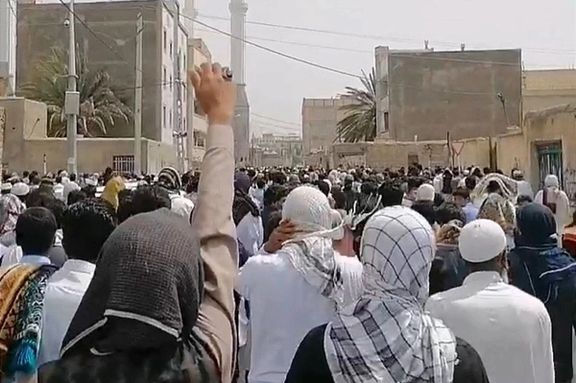
Influential Sunni cleric Mowlavi Abdolhamid says with engineered elections, the regime has barred competent individuals from positions of power and weakened the country.
Abdolhamid accused the regime of allowing only incompetent people to be elected to the parliament, presidency and as constitutional watchdogs whose job is to supervise the supreme leader and to elect his successor. “Worthy and competent individuals,” he said, cannot be chosen in the kind of elections that the regime holds.
Abdolhamid who has gained huge popularity for his fiery Friday sermons since protests began in mid-September warned that methods employed by the regime, and the exclusion of capable individuals, has resulted in people’s dissatisfaction and fuelled recent protests.
He went on to say that the Iranian people wish the same prosperity and development for their country that freely elected leaders bring elsewhere in the world.
Over the years, the hardliner Khamenei-appointed Guardian Council has tightened its control over the election process. In the presidential elections of 2021, the council disqualified the long-time regime loyalist and moderate conservative, former Parliament Speaker Ali Larijani to ensure hardliners seize the presidency. Already, in 2020, by disqualifying hundreds of candidates, the Guardian Council allowed hardliners to gain a strong majority in parliament.
“We hear that some people are making plans for future elections. [These could be the type of] elections that people don’t want. The people want free elections. They want to elect people who are capable and strong executives with the power to make [their own] decisions,” he told his congregation in Zahedan this Friday.
Sunni cleric Mowlavi Abdolhamid
“We have not been able to use capable people and competent executives. Weak lawmakers weaken the parliament, and such weak parliaments are unable to manage the country at times of crisis,” he said. “You are doing injustice to this country by entrusting the work to a weak government and president,” he added.
Abdolhamid also called for a new constitution. “Stop [enforcing] the laws that have not worked until now. Why should we stick to something that was ratified forty-four years ago? He asked.
The parliamentary elections of March 1, 2024, has great importance to the regime which has always relied on high turnout of the electorate as proof of its legitimacy.
However, after last years’ several-month-long protests, the chances of anything other than elections with a very low turnout are quite slim as those who protested, and their supporters, and even many Islamic Republic loyalists, have long vowed never to run or vote in any election again.
Apart from the 290 members of the Iranian parliament, voters must also choose 88 members of the Experts Assembly in the March elections.
Some pundits claim turnout in the 2024 elections may be as low as 15 percent. The turnout in the highly engineered elections in 2020 which resulted in a hardline majority in the parliament was the lowest ever in the history of the Islamic Republic.
In the capital Tehran just over 26 percent voted in 2020 but according to government figures, national turnout stood at over 42 percent. In the 1996 parliamentary elections 71 percent had voted.
Hardline media such as the Revolutionary Guards (IRGC) linked Tasnim claim that Larijani is going to run in the elections with his own slate which the former President Hassan Rouhani is going to support.
Rouhani has neither confirmed nor denied his intention to get involved in the upcoming elections but Larijani’s office in a statement Monday denied Tasnim’s report. The statement said there was no talk of any election activity, consultation with others, or an electoral list.
Taking a jab at hardliners in power, the statement said those who are after excluding others should not worry about Larijani running in the elections and that it is not likely to create an atmosphere of “fake competition” with false news about rivals’ intention to run.
Former parliament Speaker Ali Larijani (left) and former President Mohammad Khatami
Former President Mohammad Khatami says Iran's Islamic revolution has deviated from its path and ex-parliament Speaker Ali Larijani argues for major policy changes.
Khatami has reiterated in a meeting with teachers that Islamic Republic's policies are self-destructive and suggested that the government should embark on reforms. Khatami pointed out that governance in Iran needs to be reformed if the Islamic Republic is to survive.
He further suggested that all social groups in Iran should follow the non-violent style of Iranian teachers' protests. He further said that the government should represent the people and the people should be able to replace the government. This can be achieved though free and fair elections, adding that in an ideal system everybody should have equal right to power, wealth and status.
“A regime change in Iran is impossible, but the government is undermining itself. I suggest it reform itself instead,” the mild-mannered reformist politician said.
Khatami who was president from 1997-2005 tried to boost freedom of speech in his first time but he was over-ruled by conservatives supported by Supreme Leader Ali Khamenei, who closed dozens of newspapers and cracked down on dissidents.
Meanwhile, former Majles Speaker Ali Larijani in a sarcastic letter denying an IRGC-linked Tasnim news agency report that the he was preparing to run for parliament in early 2024, said: "The country needs a change in policy." He also accused Iranian hardliners of purging the political landscape of moderate voices.
Reformist commentator Sadeq Zibakalam
Reformist commentator Sadeq Zibakalam in an article interpreted Larijani's statement as meaning that "existing policies cannot stand any longer."
He said Larijani has used the word "purification" rather than purging in his letter as a political detour to evade a harsh response by the government. However, he meant that the regime can no longer continue the policies it has been following during the past 44 years. What Larijani wants, said Zibakalam, is "a revision of Iran's political structure."
Zibakalam added: "In a nutshell, the government needs to ask itself whether the country's main problem is political or economic or social. What has led to the sulking of the post revolution generations with the government? Why there is so much despair and disillusionment in the society? In fact, Laijani has used the word purging or purification to make sure that he will not be accused of sympathy with protesters, opposition or counter-revolutionaries."
Zibakalam also referred to the term "artificial [political] competition" in Larijani's letter where he said: "It is unlikely that you can create artificial competition ahead of the election [by spreading disinformation about the participation of moderate political figures]."
Zibakalam said: "In fact, the protests last year shook many state officials. Larijani and individuals like him have realized that wrong policies of the government have pushed the country into a dead-end. What he is saying is that if the government continues those policies, even political figures such as him will find the election meaningless. And what is more important is that apart from the elections, the country is suffering from this chaos."
Zibakalam explained: "Other moderate and realist political figures and groups should also come to the conclusion that an election which is not free and fair would be meaningless. Even some conservatives should understand that. If nothing changes, only the ultraconservative Paydari Party and radical groups will take the 2024 election seriously."
The outspoken commentator, who has somehow evaded arrest so far, said that with the Raisi administration's economic failure, more moderates and moderate conservatives such as Larijani will demand a change in policies.
Twenty-six people have been indicted for the brutal events of Bloody Friday in Zahedan, which led to the death of 90 civilians.
Ahmadreza Pourkhaqan, Head of the Judicial Organization of the Armed Forces, who has travelled to the restive city in Sistan and Baluchestan province claimed Thursday that on the order of the Supreme Leader Ali Khamenei he is going to serve justice to those affected.
TheBloody Friday crackdown on protesters in the provincial capital of Sistan and Baluchestan in September saw security forces kill more than 90 people, including women and children following protests against the killing of Mahsa Amini and the rape of a 15-year-old Baloch girl by the police chief of Chabahar. Over 300 people were seriously injured.
“Eleven of the defendants in the case are charged with shooting leading to murder and wounding, and the remaining 15 have been indicted for abusing their position, illegal shooting, etc.” added Pourkhaqan.
“If someone has committed a crime, we will deal decisively with them and will not allow people's rights be violated,” alleged the cleric.
Earlier in March, an Iranian lawmaker called for justice for the victims of Bloody Friday. Moineddin Saeedi, representative of Chabahar city, warned President Ebrahim Raisi that the issue should be handled “with special attention”.
The government has failed to conduct a transparent investigation or hold any security officials responsible for the deaths so far.
Iranian dissident figure Masih Alinejad has been put under police protection on a visit to the UK as threats to her life continue.
The US-based opposition activist, in London to meet lawmakers and lobby for proscribing the Islamic Revolutionary Guards Corps as a terrorist organization, said she has been put under 24-hour police protection in the UK after the Metropolitan police received threats to her life.
After she appeared at the Piers Morgan Uncensored show earlier this week, British police came to see her at her hotel room, informing her that they would be giving her protection during the remainder of her stay.
However, unperturbed, in spite of numerous threats to her life from IRGC operatives abroad, the fearless campaigner said: “I’m not as scared for my life, I survived kidnapping plots,” she said. “I survived an assassination plot, so I am not scared for my life at all. I dedicate my life to giving voice to voiceless people.”
Alinejad said the move confirmed the level of danger she continues to live under, the regime seeing her outspoken leadership against the Islamic Republic as a major threat.
“I know that the British are a little bit relaxed when it comes to death threats. Now, I believe that the level of the threat is very intense, and it’s very serious.”
It has, however, given her direct access to security chiefs to fight for proscribing the IRGC, which has been behind numerous attacks globally, not only on Iranian soil.
Since 2015, there has been a surge in IRGC activity in the UK, Europe and the United States. Most recently, UK spy agency MI5 acknowledged the real threat from Iran’s “aggressive intelligence services” to kidnap or kill UK-based people in 2022.
Iran International was warned by authorities in November that its journalists were under threat from Iranian agents and the Metropolitan Police took measures to strengthen security around the network’s office in the area.
Armored police vehicles are seen outside the headquarters of Iran International on Nov. 19, 2022
On February 18, the network announced that following the advice of UK anti-terrorism officials it decided to temporarily move its studio operations to the US.
In her remarks at Sir Harry Evans Global Summit in Investigative Journalism on Wednesday, she said, "I told the members of the British Parliament that you asked the Iran International network to stop their work in London... Instead of canceling the activities of journalists, you should stop the Islamic Republic."
She made the remarks at a panel discussion titled "Iran's War Against Journalists," during which she talked about the latest developments of the "Women, Life, Freedom" protests in Iran, sparked by the death in custody of Mahsa Amini, and the Islamic Republic’s repression of journalists and any voice of dissent at home and abroad.
The British embassy in Tehran has been a regular flashpoint in recent years. In December, its walls were defaced by the Basij paramilitary militia, one of the forces operating under the IRGC, with slogans labelling it a “terrorist center”.
Alinejad, who has become one of the main opposition figures amplifying the voice of protesters inside Iran, has appeared at the UN and met with several European leaders such as France’s Emmanuel Macron and the Netherland’s Mark Rutte.
Talks about further restrictions on the activities of the regime and proscribing the IRGC have been among the hot topics at the British parliament in the past several months.
Despite repeated calls by a large number of lawmakers, London has failed to take any tangible actions against Iran and its most important arm the IRGC. However, several rounds of sanctions and other punitive measures have been taken but Iranian people suffering under the atrocities of the regime do not believe that they have been enough.
Earlier in the week, The UK’s Charity Commission removed trustees from the board of the Islamic Center of England for its links to Iran. The UK's security minister Tom Tugendhat welcomed the decision by the regulator, saying its leadership was appointed by the head of the Islamic Republic of Iran.
The Iranian flag waves in front of the International Atomic Energy Agency (IAEA) headquarters in Vienna, Austria, March 1, 2021.
A former Iranian diplomat says Tehran may have concluded that it should replace idealism with pragmatism to end the long-standing impasse in its foreign policy.
At the same time, a reformist commentator in Tehran has also said that it is essential for Tehran to reform its foreign policy as a precondition to attract foreign and domestic investment.
Hojjatollah Joudaki, a former Iranian diplomat in Egypt, told Etemad Onlinethat a recent trend of changing tens of street names in Tehran could be the first move in the interest of pragmatism.
Iran had named many streets after terrorist figures such as Khaled Eslamboli, the man who assassinated President Anwar Sadat for giving asylum to the Shah of Iran. The street's name was changed following the resumption of ties with Saudi Arabia in anticipation of further extending the regional rapprochement.
The interview with Joudaki coincided with media reports indicating that talks took place between Iranian and Egyptian officials in Oman.
Hojjatollah Joudaki, a former Iranian diplomat
Joudaki argued that the hard core of the Iranian regime might have finally noticed the Islamic Republic’s isolation in the region.
He claimed that the resumption of Iran's ties with Egypt was hindered by the United States and Saudi Arabia. Now that Iran has made peace with Saudi Arabia, it is time to think of resuming the ties between Tehran and Cairo. He added that hardliners who were against restoring ties with Egypt also think that maintaining relations with Cairo and other regional capitals could help Iran to surmount its economic problems.
"While there seems to be no hope in the revival of the JCPOA, one solution for Iran could be restoring its ties with its neighbors and regional states," said Joudaki, adding that Iranian leaders have concluded that it is advantageous to end their international isolation. He added that the pressure groups who prevented better relations with Iran's neighbors are still there, but they have realized what have they done to the country.
Reformist commentator Abbas Adi
Meanwhile, in a commentary in Etemad daily, reformist commentator Abas Adi wrote: "reforming Iran's foreign policy is a must. Without solving the problem of [nuclear accord] JCPOA and maintaining stable foreign relations, it is not possible for Iran to attract any domestic or foreign investment."
Abdi wrote that Supreme Leader Ali Khamenei's plan for the current year, that is "harnessing inflation and boosting production" requires large investments that would facilitate the 8 percent economic growth envisaged by Khamenei." He wrote, "This can be made possible only through restoring the country's infrastructure. But if you ask me, the key here is prioritizing domestic investment over foreign investment."
Abdi’s preference for domestic investment is a more practical approach, as he probably knows that Tehran is not inclined to improve relations with the West, which could unblock foreign investments.
"At the same time, we need to look for foreign investment. But the reason for prioritizing domestic investment is that domestic capital is either invested in non-productive areas or is exiting the country."
Abdi added that priority should be given to the private sector as the government lacks the resources for investment.
He further pointed out that Iran needs to remove major obstacles such as the state-controlled banking system, instability in policymaking, financial corruption, and the absence of free media. All of these are obstacles to an efficient economy with inflation and economic growth, Abdi said.
Apart from the 290 members of the Iranian parliament (Majles), 88 seats of the assembly of experts are also up for grabs on the same date.
Mohammad Reza Gholamreza, the Chairman of the Election Headquarters
Less than ten months before the elections, media affiliated with various segments of the political landscape have started to play with the news to support their own possible candidates, to tarnish the image of their opponents and to spread disinformation for various reasons.
IRGC-Linked Tasnim news agency reported on Monday that former Majles Speaker Ali Larijani is planning to nominate himself as a candidate as well as presenting a list of other likeminded candidates.
Etemad online has confirmed the report after seeking the views of politicians close to Larijani who was the longest serving speaker of the Iranian parliament from 2008 to 2020. In the meantime, other news sources have reported that former President Hassan Rouhani is going to support Larijani and help him to set up his campaign. While there has been no confirmation or denial from Rouhani in this regard, Larijani later denied Tasnim's report.
Former Majles Speaker Ali Larijani
According to Ruydad24 new website, media and politicians are speculating over three different scenarios about the results of the upcoming elections and its impact on the country's political landscape.
The most optimistic scenario is that the regime will allow some moderate conservatives to enter parliament and form a weak minority against an ultraconservative majority like the one that is currently in place, wrote Rouydad24.
However, Sazandegi newspaper wrote that so far there is no indication that the regime’s core might give up the idea of consolidating power within the conservative camp. The daily added that this is a likely option for the hardliners considering the crisis of governance under their reign.
The regime has a choice between a tightly engineered election, similar to the 2020 parliamentary and the 2021 presidential votes that gave the power to hardliners or allowing more moderate insiders also to get elected.
In case of the first option, large segments of politicians and the lectorate will most likely boycott the vote, especially after the popular protests and simmering antipathy toward Supreme Leader Ali Khamenei and his loyalists expressed in the streets.
According to Rouydad24, the most likely scenario for the upcoming election is that the regime will stick to its current totalitarian form and would want to keep all power by allowing Khamenei loyalists to dominate the state.
Nonetheless, the protests and the deepening economic crisis have proven that a consolidated conservative government does not necessarily mean that hardliners are united. There have been serious infightings within the conservative camp this year even during recent days as a member of the parliament close to populist former President Mahmoud Ahmadinejad brought about one of the biggest rifts between the Majles and the government by disclosing a major political and economic corruption case.
There is also the distant possibility of a proreform victory if Khamenei decides to free himself from the current political and economic impasse and allow centrists and reformists to run in the elections.