• العربية
  • فارسی
Brand
  • Iran Insight
  • Politics
  • Economy
  • Analysis
  • Special Report
  • Opinion
  • Podcast
  • Iran Insight
  • Politics
  • Economy
  • Analysis
  • Special Report
  • Opinion
  • Podcast
  • Theme
  • Language
    • العربية
    • فارسی
  • Iran Insight
  • Politics
  • Economy
  • Analysis
  • Special Report
  • Opinion
  • Podcast
All rights reserved for Volant Media UK Limited
volant media logo

Few Believe Impeachment Of Iranian Minister Will Improve Economy
Iran International Newsroom
May 1, 2023, 11:36 GMT+1Updated: 18:12 GMT+1
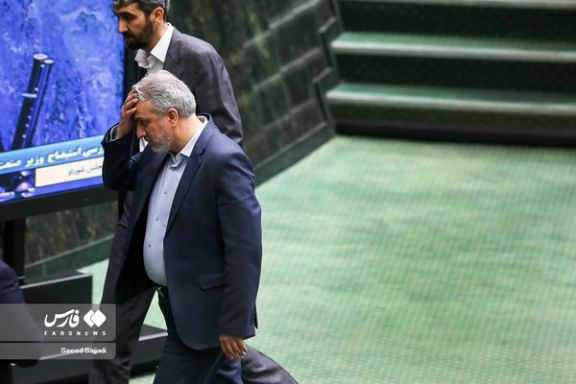
Iran’s Industry Minister Reza Fatemi-Amin after the parliament session to impeach him on April 30, 2023

Although Iran’s Industry Minister Reza Fatemi-Amin was impeached by parliament on Sunday, few believe that it can be a remedy for Iran’s ailing economy.

Jalil Rahimi Jahanabadi told Rouydad24 news website: "Every one of Raisi's ministers we have dismissed has been replaced by someone even weaker." He predicted that someone several times lower in rank than Fatemi-Amin will become the next minister of industry.

Jahanabadi reiterated that it is highly unlikely the next minister would be more experienced, having better plans or being more capable than his predecessor in any other way. He also argued that Fatemi-Amin was a victim of the government's unclear policies. 

Without naming Supreme Leader Ali Khamenei, who usually makes all key decisions without being accountable for them, Jahanabadi charged that those policies are often made by those whose positions are beyond the government's control.

Industry Minister Reza Fatemi-Amin defending himself at the parliament on April 30, 2023
100%
Industry Minister Reza Fatemi-Amin defending himself at the parliament on April 30, 2023

He said: "A thousand presidents like Raisi and a thousand ministers such as Fatemi-Amin will become the victim of those policies as long as the country's strategic policies are not determined."

Jahanabadi said even more pessimistically that a new minister will take office, change all of the ministry's deputies and major managers and before he can control the affairs of the ministry, he will have to be impeached for similar reasons. 

Lawmaker for Tabriz, Ahmad Alirezabeigi who had initially charged the former minister with giving 75 SUVs to parliamentarians to avert a previous impeachment motion, said after Fatemi-Amin's dismissal that he has given 147 cars to the lawmakers. Alirezabeigi told Didban Iran website that he has presented evidence supporting his claim to the Public Prosecutor's Office. 

He said a document signed by the executive deputy to the speaker of the parliament indicates that he had designated at least 57 lawmakers to receive the cars at a discounted price several times lower than market value. He said the profit for the lawmakers was huge due to the vast difference between the price set by the importing company and the sale price in the market.

Ironically, although Fatemi Amin has been impeached and replaced from his post partly because of the deal about the cars, none of those who have received the cars have been reportedly questioned, indicted or even publicly named. 

Former President Mahmoud Ahmadinejad (undated)
100%
Former President Mahmoud Ahmadinejad

On Saturday, one day before the impeachment, Alirezabeigi said in a statement published on former President Mahmoud Ahmadinejad's Telegram channel that he had been summoned for questioning by both the Prosecutor's Office and the Board Supervising Lawmakers' Behavior. The channel presented long lists of the lawmakers who had received the car but blackened their names to avoid prosecution for possible libel.

In the meantime, while the controversy over impeachment continues, former government spokesman Ali Rabiei noted in a commentary in Etemad Online website that the campaign against financial corruption should be accompanied by structural reforms before being turned into security and judiciary projects. 

Rabiei accused Iranian governments of failing to carry social projects forward. Interestingly, Rabiei himself has been a member of the government in most of the 43 years the Islamic Republic has been in power. 


Most Viewed

Ghalibaf defends Iran-US talks amid hardline backlash
1
INSIGHT

Ghalibaf defends Iran-US talks amid hardline backlash

2
INSIGHT

A nation in limbo: 100 days after the massacre, has the world moved on?

3
ANALYSIS

From instability to influence: Pakistan’s pivotal role in US-Iran diplomacy

4
ANALYSIS

100 days on: why Iran’s January protests spread across social classes

5

War-hit homeowners feel abandoned as Iran’s reconstruction aid fades

Banner
Banner

Spotlight

  • War-hit homeowners feel abandoned as Iran’s reconstruction aid fades

    War-hit homeowners feel abandoned as Iran’s reconstruction aid fades

  • 100 days on: the anatomy of Iran’s January crackdown
    INSIGHT

    100 days on: the anatomy of Iran’s January crackdown

  • Ghalibaf defends Iran-US talks amid hardline backlash
    INSIGHT

    Ghalibaf defends Iran-US talks amid hardline backlash

  • 100 days on: why Iran’s January protests spread across social classes
    ANALYSIS

    100 days on: why Iran’s January protests spread across social classes

  • From instability to influence: Pakistan’s pivotal role in US-Iran diplomacy
    ANALYSIS

    From instability to influence: Pakistan’s pivotal role in US-Iran diplomacy

  • A nation in limbo: 100 days after the massacre, has the world moved on?
    INSIGHT

    A nation in limbo: 100 days after the massacre, has the world moved on?

•
•
•

More Stories

Iran Police Uses Surveillance Tool To Monitor Prisoners After Release

May 1, 2023, 11:28 GMT+1

Researchers at the Lookout Threat Lab have discovered a new Android surveillance tool attributed to the Islamic Republic's Police (FARAJA).

The company that offers insight into mobile threats has been tracking a spyware named BouldSpy since March 2020, which configures the tool’s command and control (C2).

Since 2023, security and intelligence researchers have described the malware as an Android botnet and ransomware.

Lookout researchers evaluate that BouldSpy includes ransomware code, but it is unused and nonfunctional, indicating ongoing development or misdirection by the actor.

“BouldSpy has victimized more than 300 people, including minority groups such as Iranian Kurds, Baluchis, Azeris, and possibly Armenian Christian groups,” said Lookout in a statement.

It appears that the spyware was also used to monitor and counter illegal trafficking activities related to weapons, drugs, and alcohol.

To further monitor the target after release, FARAJA likely installs BouldSpy on devices obtained during detention, adds Lookout.

Many of the malware's activities took place during protests following the death in custody of Mahsa Amini in 2022.

“The first locations exfiltrated from the victims are, with few exceptions, concentrated near Iranian provincial police stations, Iranian Cyber Police stations, Law Enforcement Command facilities, and border control posts. Based on this, we theorize that a victim’s device is confiscated once detained or arrested, and then subsequently physically infected with BouldSpy.”

It is still not clear how many people were detained during the nationwide protests in Iran. While thousands of young and teenage protesters were arrested in street demonstrations, hundreds of political activists, journalists and writers or artists have also been detained.


We Will Not Allow Iran To Put Noose Of Terror Around Us: Netanyahu

May 1, 2023, 09:53 GMT+1

Israeli Prime Minister Benjamin Netanyahu said Sunday he would stop Iran from strangling the Jewish state with a "noose of terror."

Speaking at the weekly cabinet meeting, he said the country’s security personnel are “working on this matter around the clock … and we will continue to act both offensively and defensively against the aggression of Iran and its terrorist satellites”.

The Israeli Prime Minister's statements about the aggressions of the Islamic Republic come at a time when Iran’s foreign minister toured Lebanon’s border with Israel Friday during a visit to the Arab nation, and was documented looking out at the Jewish state his regime regards as an archenemy.

After meeting with Hezbollah Secretary General Hassan Nasrallah, Hossein Amir-Abdollahian took the tour along with several Lebanese parliamentarians and members of the Iranian-backed terror group.

“Positive developments in the region will lead to the collapse of the Zionist entity,” he said during his tour.

Mehr state news agency called Amir-Abdollahian's presence at the Israel-Lebanon border a "response" to the move by Israel's foreign minister, who visited Iran's borders during the opening of the country's embassy in Ashgabat, the capital of Turkmenistan.

Meanwhile, an Israeli air attack near the city of Homs hit Iranian targets early Saturday, while Syrian state media reported that some missiles were intercepted.

Meanwhile, Syrian Observatory for Human Rights, based in the United Kingdom, reported that Israeli missiles fired from warplanes destroyed a Hezbollah ammunition depot near Homs airport.

Iran’s Currency Falls By 10% In One Month Amid Strikes

May 1, 2023, 09:51 GMT+1

Iran’s rial hit its lowest point in one month on Monday, falling by 10 percent against the US dollar, as sanctions remain in place and the economy is in crisis.

The rial hit a low of 550,000 against the US dollar for the first time since April 1, when an apparent intervention by the Central Bank of Iran (CBI) had brought the rate down to around 500,000 rial for each dollar.

In early 2018, the rial was trading at around 40,000 when former US President Donald Trump decided to pull out of the JCPOA nuclear agreement and impose crippling sanctions on Iran. Since then, the rial has fallen by almost 14-fold.

A series of worker strikes have been underway since April 22, affecting energy, petrochemical, steel and other sectors, as the rial falls and inflation spikes.

Monthly salaries for ordinary workers that were equivalent to $220 one year ago are now around $120 in purchasing power.

An Iranian official said Sunday that workers’ pay covers expenses for just nine days of the month for a small family.

Negotiations in 2021 and 2022 to reach a new nuclear agreement reached a deadline last September, prompting markets to sell off rials. Since then, the currency has lost half its value.

In addition to the nuclear issue, Iran’s supply of weapons to Russia and its brutal and deadly crackdown on anti-government protesters in recent months have made further talks more difficult as the United States demands Iranian policy changes at multiple levels.

Exiled Prince, Iranian Opposition Slam Letter By Israeli Lawmakers

May 1, 2023, 06:56 GMT+1
•
Maryam Sinaiee

Prince Reza Pahlavi and Solidarity for a Free Iran have slammed a letter by 33 Knesset members to Israeli foreign minister Eli Cohen, threatening Iran's territorial integrity.

Following Cohen's recent state visit to Azerbaijan, the Knesset members in a letter delivered to Cohen’s office asked the Israeli government to “pressure Iran to stop oppressing the Azeri minority in northwest Iran” based on a request by the Jewish community in Azerbaijan.

Before a scheduled speech at the Anti-Defamation League, Pahlavi strongly condemnedthe action of the Israeli lawmakers.

“The verbal assault on Iran’s territorial integrity by 32 members of the Israeli parliament is completely unacceptable and a service to the interests of the anti-Iranian Islamic Republic regime.”

Also, in a statement published on Twitter Sunday, the diaspora political group (7th Aban Front in Persian) said the Knesset members’ letter regarding “the Azeri minority” in Iran is “a clear case of action against Iran's existence”.

“Solidarity for a Free Iran considers this letter a hostile act against the Iranian nation and strongly condemns it,” the statement said.

“It is noteworthy that the letter of these Knesset members is in sheer contradiction with the statements made by Israeli government officials regarding friendship between the two nations of Iran and Israel during the recent visit of Prince Reza Pahlavi,” Solidarity for Free Iran said.

Prince Reza Pahlavi, a leading opposition figure, had visited Israel earlier this month and met with Israeli officials including Prime Minister Benjamin Netanyahu. This was the first time a prominent Iranian political figure had paid a public visit to Israel.

Prince Reza Pahlavi in Israel in April meeting Prime Minister Benjamin Netanyahu
100%
Prince Reza Pahlavi in Israel in April meeting Prime Minister Benjamin Netanyahu

The group also stressed its belief in friendly relations with all countries and fighting against “reactionary discourses such as antisemitism” in the post-Islamic Republic Iran and condemned the Iranian regime’s animosity toward Israel but added that they would not allow “any country or political group to take advantage of such principles to spread hate and contentiousness against the Iranian nation.

The Knesset members accused the Iranian regime of “carrying out a policy of cultural genocide by restricting the right of members of the Azeri minority to study and spread its heritage, to teach its language and even to register children with Azeri national names.”

Around a quarter of Iran’s population is Turki-speaking Azari (in Iran the word is Azari – not Azeri), with analysts and activists disagreeing over the closeness of their cultural-linguistic links to their neighbors to the north.

It should be noted that Supreme Leaser Ali Khamenei and many past and current high-ranking Iranian officials come from the Azari community.

The letter said the Jewish community of Azerbaijan is “very concerned” about the persecution of the said ethnic minority in Iran and stressed that the country of Azerbaijan is one of the most important strategic allies of Israel in the region.

“Obtaining international support as broad as possible for the national aspirations of the people of South Azerbaijan (term used by Baku for Iran’s Azarbaijan) will be a fatal blow to the Ayatollah regime, and establishment of the sovereign state of South Azerbaijan,” they wrote.

Supporting the separation of what they called South Azerbaijan from Iran would also be “an appropriate response on the level of political activism to the subversion of the Ayatollah regime” against Israel.

Tensions have been high between Tehran and Baku, an Israeli ally since November 2022 when both sides accused each other of engaging in terrorism and espionage. Tehran has also accused Baku of harboring Israeli intelligence and military elements that plan to use its territory in a possible attack against Iran’s nuclear facilities.

Solidarity for a Free Iran was founded by prominent political activists after a gathering of political and civil activists from the Iranian diaspora in Brussels in late October, less than three months after Mahsa Protests began and spread across the country.

Unions, Rights Groups Voice Support For Iran’s Strikes

Apr 30, 2023, 21:59 GMT+1
•
Iran International Newsroom

A group of 15 trade unions and civil rights groups issued a statement on the eve of International Workers' Day to voice support for the ongoing protests and strikes in Iran.

The Sunday statement issued on the occasion of May Day underlined that the Islamic Republic "neither deserves to survive nor it is capable of surviving.”

Decrying the “bloody crackdown” by the regime during the current wave of protests ignited by the death in custody of Mahsa Amini, the statement said that people from all walks of life including "teachers, workers, filmmakers, artists, and civil and political activists” are against the Islamic Republic.

They noted that the "revolutionary” uprising of the Iranian people is “still alive and moving" forward and no day passes without rallies and acts of protests calling for change.

Referring to the sexual discrimination against women in Iran and the chemical attacks on schoolgirls, they said "Women are deprived of their most basic human rights."

The civil rights groups and labor unions also said the regime "is not able to control rising prices and inflation even for a single week and has plunged a community of 90 million people into poverty and misery in a rich country."

Logos of unions and groups issuing a statement in support of Iran's strikes and protests (file photo)
100%
Logos of unions and groups issuing a statement in support of Iran's strikes and protests

The Council for Organizing Oil Contract-Workers' Protests, which has been one of the main organizers of the current wave of strikes, and workers of the Haft-Tappeh Sugarcane complex – who recently snubbed President Ebrahim Raisi -- were among the signatories of the statement.

The statement came as workers in more than 100 oil, gas, petrochemical and other plants across the country have been staging strikes since April 22, protesting poor working conditions, low wages and rising cost of living. Almost all the striking workers in oil, gas, steel, petrochemicals and other industries, are not officially hired by the country’s oil company or relevant ministries and are working on temporary contracts, risking their only means of livelihood by joining the strikes.

Authorities claim that the strikes are being organized by anti-regime groups, a charge the Islamic Republic often makes to de-legitimize the demands of the workers who earn less than $200 a month. An official at South Pars gas field on the Persian Gulf stated that 4,000 protesting workers will be replaced by new ones.

Earlier in the day, three prominent Iranian labor activists condemned the recent detention of workers calling it "organized brutality" by the regime.

More than 1,600 labor rallies and strikes have been held in the past year across Iran. The Islamic Republic’s security and judiciary apparatus have summoned, arrested and imprisoned dozens of labor activists to stifle dissent.

In their Labor Day statement, the signatories also called for "immediate and unconditional release of all political prisoners,” and also cautioned the authorities against “criminalization of political, trade union, and civil actions."

In recent years, as the Iranian National Oil Company has ceded many operations to quasi-private companies, most of the work is done by temporary contract workers with little pay and no benefits.

The so-called private companies are controlled by military or other state entities, or by well-connected regime insiders who quash labor demands by using government security forces.







