• العربية
  • فارسی
Brand
  • Iran Insight
  • Politics
  • Economy
  • Analysis
  • Special Report
  • Opinion
  • Podcast
  • Iran Insight
  • Politics
  • Economy
  • Analysis
  • Special Report
  • Opinion
  • Podcast
  • Theme
  • Language
    • العربية
    • فارسی
  • Iran Insight
  • Politics
  • Economy
  • Analysis
  • Special Report
  • Opinion
  • Podcast
All rights reserved for Volant Media UK Limited
volant media logo

Iran Gov’t Quashes Chances Of Referendum
Iran International Newsroom
Apr 26, 2023, 16:19 GMT+1Updated: 17:55 GMT+1
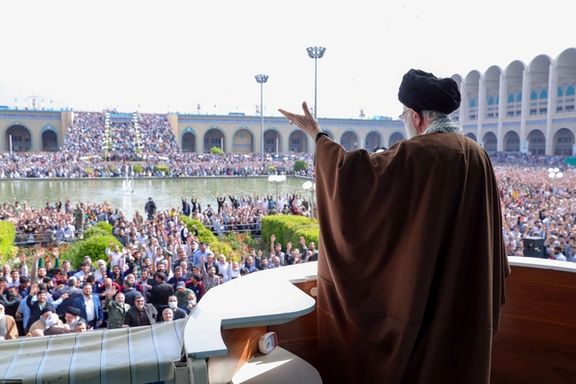
Iran’s ruler Ali Khamenei addressing his supporters at Tehran’s Mosalla on April 22, 2023

Following Supreme Leader Ali Khamenei’s strong rejection of a possible referendum, the administration’s newspaper has warned of the perils of a plebiscite in Iran.

The government’s official daily, Iran, published a commentary about the calls for a referendum, insisting that "issues related to national security can be very sensitive, and depending on the specific circumstances of each country, holding referendums on these issues may lead to unpredictable and dangerous results."

Nationwide anti-regime protests since September and the resulting instability raised the issue of a referendum on the constitution, with the unspoken intent of limiting the powers of the Supreme Leader.

Amid the hijab controversy and hot debates among politicians, calls for putting contentious issues to a popular vote have been increasing in recent weeks, but the authorities are worried that the seemingly innocent and legal demand will further reveal the tyrannical nature of the regime, especially after pro-regime students recently confronted Supreme Leader Khamenei about it.

“No political system exposes its existence to re-voting,” read the article, adding, “this is basically a strange and unconventional issue that is proposed by some. Therefore, to expect the Islamic Republic to hold a referendum on its own existence and to ask the Iranian people about its continuation is a wrong and logically baseless issue.”

The paper claims that “the main adverse consequence of the referendum is the loss of public trust... because it may lead to unjust justification of decisions.” Among other negative consequences is “an aggravation of social divide... if the result of the referendum is not accepted by some groups for various reasons.” It can even “pave the way for rioters to enter the armed phase against the political system,” the article claimed.

The article also claimed that a referendum can have a negative impact on the country’s foreign relations and justify further international pressures against the regime. Another negative impact can be on the economy because a referendum implies “the instability of the political situation.”

Almost all the points that the article enumerated prove that the government newspaper already knows what the result of such a referendum would be.

The daily added that if the system is acceptable enough that the people trust it for holding a referendum, it means the legitimacy of the political system is recognized.

However, almost all dissident figures have called on international bodies to oversee a possible referendum because the regime has proven time and again that it cannot be trusted with the people’s vote as was the case in the 2009 presidential election, which led to about two years of regular anti-government protests.

Former regime insider and current opposition figure Mir-Hossein Mousavi, who was a presidential candidate in 2009 and has been under house arrest since 2011, as well as former president Hassan Rouhani and several others have called for a plebiscite over key issues, such as a new constitution, or the nuclear program.

Former president Hassan Rouhani (right) and Supreme Leader Ali Khamenei (undated)
100%
Former president Hassan Rouhani (right) and Supreme Leader Ali Khamenei

At a meeting with the senior officials of his government, former lawmakers, journalists and politicians on April 5, Rouhani reiterated that the answer to people’s demands could be holding referendums as envisaged by the Constitution of the Islamic Republic.

Article 59 of the Constitution of the Islamic Republic, which was ironically approved by a referendum after the Islamic Revolution of 1979, stipulates that in extremely important economic, political, social, and cultural matters, the functions of the legislature may be exercised through direct recourse to popular vote by holding a national referendum. It must be approved by two-thirds of the members of parliament according to the Constitution.

Over 400 Iranian civil and political activists also issued a statement mid-April saying the only "violence-free and democratic" solution for transition from the Islamic Republic is holding a democratic referendum. The signatories, including many former officials of the regime, noted that the most important lesson of the "Woman, Life, Freedom" movement is the necessity of "organized efforts to demand justice, as well as the abolition of intimidation, privilege and discrimination."

A few days later, Iran’s ruler, Khamenei, dismissed the possibility of a referendum, saying that people are not capable of making decisions. During a meeting with a cherrypicked number of students on Tuesday, Khamenei questioned the viability of a referendum. He said: “Is it possible to hold a referendum on various issues in the country? Where in the world do they do this? Do all the people who have to participate in the referendum have the ability to analyze that issue?”

A video clip of a Basij student “confronting” Khamenei during his speech went viral, perhaps indicating that even some loyalists are discontented with the regime’s performance.

The article claimed that “There must be a popular consensus about holding a referendum. It must be proven that at least over 50 percent of the people demand a referendum on a specific issue.”

It did not elaborate on how people can make the regime hear their demand if there is no chance for a plebiscite.

The daily claimed, in familiar rhetoric, that “the foreign media have construed from Khamenei’s words that the Supreme Leader is against the referendum, and worse, that he is against the opinion of the people and does not consider them worthy to express an opinion. However, it must be said that Ayatollah Khamenei's answer is not related to the principle and philosophy of the referendum; rather, it is a management reminder.”

Khamenei’s rhetoric of comparing his regime with other countries is misleading because he and his loyalists have severely restricted most freedoms and manipulated elections, jailed opponents and critics and jailed or killed protesters.


Most Viewed

Ghalibaf defends Iran-US talks amid hardline backlash
1
INSIGHT

Ghalibaf defends Iran-US talks amid hardline backlash

2
INSIGHT

A nation in limbo: 100 days after the massacre, has the world moved on?

3
ANALYSIS

From instability to influence: Pakistan’s pivotal role in US-Iran diplomacy

4
ANALYSIS

100 days on: why Iran’s January protests spread across social classes

5

War-hit homeowners feel abandoned as Iran’s reconstruction aid fades

Banner
Banner

Spotlight

  • Bread shortages, soaring prices strain households in Iran, residents say
    VOICES FROM IRAN

    Bread shortages, soaring prices strain households in Iran, residents say

  • War-hit homeowners feel abandoned as Iran’s reconstruction aid fades

    War-hit homeowners feel abandoned as Iran’s reconstruction aid fades

  • 100 days on: the anatomy of Iran’s January crackdown
    INSIGHT

    100 days on: the anatomy of Iran’s January crackdown

  • Ghalibaf defends Iran-US talks amid hardline backlash
    INSIGHT

    Ghalibaf defends Iran-US talks amid hardline backlash

  • 100 days on: why Iran’s January protests spread across social classes
    ANALYSIS

    100 days on: why Iran’s January protests spread across social classes

  • From instability to influence: Pakistan’s pivotal role in US-Iran diplomacy
    ANALYSIS

    From instability to influence: Pakistan’s pivotal role in US-Iran diplomacy

•
•
•

More Stories

Junk Cars In Iran Waste 33m Liters Of Gasoline Per Day, Says Official

Apr 26, 2023, 15:26 GMT+1

An Iranian official says scrapping worn-out cars can save Iran at least 33 million liters of gasoline (8.7 million gallons) a day.

The chairman of the Association of Car Scrapping Centers said Tuesday that currently 14 to 15 million junk vehicles are on the roads, all consuming massive amounts of gasoline.

Consequently, Mohammad Mashhadi Sharif predicted that Iran's gasoline consumption will increase by 33% in the next 4 years.

Of these sub-par vehicles, there are about 3 to 3.5 million passenger cars, 500,000 public transportation vehicles, 10 to 11 million motorcycles, and 200 to 300 thousand worn-out trucks in the country.

Iran is awash with old cars, not least, due to the difficulty of importing newer models which are restricted and heavily taxed. The government has placed massive tariffs on imported vehicles --from 55 percent of their price to 95 percent depending on the capacity of their engines, making it even more expensive to buy good cars.

Iran’s government has a monopoly on car manufacturing which has led to high prices and a lack of innovation. However, the government has been unable to keep up with demand and as a result, there is a long waiting list for new vehicles, Iranians preferring second-hand options, which are also often far from meeting minimum safety standards.

Iran Upholds Dual National’s Death Sentence

Apr 26, 2023, 13:52 GMT+1

Iran’s judiciary has approved the death sentence of Iranian-German prisoner Jamshid Sharmahd, for alleged involvement in terrorism.

Masoud Setayeshi, the spokesman of the judiciary, announced the news of the high profile case in a press conference on Wednesday.

The news of Sharmahd’s kidnapping in Dubai and transfer to Tehran by regime agents was first released in August 2020. He was accused of heading a pro-monarchist group, Kingdom Assembly of Iran, behind of a deadly 2008 bombing and planning other attacks across the country.

Based in Los Angeles, the little-known group seeks to restore the Iranian monarchy that was overthrown by the 1979 Islamic revolution. It also runs pro-Iranian opposition radio and television stations abroad.

Since his arrest, human rights organizations have warned of 67-year-old Sharmahd’s deteriorating health. Sharmahd, who also holds US residency, has been held in solitary confinement and was denied an independent attorney and fair legal procedures. In February, Iran's judiciary sentenced him to death.

Sharmahd's daughter, Ghazaleh, has repeatedly asked German leaders to prevent the execution of her father and to work harder for his release. He is one of an unknown number of Western prisoners held in what human rights organizations have dubbed hostage diplomacy.

The prisoners in question have been arrested on charges of espionage or other alleged crimes. In some cases, they have been held for years without access to legal representation or a fair trial. This has led to accusations of arbitrary detention and a lack of due process.

The Islamic Republic denies any wrongdoing and argues that the prisoners are being held for legitimate reasons.


Iranian Hunger Striker In London Finally Invited To Foreign Office

Apr 26, 2023, 11:39 GMT+1

The Iranian hunger striker demanding the proscription of the IRGC was invited to the British Foreign Office on the 62nd day of his protest action.

Vahid Beheshti has been on a hunger strike in London since February 23 outside the UK Foreign Office to raise awareness for the need to designate the Iranian Islamic Revolutionary Guards Corps (IRGC).

On Tuesday, Beheshti was invited to the Foreign Office in central London, where he is camped, to speak to Tariq Ahmad, Minister of State for the Middle East, North Africa, and South Asia.

“We discussed the UK’s sanctioning of four more IRGC Commanders yesterday, and the importance of taking further steps and actually proscribing the IRGC as a terrorist organization,” Beheshti wrote in a tweet.

He urged that sanctioning individuals who do not leave Iran is not an effective means of stopping the IRGC’s terrorist activities.

Having survived 62 days on water, coffee, and sugar cubes, 45-year-old Vahid Beheshti can no longer walk.

Last week, a group of 125 British MPs signed a letter backing Beheshti’s calls.

Several countries including the UK and EU have been cautious to designate the IRGC for fear it will further alienate the regime and in turn, limit negotiating capacity regarding its nuclear program.

In December, members of the UK House of Commons unanimously voted for a motion that urges the government to proscribe the IRGC, but it has split the House.


Khamenei’s Trusted Cleric Gunned Down In Northern Iran

Apr 26, 2023, 10:33 GMT+1

A former Khamenei aid associated with the mass executions of the 1980s has been assassinated in the northern city of Babolsar.

Ayatollah Abbas-Ali Soleimani, the former representative of the Supreme Leader in Sistan and Baluchistan province and Kashan, was gunned down in Mazandaran province, according to the Hozeh website on Wednesday.

Soleimani's son confirmed his father’s death though said he does not know the details of the armed attack yet.

An eyewitness told Hozeh website that the cleric was sitting in a bank when the assailant grabbed the gun of the guard and opened fire. Reports say three others were also injured.

Soleimani's body being carried out of the building where he was killed

The attacker was reportedly arrested by the security forces. The assailant was reportedly one of the bank’s guards, identified only as Habibian.

The hardliner cleric was twice a member of Iran’s Assembly of Experts. As Friday prayers imam of Babolsar, he allegedly participated in the mass executions in the 1980s.

He wrote in his autobiography that he was appointed the Friday prayer imam of Babolsar so that he could confront opposition groups activities there. During his term, he also supervised the judicial system in Babolsar.

The moment the gunman opens fire

The executions in the 1980s were carried out based on a fatwa by Iran's then-supreme leader, Ruhollah Khomeini, against the MEK which carried out a wave of bombings in Iran and struck an alliance with Saddam Hussein during the 1980-88 war.

Most victims were linked to the MEK but there were also others with links to leftist and secular groups such as Fadaiyan Khalq Organization (FKO) and Tudeh Party as well as some Kurdish groups, such as Komala and the Kurdish Democratic Party of Iran.

Iranian Celebrities Warned Of Business Closures In Hijab Crackdown

Apr 26, 2023, 10:25 GMT+1
•
Maryam Sinaiee

Authorities in Iran stepped up their campaign against the mass hijab rebellion, warning to shut down several businesses belonging to celebrities and footballers.

Lists of celebrities targeted for not enforcing hijab laws were published by Revolutionary Guards (IRGC) media, Tasnim and Fars, the latest crackdown on famous names who have also been punished by bank account freezes, travel bans, pay cuts and communications shutdowns.

Some of those named include restaurants and cafes belonging to football legend Ali Daei, actress Bahareh Rahnama, actor Mohammad Golzar, footballer Karim Bagheri and football coach Alireza Mansourian, all in the capital Tehran. 

Fars has run several campaigns against those refusing to wear the compulsory Islamic headscarf in restaurants and shopping centers in the past few months and urged the authorities to shut them down.

Tasnim also said Baccarat Lounge, a restaurant owned by the national soccer team coach Amir Ghalenoei has already been shut down because its staff did not abide by the hijab rules.

National soccer team coach Amir Ghalenoei (Undated)
100%
National soccer team coach Amir Ghalenoei

In its report, Tasnim claimed that “all citizens” appreciate and support authorities’ actions against infringers and that no exception was being made for celebrities who have become a legitimate and powerful voice for the protesters.

A few hours later, Tasnim reported that one of the capital’s newest shopping malls, Opal Mall, was shut down because its board of directors had ignored “repeated warnings” to prevent uncovered women from entering the mall.

A wave of Iranian sports and cinema celebrities have used their social media accounts to voice their support for the protests that began in mid-September following the death of a 22-year-old girl, Mahsa (Jina) Amini in the custody of morality police.

Amini was arrested for what the authorities deemed ‘inappropriate’ wearing of the hijab. Since then, the hijab rebellion has grown to levels too worrying for the religious and political establishment who consider defiance of the hijab equal to defiance of the regime itself.

Taraneh Alidousti (undated)
100%
Taraneh Alidousti

Some outspoken celebrities including actress Taraneh Alidoosti and Katayoun Riahi were arrested or came under various pressures including foreign travel ban during the protests.

Riahi, 61, was the first among Iranian female artists to express her solidarity with the Mahsa Movement by sharing her photo without a veil on Instagram. “Iranian women are each other’s voices,” she said in her post.

The police said Monday that Riahi, who was put on trial in January for supporting the protests, and Pantea Bahram, who recently attended an event unveiled, have been indicted for hijab defiance.

Ahmad Reza Abedzadeh (left), Mahdi Mahdavi-Kia (center), Ali Karimi (Undated)
100%
Ahmad Reza Abedzadeh (left), Mahdi Mahdavi-Kia (center), Ali Karimi

Daei and other legendary soccer players including Mehdi Mahdavi-Kia, Karim Bagheri, Ahmad Reza Abedzadeh, and others who supported the protest movement have also been subjected to similar pressures.

In December authorities forced a Dubai-bound Mahan Airlines plane to land in its Kish Island to prevent Daei’s family from leaving the country. Daei is a hero for Iranians as he was an international soccer legend and the captain of the national team from 2000-2006 whose record of 109 international goals was broken only 2021 by Cristiano Ronaldo.

Katayoun Ruyahi (left), and Golab Adineh (April 2023)
100%
Katayoun Ruyahi (left), and Golab Adineh

Many other artists and athletes, including popular Golab Adineh and Fatemeh Motamed-Aria have also refused to wear the hijab in public and published photos of themselves without the hijab on social media. The regime feels if they do not crack down on such defiance, it will create an unstoppable wave amongst society.

At the start of the month, Supreme Leader Ali Khamenei reiterated the regime's stance on hijab, which became mandatory after the start of the regime in 1979. He said: “Discarding hijab is haram based on Sharia and also politically." His declaration was a clear signal to authorities that they need to do anything it takes to re-establish control over women and re-impose the hijab rules.