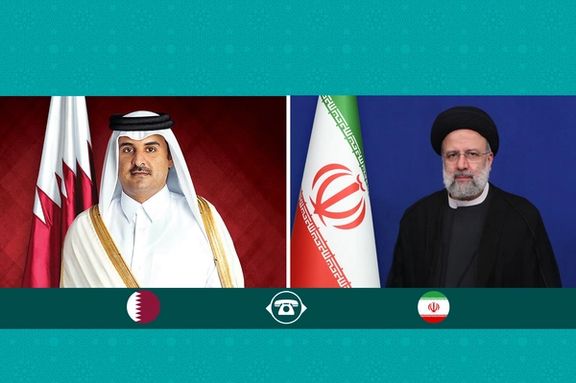
A combo photo of Emir of Qatar Sheikh Tamim bin Hamad Al Thani (left) and Iran’s President Ebrahim Raisi
Iran continues outreach to regional Arab countries aimed at isolating Israel, as top Israeli officials are warning of a multi-front war orchestrated by Tehran.
President Ebrahim Raisi held a telephone conversation with the Emir of Qatar, Sheikh Tamim bin Hamad Al Thani Thursday and urged unity among Muslim countries against Israel and in defense of Palestinians.
Tasnim news website affiliated with the Revolutionary Guard claimed that the Emir also “harshly condemned Israel’s aggression.”
Iran’s diplomatic activism follows an agreement in March to normalize relations with Saudi Arabia, which has emboldened Tehran to use military and political levers to harm nascent ties between Jerusalem and Arab capitals.
The rapprochement with Saudi Arabia opens the door for the Iranian regime to explore deeper ties and influence with other Sunni Arab states, including the United Arab Emirates, Egypt, Jordan and others.
Iranian Foreign Minister Hossein Amirabdollahian (right) and his Saudi counterpart Faisal bin Farhan Al Saud
Mehr, another IRGC-affiliated website, reported a telephone conversation between Iranian foreign minister Hossein Amir-Abdollahian and his Jordanian counterpart Ayman Safadi Thursday evening.
Amir-Abdollahian praised Jordan’s “efforts in defending the Palestinians and their holy places in Quds” (Jerusalem). He also emphasized the importance of Islamic unity, saying “the Zionist regime is the biggest threat in the region.”
Israeli officials have been warning of a multi-front conflict with Iran’s proxies in the region, with attacks coming not only from Gaza but also Lebanon and Syria.
In the most recent round of violence, Palestinian groups under the protection of Hezbollah launched rocket attacks from Lebanon, as Iranian forces continue their plans to amass weapons and power in Syria.
Israeli Defense Minister Yoav Gallant warned Thursday that his country would likely see multi-front military escalation in the near future.
Israeli Defense Minister Yoav Gallant
This is the end of the era of limited conflicts,” he told reporters. “We are facing a new security era in which there may be a real threat to all arenas at the same time.”
Gallant went on to say, “We operated for years under the assumption that limited conflicts could be managed, but that is a phenomenon that is disappearing. Today, there is a noticeable phenomenon of the convergence of the arenas.”
The defense minister directly accused Tehran of orchestrating the new strategy as “the driving force” which supports its proxy militant groups by transferring “resources, ideology, knowledge, and training.”
Former Israeli Prime Minister Naftali Bennett told Iran International this week that the Iranian regime spends tens of billions of dollars every year to support terror groups such as Hezbollah and Islamic Jihad instead of its own people, noting that such a substantial amount should be invested to improve the lives of Iranians.
Although Gallant’s estimate was a bit lower, but still it amounted to a few billions of dollars a year, including hundreds of millions to loyal Shiite militias in Iraq and Yemen.
Palestinian Islamic Jihad leader Ziyad Nakhaleh admitted recently that Iran has spent billions of dollars to prop up Palestinian militant groups in the past two decades. Tehran pays for every house destroyed in Gaza and transfers all the weapons needed, he added.
Iran’s overall military spending should also be considered as part of the threat Tehran poses to Israel., as it readily transfers troops to Syria, finances proxies in the war-torn country and develops a formidable drone and missile force.
Chief of Staff for the Armed Forces of the Islamic Republic Major General Mohammad Bagheri
Iran’s most senior military commander says the US is afraid of the Revolutionary Guards, hailing the IRGC’s might and strategic capabilities.
Chief of Staff for the Armed Forces of the Islamic Republic Major General Mohammad Bagheri made the remarks in a congratulatory message on the occasion of the establishment of the IRGC, which is on Saturday.
“The IRGC's all-round strategic capabilities have not only brought about security and peace for the great nation of Iran and increased the deterrence power of the country, but have also caused fear and anger in the camp of various enemies of this land,” he said in a message addressed to IRGC’s commander-in-chief Hossein Salami.
In the jargon of the Islamic Republic, the main enemy refers to the United States, also dubbed as the great Satan, followed by Israel, and depending on the current state of affairs the word can extend to other Western countries.
Similar Iranian statements have increased recently as conflict flared up between Israel and militant groups supported by Tehran.
Bagheri’s remarks came a day after US Secretary of State Antony J. Blinken issued a statement, announcing sanctions on elements of Iran’s military procurement network. “These elements -- one individual and six entities -- based in Iran, China, and Malaysia have supported procurement activities of the US-sanctioned Iranian company Pardazan System Namad Arman (PASNA), which is linked to Iran’s Ministry of Defense and Armed Forces Logistics,” read the statement.
Stressing that Washington remains firmly committed to taking action to disrupt Iran’s military programs, the US said, “Iran’s proliferation of weapons destabilizes the Middle East and beyond, and we will continue to work with allies and partners to counter such activity.”
Drones are seen at a site at an undisclosed location in Iran, in this handout image obtained on April 20, 2023.
Leading experts have warned Iran’s drone technology must be countered with a range of strategies to meet the growing threat.
In a policy forum at the Washington Forum on Thursday, General Kenneth McKenzie outlined how Iran drone technology is “being exported” and “having a battlefield effect” in Ukraine.
Now executive director of the Global & National Security Institute at University of South Florida, the retired US general said Iran has developed its drone technology to a point where it has an "overmatch" capability against its neighbors, allowing it to overwhelm their defenses.
He added that he believes Iran values their drones as much as their nuclear program.
The defense against the Iranian drone program is an integrated air and missile defense, in which the United States and allies share information in a way that does not impinge on individual states’ sovereignty, according to McKenzie, who emphasized the importance of meeting the threat to counter Iran’s influence.
Russia has used hundreds of Iranian Shahed suicide drones to attack Ukrainian infrastructure and try to overwhelm Kyiv’s air defenses during large-scale missile attacks.
Iran's Army chief Major General Abdolrahim Mousavi and Defense Minister Brigadier General Mohammad-Reza Ashtiani visit a drone site at an undisclosed location in Iran, in this handout image obtained on April 20, 2023.
Announcing new sanctions on Iran's military procurement networks, Secretary of State Antony Blinken said Thursday, "The United States remains firmly committed to taking action to disrupt Iran’s military programs and its procurement networks."
Damien Spleeters, deputy director of operations at Conflict Armaments Research, explained how disrupting supply chains for components and materials that go into Iran’s drone program can counter their capabilities.
The Islamic Republic needs parts that are produced abroad to sustain their drone program, said Spleeters, who added that both Russian and Iranian weapons depend upon components and technology from the West.
Spleeters called for cooperation from companies involved in both the manufacture and distribution of parts in order to trace the supply chain.
However, he warned that Iran is attempting to reduce the “footprint” of the supply chains from non-domestic sources going into its weapons systems and engineering program. If successful in their attempts to hide the identity of their suppliers, Iran will increasingly be able to defy sanctions.
Valerie Lincy oversees the Iran Watch website as the Wisconsin Project on Nuclear Arms Control, where she is executive director.
Drones are seen at a site at an undisclosed location in Iran, in this handout image obtained on April 20, 2023.
She described Iran’s drone technology as “mature and diversified”, and the product of state-run producers in Iran, working on design and manufacture, served by private companies in the Islamic Republic providing procurement and services. Lincy also outlined how individuals outside Iran are vital in providing help for the drone program.
Calling for the expansion of sanctions, Lincy said they can be effective in stopping foreign companies supplying Iran’s drone program, and may also deter prospective supplies from doing business with Tehran in the first place.
While sanctions and export controls have had some success, she said, there is far more that the EU can do against Iran’s drone program and foreign suppliers feeding into it. Lincy warned that China is a problem, with companies there directly supplying Iran with parts and technology for drones.
Allies must work together in a multi-pronged approach to counter the Iranian drone threat, she said, including using better export controls and increased intelligence sharing.
A business official says that Iran has lost its oriental carpet exports to rivals, despite having the reputation of the world capital of hand-made rugs.
While in the 1980s Iran was exporting $1.7 billion of rugs, now the volume of exports is so low that “I am ashamed even to mention the figure,” Razi Haji-Aghamiri told ILNA a member of carpet producers’ chamber of commerce news agency in Tehran.
According to Haji-Aghamiri, Iran’s annual exports have dropped to $50 million, while India, Pakistan and more recently Turkey and Afghanistan have taken Iran’s global market share.
The trouble began around 2005, when former populist president Mahmoud Ahmadinejad was elected and Iran’s relations with the West took a turn for worse, he said.
In late 2000s, the United States and its European allies began demanding restrictions on Iran’s nuclear program that involved enrichment of uranium. As talks to resolve the issue failed, the West with the tacit agreement of China and Russia imposed international economic sanctions on Iran, restricting its trade and ability to conduct normal banking relations with the world.
Iran’s rug industry is now limited to its own local market, while people’s living standards have dropped in the past five years due to renewed US sanctions.
Business circles have become optimistic that after the recent agreement to restore ties with Saudi Arabia, exports can increase to the wealthy oil exporter and other regional countries. However, Haji-Aghamiri told ILNA that Saudi Arabia does need Iranian rugs, because it has a small market for the product.
Iran’s state TV says journalist and political activist Keyvan Samimi was once again arrested on Thursday after his recent release.
The state TV introduced Samimi as an element linked to Mujahedin-e Khalq claiming that he was arrested on charge of "reconnecting with anti-revolutionary groups abroad".
It is not yet known which intelligence outfit arrested the political activist, but Mustafa Nili, a lawyer, wrote in a tweet that even Samimi's son was unaware of his father's arrest.
Stating that he was informed about the arrest through TV, he wrote "It was very shocking. I called his son, but they had no information and they heard about the arrest from me."
The lawyer also denied the claim by the state TV that his client was released upon "Supreme Leader's amnesty", saying that his release came after he served a sufficient amount of time.
74-year-old Keyvan Samimi, who is known as the oldest imprisoned journalist in Iran, is the editor-in-chief of "Nameh" magazine. He was released from prison on January 26, two months after he began to serve his two-year sentence while his health was deteriorating.
After his release, Samimi supported Green Movement leader Mir-Hossein Mousavi's statement for "holding a free referendum" in Iran and "drafting a new constitution".
Samimi also said in an interview with "Etemad" newspaper that "corruption" in the Islamic Republic began one day after the establishment of the Islamic Republic in 1979.
Former president Akbar Hashemi Rafsanjani leading a prayer with Ayatollah Ruhollah Khomeini's grandson Hassan Khomeini (left), former presidents Hassan Rouhani (2nd left) and Mohammad Khatami (center), former parliament speaker Ali Akbar Nateq-Nouri (2nd right) and former vice president Eshaq Jahangiri (right) standing behind him
For the second time in less than a week, Iranian media have disclosed hitherto unknown secrets about assassination attempts on the country's former presidents.
Although the coincidence could be the result of rivalry between various media outlets to come up with scoops, the question "Why now?" remains valid.
In the absence of official explanations about why these reports are being published now, some conspiracy theorists maintain that the publication of successive reports about the assassinations may be intended to scare regime insiders who occasionally criticize Khamenei and his hard-headed resistance to change while the country is in deep political and economic crisis.
The latest revelation about an assassination attempt on former President Akbar Hashemi Rafsanjani dates back to 2014 when he was the Chairman of Iran's Expediency Council. The allegation refers to the unpublished parts of Rafsanjani’s memoires saying that security officials arrested a man on charges of setting fire to the offices of two of his secretaries.
Rafsanjani’s family has access to the unpublished volumes of his memoirs.
Rafsanjani who had previously escaped an assassination attempt in 1979, asked the Interior Ministry months later why the case had remained inconclusive. The ministry said that the assassin was handed over to the relevant authorities.
Rafsanjani who was worried about a possible attempt on his own life after being disqualified from running in the 2013 presidential election, further chased the case, but he was told that the authorities cannot trust the assassin's confessions as he made them under duress.
According to memoirs, later, the IRGC changed the story and claimed that the man wanted to kill Supreme Leader Ali Khamenei.
Subsequently, the IRGC insisted on changing Rafsanjani's bodyguards. The former President opposed the idea, and asked Khamenei to intervene. Khamenei ordered the IRGC not to change Rafsanjani's bodyguards, but the IRGC went ahead and retired some of the bodyguards and replaced others, said Rafsanjani's son Mohsen.
Iran’s Supreme Leader Ali Khamenei (left) and former president Akbar Hashemi Rafsanjani
Rafsanjani was Iran's President from 1988 to 1997. The media reported that his successor, the reformist Mohammad Khatami who was in office from 1987 to 2005, was also the target of an assassination attempt in 1999 that never happened. According to these reports, a member of his security team had planned to assassinate Khatami but when he sought a fatwa from Grand Ayatollahs for his murder, one of the clerics told the security agencies that a man was planning to kill Khatami.
The security team, instead of further chasing the case or interrogating the assassin, gave him leave of absence for some time, during which the man went to his hometown in Lorestan Province where he planted a bomb near a government office and was subsequently arrested and the courts began to investigate the assassination attempt on Khatami. According to -then- Deputy Intelligence Minister Saeed Hajjarian, the man was sentenced to just three years in jail.
However, Khatami ordered his office to lend financial assistance to his family members while he was in jail. Khatami later forgave the man and declared that he has no complaint against him, said Hajjarian.
Ironically, a few months later, another assassin attacked Hajjarian and left him physically impaired.
According to Etemad Online, Farshad Toolabi, the assassin who wanted to Kill Khatami later told reporters that he had considered many different ways to kill Khatami, but he finally decided to kill him during a suicide attempt by triggering an explosive vest as he pretended to hug Khatami. Toolabi said that at the time, he was a 30-year-old IRGC captain serving with the security team at the President's Office.
He also said that he was interrogated by intelligence agencies for 18 months before he was finally released from jail after Khatami intervened. He told reporters that he still wishes to see Khatami and thank him for facilitating his release.