• العربية
  • فارسی
Brand
  • Iran Insight
  • Politics
  • Economy
  • Analysis
  • Special Report
  • Opinion
  • Podcast
  • Iran Insight
  • Politics
  • Economy
  • Analysis
  • Special Report
  • Opinion
  • Podcast
  • Theme
  • Language
    • العربية
    • فارسی
  • Iran Insight
  • Politics
  • Economy
  • Analysis
  • Special Report
  • Opinion
  • Podcast
All rights reserved for Volant Media UK Limited
volant media logo

Iran’s Nuclear Chief Admits Country Blighted By Year Of Challenges
Iran International Newsroom
Apr 7, 2023, 18:59 GMT+1Updated: 17:43 GMT+1
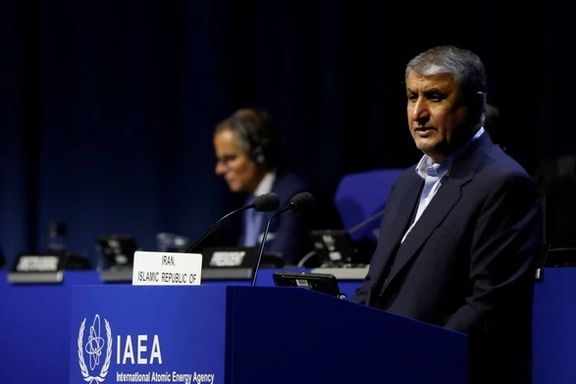
Head of Atomic Energy Organization of Iran Mohammad Eslami and International Atomic Energy Agency Director General Rafael Grossi attend the opening of the IAEA General Conference at their headquarters in Vienna, Austria, September 26, 2022.

The past year was a year full of tensions and Iran faced complex behaviors by Western powers, nuclear chief Mohammad Eslami said at the Friday Prayers in Tehran.

Eslami who is the head of the Atomic Energy Organization of Iran (AEOI) addressed the Friday congregation at its traditional venue in Tehran University, trying to portray the country’s nuclear program as a beacon of its scientific achievements and useful for civilian purposes.

Eslami also reiterated a common propaganda point by the Islamic Republic that Western powers do not want Iran and similar countries to gain access to technology, an argument debunked by economic progress China, South Korea, and others have made.

“New technologies are the arena of domination,” Eslami claimed, adding that Iran is being “punished for its progress.”

Anti-regime Iranians know this well and hold the Islamic Republic responsible for their economic pain and the country’s international isolation, as well as lack of freedoms and repression.

Iran’s secret nuclear program was revealed in 2002, followed by international and particularly Western pressure to come clean and accept monitoring by the International Atomic Energy Agency (IAEA), as well as limit the degree of its uranium enrichment to civilian uses.

After years of diplomacy, world powers, including Russia and China, agreed to impose sanctions on Tehran to force it to come to an agreement. In 2015, the Joint Comprehensive Plan of Action (JCPOA) was signed between Iran, the United States, United Kingdom, France, Germany, Russia and China, suspending the sanction in exchange for limiting the nuclear program.

However, in 2018, former US President Donald Trump withdrew from the agreement, criticizing it as a weak deal that would allow Iran to pursue nuclear weapons once the agreement’s sunset clauses kicked in.

Eslami said that despite Western declarations of a desire to return to the JCPOA, “they were not committed to their own rationale and words,” putting Iran in a tough position. “They exceeded in putting pressures,” he added.

The US withdrawal was followed by new American sanctions on Iran’s economy, which began to seriously affect its finances. Tehran announced that it would no longer abide by JCPOA limitations and would increase both the quantity and level of its enrichment. However, once President Joe Biden won the 2020 election and vowed to return to the JCPOA, Tehran announced its decision to increase the enrichment level to 20 and then 60 percent, getting closer to weapons-grade uranium.

Iranian President Ebrahim Raisi (left) and head of Iran's Atomic Organization Mohammad Eslami during a visit to Bushehr nuclear power plant, in the city of Bushehr, southern Iran (undated)
100%
Iranian President Ebrahim Raisi (left) and head of Iran's Atomic Organization Mohammad Eslami during a visit to Bushehr nuclear power plant, in the city of Bushehr, southern Iran

Negotiation followed in Vienna from April 2021, but by September 2022 the talks had reached a deadlock. Iran is now accumulating 60-percent uranium, while the US is maintaining the sanctions and saying that Tehran was deceptive during the talks and a return to the JCPOA is no longer on its agenda.

While Eslami in his speech tried to claim that the nuclear program has a useful civilian role, 60-percent enrichment can only have a military purpose – reaching the 90-percent weapons grade level.

The economic cost of the nuclear program has been very high for Iran, keeping economic growth near zero for more than a decade, leading to widespread poverty, antigovernment protests and one of the worst government repressions of the 21st century.

Opponents argue that the government did not need to make the country a hostage to its nuclear program, which has had virtually no economic benefit and only made the people of Iran suffer the price of punishing sanctions.

If the country had been transparent and abided by non-proliferation rules, it could have bought enriched uranium for civilian purposes from other countries. It’s intransigence has led to nothing but global isolation and the suffering of the Iranian people.


Most Viewed

100 days after carnage: Iran economy reels from war, inflation, unemployment
1
INSIGHT

100 days after carnage: Iran economy reels from war, inflation, unemployment

2
INSIGHT

Ghalibaf defends Iran-US talks amid hardline backlash

3
EXCLUSIVE

Iranian assaulted in London amid concern over threats to regime critics

4

IRGC fires at Indian vessel in Hormuz

5
INSIGHT

A nation in limbo: 100 days after the massacre, has the world moved on?

Banner
Banner

Spotlight

  • War-hit homeowners feel abandoned as Iran’s reconstruction aid fades

    War-hit homeowners feel abandoned as Iran’s reconstruction aid fades

  • 100 days on: the anatomy of Iran’s January crackdown
    INSIGHT

    100 days on: the anatomy of Iran’s January crackdown

  • Ghalibaf defends Iran-US talks amid hardline backlash
    INSIGHT

    Ghalibaf defends Iran-US talks amid hardline backlash

  • 100 days on: why Iran’s January protests spread across social classes
    ANALYSIS

    100 days on: why Iran’s January protests spread across social classes

  • From instability to influence: Pakistan’s pivotal role in US-Iran diplomacy
    ANALYSIS

    From instability to influence: Pakistan’s pivotal role in US-Iran diplomacy

  • A nation in limbo: 100 days after the massacre, has the world moved on?
    INSIGHT

    A nation in limbo: 100 days after the massacre, has the world moved on?

•
•
•

More Stories

Iran Pundits, Ex-Diplomats Welcome An Interim Agreement With US

Apr 6, 2023, 20:46 GMT+1
•
Iran International Newsroom

In a move might have been encouraged by the Iranian government, several commentators and former diplomats have called for the resumption of nuclear talks.

The pundits, who felt they could express their views in the local media, also supported an interim agreement with the United States which they said could be a positive achievement for Iran.

Former diplomat Ali Majedi advised the government in a commentary in Etemad daily, "not to be afraid of negotiations as Iran's foreign policy needs a serious development." He added that an interim agreement could be a prelude to returning to the 2015 Joint Comprehensive Plan of Action (JCPOA).

The idea of an interim agreement is a suggestion made by the United States which says it is currently not planning to return to the JCPOA, wrote Etemad.

Majedi said that a change in foreign policy has started with an agreement with Saudi Arabia to resume diplomatic ties after seven years of tensions. Majedi added that Supreme Leader Ali Khamenei's remark about Iran not holding a grudge against Europe in his Iranian New Year address could be a green light to Iranian diplomats to start settle the differences over the JCPOA.

Former diplomat Ali Majedi (undated)
100%
Former diplomat Ali Majedi

However, Khamenei later said in an early April speech that Iran should look for partners other than the United States and Europe.

Majedi, however, was not sure about the nature of an interim agreement and "what it means? Whether it is for six months or longer? Whether it can be extended?" Iran has previously dismissed an interim agreement emphasizing that it accepts nothing other than the 2015 agreement.

Majedi reiterated that if Iran can return to the agreement with the West and have the sanctions lifted, it would help its ailing economy. He added that "For its own interests, Iran's leaders should trust their negotiators no matter if the talks can or cannot be fruitful."

Meanwhile, another former diplomat , Abdolreza Faraji Rad suggested that "Iran and the United States had better start confidential negotiations," adding that "they might be able to reach an agreement if they talk face-to-face." The latest rounds of negotiations between Iran and the United States were indirect talks with European mediation, but the talks were suspended after Russia invaded Ukraine and Khamenei explicitly supported Russia and later Iran sent drones to be used against Ukraine.

Former diplomat Abdolreza Faraji-Rad (undated)
100%
Former diplomat Abdolreza Faraji-Rad

Faraji Rad added that the idea of an interim agreement and a new round of talks with the United States was put forward months before US media broke the news.

Taking the lead in the opposition to an interim government was IRGC-linked newspaper Javan which has always opposed any negotiations with America.

He said the United States and Europe are still not interested in renewed talks with Iran, but they have been mulling the idea of new negotiations in a bid to dissuade Iran from supporting Russia in the war against Ukraine. They believe winning Iran's heart with a Plan B including lifting some of the sanctions and allowing more oil exports could entice Iran to stop uranium enrichment at 60-percent level.

In another development, media commentator Hassan Beheshtipour said, "an interim agreement can be a temporary solution as a long-term agreement is impossible without holding negotiations with the United States."

Media commentator Hassan Beheshtipour (undated)
100%
Media commentator Hassan Beheshtipour

Beheshtipour, however, maintained that "an interim agreement cannot solve Iran's economic problem." He added that the most Iran can win in such an interim government is releasing its $7 billion frozen assets in South Korea.

He said, "Iran should nonetheless welcome the agreement if it helps solve its economic crisis. Otherwise, if Iran thinks it won’t face a major economic issue in the next four or five years, it can always wait for a more comprehensive agreement and a better solution."

US Dismisses Reports About Its Plans For a Partial Deal With Iran

Apr 6, 2023, 20:13 GMT+1

US State Department says reports about the administration planning a partial, interim nuclear deal with Iran are “rumors” that “tend to seldom be accurate.”

In response to a question on the issue by Iran International, State Department Deputy Spokesperson Vedant Patel also insisted that the President Joe Biden “has long said that he's committed to ensuring Iran never get to nuclear weapon, and we still believe diplomacy is the best way to achieve that goal. At the same time, we're preparing for all possible options and contingencies in coordination with our allies and partners.”

Axios reported on April 3 that according to multiple sources the administration shared a plan with allied governments to strike a partial deal with the Islamic Republic to freeze its uranium enrichment at 60 percent in exchange for some sanctions relief.

If true, Iran would gain the advantage of being a few months away from producing 90-percent enriched uranium needed for a nuclear weapon and enjoy the benefits of sanctions relief.

The Axios report also said that Israeli officials told the Biden team that Iran would be threading on dangerous ground that could lead to an Israeli military strike if it enriches above the 60-percent level.

However, spokesperson Patel said, “Rumors about nuclear diplomacy tend to seldom be accurate.” This is basically the same response given to Axios before it published its report, which does not categorically deny the report but tries to categorize it as a rumor that could be inaccurate.

Nearly 18 months of indirect talks with Iran to revive the 2015 nuclear accord, the JCPOA, reached a deadlock in September, and the administration since then has insisted that continuing the talks is not on its agenda.

Biden Admin Yet To Deny Claims Of Possible Interim Deal With Iran

Apr 5, 2023, 11:13 GMT+1
•
Iran International Newsroom

As reports emerge that Washington is contemplating an interim agreement allowing Iran to enrich uranium to 60%, the Biden Administration is mostly silent.

Reports in Axios claim that a new proposal is being tabled which would offer Iran sanctions relief in exchange for a freeze on certain parts of the nuclear program.

The administration told Axios that it does not want to comment on "rumors" but reports of a plan for an interim deal have quoted several diplomats.

Iran has amassed 87.5 kilograms of 60% enriched uranium, according to an International Atomic Energy Agency report from late February. Experts say that if that uranium is enriched to 90% weapons grade, it would be a sufficient quantity to produce at least one nuclear bomb.

If the Biden team tries to gently return to the 2015 nuclear agreement, taken off the agenda last year over Iran's military assistance to Russia and Tehran's crackdown on anti-government protests, there are other risks ahead.

If sanctions are reduced in exchange for freezing Iran's enrichment at 60 percent, it will essentially recognize Tehran's right to hold on to fissile material that has no civilian use and can be only employed to make nuclear weapons. Under such a deal, Iran can change its mind in the future and quickly ditch the deal and dash towards a bomb in a few months, while having profited from sanctions relief.

Advanced enrichment machines in Iran's Fordow underground facility. Undated
100%
Advanced enrichment machines in Iran's Fordow underground facility

The White House has failed to clearly deny the latest news, which suggests to many in Washington, that it is more a reality than a rumor.

An agreement on returning to the 2015 nuclear agreement was nearly reached last September, but Iran pulled out at the last minute after Western countries rejected its demand to shut down the International Atomic Energy Agency (IAEA) investigation into undeclared nuclear sites.

There is huge concern in the global community. Gabriel Noronha, the ex-State Department Iran advisor, said on Twitter: “This October, Iran can buy and sell ballistic missiles and long-range drones to any country (like Russia) *legally* under international law. The UN's asset freeze against 67 Iranian nuclear scientists and entities expires then too.

“In October 2025, all UN sanctions on Iran expire. The European Union pledged to end all its sanctions on Iran then as well. And what's worse, at that point, it will be next to impossible to ever put new ones back in place.”

The Iran threat remains high in Israel, Tehran's archenemy, which has told the US that with or without it, it will deal with the threat it poses. This week, Prime Minister Benjamin Netanyahu told its intelligence agency, Mossad, that Iran remains the threat of the generation.

Joint US-Israeli military drills in January 2023
100%
Joint US-Israeli military drills in January 2023

Israeli officials recently told the Biden administration and European officials that Iran risked a military strike if it enriches uranium above the 60% level, according to Axios.

At a gathering of intelligence staff this week, Netanyahu said: "In every generation there are those who rise up to destroy us and in this generation Iran has risen up to destroy us. If we do not prevent Iran from obtaining nuclear weapons, we will be in a different reality in which the entire world will be hostage to those who have inscribed on their flag their desire to destroy us; therefore, this is our supreme mission.”

Jason Brodsky, policy director at United Against A Nuclear Iran, said the US must find a new approach, the last two years among the administration’s biggest failings. Allowing it to have a 60% threshold will only embolden it further.

Writing for The Atlantic Council, he said: “Tehran has been emboldened to continue to test international red lines by the absence of nuclear deterrence. While the diplomatic door remained open for two years, the regime made its greatest advances. Between May 2018 and January 2021, when the Donald Trump administration was pursuing its maximum pressure policy, Iran only carefully, incrementally, and reversibly advanced its nuclear program beyond the JCPOA limits.”

He, as with others such as Noronho, calls on nations to enact the snapback mechanism, allowing nations to pull back the relief that ending the sanctions on Iran would bring.

“The United States and Europe urgently need a new Iran policy. And the way to begin would be for either Britain or France, as permanent members of the UN Security Council, to invoke the snapback sanctions mechanism under UN Security Council Resolution 2231.

“It would shatter the Iranian decision-making calculus, which begot escalation under the assumption that the United States and Europe would always remain at the negotiating table no matter what steps Tehran takes.”

Politicians, Media In Iran Suggest Returning To JCPOA Is Essential

Apr 4, 2023, 13:04 GMT+1
•
Iran International Newsroom

A former Iranian diplomat says the implementation of the 2015 nuclear deal (JCPOA) is essential for the Islamic Republic's survival.

Nosratollah Tajik also said in his interview with reformist daily Etemad that the revival of the JCPOA has been almost forgotten as a result of miscalculations by Iran and the West.

Russia and China have taken advantage of the situation to strengthen their presence in the region, he argued, warning that Iran should not ignore the implications of this strategic development.

Referring to Iran's rapprochement with Saudi Arabia, Tajik noted that good regional relations will be helpful only if Iran has no problems in its international relations. In other words, good ties with neighbors are essential but not enough for Iran. The revival of the JCPOA can pave the way for Iran to leave behind its global isolation.

Former Iranian diplomat Nosratollah Tajik (undated)
100%
Former Iranian diplomat Nosratollah Tajik

This comes while according to Tajik, the West sees the recent joint military exercise by Russia, China and Iran in regional waters as a manifestation of Tehran's pro-East policy and a challenge to the United States.

In another development, former government spokesman Ali Rabiei wrote in a commentary in Etemad that "Those who thought US sanctions would benefit Iran have now realized that sanctions cost Iranian lives and bring about breath-taking poverty to the country.

Many Iranian officials including Supreme Leader Ali Khamenei have claimed since the 2010s that sanctions have helped Iran to make indigenous progress, but they failed to present any evidence of economic success, while economists have maintained that the sanctions have led to Iran's worst crisis in modern history particularly by reducing oil exports and restricting international banking.

Meanwhile, Rabiei predicted that Iran's problems are likely to redouble in the current year as a result of the nationwide protests that have rocked the country in since September 2022. He further predicted that "what started last year is most likely to continue in the current year. He said, "Sometimes such events affect a whole generation by bringing to surface deep-rooted social, economic and political problems as well as Iran's fundamentalist cultural policies" that bring a modern nation face to face with the government.

Former government spokesman Ali Rabiei (undated)
100%
Former government spokesman Ali Rabiei

Likewise, he said that last year's protests have their roots in developments throughout 2020 and 2021, including elections that were not free and fair. Also, a pandemic that was not properly managed and US sanctions, that continued even after Donald Trump left the White House although the situation of sanctions has been slightly less difficult for Iran during Biden's presidency. However, the economic problems resulting from the sanctions created a state of despair that strengthened other destabilizing factors.

Despite these lessons, conservative daily Jomhouri Eslami wrote in an editorial on April 3 that Iran's ultraconservative President Ebrahim "Raisi is adamant to go ahead with his failed policies."

Iran's President Ebrahim Raisi (undated)
100%
Iran's President Ebrahim Raisi

The daily wrote that rhetoric by senior officials during the first two weeks of the Iranian New Year that started on March 21 show that the government is not inclines to change counter-productive policies. The daily was referring in particular to Supreme Leader Ali Khamenei's position on hijab enforcement and other cultural issues in his New Year address, without naming him. The daily advised officials to see the people's lack of trust in the government, their daily protests in different forms and the number of those who leave the country to realize that “Iran is not feeling well.”

The editorial further suggested that the government should end the political game over the negotiations to revive the JCPOA and reconsider its approach to relations with the West to solve Iran’s serious economic crisis.

Biden Admin Discussed A Partial Iran Deal With Allies - Axios

Apr 3, 2023, 22:04 GMT+1

The Biden Administration has been entertaining the idea of a partial nuclear deal with Iran and has discussed it with allies, Axios reported on Monday.

According to a report by Barak Ravid, its correspondent in Israel, Axios said that according to ten Israeli and Western sources the administration shared the plan with allies.

In exchange for freezing Iran’s uranium enrichment at 60 percent the US would ease some sanctions. If true, Iran would gain the advantage of being a few months away from producing 90-percent enriched uranium needed for a nuclear weapon and enjoy the benefits of sanctions relief.

The report says that Israeli officials told the Biden team that Iran would be threading on dangerous ground that could lead to an Israeli military strike if it enriches above the 60-percent level.

Since September when nuclear talks reached a deadlock the Biden administration has been insisting that it is no longer focused on restoring the 2015 nuclear deal known as the JCPOA. The White House has been insisting on Iran respecting human rights and refraining from supplying weapons to Russia, in what seems to be a new and tougher position regarding the Iranian regime.

A US National Security Council spokesman told Axios that the administration is “absolutely committed to ensuring Iran never acquires a nuclear weapon, and we still believe diplomacy is the best way to achieve that objective,” but rejected the report of a partial deal as second-hand rumors, insisting that “nearly all such rumors are false.”.



