• العربية
  • فارسی
Brand
  • Iran Insight
  • Politics
  • Economy
  • Analysis
  • Special Report
  • Opinion
  • Podcast
  • Iran Insight
  • Politics
  • Economy
  • Analysis
  • Special Report
  • Opinion
  • Podcast
  • Theme
  • Language
    • العربية
    • فارسی
  • Iran Insight
  • Politics
  • Economy
  • Analysis
  • Special Report
  • Opinion
  • Podcast
All rights reserved for Volant Media UK Limited
volant media logo

Iran Scholars, Educators, Discuss Characteristics of Generation Z
Iran International Newsroom
Apr 2, 2023, 12:33 GMT+1Updated: 17:43 GMT+1
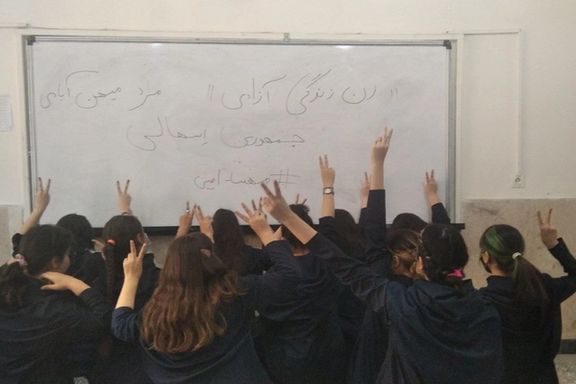
Several schoolgirls unveiling in their classroom in support of the Women, Life, Liberty movement

Experts in Iran concur that Generation Z, men and women born after 2000, were the driving force in recent nationwide protests and the Women, Life, Freedom movement.

In an April 1 report, Khabar Online website has interviewed 8 social scientists and commentators about Generation Z's role in Iran's new revolution. Mostafa Mehraeen, a sociologist told the website that "This generation has a thorough understanding of life and human beings and wishes to spread peace on earth." Mehraeein further described Generation Z as "a generation that is an expert on philosophy without having studied it."

Referring to views that this generation is cut off from the past, Mehraeein said that various generations are not separate from each other. In fact, we live in the past, present and future at the same time. "We are facing a generation that has been educated by the previous generation," he said.

Demographer Shahla Kazemipour (April 2023)
100%
Demographer Shahla Kazemipour

Demographer Shahla Kazemipour also pointed out that the Generation Z is not a separate entity far from the mainstream society. But they do not need to be in the streets to see embezzlements and financial corruption by officials. They can see everything on social media from behind their computer monitors.

She added, "While the previous generation came from families with up to 7 children, Generation Z comes from smaller families who can spend more on their children's education. At the same time, unlike the previous generation, they have access to communication tools such as the Internet. So, their world is bigger than Tehran or Iran. That is why they are socially more mature than the previous generation.

Mohammad Taghi Fallah, a teacher, said, "Generation Z is looking for its own independent identity. In their world, the individual is an active member of the society and his or her uniqueness is the most eye-catching characteristic element.

Sociologist Ahmad Bokharaei (undated)
100%
Sociologist Ahmad Bokharaei

Ahmad Bokharaei, a sociologist, said the members of Generation Z were in the forefront of the protests in Iran. They were brave and had very little to lose. Although protesters were from different age groups but Generation Z's presence was more visible.

He warned that if their voice is not heard, the chances are that they will be disillusioned and left with no more motivation. This can even lead them to commit suicide or try drugs.

Another sociologist, Mehdi Ghavamipour, told Khabar Online that although there is a generational gap in most other societies, the characteristics of Iran's ideological society has made the divide between Generation Z and previous generation wider. He added that the conflict between traditions and modernity has made Generation Z's interests, demands and prejudices different from those of other generations.

He added that some scholars see this as a gap between the official culture and the pop culture as well as the impact of the crisis of inefficiency in the government. This new generation, he said, stresses the significance of modern life and ignores or totally rejects traditional concepts. They follow a different lifestyle than the previous generations.

Mohammad Reza Niknejad, a teacher, said the main characteristic of this generation is its bravery and knowledge. They have proven that older individuals are not necessarily more knowledgeable than the youths. In fact, in many families, the elderly have realized this difference and adapted their lifestyle to what their children want.

Iranian sociologist Mostafa Abroshen (undated)
100%
Iranian sociologist Mostafa Abroshen

Iranian sociologist Mostafa Abroshen, on the other hand, says Generation Z is a manifestation of the post-modern approach in the Iranian society. This generation challenges and questions both traditions and modernity. They demand pluralism and oppose unilateralism. They also challenge the traditional society's sanctities. They look down at the kind of obedience that was prevalent in the traditional families.

Nearly all these characteristics have been observed during more than six months of protests in Iran when the new generation challenged the values propagated by Iran's traditional clerics and the regime during the past four decades.

Nargess Malekzadeh, a teacher, observed that "Generation Z was not born during the 2022 protests. They are the children of a silently protesting previous generation that nurtured the new generation."

Most Viewed

Ghalibaf defends Iran-US talks amid hardline backlash
1
INSIGHT

Ghalibaf defends Iran-US talks amid hardline backlash

2
VOICES FROM IRAN

Bread shortages, soaring prices strain households in Iran, residents say

3
INSIGHT

Iran diplomacy wobbles as factions compete to avoid looking soft on US

4
ANALYSIS

The politics of pink: how Iran uses cuteness to rebrand violence

5

War-hit homeowners feel abandoned as Iran’s reconstruction aid fades

Banner
Banner

Spotlight

  • Is Iran entering its Gorbachev moment?
    INSIGHT

    Is Iran entering its Gorbachev moment?

  • Iran crackdown reaches cemeteries as graves of slain protesters defaced
    EXCLUSIVE

    Iran crackdown reaches cemeteries as graves of slain protesters defaced

  • Iran diplomacy wobbles as factions compete to avoid looking soft on US
    INSIGHT

    Iran diplomacy wobbles as factions compete to avoid looking soft on US

  • The politics of pink: how Iran uses cuteness to rebrand violence
    ANALYSIS

    The politics of pink: how Iran uses cuteness to rebrand violence

  • Bread shortages, soaring prices strain households in Iran, residents say
    VOICES FROM IRAN

    Bread shortages, soaring prices strain households in Iran, residents say

  • Ghalibaf defends Iran-US talks amid hardline backlash
    INSIGHT

    Ghalibaf defends Iran-US talks amid hardline backlash

•
•
•

More Stories

Iran Regime Keeps Sealing Shops, Malls In Which Hijab Not Observed

Apr 2, 2023, 10:47 GMT+1

Dozens of shops and malls in which Iranian women continue to flout the regime’s mandatory hijab rules have been closed down across Iran with dozens more women arrested.

As the regime fights a losing battle against the wave of women bravely participating in a nationwide hijab rebellion, the tide against oppression continues.

In Kashan, Esfahan (Isfahan) province, Karim Ahmadi, an IRGC commander, said more than 40 shops have been shut down for their customers not complying with Islamic dress code.

Meanwhile, upon the order of the city prosecutor, Kashan Mall, the largest commercial and tourism center of the city has also been sealed for mass breaking of the compulsory hijab rule.

A video from Kermanshah in the west shows the staff of Taq-e Bostan historical complex preventing women without the headscarf from visiting the ancient monument.

In the southern Khuzestan province, Dezful's prosecutor, Mehdi Amadeh said "one of the city’s tourist sites has been sealed since Friday due to non-compliance with moral standards".

As women across Iran defiantly dance in public as protest against female oppression, Amadeh also said, “While not observing the hijab, some women also danced without the veil.”

On Thursday, the Dezful prosecutor announced several people have been arrested on charges of embarking on a tour in the Dez Lake area and "norm breaking" during the event. Government authorities are not backing down on this issue. On Saturday, President Ebrahim Raisi declared the compulsory hijab "obligatory" adding that "it is a religious necessity”.

Iran’s FM Says Meeting With Saudi Counterpart To Be Confirmed In Two Days

Apr 2, 2023, 08:57 GMT+1

Iran’s foreign minister says within the next 48 hours he will have a phone conversation with his Saudi counterpart to confirm the date and venue of their expected meeting.

Hossein Amir-Abdollahian made the comments on Saturday on the occasion of the national flag day.

Following the recent agreement between Iran and Saudi Arabia in Beijing to resume diplomatic relations and reopen embassies and consulates, Amir-Abdollahian and his Saudi counterpart, Faisal bin Farhan, had two phone conversations. During their second phone call, it was agreed that the two foreign ministers hold a meeting in the fasting month of Ramadan.

Iranian foreign minister further claimed that the Islamic Republic “owes its legitimacy to the great people of Iran, and the key to the stability of the Islamic Republic is the continuation of such legitimacy and the vote of people.”

“In the past forty-four years, the enemies made many efforts to incur their enmity against the Islamic Republic…and the holy flag of Iran. However, hoisting of Iranian flag after 44 years proves the failure of their policy and…the heart-felt interest of Iranians all over the world for the great and Islamic Iran,” he added.

His statements come as the Islamic regime has been facing a more serious legitimacy crisis over the past six month with mass protests across the country with people clearly calling for the ouster of the regime.

He also talks of heart-felt support of Iranians across the world as tens of thousands of Iranian living abroad have repeatedly staged protests in different cities of the world to condemn the brutality of the regime which killed over 500 protesters and wounded many more since the death of Mahsa Amini in police custody in September.

Israel Attacks New Targets In Syria As Second IRGC Officer Dies

Apr 2, 2023, 08:29 GMT+1
•
Iran International Newsroom

Israel attacked targets for a third time in four days in Syria hitting two bases where Iranian forces operate in Homs province early on Sunday.

Syria’s defense ministry announced the attacks without providing much detail, while Western intelligence sources told Reuters the strikes hit a series of air bases in the central region of the country where Iranian forces are based.

Meanwhile, media close to the Revolutionary Guard in Tehran reported that a second officer described as a military adviser, who was wounded in a similar attack on Friday died of his injuries.

"Meqdad Meqdani (Meghdad Meghdani) was wounded during the Zionist attack on Friday dawn and was martyred," Mehr news affiliated with the IRGC said.

On Friday, IRGC announced the death of an officer in one of the earlier Israeli attacks. "The Islamic Revolutionary Guards Corps has announced the martyrdom of guardsman Milad Haydari, one of the IRGC's military advisers and officers, in the criminal attack of the Zionist regime on the outskirts of Damascus at dawn today," the media quoted an IRGC statement, which also threatened revenge.

Iran usually does not report the extent of its casualties in Syria and some observers say that acknowledging the deaths of two IRGC personnel can be a sign of Tehran’s plan to retaliate against Israel to avenge the blood of “martyrs.”

An undated photo of Meqdani in uniform. Location unknown
100%
An undated photo of Meqdani in uniform. Location unknown

Israel, which rarely acknowledges attacks in Syria has not commented so far on this week’s strikes.

Israel launched "an aerial aggression from the direction of northwest Beirut targeting some outposts in Homs city and its countryside at 00:35 a.m.", the Syrian defense ministry said in a statement on state media.

Iran says its officers serve in an advisory role in Syria at the invitation of Damascus. Dozens of Revolutionary Guards members including senior officers have been killed in Syria during the war.

A war monitoring group based in London reported that this was the 9th Israeli attack in 2023. “Explosions were heard and fire broke out in the scientific research area in Khirbat Al-Tain,” the Syrian Observatory for Human Rights (SOHR) said. Positions in Al-Qasir area and Al-Daba’a military airport were also hit, where ambulances rushed amid reports of casualties.

SOHR added that according to “reliable sources” five Revolutionary Guard officers, including a senior commander, were killed in the first Israeli strike in Damascus on Thursday.

Reuters quoted wo Western intelligence sources who requested anonymity due to the sensitivity of the matter said the rocket strikes targeted the T4 air base located west of the ancient city of Palmyra, and al Dabaa airport near al Qusayr city near the Lebanese border, an area with members of the Iranian-backed Hezbollah.

Israel has intensified strikes in the last year on Syrian airports and air bases to disrupt what it says is Iran's use of aerial supply lines to deliver arms to militias.

According to Reuters, Western intelligence sources have said Iran is increasingly using several civilian airports to deliver more arms, taking advantage of heavy air traffic as cargo planes offload relief aid following February's deadly earthquake.

In March Israel targeted the airport in the northern city of Aleppo where Iran said it was delivering aid for earthquake victims, but Israel characterized the flights as military in nature disguised as assistance.

Meanwhile Fars news agency in Tehran, also affiliated with the Revolutionary Guard reported that memorial services in Iran and Syria will be held for the first officer, Milad Haydari.

Conflicts Over Hijab Continue In Iran As Regime Insists On Enforcement

Apr 2, 2023, 06:51 GMT+1
•
Maryam Sinaiee

Conflicts between vigilantes and women defying hijab in public occur almost daily now while authorities including the President insist on enforcement of rules.

There has been a torrent of comments by clerics and hardliners in recent days against women who ignore hijab rules, while thousands appear in public without a headscarf. As regime vigilantes are encouraged to stop women and admonish them, another serious conflict is brewing in the country.

A video from the CCTV of a convenience store in Shandiz near the religious city of Mashhad went viral on social media Friday that showed a man dumping a large tub of yogurt after an argument on the head of a ‘hijabless’ woman and her mother, who was wearing a headscarf.

The man, apparently a member of the Revolutionary Guards’ Basij militia, had been carrying out his Islamic duty of “calling to virtue and forbidding wrong”. Local authorities said Saturday the man was arrested for disturbing public peace and insulting the women. Officials said that carrying out the duty of hijab enforcement should remain limited to verbal warnings only.

Both women were also arrested for defying hijab rules and the owner of the business was given a warning for allowing violation of the hijab law on his premises.

Dr Mohsen Borhani, a professor of criminal law at Tehran university, who was recently sacked for criticizing the regime after the execution of four young protesters, argued in a tweet Friday that even according to Islamic Sharia and laws, carrying out the religious duty of calling to virtue and forbidding wrong should never go beyond a verbal warning.

Attacking people and their property or violating their dignity and rights are criminal acts and victims have the right to self-defense according to Article 156 of the Islamic Penal Code of Iran, Borhani, a well-known religious scholar, wrote.

Moderate Muslims, including some clerics, have also been critical of hardliners intimidating women to impose the hijab.

Protests in Iran (undated)
100%
Protests in Iran

“This was not a tub of yogurt that was thrown on a girl’s head. It was bigotry and a putrid sludge crammed into the head of the yogurt-thrower over the years,” reformist politician and cleric Mohammad Ali Abtahi who served as vice-president under Mohammad Khatami in late 1990s and early 2000s protested in a tweet.

‘Hijabless’ girl in Gonbad-e Kavous, a rather conservative city in northeastern Iran

In July 2022, after weeks of harsher measures on the streets, President Ebrahim Raisi ordered all government entities to strictly implement a “chastity and hijab” law approved by the Supreme Cultural Revolution Council under hardliner Mahmoud Ahmadinejad in 2005. He insisted again today, Saturday, that women should abide by the hijab rules.

“Chastity and hijab are religious matters and all pious Muslims stress on its necessity. Hijab protects the individual and the society from all harms and deviations,” he said, adding that since there is a law, even those who say they do not believe in hijab must abide by the rules. “Women and girls have shown that they abide by the law and will continue to do so.”

In the past four decades women generally demonstrated their opposition to compulsory hijab by making their headscarves smaller and letting their hair cascade on their shoulders from under it or making their tunics tighter and trousers shorter, wearing colorful clothes and putting on make-up.

Authorities referred to these women’s hijab as ‘bad’ or ‘improper’ and called them ‘bad-hijab women’.

It was only in 2018 that some women in Tehran and other larger cities began to wear their headscarves on their shoulders rather than their heads wherever they could. Now many are not even carrying a headscarf in their bag to use if they get into trouble. They are referred to as ‘hijabless’.

Defiance of hijab rules as a form of civil disobedience has hugely grown across the country after the death the 22-year-old Mahsa (Jina) Amini in custody of morality police in mid-September. Many believe that there is no sign ‘hijabless’ women will allow to be bullied again into wearing the hijab.

Medicine Shortages, Rising Prices In Coming Months, Iran Lawmaker Says

Apr 1, 2023, 21:55 GMT+1
•
Iran International Newsroom

Medicine shortages and rising prices have already been grave in Iran but now officials say the situation will aggravate in the coming months.

Masoud Pezeshkian, the representative of Tabriz at the parliament and a member of the medical and healthcare committee, said Saturday that the drug manufacturers in the country cannot import the raw materials to produce medicines due to the elimination of the government’s subsidies.

Parliament approved the government’s decision to scrap an annual $9-14 billion subsidy for essential food and medicines in March 2022, despite warnings of more inflation and hardship. The idea to eliminate the subsidy emerged after hardliner president Ebrahim Raisi assumed office earlier in the year in August, counting on support from conservatives and ultra-conservatives in control of the parliament.

“Medicines will become more expensive this year, and because medicine manufacturers do not have the necessary funds to import the raw material for drug production, they may not be able to produce as much medicine as the population needs, so we will also face a shortage of medicine,” Pezeshkian said.

Lawmaker Masoud Pezeshkian (undated)
100%
Lawmaker Masoud Pezeshkian

Criticizing the administration for not providing the necessary funds to import medicine, he added that the inflation was so high in the previous Iranian year that people could not afford to buy medicines anymore. The Central Bank of Iran announced last week that the annual inflation rate stands at 46.5 percent, among the highest in Iran in more than 30 years. Iran’s rial fell to more than 600,000 in late February from 300,000 in late August. Although the national currency bounced back to about 540,000 it is still down about 50 percent compared to six months ago. 

His remarks echoed earlier statements by officials such as lawmaker Hosseinali Shahriari, who warned in March that "the financial resources foreseen in the budget bill for the next Iranian (which started March 21) year are not sufficient at all... we will face problems regarding medicines and medical equipment.”

Taghi Naghdali, a member of the parliament's judicial and legal committee, said in September that without allocation of cheap foreign currency to pharmaceutical imports the government's Medicine Assistance Plan is bound to fail. Health Minister Bahram Eynollahi, who always tries to downplay the severity of the situation, had called the plan “a miracle” in its early days but announced in January that the government faces a deficit of about 360 trillion rials (about $7 billion in today’s exchange rate) for supplying the needed medicines. Eynollahi also claimed that drugstores are full of medicines and only a few items are not available.

Mohammad Reza Afkhami, Secretary of Khorasan Razavi Pharmacists Association, warned last year that in addition to medications for special illnesses, some common medications like cold pills, acetaminophen, amoxicillin, distilled water, and syringes are scarce due to the government mismanagement. He added that many of the pharmacies are going bankrupt due to economic problems, noting that pharmacies are not separate from other guilds and are not in a good economic situation.

medicines-shortages-iran (file photo)
100%
A pharmacy in Iran's capital Tehran

Homayoun Najafabadi, another member of the parliament's health committee, also said last year that the shortage and high prices of medicines are not limited to certain drugs anymore, and very common medications are also scarce and expensive. The deputy head of the Iranian Pharmaceutical Importers Association, Mojtaba Bourbour, said in January 2022 that the government’s claim of self-sufficiency in production of raw materials for medicine and pharmaceutical products is not true. “About 80 to 90 percent of the needed raw materials are imported from China and India," he said, adding that some medicines are imported from China but sold as made in Iran. 

In the previous Iranian year, the medicine crisis intensified as people suffered from multifold price increases while many medicine items were not available in the market at all, pushing people to the black market fed with smuggled medicines.

The Islamic Republic has been claiming that United States sanctions prevent procurement of medicines, while Washington insists that humanitarian aid is exempt from sanctions and in fact, food, health and humanitarian products are not sanctioned. Iran has been importing more than $1.5 billion of medicines a year. Iran imports around 100 million euros of medicines a month just from Europe and also large quantities from China and India.

Considering the incessant bemoaning by the Islamic Republic’s officials about the effect of US sanctions on shortages of medicine in the country, there are speculations that the government is pleased with the psychological effects of the shortages on foreign audiences, wearing down a people already fatigued by months of revolutionary fervor.