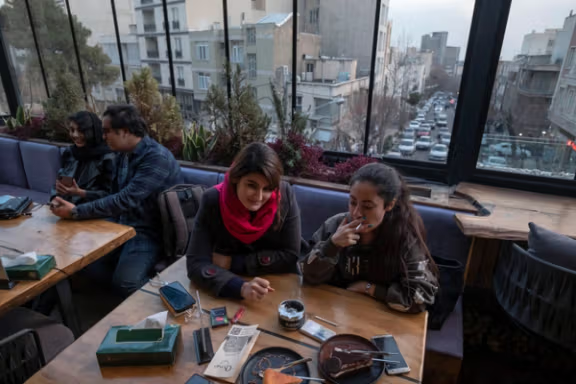
Young women in a Tehran cafe, defying obligatory hijab. January 29, 2023
Friday imams across Iran excessively eulogized Supreme Leader Ali Khamenei and demanded tighter hijab control and enforcement of the Ramadhan restrictions.
“His highness the Supreme Leader is the best personality [created] after the Imam of the Age,” Kazem Sadighi, Friday imam of Tehran told his congregation Friday in his first sermon of the new Iranian year.
In Shiite eschatology, the twelfth imam, Mahdi, is a messianic figure thought to have been in occultation by divine will since 941 CE. He is referred to as the Imam of Ages who will appear at the end of time to cleanse the world of sin and evil. Khamenei’s devotees often refer to him as the representative of the Imam of Ages, with absolute power to rule.
Sadighi also promised that Iranians will make the world a better place under Khamenei’s banner who he said is the commander-in-chief of all of the world’s oppressed people and “the resistance front” against the world powers and “an example [for mankind], an imam, a leader and divine executive.”
Sadighi leading the Friday prayer in Tehran on March 24, 2023
“The esteemed Leader has waged war on Satan and named this year as the year bridling inflation and boosting production,” another imam in the southern city of Shiraz, Ayatollah Lotfollah Dozhakam said in his sermon while exhorting his congregation to obey Khamenei.
“We can’t claim we are Muslims and awaiting the appearance of the Imam of Ages but do not obey his representative (Khamenei),” Dozhakam said.
Another Khamenei appointed Friday imam, Hojjat ol-Eslam Mahmoud Noorpour who also represents him in the northern Golestan Province told his congregation that hijab is “the most important institution of the Islamic Republic” and urged the authorities to enforce it at government offices, public places, hospitals and pharmacies, shops, and schools and universities.
Women in a hijab enforcement patrol tasked with "advising" women to cover their heads
Many women have been refusing to wear the compulsory hijab since September when anti-government protests engulfed the country in reaction to the death of the 22-year-old Mahsa (Jina) Aamini in the custody of the morality police. The young woman was arrested and taken to a detention center because the morality police patrols deemed her hijab not appropriate enough.
Photos and videos posted on social media these days show many women stepping into shops and banks and riding on public transport with no headscarf. To the religious and hardline political establishment, refusal to wear the hijab is nothing short of open defiance of the regime and its ideology.
But it is not only the hijab that they are worried about these days. The month of Ramadhan has arrived. For decades, the regime has banned all eating, drinking, and smoking in public including at workplace and schools before dusk when those who fast can begin eat and drink.
Police stopping a man on the street for smoking during the month of Ramadhan
Clerics have even coined a term for the acts of eating, drinking, or smoking in public during the fasting hours which could very loosely be translated into “showing off in public that one is not fasting”. This ‘crime’ is punishable by ten to sixty days of prison or up to 74 lashes.
Even girls as young as nine are required to abide by the fasting rules at school because it is the age they are believed to be mature enough to wear the hijab and to fast. For boys the age of maturity comes much later, at fifteen.
“Respecting the holiness of the month of Ramadhan is a must for all. Showing off that one is not fasting is even worse than not fasting,” Ghorbanali Dorri-Najafabadi, the Friday imam of the city of Arak said while his peer in Gonbad, Noorpour, urged the police and state-sponsored vigilantes who are mainly responsible for warning those who do not abide by the hijab to “take decisive action against those who break the law.”
Iran’s foreign ministry has condemned US retaliatory strikes on its proxy forces in Syria, labelling them as “terrorist aggression” against “civilian targets.”
Ministry spokesman Nasser Kanaani was quoted by the official news agency IRNAas saying, “The continuation of America’s illegal presence in, and occupation of parts of Syria, as well attacks against different targets in that country, are violations of international law and Syria’s sovereignty and territorial integrity.”
The US military retaliated against drone and rocket attacks targeting its bases in northeastern Syria launched by proxy forces controlled by Iran’s Revolutionary Guard, the IRGC, on Thursday and Friday.
The Pentagon and the Biden administration, while reiterating their determination to defend US personnel, emphasized that they were careful in their military strikes to minimize loss of any Iranian lives and collateral damage.
Kanaani referring to US support for “the fake Zionist regime” said, “US claims of maintaining a presence in Syria for fighting against the Islamic State group, which the US has a major role in its creation, is simply an excuse for occupation and pillaging Syria’s national wealth, including its energy resources.”
Tehran has been repeatedly alleging that the United States is “stealing oil” from Syrian oil fields close to its bases.
The spokesman also rejected US accusations as unfounded, implicitly referring to statements that attacks on US forces were launched by militias under Iranian command.
Critics in the US have accused the Biden Administration of a meek response to Iranian-led attacks in Syria and Iraq. Since President Joe Biden assumed office there have been 80 such attacks and but only a few US retaliatory strikes.
President Ebrahim Raisi delivering a speech to hardliner parliament in 2021
An article in Tehran media says even if the nationwide protests had not occurred, the government of President Ebrahim Raisi would have faced serious problems.
The article by journalist Davoud Heshmatiin Shargh said Raisi was too optimistic toward the loose coalition among conservative groups that formed his government and took over the parliament. In fact, popular protests may have delayed the activation of fault-lines within the government and preserved its unity. "The coalition was too fragile," Heshmati wrote.
"Despite the delay, in its emergence, the political deadlock is quite visible. The government is incapable of making decisions and this makes next year's developments interesting," he said.
According to the author, "the Iranian society is alive, but Iranian politics is in coma." The Iranian society is anything but "indifferent." Everyone thought the youth were apolitical, but they managed to create a great movement in the streets even without a leadership and organization. What brought them together was the demands for freedom in choosing their lifestyle.
The protests that erupted last September after the death of a young woman in police custody over her ‘inadequate hijab’, was led by teenagers and young people, especially women.
Another issue Heshmati pointed out was that the Iranians had already lost hope in elections after former president Hassan Rouhani refused to or was unable to address the issue of democracy and representation and instead dedicated his efforts to resolving the nuclear issue with the West, only to be blocked by hardliners.
Journalist in Tehran, Davoud Heshmati
Heshmati wrote that part of the reason hardliners took over the parliament in 2020 and the presidency in 2021, was the people's disillusionment about the possibility of change and reform after eight years of a centrist president. The majority simply did not turn out to vote, giving hardliners the victory.
As a result, Heshmati argued, political action that should have happened during elections spilled to the streets where activists with little or no political background took the lead. Now, they have returned to their homes, tired and battered. The government in Iran is adamant not to recognize their movement and the opposition outside the country can only radicalize the movement and work hard to advocate the demand for regime change.
This has led to a situation in which the society is in an unpleasant political state and the government has lost its capacity to handle the economic crisis because of the impact of the protests and rivalries that are tearing apart the political system.
As a way out of this situation, Heshmati suggested that the regime needs to restore the people's trust in the political system by attaching importance to the ballot box in the parliamentary elections in 2024 and by encouraging everyone to take part by promising representation and allowing political parties to become active.
Meanwhile, both the protesters who took to the streets for months and politicians in Iran maintain that"Iranians no longer believe in the reformist-conservative dichotomy," and they are unlikely to settle for stage-managed elections that would bring the same old useless politicians to the parliament.
In the absence of rigorous street protests, people who chant slogans from their rooftops or out of their windows every night make it known that their demands are beyond what reformists and conservatives tolerated by the regime can claim to meet.
Meanwhile, like many other politicians and analysts during the past months, an article in Donya-e Eqtesad (Economic World) pointed out that Iran's domestic problems are unlikely to be solved without addressing key foreign policy issues most markedly the nuclear issue.
Iran's security council Saturday warned the United States against further attacks on its proxy bases in Syria stressing that any further strikes will be countered immediately.
Supreme National Security Council spokesman Keyvan Khosravi issued the warning following reports about an increase in casualties of US attacks on pro-Iranian militias in Syria.
So far, militias controlled by Iran have carried out at least two attacks on US bases in northeastern Syria, with two instances of US retaliation.
According to a report by the UK-based Syrian Observatory for Human Rights, the attacks left 19 dead, including three Syrian regime soldiers and 16 members of Iran-backed forces.
The Observatory said the attacks were carried out in the early hours of Friday local time by US fighter jets and drones, targeting positions of forces led by the Iranian Revolutionary Guards (IRGC) in Al-Bokamal desert, as well as other positions on the southern outskirts of Al-Mayadeen city and an ammunition warehouse opposite the “Officers Residences” in Harabesh neighborhood in Deir ez-Zur city.
The Pentagon said on Friday that the US military carried out the attack against militia groups who it blamed for a drone attack on Thursday that killed an American contractor, injured another, and wounded five US troops.
The US intelligence community assessed that the one-way attack drone was Iranian in origin, the military said, a conclusion that could further aggravate already strained tensions between Washington and Tehran.
An Iranian car factory producing older French models
The head of construction workers trade union in Iran says the labor force is unwilling to work in large industries because of low wages amid a shortage of skilled workers.
Akbar Showkat told ILNA news agency in Tehran on Saturday that neither the employers nor expert workers are satisfied with production and work at factories because of the government’s wage policies.
Because of highly erratic currency rates, businesses are reluctant to take risks as there is the ever-present danger of higher inflation.
“Most of the employers’ expenses are related to working capital, which leads to an increase in the price of manufactured goods every year and as a result it puts more pressure on the workers’ lives.”
Critics say the minimum wage increase for the new Iranian year violates the labor law by disregarding the inflation rate, which is more than 50 percent, while workers received half that amount for the new Iranian year which started on March 21.
Almost 15,000 workers have signed a petition, saying the 27 percent increase in the minimum wage and benefits to 82 million rials per month ($180) for a family of 3.3 is “unfair”.
The minimum wage in Iran is determined by a council composed of government, business, and government-approved unions, and in fact it sets the income for most wage earners.
Labor representatives insist that next year’s minimum wage in the non-governmental sector should be on par with the inflation of over 50 percent, but government representatives are of the idea that salaries should increase at about the same rate that public-sector employees are set to receive.
At least two people have been killed on Saturday in a gas explosion in southwest Iran, the Iranian IRGC-affiliated Fars News Agency reported.
Amir Abbas Najafi, Deputy of Khuzestan Province Red Crescent Relief and Rescue Department told Fars that “Unfortunately, two people were killed at Butan gas distribution company of Ahvaz after a 4,000-liter tank exploded.
"The fire is spreading to another tank, but firefighters are trying to put out the flames, and members of the Red Crescent are providing support at the scene of the incident," he added.
The cause of the accident is still unknown and under investigation.
Head of Ahvaz Fire Department, Ebrahim Qanbari told IRNA that the fire at the tanks should not be extinguished at once and gas should be allowed to burn out because there is a possibility of other explosions.
“The firefighters are on the scene trying to keep the tanks cool until the gas burns completely and does not spread to other parts.”
On March 14, two other people were killed in a gas pipeline explosion near Ahvaz city. "The pipeline links the gas network from Mahshahr city to Ahvaz," ISNA reported, adding that one child and a woman were killed in the blast.
Poor safety measures and Iran's aging infrastructure have been blamed by some authorities for similar accidents in the past.