• العربية
  • فارسی
Brand
  • Iran Insight
  • Politics
  • Economy
  • Analysis
  • Special Report
  • Opinion
  • Podcast
  • Iran Insight
  • Politics
  • Economy
  • Analysis
  • Special Report
  • Opinion
  • Podcast
  • Theme
  • Language
    • العربية
    • فارسی
  • Iran Insight
  • Politics
  • Economy
  • Analysis
  • Special Report
  • Opinion
  • Podcast
All rights reserved for Volant Media UK Limited
volant media logo

Leaked Document Reveals Questions About Role Of Khamenei’s Son
Iran International Newsroom
Mar 22, 2023, 15:14 GMT+0Updated: 17:27 GMT+1
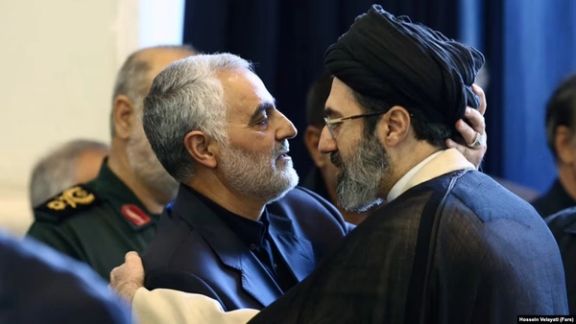
Former IRGC’s Quds Force commander Qassem Soleimani (left) and Mojtaba Khamenei, the son of Iran’s Supreme Leader Ali Khamenei

A recently-leaked document on a meeting of senior IRGC commanders and clerics with the Supreme Leader has revealed contention about the role of Khamenei’s son Mojtaba. 

The 44-page minutes leaked to media last week, contains citations of remarks by 45 IRGC commanders and clerics at a meeting at Khamenei’s office on January 3 on the anniversary of the death of Quds Force commander, Qassem Soleimani, who was killed by the US three years ago.

A sample page of the leaked document (March 2023)
100%
A sample page of the leaked document

During the meeting, Yadollah Bouali, the Revolutionary Guard’s commander in the southwestern province of Fars, criticized interventions by the Mojtaba Khamenei and forces under his command, saying that such measures disrupt the security structure of the country. He added that changes at senior level positions based on the opinions of a small group can be “disastrous.” 

However, several other commanders defended Mojtaba Khamenei and the role he plays in the country's security.

The IRGC commander in Kohgiluyeh and Boyer-Ahmad Province, Avaz Shahabi-Far, expressed support for Khamenei's son, alluding to a meeting attended by late Qassem Soleimani who praised him, calling him a “scholar in military science,” Shahabi-Far said, “I think that it is in the best interest of the country for him (Mojtaba Khamenei) to intervene and help in the matters he is allowed to.” 

Mojtaba does not hold any official position in the country, but is said to be the de facto leader of the IRGC’s Basij paramilitary forces, who are tasked with suppressing any voice of dissent among regime forces. 

Mojtaba Khamenei, the son of Iran’s Supreme Leader Ali Khamenei  (undated)
100%
Mojtaba Khamenei, the son of Iran’s Supreme Leader Ali Khamenei

Next to speak about Mojtaba’s interventions was Mohammad-Hossein Zibayinejad, also known as Hossein Nejat, another IRGC commander who served as the deputy for its Intelligence Organization and is currently the de facto commander of the IRGC's Sarallah Base. Tasked with keeping Tehran secure, it is the most important IRGC ground force HQ in Iran consisting of several of its most important units, which protect key institutions and the offices of the government.

Defending young Khamenei's role, he said he receives reports of disobedience and selling military information on a daily basis, and added that Mojtaba can help resolve such problems. Stressing that such problems should be delegated to IRGC’s Intelligence Protection Organization, and having someone like Mojtaba at the helm can be helpful.

Although it is not officially acknowledged, Mojtaba has a significant role in assigning and removing senior officials both in IRGC’s Intelligence Organization and IRGC’s Intelligence Protection Organization, two nominally separate institutions.

Amir Ali Hajizadeh, the commander of IRGC’s Aerospace Force, also supported the Supreme Leader's son. “I personally appreciate the help of Haj Agha Mojtaba's office in overcoming the problems of the air force, both in the supply sector and also... in obtaining better results,” he said. 

Mojtaba Khamenei, the son of Iran’s Supreme Leader Ali Khamenei  (undated)
100%
Mojtaba Khamenei, the son of Iran’s Supreme Leader Ali Khamenei

Morteza Amoumahdi, the IRGC commander in the city of Esfahan (Isfahan), came in as a supporter, saying that “the regrettable situation of the country is the result of ignorance, inefficiency and inability of (former president Hassan) Rouhani's administration, and worse than that, the result of the current administration's inefficient government.” 

Amoumahdi went on to say that in a meeting with Mojtaba Khamenei where the IRGC's commanders in Sistan-Baluchestan and Khuzestan provinces were also present, “we came to the conclusion that the managers appointed by the president in executive positions have led the country to this abrupt economic failure due to their incompetence and efficiency,” tacitly saying that Mojtaba can do a better job in managing the regime’s economic and political woes. 

In July 2022, an Iranian news agency’s use of the title “Ayatollah” for Mojtaba Khamenei rekindled suspicions that he is being groomed to succeed his father as the Supreme Leader. The news agency used the title in an announcement about registration at Mojtaba Khamenei’s theology course, (kharej fiqh), at Qom seminary where he has been studying and teaching for a few years now.


Most Viewed

State media slam Araghchi's Hormuz tweet, say it let Trump claim victory
1

State media slam Araghchi's Hormuz tweet, say it let Trump claim victory

2

Iran International says it won’t be silenced after London arson attack

3
INSIGHT

How Tehran bends its own red lines to boost state rallies

4
OPINION

The Hormuz get out of jail card turned to a grave

5

Iran halts petrochemical exports to supply domestic market

Banner
Banner

Spotlight

  • Too early to tell who is winning Iran war, experts say
    PODCAST

    Too early to tell who is winning Iran war, experts say

  • How Tehran bends its own red lines to boost state rallies
    INSIGHT

    How Tehran bends its own red lines to boost state rallies

  • Iran blackout cripples freelancer, small business incomes
    VOICES FROM IRAN

    Iran blackout cripples freelancer, small business incomes

  • Ideology may be fading in Iran, but not in Kashmir's ‘Mini Iran'
    INSIGHT

    Ideology may be fading in Iran, but not in Kashmir's ‘Mini Iran'

  • US blockade enters murky phase as tankers spoof signals and buyers hesitate
    ANALYSIS

    US blockade enters murky phase as tankers spoof signals and buyers hesitate

  • Why the $100 billion Hormuz toll revenue is a myth
    ANALYSIS

    Why the $100 billion Hormuz toll revenue is a myth

•
•
•

More Stories

Road Deaths Soar As Holidays Begin: Over 325 Dead

Mar 22, 2023, 14:41 GMT+0

The annual Nowruz road death toll began to climb this week with at least 325 dead in the first seven days of the new year holidays.

In spite of a plan from the country’s Traffic Police to reduce deaths during the fatal season which every year sees hundreds die on the country’s roads, fatalities were soaring once more.

On Wednesday, Chief of the Traffic Police, Kamal Hadianfar, said since March 15, 7,200 people were also injured in accidents, a significant number of those left permanently disabled.

The annual phenomenon is caused by a variety of factors as the country’s 88 million population travels for the festive season.

A combination of poor roads, poor vehicle manufacturing and maintenance and dangerous driving, make it the most fatal time of year for the country’s citizens, a bitter twist to the celebrations and symbolism of hope and new life associated with new year.

On Monday, Chief of the Traffic Police Information and Control Center, Ahmad Shirani, said Khorasan Razavi, Fars, Kerman, Esfahan and Sistan and Baluchistan provinces have the highest number of fatalities.

With the holiday continuing for another 10 days, numbers are expected to continue the upward trend. Last year, 746 people were killed in road accidents during the first 18 days of Iranian new year.

Iran has one of the worst world’s statistics in terms of road accidents -- at its worst during Nowruz.

Based on official statistics, more than 33,000 Iranians died instantly in or after road accidents in 2018. Third only to heart diseases and strokes, road accidents also account for a significant share of mortalities in the country.

Russia Launches Swarm Of Iranian Drones At Ukraine Civilian Targets

Mar 22, 2023, 12:36 GMT+0

Russia launched 21 Iranian drones against civilian targets in Ukraine Wednesday, one day after China’s President Xi Jinping concluded a visit to Moscow.

At least four people were killed in the north of the country as sirens blared across the capital Kyiv and swaths of northern Ukraine overnight. The military said that it shot down 16 of the Iranian Shahed kamikaze drones but the rest got though.

Two housing blocks and an educational facility in the riverside town of Rzhyshchiv south of the capital had been partially destroyed, the State Emergency Service said on the Telegram messaging app.

"Over 20 Iranian murderous drones, plus missiles, numerous shelling incidents, and that's just in one last night of Russian terror against Ukraine," President Volodymyr Zelenskiy said on Twitter.

In an apparent reference to the Chinese leader's visit, he added: "Every time someone tries to hear the word 'peace' in Moscow, another order is given there for such criminal strikes."

Iran has supplied hundreds of killer drones to Russia since mid-2022, angering Western powers that supply air defense weapons to Ukraine to protect both military and civilian installations. Massive Russian missile and drone attacks since September aimed to destroy Ukraine’s energy infrastructure to make it hard for civilians to survive the winter.

Iran’s Supreme Leader Ali Khamenei completely denied Iran’s involvement in the war during a speech he delivered Tuesday on the occasion of the new year Nowruz.

China proposed a peace plan for Ukraine last month, which the West has largely dismissed as vague at best, and at worst a ploy to buy time for Putin to regroup his forces.

Khamenei Claims West Is Offering Arms To Iran Protesters

Mar 22, 2023, 10:29 GMT+0
•
Mardo Soghom

In his vitriolic new year speech, Iran’s Supreme Leader claimed the US president and European heads of state arm the country’s revolutionaries.

“During recent unrest, the US president and heads of states of certain European countries openly offered weapons and financial and security support to rioters to weaken the Islamic Republic but what happened was the opposite,” he said, in spite of the country being in its worst economic recession for decades and all but isolated on the world stage.

The allegation was one of many thrown at the West in a new year speech Tuesday, amidst outright denials of Iran’s having sent drones to Russia for use in its invasion of Ukraine. “We categorically deny any presence in the Ukraine war and such a thing is not true at all,” he said.

The remarks show little has changed in the regime rhetoric after more than six months of protests calling for an end to the Islamic dictatorship.

Khamenei, whose public speeches are always peppered with scathing criticism of the West, said not only has the ‘enemy’ fanned the flames of unrest in the country, triggered by the death in custody of Iranian-Kurd, Mahsa Amini, but claimed the West’s goal is to topple the regime and in turn, see “Islam fade into oblivion”.

It is what he terms a “hybrid war” against Iran waged by the West to undermine clerical rule, a propaganda war to “undermine the nation’s will, sow despair among the youth, and make them disappointed at the future, work, and progress by fudging the facts”.

This emphasis on such conspiracies are meant to deflect attention from the fact that Iran’s economy is in crisis and young people have lost all hope for their future, yearning for cultural and personal freedoms away from suffocating religious laws.

Iran's Supreme Leader Ali Khamenei speaks during a public rally in Mashhad, March 21, 2023
100%
Iran's Supreme Leader Ali Khamenei during Nowruz gathering in Mashhad, March 21, 2023

Khamenei who espouses a 20th-century leftist ideology of anti-imperialism also accused the West of having colonial designs on Iran. “In everything they do, they seek to politically and economically dominate Iran and plunder it,” he maintained.

Perhaps reflecting his deep resentment towards Saudi Arabia, which is no secret, Iran’s 83-year old authoritarian ruler failed to mention a recent agreement with the oil-rich Persian Gulf state to normalize relations, despite the fact that the deal announced earlier this month came as a diplomatic earthquake in the region and possibly the biggest diplomatic victory for Iran in years.

Removing it from isolation from one of the region’s biggest powers, the deal has brought Iran in from the cold at a time when it has become a pariah on the world stage, not least, since the collapse of nuclear talks, the JCPOA, after Iran's intransigence in negotiations.

Khamenei has long labelled the Saudi ruling elite as “corrupt” and un-Islamic, but approved restoration of ties amid its own isolation.

Recently, more and more politicians and commentators in Iran call for an opening to the world, arguing that in the 21st century no country can succeed alone. The Iranian regime’s ongoing nuclear program and its support for dangerous militant groups around the region have further isolated the country both politically and economically.

Showing no signs of weakening these proxy groups based in several countries including Lebanon and Iraq, in addition to cells far beyond the Arab world, Khamenei also reiterated support for what he calls his “axis of resistance”.

While it is hoped that the Saudi deal will mean Iran’s disarming the Houthis in Yemen, skeptics suspect the regime will not alter its policy of arming its proxies around the region. It is as yet unclear if the Houthis too, will agree to disarming.

While relations with the West continue to nosedive, Khamenei claimed that “the West’s efforts to isolate Iran have failed,” praising his policy of forging closer relations with dictatorships China and Russia, what he has dubbed as a policy of “looking East”

He had little to say on matters of economy to reassure the people that the worst recession in decades showed any sign of abating.

Economically, Iran has fallen behind even in the oil and natural gas sectors which represent its main sources of foreign currency revenues needed for economic development. Its energy sector needs upwards of $200 billion in investments, according to its own oil minister Javad Owji, in spite of the country sitting on the world’s second biggest oil fields.

In a bizarre twist, Khamenei said that Iran should even ditch the US dollar after months of sharp declines in the value of the rial, claiming that several sanctioned countries which stopped using the dollar found “their situation got better”. He failed to give examples of such wild claims.

The fate of the country remains in the hands of an aging leader with old-fashioned diplomatic and economic policies. It may be a new year for Iran, but it is still, old rhetoric which dogs its leadership.

Israel Hits Iran-Linked Targets Near Syria's Aleppo Airport

Mar 22, 2023, 07:44 GMT+0

Israel hit targets near Syria's Aleppo airport Wednesday in an air strike reportedly aimed at destroying an Iranian arms depot.

The Syrian defense ministry said the air strike targeted the vicinity of Syria's Aleppo airport causing some "material damage.”

Israel has been carrying out regular attacks since 2017 against what it has described as Iran-linked targets in Syria, where Tehran's influence has grown since it began supporting President Bashar al-Assad in the civil war that started in 2011.

In the third attack on Aleppo airport in six months, Israel launched "a number of missiles from the Mediterranean Sea, west of the coastal city of Latakia, at 3:55 a.m.", the Syrian defense ministry said in a statement on state media.

Two regional intelligence sources told Reuters the strike hit an underground munitions depot linked to the nearby Nairab military airport, where missile-guided systems delivered onboard several Iranian military planes had been stored.

Iran has increased the use of Aleppo airport to deliver more arms over the past month, taking advantage of heavy air traffic as cargo planes offload relief aid in the wake of the February's deadly earthquake, Western intelligence sources say.

An Israeli strike on March 7 that knocked Aleppo airport out of service had blown up an Iranian arms cargo shipment hours after it was delivered by an Iranian plane that Damascus said was carrying aid, the Western intelligence sources say.

Israel has in recent months intensified strikes on Syrian airports and air bases to disrupt Iran's use of aerial supply lines to deliver arms to allies in Syria and Lebanon, including Lebanon's Iran-backed Hezbollah.

The strikes are part of an escalation of what has been a low-intensity conflict termed a "war between wars", the goal of which has been to slow Iran's entrenchment in Syria, Israeli military experts say.

Iran's proxy militias, led by Hezbollah, now hold sway in vast areas in eastern, southern, and northwestern Syria and in several suburbs around the capital.

Media In Iran Slam Performance Of Hardliner Parliament

Mar 21, 2023, 20:16 GMT+0
•
Iran International Newsroom

As the Iranian year was coming to an end on March 20, some local media presented a more than disappointing assessment over the performance of the parliament.

The election for the next parliament (Majles) is less than 11 months from now, and the current parliament, whose members call themselves "revolutionaries" has had no achievement to be proud of.

Khabar Online website in Tehran summarized the "radical parliament's" track record saying that the Majles was "unable to meet the society's demands and incapable of supervising the government's performance” or holding it accountable for shortcomings the media have been complaining about on a daily basis.

According to the website, lawmakers have failed to address issues such as the the economic hardship people face, the fall of the Iranian currency, deadlock in the country's foreign policy, international isolation, inefficiency of local governors and other officials including cabinet ministers. They have not been able to impeach any minister although they talked about it every single day.

The Majles has not been able even to make the government accountable for the promises given to the people. Nor the Majles asked any serious questions about why the government has not been able to control inflation.

Prices of cars, houses and rents have been constantly on the rise, turning necessities into dreams for citizens. Journalists in Iran tweeted that in some areas people buy their daily bread on credit from neighborhood bakeries, promising to pay at the end of the month.

When at one point in February the US dollar rose to 600,000 rials, Vice President Mohammad Mokhber told the Majles that he cannot do anything about it and lawmakers "can take it or leave it." Parliament simply listened to Mokhber and took no action.

President Ebrahim Raisi with Hardliner supporters in parliament during his inauguration in August 2021
100%
President Ebrahim Raisi with Hardliner supporters in parliament during his inauguration in August 2021

During the year, most proposed bills ended in controversy and remained inconclusive. Here are some examples:

Hijab

While opposition to compulsory hijab was the one of the root causes of the uprising that shook the country for more than five months, the Majles discussed a bill that called for sending text message threats to women and freezing their ID cards and closing their bank accounts as well as forcing them to pay a fine for not wearing their headscarves "properly". They seemed not to care that this was exactly why Mahsa Amini was murdered in police custody.

Women

Another controversial bill proposed to restrict women's freedom to travel abroad, demanding that all women should have the consent of their husband, father or grandfather for a travel permit. Apart from everything else, those who drafted the bill failed to realize who would sign the permit for an 80-year-old woman who has no husband or father. After several denials by lawmakers, no one still knows if the bill has gone any further.

Documenting Crimes and Brutality

As photos and videos of police brutality during the protests went viral on social media, the parliament approved that filming such scenes is strictly prohibited. The bill even called for harsh punishment for anyone who circulated such images on social media or sent them to foreign-based media. Those breaking the law could be charged with colluding with the enemy and acting against national security, the bill stipulated.

"Fake" News

Another controversial bill called for prosecution of anyone who posted any "false" story on social media. The bill said that courts, which are in fact controlled by intelligence agencies, are the authority to determine if a news story was fake. Basically, the bill meant that any account of events different from the official version is punishable.

Other similar bills included barring university students from travelling abroad as a punishment for taking part in protests, as well as controversial attestations that forced government employees to learn to recite the Koran.

While these bills backed by hardliners may not have majority support, supporters can get them passed at the opportune moment. Meanwhile, the parliament has not tackled any legislation to alleviate the financial hardships endured by citizens.