• العربية
  • فارسی
Brand
  • Iran Insight
  • Politics
  • Economy
  • Analysis
  • Special Report
  • Opinion
  • Podcast
  • Iran Insight
  • Politics
  • Economy
  • Analysis
  • Special Report
  • Opinion
  • Podcast
  • Theme
  • Language
    • العربية
    • فارسی
  • Iran Insight
  • Politics
  • Economy
  • Analysis
  • Special Report
  • Opinion
  • Podcast
All rights reserved for Volant Media UK Limited
volant media logo

Sunni Leader Says Religion Is Failing The People Of Iran
Iran International Newsroom
Mar 18, 2023, 03:21 GMT+0Updated: 17:44 GMT+1
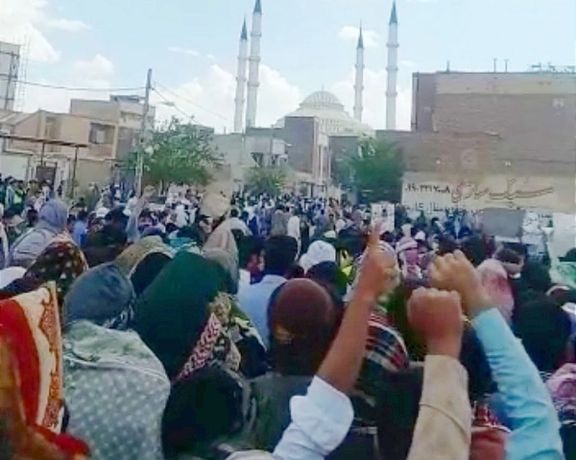
A protest rally by the people of Zahedan on March 17, 2023

March 17 was the last Friday in the Iranian year as people in Zahedan held anti-regime rallies for the 24th week and heard another historic speech by their Sunni leader. 

Like in the previous weeks, Mowlavi Abdolahamid delivered a moving Friday sermon, saying that a single ideology cannot and should not be the only dominant view in the country. "One ethnic group and one religion cannot rule the country,” he stated. 

Iran is ruled by Shiite Islamic sect ideology and clerics since the 1979 revolution that toppled the monarchy.

Decrying the domination of a single religious view in the country as the cause of Iran's political deadlock, Abdolhamid said that “Iran is a rainbow of ethnicities, religions and pluralities,” suppressed by the ruling religious view for the past 44 years. The Islamic Republic has not been able to establish equality and balance among such a variety of views while ideas have failed the nation.

Implicitly calling for a secular democracy, Abdolhamid said that the Islamic Republic has limited the Iran’s potential with its narrow interpretation of religion in governing the country. 

He said that the regime has prevented meritocracy by preventing people of other ideologies from acquiring positions and important roles in the government. He pointed out that Sunni Iranians have no significant role in the judiciary and administration even at local level. 

“Our dear Shia friends also complain about such discrimination, saying that that qualified individuals, who are not very committed to religious practices but are capable academics, thinkers and worthy managers have been discriminated against,” he added. 

He emphasized that the "rainbow" is the right metaphor for the diversities in Iran, denouncing the dominant religious ideology for not creating equality for other ideas. 

A placard held by people of Zahedan during a protest rally on March 17, 2023
100%
A placard held by people of Zahedan during a protest rally on March 17, 2023

"Today, a military and security point of view prevails throughout Iran, but no country whose ruling point of view is security and military will develop," he said. The view of the government should be comprehensive and national, not religious, because the religious view will fail, he noted. 

Comparing the current value of the national currency with that of the Pahlavi era before the 1979 Islamic Revolution, he criticized the narrow and religious view of the ruling power of the country that has damaged the principles of Islam in the country.

The Iranian rial has dropped from 70 against the US dollar in 1979 to 470,000 currently. 

He condemned "torture, beating, killing and violation of people's rights," saying that the oppression of others is "worse than polytheism and disbelief.”

"The presence of police officers in the streets should be avoided,” he added. “In many countries, when security is high, there is no need for a visible police presence since the people's general trust in the government is strong."

Activists reported a large presence of security forces in the restive city as hundreds of demonstrators took to the streets, chanting "Freedom, Freedom, Freedom," "We don’t want the Islamic Republic" and "Political prisoners must be released."

Zahedan is the provincial capital of Sistan-Baluchestan Province, home to Iran's Sunni Baluch minority of up to two million people.

Residents have been holding protest rallies every Friday since September 30 when security forces killed nearly 90 people, in the deadliest incident so far in the nationwide demonstrations triggered by the September death in custody of a 22-year-old Kurdish woman, Mahsa Amini. 

Most Viewed

Ideology may be fading in Iran, but not in Kashmir's ‘Mini Iran'
1
INSIGHT

Ideology may be fading in Iran, but not in Kashmir's ‘Mini Iran'

2
INSIGHT

Hardliners push Hormuz ‘red line’ as US blockade tests Iran’s leverage

3
VOICES FROM IRAN

Hope and anger in Iran as fragile ceasefire persists

4

US sanctions oil network tied to Iranian tycoon Shamkhani

5

Iran International says it won’t be silenced after London arson attack

Banner
Banner

Spotlight

  • Hardliners push Hormuz ‘red line’ as US blockade tests Iran’s leverage
    INSIGHT

    Hardliners push Hormuz ‘red line’ as US blockade tests Iran’s leverage

  • Ideology may be fading in Iran, but not in Kashmir's ‘Mini Iran'
    INSIGHT

    Ideology may be fading in Iran, but not in Kashmir's ‘Mini Iran'

  • War damage amounts to $3,000 per Iranian, with blockade set to add to losses
    INSIGHT

    War damage amounts to $3,000 per Iranian, with blockade set to add to losses

  • Why the $100 billion Hormuz toll revenue is a myth
    ANALYSIS

    Why the $100 billion Hormuz toll revenue is a myth

  • US blockade targets Iran oil boom amid regional disruption
    ANALYSIS

    US blockade targets Iran oil boom amid regional disruption

  • Iran's digital economy battered by prolonged blackout
    INSIGHT

    Iran's digital economy battered by prolonged blackout

•
•
•

More Stories

Prison Sentence Upheld For Iranian Lawyer Defending Protesters

Mar 17, 2023, 21:21 GMT+0

A human rights organization says the prison sentence of an Iranian lawyer and a member of the Central Bar Association has been confirmed by an appeals court.

The US-based Human Rights Activists News Agency (HRANA) reported Thursday that an Appeals Court in Markazi Province sentenced Mohammad Arman to 18 months in prison and a fine of 150 million rials (nearly 300 USD).

Arman received the sentence for “spreading falsehood,” added HRANA quoting an informed source as saying that Arman’s social media pages have also been removed.

This verdict was upheld while dozens of lawyers in Iran have been arrested by the security agencies in recent months amid the nationwide protests and some of them are still in prison.

These lawyers were representing political prisoners, and many of their families.

A few days earlier, the lawyer representing Mahsa Amini's family, the woman whose death led to mass unrest in Iran, was also arraigned by a revolutionary court for "propaganda against the state".

Saleh Nikbakht was summoned to the second branch of the Revolutionary Prosecutor's Office located in Evin prison in Tehran after he gave interviews with journalists abroad.

The Law Society Gazette, which is a British weekly legal magazine for solicitors in England says at least 66 lawyers have been arrested and detained in Iran since protests started last September, including 11 who have been sentenced, while 47 were released on bail.

Raisi Tries To Lure Back Expatriates To Iran With Promises

Mar 17, 2023, 20:14 GMT+0
•
Maryam Sinaiee

Capital flight and brain drain are two of the most serious challenges Iran faces as President Raisi claims his government is ready to help investors and experts to return.

Speaking at a gathering of expatriate Iranians in Tehran Wednesday, Ebrahim Raisi said he has ordered the foreign ministry to form a taskforce to help resolve any legal or consular problems expatriate investors and experts may be facing for returning to the country.

By most estimates, 4-5 million first-generation Iranians have settled in other countries, but adding their children born abroad, who often acquire Iranian citizenship, the number can be much higher. There are also many immigrant communities in Asian countries, where no precise numbers exist. Some put the total number of Iranians outside the country at any given time at close to 8 million.

Raisi also ordered the ministry to lay the grounds for investments by expatriates and facilitate contacts with academics while claiming that a very bright future is awaiting the country and he cast the blame for the feelings of frustration and disappointment on “the enemy.”

At the same meeting, Foreign Minister Hossein Amir-Abdollahian said removing obstacles in the way of investment for expatriates, facilitating the return and employment of academics in Iranian universities, facilitating travel, and “countering the enemy’s media war against the Iranian nation in the country and abroad” were some of the most urgent tasks that the ministry would try to tackle.

Many Iranians living abroad, particularly those with dual citizenship who could be accused of spying for foreign governments, are wary of returning home for the fear of not being allowed to leave or even being imprisoned for their political activities or criticism of the regime while living abroad.

Dozens of dual nationals, particularly citizens of western countries such as the United States, Britain, and Germany have been sentenced to prison on charges of espionage in recent years. Some, such as Iranian-American businessman Siamak Namazi and Iranian-German rights activist Nahid Taghavi are still in prison.

The Islamic Republic often uses these prisoners as bargaining chips in negotiations with foreign governments or swaps them with Iranian prisoners and for money.

In November, amid nationwide anti-government protests, Amir-Abdollahian said the ministry had launched a portal that expatriates could check to find out if they could be in trouble for leaving Iran if they went back home, promising help from the ministry if there were any problems.

In the past six months, tens of thousands of Iranians have participated in protest rallies in support of the Mahsa protest movement in many major cities across the world. Many fear identification by the regime agents during such protests and danger of serious repercussions if they wanted to go back home.

Domestic issues such as inflation, international sanctions, political strife and politically driven economic risks, corruption and social restrictions have driven millions -- from investors to academics and professionals -- to emigrate in the past four decades.

The precise amount of capital leaving Iran is very difficult to calculate but it can be deducted from the official data on net capital account deficit. Head of Tehran Chamber of Commerce, Industries, Mines and Agriculture Masoud Khansari said in an interview with ILNA website in Tehran in early January that the annual outflow of capital has reached $10 billion. .

According to official figures, Iran's net capital account balance was positive from 2001 to 2005 when there was foreign investment. But in the following years, except in 2014, the balance has always been in the negative.

The hard currency outflow from the country is invested in various ways including in property, stocks, bonds, cryptocurrencies, or establishment of companies abroad.

Many of the people sending their money out could be the very regime insiders whose political connections has helped them make huge financial gains over the years. Many have invested in the property markets in neighboring countries such as Turkey, Georgia and the United Arab Emirates.

Husband Of Ex-Detainee Slams UK Govt. Over Iran Hostages

Mar 17, 2023, 18:09 GMT+0

The husband of former Iranian-British hostage, Nazanin Zaghari-Ratcliffe, detained in Iran for several years, has accused the UK government of soft pedaling on Iran’s treatment of hostages.

Speaking to the Guardian on Thursday, Richard Ratcliffe criticized British officials, saying that they are losing interest in hostages after negative publicity surrounding his wife’s detention has subsided.

“One year on, I do find it upsetting how the government won’t say how many Brits are currently held hostage by Iran, that they tried to imply to parliament this week that states do not take hostages, and that since Nazanin’s case, they have not recognized the torture of any British citizen by a foreign government,” he added.

The Foreign Office minister, David Rutley, told the foreign affairs select committee on Monday that the UK did not believe a state could act as hostage taker, and instead uses the term “arbitrary detention for diplomatic leverage”.

Liam Byrne, a Labour MP said that hostage families needed a single point of contact who had a reporting line to the UK prime minister “to knock the proverbial heads of government together”.

However, the Foreign Office stated, “The UK will never accept our nationals being used as political leverage and we continue to press Iran to end this abhorrent practice.”

Ratcliffe raised his criticism on the first anniversary of the release of Nazanin Zaghari, who had earlier criticized London for the process of her release.

Israeli Premier’s Meetings In Europe Are A Message For Iran

Mar 17, 2023, 15:19 GMT+0
•
Iran International Newsroom

A senior Israeli official has told Iran International that Prime Minister Benjamin Netanyahu's recent visits to Europe is to convey the message that Israel would act alone against Iran if need be.

The official, who spoke on condition of anonymity, said Friday that Netanyahu's meetings with European leaders were aimed at reassuring them that Israel would do whatever it deems necessary against the Islamic Republic’s nuclear program. 

“Recent trips to some European countries and meetings with the leaders of these countries are both a message for Europe and a direct message for the Iranian government," the source said, noting that Tehran has "received" this message.

On the backdrop of tensions over his government’s controversial overhaul of Israel’s judicial system, Netanyahu held meetings with Germany's aders, including Chancellor Olaf Scholz and President Frank-Walter Steinmeier, on his one-day trip to Berlin on Thursday where they talked about concerns over Iran’s fast-paced nuclear enrichment. 

Israel will "do what it has to do, even alone" in the face of Iran's nuclear threat, the source said, adding that Netanyahu urged Schultz in their meeting to confront Iran with more strength and seriousness. 

Moreover, the Israeli official told Iran International that thanks to Mossad operations inside Iran, progress in Tehran’s nuclear program with military potential was pushed back for seven years, but currently Tehran has passed serious red lines. 

The official added that Israel and Germany are very close in finalizing a deal for the sale of the Arrow 3 -- or Hetz 3 in Hebrew -- exoatmospheric hypersonic anti-ballistic missile system to Berlin. The system is jointly developed and produced by Israel Aerospace Industries and Boeing under the management of the Israeli Ministry of Defense's "Homa" (rampart) administration and the US Missile Defense Agency. 

As he stood with Scholz at the Holocaust memorial Platform 17 in Berlin, Netanyahu appeared to compare Iran with the Nazis, and spoke of the necessity of halting catastrophe in its early stages. “The main lesson we have learned is that when you are faced with such evil, you have to obstruct the evil designs early on to prevent catastrophe,” he said. 

Netanyahu has time and again threatened military action against the Islamic Republic’s nuclear program as it enriches uranium closer to weapons-grade levels. On March 9, Netanyahu told Iran International that Tehran is “dangerously moving forward” in its nuclear program, claiming that he returned to the government primarily to make sure that Iran cannot become a nuclear “threshold power.”

However, German officials also criticized Netanyahu for rejecting a compromise proposal by Israeli President Isaac Herzog for overhauling the legal system. Voicing concern about the planned overhaul, Scholz hailed efforts by Israel’s figurehead to seek a “broad basic consensus.”

Iranian Rear Admiral Ali Shamkhani, the secretary of the Supreme National Security Council meets the Saudi Minister of State and National Security Adviser Musaed bin Mohammed Al-Aiban, and China's Director of the Office of the Central Foreign Affairs Commission Wang Yi, in Beijing, China, March 10, 2023.
100%
Iranian Rear Admiral Ali Shamkhani, the secretary of the Supreme National Security Council meets the Saudi Minister of State and National Security Adviser Musaed bin Mohammed Al-Aiban, and China's Director of the Office of the Central Foreign Affairs Commission Wang Yi, in Beijing, China, March 10, 2023.

Netanyahu met with Italian premier Giorgia Meloni last week when both both called for bolstering bilateral ties. His meeting with Meloni came just after Iran and Saudi Arabia announced a resumption of diplomatic ties, a development that Netanyahu was widely criticized at home for failing to prevent.

Head of Israel’s National Security Council Tzachi Hanegbi told Iran International earlier in the week that the rapprochement between Tehran and Riyadh has nothing to do with Iran’s nuclear program. He described the agreement as a way to prevent the Islamic Republic from arming Yemen’s Houthis against the Saudi-led coalition, noting that Riyadh itself is worried about Tehran’s nuclear enrichment at weapons-grade. 

On March 13, Iranian diplomat Kourosh Ahmadi said in an interview with Etemad Online that Europe and the United States probably welcome the breakthrough because it makes it less likely for Iran to disrupt the flow of oil from the Persian Gulf in case of an Israeli attack on its nuclear installations. He added that the agreement between Tehran and Riyadh will lead to a reduction in urgency for the US to supply arms to Persian Gulf Arab states as they would be now less concerned about possible threats from Iran.

Iran Continues To Praise Good Relations With Arab Neighbors

Mar 17, 2023, 11:14 GMT+0
•
Iran International Newsroom

Iran will push forward at rapid speed as it forges better relations with its Arab neighbors following the recent agreement to restore ties with Saudi Arabia, according to the regime.

In a glowing article published Friday, IRNA, the state news agency, portrays the agreement with Saudi Arabia, signed a week ago in Beijing, as a historical event that heralds a new era in the Middle East.

Iran’s national security chief Ali Shamkhani, an old IRGC hand, visited the United Arab Emirates Thursday and met with members of its top leadership. However so far, there is no concrete information about details of the discussions in UAE and Iranian media.

IRNA, however, said the visit shows that once Tehran and Riyadh embark on rapprochement, Saudi allies would follow and “foreign influence” will be reduced in the region, implicitly referring to the United States.

Shamkhani met with UAE President Sheikh Mohammed bin Rashid and ruler of Dubai and other top officials Thursday. “Their talks covered regional and international issues of mutual concern, and the importance of working to support peace and co-operation in the region to enable progress and prosperity for its people,” state news agency Wam reported.

Iranian media have hinted that Shamkhani’s agenda included discussions with the UAE to help Iran overcome some of the impact of US economic sanctions, as the regional trade and banking hub.

Iran has already been using middlemen and contacts in the UAE to facilitate its illicit oil trade and money laundering efforts. But any official commitment by the UAE is hard to imagine given the potential violation of US sanctions.

Reuters quoted two unnamed Iranian officials Thursday as saying that last September, Iran's Supreme Leader Ali Khamenei lost patience with the slow pace of bilateral talks with Riyadh and summoned his team to discuss ways to accelerate the process, which led to China's involvement.

This would mean a complete about-face by Khamenei whose zealous followers attacked the Saudi embassy in Tehran in January 2016, an incident that led Riyadh to cut diplomatic ties.

Attack on Saudi Arabia's embassy in Tehran in January 2016
100%
Attack on Saudi Arabia's embassy in Tehran in January 2016

Khamenei and other senior clerics have over the years repeatedly castigated the Saudi ruling family as lackeys of the United States who were harming the interests of Muslims. Khamenei has so far been silent on the agreement with Riyadh, but he is scheduled to address the nation next Tuesday on the Iranian New Year, Nowruz.

Other reports have indicated a more forceful Chinese role in persuading Tehran to offer guarantees to Riyadh to facilitate normalization.

The Wall Street Journal reported Friday that Tehran has pledged not to send arms to Yemen’s Houthis who have been fighting Saudi-led forces for nearly a decade, quoting US and Saudi officials.

Yemen is clearly the most immediate issue the Saudis want to see resolved, as without Iran’s military backing, the Houthis have to show flexibility and perhaps conclude a peace agreement in the war-torn country.

An interesting part of the report by IRNA is the reference to popular protests that erupted last September after the death of Mahsa Amini in ‘hijab police’ custody. IRNA says that good relations with neighbors will help derail enemy plans to destabilize the Islamic Republic, repeating accusations that protests were part of a Western conspiracy.

It also emphasizes the need for a “rational” foreign policy, a term so far used by critics of the hardliners in full control of the government. It says the deal with Saudi Arabia and Shamkhani’s trip to the UAE can help calm the domestic political scene. These comments clearly show how far the regime has been shaken by the popular protests and how extending a hand to its Arab neighbors is now more a necessity than choice.