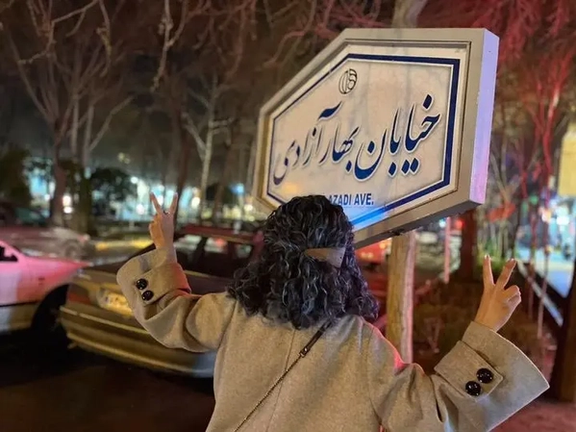
An Iranian woman unveiling in public in front of a street sign that reads “the spring of freedom street” in Tehran
Young Iranians took to the streets in several cities Monday after a call for three nights of protests, including the celebration of the ancient fire festival Tuesday.
Videos posted on social media show small groups of youth marching and chanting anti-government slogans in some neighborhoods of the capital Tehran, Mashhad, Qazvin, and Malayer. A few videos show burning trash bins and car tires on the streets and youth throwing firebombs at government buildings and banks.
Youth groups had called since late February for three nights of protests, including the Charshanbeh Souri fire festival on Tuesday. In its social media posts, the United Youth of Iran, an alliance of various “neighborhood youth” groups from around the country fighting to overthrow the regime, urged everyone to form “neighborhood-centered” groups and take to the streets to protest.
The group vowed in a statement to turn the fire festival into a “symbol” of battling the “suppressive and criminal regime” and “the reactionary Islamic culture” that “has eliminated or harshly suppressed individuals for their different beliefs for many years.”
Protesters in Malayer in Hamedan Province chanting “Death to the Dictator” and “Death to Khamenei”
The fire festival is celebrated on the eve of the last Wednesday of the year, just before the New Year (Nowruz), which marks the day of the Spring Equinox. The festival dates to pre-Islamic times and for the same reason, its celebration is considered as a pagan practice by the clerics running the country since the Islamic Revolution in 1979.
Celebration of ancient festivals such as Nowruz and Charshanbeh Souri have persevered despite the many efforts of religious fundamentalists who tried to obliterate and replace them with Islamic feasts.
An artwork created in support of protests in the last week of the Iranian year showing a police car on fire
Nowruz is still the most important calendar event of the year and celebrated as always, but Charshanbeh Souri has taken a quite different character. Authorities resorted to harsh measures to suppress its celebration in the streets, often bringing out the police, Basij militia, and vigilante groups who clashed with the youth and even arrested them for lighting bonfires.
Protesters in west Tehran chanting a slogan against Supreme Leader Ali Khamenei
Ancient Iranians lit fires on their rooftops during the last five days of the year to help the spirits of the dead to find their way and reunite with their families.
In more recent times, people made several small brushwood fires in their courtyards or outside the house and jumped over the flames chanting, “Take away my sickly pallor and give me your red glow! ” Firecrackers were also popular with the children and youth.
Jumping over fire was followed by a host of traditions including lighting candles, singing, dancing, poetry recitation, going door to door and banging on bowls with spoons to get treats, and sharing food.
Small firebomb thrown at a university campus entrance in west Tehran for housing security forces and providing them with a place for keeping detainees in previous protests as “warning”.
Over the years, massive bonfires and small homemade bombs have largely taken the place of brushwood fires and firecrackers. Streets often turn into battlegrounds between the dancing and merrymaking youth and the police on the last Tuesday of the year.
In a statement Tuesday, the ministry of intelligence said it had arrested members of terrorist teams” across the country including twenty-one members of a group linked with the Mujahedin-e Khalq Organization (MEK) in Tehran and confiscated a variety of explosives from them.
Those arrested were planning to set fire to public property such as buses, the ministry claimed and vowed to take decisive action against “terrorists” who, it said, aim to harm people and “cast the blame for their criminal actions on the security forces.”
Security forces gathered near a university to disrupt a protest on October 3, 2022
The UN special rapporteur on human rights in Iran has released his latest report, portraying the grim situation of protesters and the regime’s bloody crackdown.
In his latest report released to media on Friday, Javaid Rehman briefed the UN human rights council at its 52nd session on the events leading up to and since the death of Jina Mahsa Amini in September, highlighting the most pressing human rights concerns up to December 31.
Rehman expressed regret that the Islamic Republic authorities continue to deny him entry to the country and reiterated his request to carry out visits to the country in accordance with the Human Rights Council resolution establishing his mandate.
The Special Rapporteur deplored the brutal response of the Iranian authorities to the protests, saying the unabated violent response by security forces reportedly led to the deaths of at least 476 persons, including at least 64 children and 34 women, 5 hundreds of protesters being severely injured and thousands being arrested, detained or incarcerated.
Javaid Rehman during an interview with Iran International in December 2022
His report is derived from many submissions and multiple online and in-person meetings with victims of the human rights violations, their families and lawyers, civil society and human rights organizations, government officials, media and other relevant stakeholders.
“The violent state response to the protests started immediately following the death of Jina Mahsa Amini, contrary to the reports by Iranian authorities, which claim that security forces were instructed to act with tolerance and restraint,” read the report, adding, “On the contrary, directions given by the highest state authorities point out a deliberate policy to crush protests at all costs.”
“Videos, reports and eyewitness testimonies have shown security forces (including the police, the Islamic Revolutionary Guard Crops and the Basij militia) violently cracking down on protesters and have revealed a widespread pattern of unlawful lethal use of force, including the use of shotguns, assault rifles and handguns against the protesters,” it added.
A woman targeted with shotgun 'birdshots' during protests in Iran
The report also said that there is evidence of deliberate killings in many cases, with security forces shooting at individuals at close range. It mentioned Minoo Majidi, a 62- year-old mother, who was shot by security forces with 167 shotgun pellets in Kermanshah and died on her way to hospital and Hadis Najafi, a 23-year-old woman who died during a protest in Karaj on September 21 after being shot multiple times in the heart, abdomen and neck.
Highlighting that at least 64 children were reportedly killed by security forces in the protests, the report mentioned some of the cases such as four girls and one boy who were beaten to death, including two 16-year-olds, Sarina Esmailzadeh and Nika Shakarami and 15-year-old Sarina Saedi from Sanandaj and a 16-year-old boy Mehdi Mousavi Nikou.
Two teenage girls who lost one eye to gun pellets fired by security forces during protests
Ethnic and religious minorities who have suffered decades of systemic and systematic discrimination and persecution have been disproportionately affected in the current wave of repression with over half of the total number of those killed being from Baluchi and Kurdish-populated provinces, the report said, noting that children from the country’s Baluch and Kurdish minorities constitute 63 percent of the recorded child victims.
Expressing concern over the large number of protesters severely injured because of direct shots to the head, Rehman said that hundreds have reportedly suffered severe eye injuries or lost their eyesight due to the use of metal pellets and rubber bullets by the security forces but did not seek medical care from government facilities in fear of reprisals, torture and detention.
The Special Rapporteur also expressed deep concerns about the policy of mass arbitrary arrests and detention of protesters, that led to the arrest of more than 18,000 individuals, of whom the identity of 2,942 individuals has been confirmed.
The report also underlined the harassment of families and cover up of human rights violations and violations of the right to due process and fair trial. “The Special Rapporteur is alarmed at the execution of two protesters and the reported sentencing to death of several others after sham trials, violating the right to a fair trial and denying the right to due process,” it said.
Paying tribute to all those who have continued to communicate information despite the heavy risks, Rehman said the regime’s so-called investigations into the death of Mahsa Amini were neither credible nor transparent and have failed the minimum requirements of impartiality and independence.
The report concluded that since the start of the protests, the highest authorities of the regime have instigated violence and instructed the security forces to “confront the enemies”.
Some of the schoolgirls hospitalized with symptoms of poisoning
Iran's state television aired the so-called ‘confessions’ of a man and his daughter arrested and accused of attacking schools in southern Iran with N2 gas canisters.
The video first shown by the local channel of the state broadcaster (IRIB) in Fars Province in southern Iran showed a girl sitting with her back to the camera being interrogated by a man. Authorities routinely arrange for forced confessions on TV.
The girl says in the video that she obtained the nitrogen gas canisters from a friend and together with her father, a hospital worker, threw them in the courtyards of seven different schools and went to hospitals to film the victims to post the videos as Instagram stories and posts.
For three months, girls’ schools have been targeted by unknown people with some kind of chemical agents, sending hundreds of students to hospital. The government has not arrested the real culprits of the large-scale operation.
Authorities who initially tried to attribute the children’s illness to psychogenic factors have so far not released any details about the chemical agents used in school attacks across the country, which some poisoned students have described as smelling like putrid fruit, or shown any canisters or other vessels used for holding these chemicals.
Many ordinary Iranians have been suspicious of involvement of the regime itself, or religious extremists protected by the regime, in the school attacks and call the acts “state terrorism”.
IRIB news bulletin including forced statements of a young woman arrested for school attacks in Larestan
“I tagged Iran International TV,” the unnamed girl tells her interrogator in the video shown by the state television and claims that by reporting the incidents she wanted to cause negative feelings about the regime in people’s minds.
On Monday, for the first time since the first attack Supreme Leader Ali Khamenei addressed the issue. “If there are really hands at work, or individuals or groups that are involved in this, this will be a huge crime that cannot be overlooked,” he said, adding that culprits should be given maximum punishment for their crime.
The interior ministry in a statement Wednesday said some individuals had been arrested in Khuzestan, West Azarbaijan, Fars, Kermanshah, Khorasan and Alborz provinces. No one has yet been arrested in the religious city of Qom, where the first attack was reported on November 31. Since then, 29 more schools have been attacked in the same city.
Victims of school gas poisoning attacks outside a school in Larestan Monday
Spokesman of Law Enforcement Forces (Faraja), Brigadier General Saeed Montazerolmahdi, said Friday that a team of two men, 50 and 22, and three girls including a 21-year-old who still attended high school, were arrested for the poisonings in Larestan, for which the girl was made to confess on television.
The police chief alleged that the accused had also made recordings of the school attacks and sent it to “hostile media including Iran International TV”. He claimed that the accused girls confessed they wanted to create an atmosphere of insecurity in schools and defame the Islamic Republic.
On Thursday the head of the justice department of Kordestan Province, Seyed Hossein Hosseini, said authorities had arrested five “leaders and top members of networks” involved in “spreading rumors and lies” and arrest warrants were issued.
Instead of arresting the perpetrators, the police has been detaining journalists and citizens for speaking out about the chemical attacks.
The Revolutionary Guards (IRGC) linked Tasnim News Agency also reported on Friday that an Instagram influencer with 700,000 followers was arrested in Urumieh.
Quoting unnamed “informed sources, Hamshahri Online said the influencer was arrested for “spreading rumors about students’ poisoning” and causing feelings of apprehension among citizens through Instagram stories.
The logo of the Alliance for Democracy and Freedom in Iran
Prominent Iranian dissident figures, who have recently made an alliance against the Islamic Republic, has issued a Charter of Solidarity and Alliance for Freedom.
Exiled Prince Reza Pahlavi, Nobel peace prize laureate Shirin Ebadi and Canada-based activist Hamed Esmaeilion, as well as US-based author, journalist and women’s rights activist Masih Alinejad, actress and activist Nazanin Boniadi and Secretary General of Komala Iranian Kurdish party Abdullah Mohtadi had said that they would release the charter that would lay the foundations for political representation of the aspirations of protesters in Iran and gain support for isolating the Islamic Republic.
The document is also called the Mahsa Charter in reference to “the murder of Mahsa (Jina) Amini and the beginning of the Woman, Life, Freedom revolution,” which has seen the people of Iran continuing to fight for freedom “to break the chains of injustice, discrimination and tyranny.”
Emphasizing that the way to building a free and democratic Iran is to overcome the Islamic Republic regime, they said, “Reaching this ultimate goal necessitates the three elements of unison, organization and relentless continuity in activism.”
They said the charter relies initially on activities outside of the country, underlining that the isolation of the Islamic government internationally is a first and necessary step for a democratic change.
The charter calls for international pressure on the Islamic Republic to halt all death sentences and to immediately release all political prisoners without condition; expulsion of the regime’s ambassadors and all its dependents by democratic governments and acknowledging the alliance of opposition figures as well as their charter; and facilitating any means necessary to aid the people of Iran.
“Subsequent actions will take place with the participation of activists inside Iran to focus on fair transitional justice, the formation of a council for the transition of power, and the means by which power is transferred to a secular, democratic government,” reads the charter, adding that “The Alliance will introduce actionable initiatives using democratic methods to be implemented at the earliest opportunity in order to bring to fruition the civil action struggles of the people of Iran.”
The members of the alliance have repeatedly said that anyone who accepts the core values of the group is welcome to join them, but until now there had not been a clear explanation for their main values. They enumerated 17 common values for a democratic Iran, noting that the form of the future government will be a secular-democratic system determined through a referendum. “All political and official members of the state shall be elected through a free and democratic election process whereby citizens of all beliefs, ethnicities, gender and sexual orientation be afforded dignity and equal rights before the law.”
The need to maintain the territorial integrity of Iran while accepting diversity in language, ethnicity, religion and culture; and to decentralize power by deferring financial, bureaucratic and policy making affairs to elected provincial, city, and regional administrations is also among the values.
The charter also talks about the formation of an independent organization to supervise elections and the acceptance of domestic and international monitoring of elections, which would result in “a new national constitution through an inclusive and transparent process.” “The new constitution shall adhere to the Universal Declaration of Human Rights in its entirety.”
One of main points of the charter is the abolition of the Islamic Revolutionary Guards Corp – or the IRGC -- and all of its subsidiaries. “The possibility to integrate IRGC elements into other armed forces such as the army may only be possible in the absence of involvement in crimes and based on necessary qualifications,” it said, adding that “The military shall only be responsible to defend the territorial integrity of the country.”
It also called for “cooperation and peaceful relations with all countries in the world, and to cease all interference in the affairs of other countries, and to join the International Criminal Court.” Joining the International Convention on Nuclear Safety and the Financial Action Task Force (FATF) were key values in the charter.
“To overcome the Islamic Republic’s tyranny, all Iranians who are committed to freedom must unite. The courage of the people of Iran and their persistent fight for freedom shall be the bright beacon of hope for our future. Let us stand united in the creation of a free tomorrow," the charter concluded.
An Iranian man holding a placard in support of the Sunni leader of Zahedan, Mowlavi Abdolhamid, during Friday prayers on March 10, 2023
People in the southeastern city of Zahedan held protest rallies on Friday for the 23rd week in a row amid a heavy security presence, chanting anti-regime slogans.
Following the Friday prayers and sermons by Sunni leader of the city Mowlavi Abdolhamid, people held demonstrations chanting “We don’t want a child-killing regime.”
The outspoken cleric’s sermons contained fewer disparaging remarks about the regime compared with previous weeks, but he kept criticizing the ruling power for discrimination and bloody crackdown on dissent.
He said the country is in a deadlock in domestic and foreign policies, and called for fundamental change “according to people’s demands.” “The problems will not be solved until the rights of minorities, women and youth are respected," he noted.
Abdolhamid described "national interests, security and freedom of all Iranians and justice for all throughout Iran" as the basic priorities of the country.
He also touched on the issues specific to the people of the province, such as lack of drinking water and the government not issuing identification documents for people residing there.
Forces under the command of the Revolutionary Guard have killed well over 100 people in the Baluch-populated region since September 30 when the bloodiest crackdown took place in Zahedan.
The Sunni people of the city of Galikesh in Golestan province, where there are also large Sunni Baluch communities living for decades, held gatherings in support of their Mowlavi (Imam), Mohammad-Hossein Gorgij, who has reportedly been put under house arrest.
An Iranian woman walks past a group of pro-regime demonstrators in Tehran.
Iran's hardliners appear to be launching a new effort to enforce veiling laws more forcefully again to put a stop to women’s increasing defiance of the compulsory hijab.
At a meeting of the State Social Council Thursday, President Ebrahim Raisi described women’s abidance by veiling laws as a “sharia requirement” and said all authorities are of the same mind on this matter. “It is necessary for everyone to feel responsible, and although some people may have different opinions on this matter, in social life, adherence to legal standards should be considered as a principle".
He also claimed that the social experience of the Islamic Revolution has shown that the Iranian women themselves are adamant on keeping the veiling as a priority to ensure their safety and security in the society while also calling on all responsible entities to support those who practice ‘amr-e be marouf’, that is, calling others to enjoin what is good and forbid them from doing what is wrong.
This video shows a veiled woman taking photos of two young girls on the street and telling them the photos will be used to identify them with face recognition software.
Raisi’s very influential father-in-law, Ahmad Alamolhoda, who represents Supreme Leader Ali Khamenei in Khorasan-e Razavi Province, urged “pious” women and men not to allow the women in the Iranian society unveil. Making similar remarks about individual’s responsibility to enforce the hijab last week he had implied that the regime and its security apparatus are no longer able to take the burden of stopping those who defy the compulsory hijab.
Iran’s President Ebrahim Raisi (left), Mashhad’s representative in the Assembly of Experts Ahmad Alamolhoda (center) and Supreme Leader Ali Khamenei
Several videos have emerged on social media in the past few days of disputes in public over veiling between its proponents and the women who are now defiantly appearing ‘hijabless’ in public.
“You live in an Islamic society and you must abide by its law,” a veiled woman holding a baby in her lap in a city bus is seen telling another womanin a video apparently taken in Isfahan, but the ‘hijabless’ young woman who is filming the incident with her mobile phone, objects and tells her how she dresses is none of other people’s business. The veiled woman threatens her with filming her, sending it to authorities and causing her trouble in getting into university for her defiance of the hijab.
A veiled woman being thrown out of an underground car by a crowd of young girls after trying to exhort them about observance of hijab.
To enforce the veiling rules the regime has always used the so-called ‘morality police’ as well as organized groups of male and female Basij militia. It was in custody of the morality police that the 22-year-old Mahsa Amini suffered injuries that led to her death in September, fueling the longest-ever anti-regime protests in the country.
The morality police have been keeping a very low profile in the past few months but on Wednesday hardliner female lawmaker Zohre Elahian said in a tweet that Basijis held their first “verbal warning (amr-e be marouf) maneuver” in some areas of the capital.
“The devout Basijis’ act, after the recent domestic and foreign riots and seditions in the country, is unprecedented,”she tweetedwith a hashtag calling on authorities for support.
A video posted Wednesday on Twitter showed a long line of black-veiled women parading on a street in Isfahan in central Iran. The post called the parade “the great and mighty maneuver of chaste Isfahani ladies.”
These “maneuvers” seem to be part of a larger initiative planned to bring anti-compulsory hijab movement under control before more women flaunt the hijab rules in the intense heat of the summer.