• العربية
  • فارسی
Brand
  • Iran Insight
  • Politics
  • Economy
  • Analysis
  • Special Report
  • Opinion
  • Podcast
  • Iran Insight
  • Politics
  • Economy
  • Analysis
  • Special Report
  • Opinion
  • Podcast
  • Theme
  • Language
    • العربية
    • فارسی
  • Iran Insight
  • Politics
  • Economy
  • Analysis
  • Special Report
  • Opinion
  • Podcast
All rights reserved for Volant Media UK Limited
volant media logo

IAEA Unlikely To Censure Iran At Board Meeting This Week
Iran International Newsroom
Mar 7, 2023, 09:59 GMT+0Updated: 17:55 GMT+1
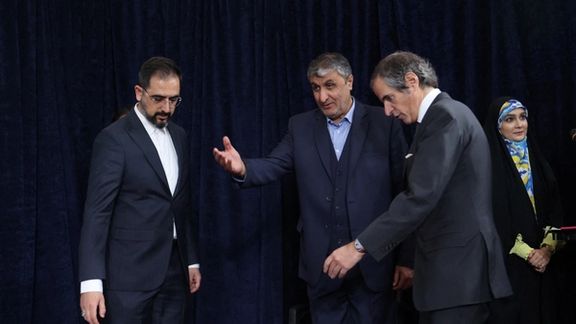
Rafael Grossi (L) with Iran's nuclear cheif Mohammad Eslami in Tehran on March 4, 2023

Western officials indicate there will be no censuring of Iran at a meeting of the UN watchdog, the IAEA this week in the wake of its visit to Tehran last weekend.

Rafael Grossi, IAEA's Director General, was invited by the Islamic Regime in a bid to show transparency, fighting the implications of bitter sanctions which are crippling the country's economy.

Grossi received commitments that the Islamic Republic will cooperate with the watchdog to resolve outstanding issues regarding monitoring and past activities but the pledges Iran made have yet to be worked out in any great detail. On Monday, Grossi announced in a press conference that he cannot guarantee any tangible changes or that greater transparency will result from his visit. 

"We have our ideas and this will be part of the technical discussions that are going to be undertaken as a follow-up to my visit, and to the joint statement. And a technical team will be travelling to Iran very soon to do that," he said. "We will have to discuss...this, how do we do it," Grossi said on Monday, conceding that this and other issues would largely hinge on future technical talks.

His remarks were met with skepticism by the global community, seen as a walking back of the statements he had made only two days before (Saturday) in which Grossi told a news conference they had agreed to re-install extra monitoring equipment such as surveillance cameras, at nuclear sites that was put in place under Iran's 2015 nuclear deal with major powers, but then removed last year as the deal unravelled following the U.S. withdrawal in 2018.

AFP also quoted anonymous Western diplomats that there are no plans to censure the Islamic Republic at the board meeting.

IAEA monitoring cameras used in Iran's nuclear installations being displayed in Vienna in December 2021
100%
IAEA monitoring cameras used in Iran's nuclear installations being displayed in Vienna in December 2021

The US State Department spokesperson Ned Price said he held low hopes to Iran's keeping its promises, given recent history. During his Monday briefing with reporters, he said: “Iran committed to take important steps and expressed a readiness to provide long overdue cooperation with the agency on the outstanding safeguards issues. We expect, most importantly, Iran to take prompt and concrete action in line with the joint statement. Too many times in the past we’ve seen Iran issue vague promises, only never to follow through.”

Iran has been repeatedly censured in the past two years by the IAEA Board of Governors consisting of 35 nations for its lack of cooperation with the international nuclear watchdog.

Prior to this week's meeting, it was disclosed that monitoring discovered particles of uranium enriched to 84-percent purity in Iran’s Fordow enrichment installation, and it was expected that a more stringent censure would be issued at the board meeting. But Grossi’s 11th hour trip to Tehran and pledges made by the Iranian side seem to have eliminated that possibility, for now.
Both Grossi and Price have also indicated that it will take weeks, if not months, until Iran’s real intentions can be judged. This means that the current board meeting might just adopt a wait-and-see approach and not issue a resolution.

This was most likely Tehran’s intention when they invited Grossi for talks at short notice, as Iran has faced increasing isolation internationally since September saw anti-regime protests sweep across the country. Brutal crackdowns have led to more than 500 Iranian civilians being killed in protests, sparked by the death in custody of Mahsa Amini, arrested by the morality police for not wearing her hijab properly.

Additionally, revelations of Iran's supplying kamikaze drones to Russia since September has induced further Western sanctions and dashed the hopes for the resumption of nuclear talks.

“When it comes to the meeting of the Board of Governors, of course Iran will be a topic at the Board of Governors," Price said in this week's briefing. "We’re engaged with our European allies, we’re also engaged with the IAEA itself, on the most effective means by which to see to it that Iran is held to the commitments that it has made."

One reporter asked Price about repeated statements by Iranian officials that they have been receiving messages from Washington about resuming JCPOA talks that reached a deadlock last September which Price dismissed, reiterating that for the Biden administration the talks are not a priority.

“I haven’t seen the full context of these remarks, but what I can tell you is that we have heard plenty of misleading statements and outright lies from Iranian officials over the course of weeks now. The JCPOA is not on the agenda; it has not been on the agenda for some time.”


Most Viewed

100 days after carnage: Iran economy reels from war, inflation, unemployment
1
INSIGHT

100 days after carnage: Iran economy reels from war, inflation, unemployment

2
INSIGHT

Ghalibaf defends Iran-US talks amid hardline backlash

3
INSIGHT

A nation in limbo: 100 days after the massacre, has the world moved on?

4
ANALYSIS

From instability to influence: Pakistan’s pivotal role in US-Iran diplomacy

5
ANALYSIS

100 days on: why Iran’s January protests spread across social classes

Banner
Banner

Spotlight

  • War-hit homeowners feel abandoned as Iran’s reconstruction aid fades

    War-hit homeowners feel abandoned as Iran’s reconstruction aid fades

  • 100 days on: the anatomy of Iran’s January crackdown
    INSIGHT

    100 days on: the anatomy of Iran’s January crackdown

  • Ghalibaf defends Iran-US talks amid hardline backlash
    INSIGHT

    Ghalibaf defends Iran-US talks amid hardline backlash

  • 100 days on: why Iran’s January protests spread across social classes
    ANALYSIS

    100 days on: why Iran’s January protests spread across social classes

  • From instability to influence: Pakistan’s pivotal role in US-Iran diplomacy
    ANALYSIS

    From instability to influence: Pakistan’s pivotal role in US-Iran diplomacy

  • A nation in limbo: 100 days after the massacre, has the world moved on?
    INSIGHT

    A nation in limbo: 100 days after the massacre, has the world moved on?

•
•
•

More Stories

Iran Politicians, Commentators Unhappy About Grossi's Visit

Mar 7, 2023, 02:46 GMT+0
•
Iran International Newsroom

Regardless of the apparent hullabaloo about IAEA chief Rafael Grossi’s visit to Tehran, politicians and commentators in Iran appear to be skeptical about the outcome of the visit.

The political editor of a leading reformist daily Etemad in Tehran, Sara Massoumi, noted that hours after a joint press conference by Grossi and Iranian nuclear chief Mohammad Eslami, the official website of President Ebrahim Raisi and all of Iran's news agencies deleted parts of what they had earlier published as Grossi's statement in the news conference.

In the deleted parts Grossi was quoted as having said, "We have had very constructive and positive meetings with Iranian officials," and "It is quite clear who should be blamed for the current situation of the JCPOA." Another deleted sentence blamed "sinister elements" for preventing IAEA's cooperation with the Islamic Republic.

On Sunday, foreign policy analyst Amir Ali Abolfath said in an interview with conservative Nameh News website that Iran should not pin its hopes on the visit, adding that "regardless of the success or failure of Grossi's trip, there is no bright outlook for the Islamic Republic's relations with the IAEA."

Abolfath noted that the IAEA is a UN body and various countries do not have equal weights at the United Nations particularly in the areas linked to security issues. He added that one cannot expect the IAEA to be satisfied about Iran's nuclear activities as long as tensions between Tehran and Washington are not reduced.

Iranian commentator Amir Ali Abolfath (file photo)
100%
Iranian commentator Amir Ali Abolfath

Meanwhile, former diplomat Fereydoun Majlesi pointed out in an interview with Khabar Online that "Iran's main problem is to have US sanctions lifted and not a visit to Tehran by Grossi." Majlesi also pointed out that Tehran should know that it cannot endlessly attack its adversaries without any repercussion.

He added that if the UN trigger mechanism or ‘snapback’ of international sanctions is activated, Iran will be in a difficult position and will have to reach out to foreign powers to solve its problems. Majlesi reiterated: "I have said many times in more than two years that the JCPOA is a burnt out case. Iran's problems are now about the Non Proliferation Treaty (NPT) and other nuclear commitments. Leaving the NPT is extremely dangerous for Iran and might lead to snapback before the end of 2023.

Grossi's visit, he said was mainly about making matters clear after 84-percent enriched uranium was detected in Iran and Grossi wanted to warn Tehran that this requires more rigorous monitoring and inspection of its nuclear activity.

Meanwhile, the editor of hardline daily Kayhan Hossein Shariatmadari wrote in a commentary on Sunday that Grossi's visit to Tehran was unnecessary and accused the IAEA chief of reporting back to Israel. He said Grossi will inform Israel before anyone else of the outcome of his visit.

In another development, the former chairman of parliament's National Security and Foreign Policy Committee Heshmatollah Falahatpisheh said in an interview with Etemad Online that Iran's Foreign Ministry is incapable of handling nuclear negotiations with JCPOA partners, and the matter should be handed over to the Supreme Council of National Security, a body closely linked to Supreme Leader Ali Khamenei.

Falahatpisheh said that the Foreign Ministry has so far missed all the opportunities it had to settle the nuclear disputes and reach an agreement with the United States and Europe.

He also said in another interview with Rouydad24 that the JCPOA should be removed from the gambling table of world powers and from the political rivalries between various political factions in Iran.

IAEA's Grossi Defends His Iran Trip, Says 'No Guarantees'

Mar 6, 2023, 16:46 GMT+0
•
Mardo Soghom

The head of UN’s nuclear agency, Rafael Grossi, told reporters on Monday that his meeting with Iran’s President Ebrahim Raisi March 4 had “enormous importance.”

Pressed by a reporter to say how his latest trip to Tehran was different from all his other previous visits that failed to resolve outstanding issues, Grossi said “there were many differences,” emphasizing that he had a chance to point out the unresolved issues with the Iranian side.

The director general of the International Atomic Agency (IAEA) also added that he had a “very substantive” discussion with Iran’s foreign minister Hossein Amir-Abdollahian. He emphasized that “talking to the decision makers” in politics “makes a big difference.”

Although Grossi highlighted his meetings with Raisi and Amir-Abdollahian, the main decision maker is the country’s ruler Ali Khamenei who controls foreign and military polices.

Grossi argued that in all areas of IAEA interaction with the Islamic Republic there was “substantive” progress. In case of the Fordow uranium enrichment facility “there will be inspection almost every other day,” he said.

In February, news emerged that the IAEA had found uranium particles at Fordow that were enriched to 84 percent – much higher than Iran’s 60-percent enrichment since 2021 – and close to weapons-grade uranium of 90-percent purity.

He also claimed that there were agreements on more monitoring mechanisms, which can mean more instruments placed in nuclear sites.

One of the many meetings between Grossi and Iran's nuclear chief Mohammad Eslami since 2021. March 5, 2022
100%
One of the many meetings between Grossi and Iran's nuclear chief Mohammad Eslami since 2021. March 5, 2022

However, Iranian officials and government websites have since denied any increased surveillance except a marginal increase of monitoring at Fordow. They have categorically denied that they agreed with Grossi to allow more cameras to be placed in Iranian nuclear installations.

Asked about these statements Grossi said he is not dismayed because he pays attention to what officials have promised him and watches their actions, emphasizing that “this is a new phase.”

“I believe there is a good opportunity,” the IAEA director said, adding that “I cannot guarantee…when people say these were promises, it is not just promises, we do have certain agreements.”

What was also revealing was Grossi’s statement that “I have to do my job and I continue, and I might have been frustrated as many other people…when there are no results… but this was a step in the right direction.”

What some journalists and critics say is that Iran might have gone a bit further this time to offer cooperation, but Grossi’s trip took place just days before the IAEA Board meeting, which leaves no time to test Tehran’s sincerity before the issue comes up in the meeting.

The Board has already censured Iran in its previous meetings for lack of cooperation with the IAEA, and with the revelation of 84-percent enrichment, the ground was set to issue another rebuke. With Grossi traveling to Tehran right before the meeting and returning with hopes of Iranian cooperation, the Board will have less reason this week to censure the Islamic Republic, although there is no real evidence that it will cooperate fully with the Agency.

Grossi admitted that he cannot even set a timetable for resolving issues with Iran. He told a reporter, who asked if he expected progress by the next Board meeting in June, that “these things take time.”

Regrading the chances to resume JCPOA talks between Iran and the West, Grossi said he is neither optimistic nor pessimistic, as this issue is beyond IAEA’s responsibilities. All he can hope is that his agency does its job to the fullest.

Talks that began in Vienna in April 2021 to revive the 2015 nuclear accord reached a deadlock last September. Since then, the United States has been saying that is not focused on the JCPOA talks, but is concerned about Tehran’s repression against domestic protests and supplying weapons to Russia.

Iran Rejects 'Lies' About Giving IAEA Significant More Access

Mar 6, 2023, 08:42 GMT+0
•
Iran International Newsroom

Iran’s official government news website IRNA has rejected most of what appeared to have been progress during IAEA chief Rafael Grossi’s two-day trip to Tehran.

IRNA published what it called “an infographic”Monday morning local time that included six short sentences each ‘debunking’ what it said were “six false claims about Iran and IAEA agreements after Rafael Grossi’s trip.”

Some of the six points, presented as responses by Iran’s nuclear agency, directly rejected statements by Grossi after his return to Vienna Saturday evening.

Iran is supposed to provide access to information, locations and people, Grossi told a news conference at Vienna airport soon after landing, suggesting a vast improvement after years of Iranian stonewalling.

The first three “lies” Iran’s nuclear agency refutes is about more inspections of nuclear installation that Iran has substantially reduced since early 2021 after its parliament passed a law restricting cooperation with the IAEA and mandating higher levels of enrichment.

First point in red fonts showed, “Individuals will be permitted to have access to Iran’s nuclear installation,” as one of the alleged fallacies. A sentence following this statement says, response by the Iran’s nuclear energy agency: “Access by individuals was never raised [in talks with Grossi] and no text was written about this.

The "infographic" published by IRNA on March 6, 2023
100%
The "infographic" published by IRNA on March 6, 2023

The second point refutes Grossi’s statement that new monitoring cameras will be installed: “There was no discussion or agreement over installing cameras.”

The third point in the “infographic” rejects Grossi’s statement that there will be a 50-percent increase in monitoring. It says that the only increase will be in Fordow uranium enrichment site where “inspections will increase from 8 to 11.”

The fourth point pertains to a long-running dispute with the IAEA over traces of uranium found in three sites used for secret nuclear activities prior to 2003. The UN nuclear watchdog is demanding a full explanation and so far the Islamic Republic has not provided it.

The fourth point rejects the claim that the IAEA will have access to the three sites, saying that the Agency once inspected these locations and has not requested another round of access.

Immediately after Grossi’s departure from Tehran, Iran's Atomic Energy Organization spokesperson Behrouz Kamalvandi had already denied giving access to individuals.

"During the two days that Mr. Grossi was in Iran, the issue of access to individuals was never raised," Kamalvandi told state news agency IRNA, adding there also has been no deal regarding putting new cameras in Iran's nuclear facilities.

On Sunday, Nour News, a website affiliated with Iran’s Supreme National Security Council rejected giving new access to the IAEA to inspect the three disputed sites.

IRNA’s publication of the infographic is yet another attempt to downplay the notion that the IAEA will be given more monitoring access to nuclear sites.

The IAEA and Iran had issued a joint statement at the end of Grossi’s trip, just two days before a quarterly meeting of IAEA’s 35-nation Board of Governors.

The statement went into little detail but the possibility of a marked improvement in relations between the two is likely to stave off a Western push for another resolution ordering Iran to cooperate, diplomats said. Iran has, however, made similar promises before that have yielded little or nothing.

Iran Website Says Expansion Of IAEA Nuclear Monitoring A Lie

Mar 5, 2023, 09:59 GMT+0
•
Iran International Newsroom

An Iranian website close to the national security council has said claims that the IAEA will install more monitoring equipment in Iran’s nuclear installations are lies.

Nour News made the statement in a tweet on Sunday, less than a day after the director general of the International Atomic Energy Agency, Rafael Grossi held talks in Tehran and reached agreement for closer cooperation and more monitoring.

Nour news said, “The most important result of IAEA director general’s trip to Tehran was achieving a joint template to speed up monitoring cooperation…News about [IAEA] providing access to individuals and to three [older nuclear] sites claimed by the agency, or installing new cameras is a lie.”

This followed Iran's Atomic Energy Organization spokesperson Behrouz Kamalvandi’s statement almost immediately after Grossi’s trip that Tehran had not agreed to give access to people.

"During the two days that Mr. Grossi was in Iran, the issue of access to individuals was never raised," Kamalvandi told state news agency IRNA, adding there also has been no deal regarding putting new cameras in Iran's nuclear facilities.

IAEA said Saturday that Iran has given sweeping assurances to the UN nuclear watchdog that it will finally assist a long-stalled investigation into uranium particles found at undeclared sites and even re-install removed monitoring equipment.

The IAEA and Iran issued a joint statement on Grossi's return from a trip to Tehran just two days before a quarterly meeting of the agency's 35-nation Board of Governors.

The statement went into little detail but the possibility of a marked improvement in relations between the two is likely to stave off a Western push for another resolution ordering Iran to cooperate, diplomats said. Iran has, however, made similar promises before that have yielded little or nothing.

"Iran expressed its readiness to ... provide further information and access to address the outstanding safeguards issues," the joint statement said. A confidential IAEA report to member states seen by Reuters said Grossi "looks forward to ... prompt and full implementation of the Joint Statement".

Iran is supposed to provide access to information, locations and people, Grossi told a news conference at Vienna airport soon after landing, suggesting a vast improvement after years of Iranian stonewalling.

But the Nour News tweet is another indication of backtracking by Iran once the IAEA board meeting ends without a damaging resolution for Tehran.

Grossi after his trip said that joint work will begin “very, very soon” to implement the agreements reached, but how soon remains to be seen. Any trip to Iran by IAEA officials to work out the details will certainly not take place overnight and reach a conclusion before the board meeting will be over later in the week.

There is a precedence of Iran inviting Grossi for talks before IAEA board meetings, without any concrete results. Grossi visited Tehran last March but the issue of uranium traces found in older sites was not resolved.

However, Grossi speaking in a joint press conference with Iran’s nuclear chief Mohammad Eslami on Saturday said talks were taking place in an "atmosphere of work, honesty..."

Iran And IAEA Announce Agreement To Pursue Cooperation

Mar 4, 2023, 18:10 GMT+0
•
Iran International Newsroom

Iran agreed to offer more cooperation to the International Atomic Energy Agency (IAEA) Saturday after a two-day visit by the agency’s chief Rafael Grossi.

A joint statement by the two parties pledged to carry out interactions “in a spirit of collaboration, and in full conformity with the competences of the IAEA and the rights and obligations of the Islamic Republic of Iran, based on the comprehensive safeguards agreement.”

Grossi traveled to Iran just days before the IAEA Board of Governors was set to meet and hear a report about Tehran’s cooperation with the UN nuclear watchdog.

In February it was revealed that IAEA inspectors had come across uranium particles in Iran’s Fordow underground nuclear facility that were enriched to 84-percent purity. Such a high level of uranium purity is just short of 90-percent needed for building a nuclear bomb.

The joint statement Saturday did not directly mention this issue, except saying, “Iran, on a voluntary basis will allow the IAEA to implement further appropriate verification and monitoring activities. Modalities will be agreed between the two sides in the course of a technical meeting which will take place soon in Tehran.”

Grossi was quoted by Reuters as saying that technical meetings with Iran will take place “very, very soon.”

The other, long-term unresolved issue for the IAEA, is traces of uranium found at three undeclared Iranian sites dating back to before 2003, after the agency launched an investigation following the revelation of a nuclear archive stolen by Israel and revealed in 2018.

Iran was pressed to provide satisfactory explanations about why there were traces of fissile material at these sites, but so far the IAEA has said Iran’s answers have not been convincing.

“Regarding the outstanding safeguards issues related to the three locations, Iran expressed its readiness to continue its cooperation and provide further information and access to address the outstanding safeguards issues,” the joint statement said.

Grossi held talks with Iran’s nuclear chief Mohammad Eslami, President Ebrahim Raisi, as well as with foreign minister Hossein Amir-Abdollahian.

Iran began exceeding enrichment levels set by the 2015 nuclear accord, the Joint Comprehensive Plan of Action (JCPOA) in 2019 after the United States withdrew from the deal and imposed full oil export sanctions.

As the Biden administration expressed its readiness in early 2021 to engage in talks to revive the agreement, Iran announced it would increase enrichment level to 20-percent purity. Later, Tehran began enriching at 60 percent and has stockpiled enough fissile material for four nuclear bombs. It would take just a few weeks to enrich the stockpile further to 90 percent.

Talks to return to the JCPOA lasted 18 months but reached a deadlock in September 2022. Iran now feels isolated and under pressure as its weapons supplies to Russia and a deadly crackdown on antigovernment protests have led to more Western sanctions and unwillingness to continue the talks.



