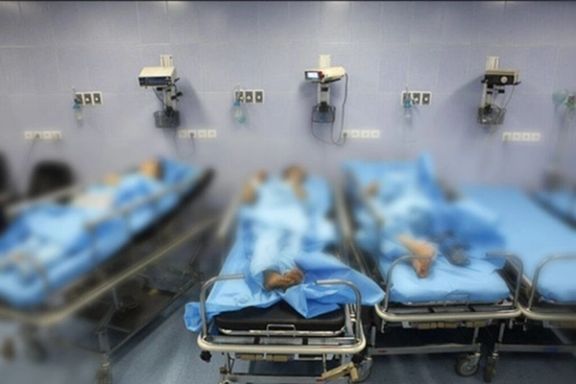
Some of the schoolgirls hospitalized with symptoms of poisoning
A lawmaker has denied involvement of religious fundamentalists in a spate of mysterious poisonings in all-female schools in Iran but demanded classes be held online.
Fatemeh Maghsoudi, representative of Boroujerd in the parliament, told the media Monday that attributing the poisonings to religious fundamentalists was “unfounded” but demanded shifting to online education until the mystery of the attacks is solved.
In a commentary published by Qom News on February 14, Nafiseh Moradi, an Islamic studies researcher at Tehran’s Al-Zahra University, speculated that the Taliban’s ban on girls’ education may have inspired the ultra-religious in Qom to carry out attacks on schools for girls to instill fear in students and their families with the aim of keeping them at home. The website was later blocked by the authorities for publishing the controversial claim.
Since then, many on social media have also attributed the school attacks to underground Shiite groups with beliefs similar to doomsday cults who are also infuriated by young female students’ anti-regime protests and refusal to wear the hijab.
Iran's prosecutor-general Mohammad Jafar Montazeri
Last week Attorney General Mohammad Javad Montazeri said in a letter to Qom prosecutor that the poisoning of students in Qom might be a “deliberate criminal act” and urged city officials to take decisive action in the case.
The first case which was reported in Qom on November 30 affected 18 students at a secondary school who fell ill with symptoms such as nausea, headaches, coughing, difficulty breathing, heart palpitations, and lethargy.
Poisonings, apparently by gas, were hushed for nearly two months but now they have spread to several other cities, particularly in Boroujerd, capital of the western Lorestan province, where several schools were hit in the past week.
Students of Ahmadieh High School in Boroujerd have said that something like a home-made bomb was thrown into the school yard that emitted a gas. Consequently, some of these students lost movement in their limbs and had to be hospitalized as were the school principal and her deputy.
Over a hundred were poisoned at 15 Khordad High School in the same city. There are reports of Tohid Middle School and Fereshtegan Primary being hit in Boroujerd in the past few days.
Isolated cases have also been reported, with very little detail, in Qazvin, and several other cities in different parts of the country.
Victims say they smelled something like bleach while others report smelling peppermint, bleach or rotten fruit before their symptoms emerged.
In response to claims on social media that Fatemeh Rezaei, an eleven-year-old girl, has died in Qom because of the poisonings, the state media on Sunday said the death of the schoolgirl in Qom had nothing to do with the school attacks.
The official news agency IRNA on Monday published an interview with the girl’s father who said the reports about his daughter’s death and its connection with the poisonings was fabricated by “anti-revolutionary media” based outside Iran. He said his daughter’s symptoms which led to her death from infection included leg pain, stomachache, vomiting and a temperature.
Deputy education minister Younes Panahi said Sunday that the serial poisoning of female students in Qom and other cities were "intentional". "It was found that some people wanted all schools, especially girls' schools, to be closed." Later on the same day, he said he was misquoted about the incidents being “intentional poisonings”.
Panahi also insisted that the chemical compounds used to poison students were not of weapons-grade chemicals used in chemical wars and that aggressive treatments were not required for the symptoms that students have been suffering from.
People looking at a board that shows exchange rates against rial
Criticism of President Ebrahim Raisi and his government in Iran reached a new level during the weekend as the US dollar exceeded 600,000 rials at one point on Sunday.
Even before reaching that unprecedented level, the media in Tehran and social media users showed disillusionment, despair and anger about the rising rates and attributed it to the government's inefficiency.
Reformist daily Shargh in its Sunday edition that was prepared the previous day when the rate was just over 575,000 rials per dollar, also criticized the government's supporters such as hardline Kayhan newspaper for keeping silent, although it used to lash out at the Rouhani administration less than two years ago when the rial was much stronger.
Shargh quoted reformist cleric Mohammad Taqi Fazel Maybodi's comment on social media about the President's father-in-law Ahmad Alamolhoda who has attributed the currency’s fall to "foreigners' conspiracy," and told him "what would have you said if such an unprecedented rise [for the dollar] occurred under former President Rouhani?"
The government and its supporters blame everyone for the hike except their own policies, wrote Shargh. The daily also quoted conservative commentator Mohammad Mohajeri as having said that Raisi had better go to former officials such as foreign minister Zarif, IT Minister Jahromi, oil minister Zanganeh and Central Bank governor Hemmati and begged them to return to their offices to put an end to the chaotic situation in their areas of expertise.
While rumors in Tehran indicate that Raisi is about to make some changes in his cabinet and replace individuals such Vice President Mohammad Mokhber, the latter told the parliament on Saturday, "You cannot find officials better than us!" Statements like that certainly dash hopes for an improvement in the situation.
Vice President Mohammad Mokhber
Iranian journalist Mohammad Aghazadeh wrote in a tweet on Saturday, "The unprecedented rise in the rate of exchange for the US dollar cannot have only economic reasons. There is a major development behind it. The current situation cannot and will not continue. This development may be engineered. Otherwise, either a spontaneous uprising by the masses or a war might determine the course of [upcoming] events."
Meanwhile, according to Rouydad24 news website, former lawmaker Mansoor Haqiqatpour has said that "radicals who have infiltrated the government do not allow real experts to tackle the problems. He added that the obstruction by radicals comes while the government is less capable than what the Iranian nation deserves.
Stressing that the Raisi administration is inefficient, the politician said, "Officials should solve the problems if they can. And if they cannot, they should say that honestly and allow others who have expertise to come forward and handle the job." He added: "This government started its work with the rate of exchange of 230,000 rials per dollar and a year and a half later, the dollar is way over 560,000 rials. This is a clear indication of the government's inefficiency."
According to Iranian academic Gholamreza Zarifian, respecting the people's trust is clearly not part of the government's priorities, and this comes while the public cannot tolerate any further crises.
Presumably referring to a recent statement by Iran’s ruler Ali Khamenei, Zarifian said: "Decision makers insist that what is going on in Iran is an example of democracy, but critics are aware that the current reality is extremely far away from any likeness of democracy and a large part of Iranians are unhappy about the status quo. The people who cannot make ends meet blame government officials' naivety and inefficiency for the economic bottlenecks in their lives."
Amnesty International says Iranian authorities are subjecting Belgian aid worker Olivier Vandecasteele to enforced disappearance, torture and other ill-treatment.
In a statement released on Monday, Amnesty International urged all states whose nationals are or have been detained at any point in Iran to promptly examine whether the deprivation of liberty amounts to an act of hostage-taking, and if so, take all appropriate measures to ensure accountability.
“He is held in solitary confinement in a windowless basement cell and is denied access to adequate healthcare and fresh air,” added Amnesty.
Additionally, his family and lawyer, as well as Belgian consular authorities, are unaware of his exact whereabouts.
Amnesty has warned that the Islamic Republic of Iran has kept this Belgian citizen as a "hostage" to exchange him with Asadollah Asadi, an Iranian diplomat.
Asadi has been sentenced to 20 years in prison for “attempted murder and involvement in terrorism” for his role in plotting to bomb a gathering of the MEK near Paris in 2018.
On 10 January 2023, Iranian state media announced that Vandecasteele was sentenced to 40 years in prison and 74 lashes, amidst indications that the Iranian authorities are holding him hostage to compel Belgian authorities to swap him for a former Iranian official imprisoned in Belgium.
Currently, at least 16 foreign citizens, most of whom dual nationals, are detained in the prisons of the Islamic Republic.
Iranian Foreign Minister Hossein Amir-Abdollahian attends the Human Rights Council at the United Nations in Geneva, Switzerland February 27, 2023.
Tens of participants at the UN Human Rights Council walked out when the Islamic Republic’s foreign minister spoke at the 52nd session of the body on Monday.
Many seats were empty while Hossein-Amir Abdollahian was delivering his speech at UHRC’s headquarters in Geneva, following calls by activists urging delegates to walk out in reaction to the regime’s gross human rights violations, especially during the ongoing crackdown on antigovernment protests.
The current session of the council, made up of 47 member countries, will last for more than five weeks and is set to tackle an extensive array of human rights issues, including discrimination and freedom of religion, both major issues in Iran.
Most participants who left the hall in protest to Amir-Abdollahian's presence were members of NGOs as most diplomats preferred to stay and listen to the Islamic Republic’s rhetoric.
Men, simulating hanging, demonstrate against the Republic of Iran in the Place des Nations during the Human Rights Council at the United Nations in Geneva, Switzerland, February 27, 2023.
Trying to manipulate the realities on the ground, the Iranian FM said, “The peaceful assemblies that took place in my country following the sad death of Mahsa Amini... turned violent following the malign interference by some terrorist elements. In this respect, a number of Persian language TV channels based in the US and the UK, acted as provocateurs of hatred and propagators of violence.”
He also claimed that an investigation was ongoing and that all the people that were arrested during the protests have been released. He also claimed that "no one has been killed," in response to Iran International’s correspondent who asked him about the Islamic Republic's killing of protesters including a 10-year-old kid.
Outraged by Amir-Abdollahian's presence, many politicians and activists expressed concern about the UN’s move to invite the Iranian official for the opening day of the five-week session. Member of the Swedish parliament, Alireza Akhondi, said, “It’s a shameful day for the UN that they allowed representatives for a murderous regime to speak here about human rights.”
“I’m expecting that they (the UN) are redrawing their badges and they are not allowing them to enter this building anymore. Because they are not respecting the human rights of anybody and they are trying to harass and make the Iranian voices to not be able to be heard,” he added.
The foreign minister’s presence was not the only issue of contention among Iranian and foreign activists as he also held several meetings on the sidelines of the UN session, such as a meeting with the UN Secretary-General António Guterres, Belgian Foreign Minister Hadja Lahbib and Finnish Foreign Minister Pekka Haavisto.
The meetings shocked social media users, especially because Lahbib cut their hair in the country’s parliament in solidarity with anti-government demonstrations. Her meeting was criticized by many activists and officials, including Belgian lawmaker Darya Safai, who pointed out that “The Belgian government goes along with hostage diplomacy.” Lahbib herself tweeted about the release of Olivier Vandecasteele, an aid worker and a former employee of the Norwegian Refugee Council sentenced to 40 years in prison in Iran. Some believe her meeting with Amir-Abdollahian was probably an attempt to plead for his release.
Canada says it has imposed sanctions on 12 senior officials from Iran's Islamic Revolutionary Guard Corps (IRGC) and Law Enforcement Forces for their role in "gross and systematic human rights violations."
In a statement Canada's foreign ministry announced on Monday that the targeted officials include Kurdistan Province Governor Esmaeil Zarei Kousha and Morteza Mir Aghaei, Commander of Basij paramilitary forces in Sanandaj, Kurdistan Province.
The measures prohibit dealings with the listed individuals, effectively freezing any assets they may hold in Canada.
They are also inadmissible to Canada under the Immigration and Refugee Protection Act, added the statement.
“Ottawa will continue to coordinate with its international partners to respond to the Iranian regime’s egregious treatment of its people, its deployment of propaganda and its actions that continue to threaten international peace and stability.”
Mélanie Joly, Minister of Foreign Affairs of Canada earlier stated that “The Iranian regime continues to brutally oppress its people and to deny them their fundamental rights and freedoms. We hear the pleas of the Iranian people, and we commend them for their bravery and resilience. Canada will not stop advocating for Iranians and their human rights.”
Iran’s suppression of nationwide protests since the death in custody of Mahsa Amini in September has drawn condemnation from international community with US and EU imposing sanctions on the regime.
Some of the schoolgirls hospitalized with symptoms of poisoning
Iran’s deputy education minister says the serial poisoning of female students in the religious city of Qom and other cities have been "intentional".
Younes Panahi said on Sunday that "It was found that some people wanted all schools, especially girls' schools, to be closed."
"It has been revealed that the chemical compounds used to poison students are not war chemicals, and the poisoned students do not need aggressive treatment, and a large percentage of the chemical agents used are treatable," he told a press conference.
Homayoun Sameh Najafabadi, a member of the health committee of the parliament, also confirmed in an interview with Didbaniran website that the poisoning of female students in schools of Qom and Borujerd is intentional.
These statements are made in a situation that earlier Youssef Nouri, the Minister of Education called the reports about the poisoning of schoolgirls "rumors", claiming that the students taken to the hospital had "underlying diseases".
However, on Sunday, Majid Monemi, the deputy governor of Lorestan, said 50 female students of a high school in Borujerd, western Iran, were poisoned again.