• العربية
  • فارسی
Brand
  • Iran Insight
  • Politics
  • Economy
  • Analysis
  • Special Report
  • Opinion
  • Podcast
  • Iran Insight
  • Politics
  • Economy
  • Analysis
  • Special Report
  • Opinion
  • Podcast
  • Theme
  • Language
    • العربية
    • فارسی
  • Iran Insight
  • Politics
  • Economy
  • Analysis
  • Special Report
  • Opinion
  • Podcast
All rights reserved for Volant Media UK Limited
volant media logo

Iranians Torn Between Modernity And Tradition, Sociologists Say
Iran International Newsroom
Feb 17, 2023, 16:09 GMT+0Updated: 18:16 GMT+1
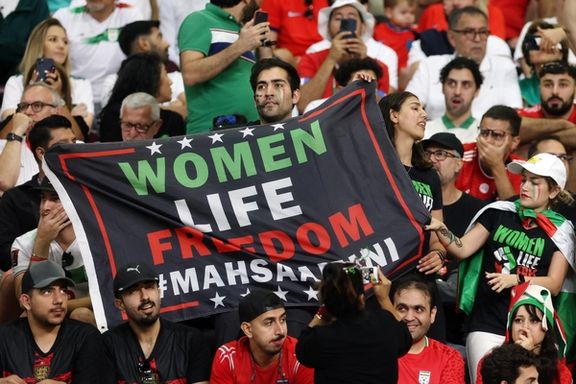
Iranian fans during the Qatar World Cup. November 21, 2022

Two prominent sociologists in Iran argue that with the decline in political participation, opportunists got concessions from the state and gained the upper hand.

Mohsen Goudarzi and Abdolmohammad Kazemipour told Shargh newspaper: "We reviewed the data for several decades and we found out that with the decline of trust between the people and the government corruption will rise and the rule of law will take a downturn."

Goudarzi maintained that all this will lead to the government's inefficiency and more corruption which will in turn, further damage the people's trust in the government and other institutions.

He argued that this vicious circle will continue, and as the situation worsens, this is not something citizens can tolerate forever. When the people feel that there is no hope for change and no institutionalized way to bring about change, they will take to the streets.

As long as corruption and inefficiency and other shortcomings persist and cause dissatisfaction, and there is no institutionalized outlet for expressing dissent, protests are always probable.

Goudarzi explained that the government, the economy, and social structures are the main ingredients of a coherent society, but many political elites believe that after politics, the economy plays the most important part in the society. In several periods before and after the 1979 revolution, and even before the revolution, Iranian politicians have asked themselves whether economic development should come before political development or vice versa.

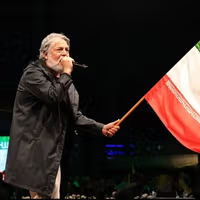
Iranian sociologist Mohsen Goudarzi
100%
Iranian sociologist Mohsen Goudarzi

A 1969 document called "The Principles of Cultural Policy" and several other studies in the mid-70s about the future of Iran have all considered social crisis as the core problem for Iran. At that time, they referred to it as a cultural crisis. In the 1970s, sociologists believed that Iran's problem was that economic growth was prioritized over cultural and political growth.

The social scientists of the 1970s believed that a fast-paced economic change had altered the material aspects of the people's life. With the transition from traditional agricultural economy to modern industrial economy, large parts of the population migrated from the villages to the margins of urban areas, where they found themselves in an environment with different ideals and values.

Social scientists believed that the newcomers to the cities found themselves alien to the new environment. In order to escape the anxiety of this dislocation, they took refuge in the safe haven of traditions, particularly in religion, Goudarzi added. The transforming society pursued material values and looked forward to a modern future, but at the same time, people did not tolerate the resulting cultural changes.

Yet another problem was that while economic growth was creating a well-off middle class, doors to political participation remained closed. Sociologists Majid Tehranian, Ali Assadi and Hormoz Mehrdad in 1970s believed that focusing on the economy and ignoring its social and political implications by the Iranian government was the root cause of tensions. They believed that in that situation the society was not able to remain stable.

Time proved them right in a matter of only a few years. Since then, sociologists made sure that focusing on the economy without paying attention to people's political and social needs will lead to catastrophe. ‌But ruling politicians in Iran, both then and now, thought that political participation could be relegated to the background. In their book, "What happened? The story of decline of Iranian society," Mohsen Goudarzi and Abdolmohammad Kazemipour have challenged this view. We have laid emphasis on the idea of balance, said Goudarzi.


Most Viewed

Ideology may be fading in Iran, but not in Kashmir's ‘Mini Iran'
1
INSIGHT

Ideology may be fading in Iran, but not in Kashmir's ‘Mini Iran'

2
INSIGHT

Hardliners push Hormuz ‘red line’ as US blockade tests Iran’s leverage

3
VOICES FROM IRAN

Hope and anger in Iran as fragile ceasefire persists

4

Iran International says it won’t be silenced after London arson attack

5

US sanctions oil network tied to Iranian tycoon Shamkhani

Banner
Banner

Spotlight

  • Hardliners push Hormuz ‘red line’ as US blockade tests Iran’s leverage
    INSIGHT

    Hardliners push Hormuz ‘red line’ as US blockade tests Iran’s leverage

  • Ideology may be fading in Iran, but not in Kashmir's ‘Mini Iran'
    INSIGHT

    Ideology may be fading in Iran, but not in Kashmir's ‘Mini Iran'

  • War damage amounts to $3,000 per Iranian, with blockade set to add to losses
    INSIGHT

    War damage amounts to $3,000 per Iranian, with blockade set to add to losses

  • Why the $100 billion Hormuz toll revenue is a myth
    ANALYSIS

    Why the $100 billion Hormuz toll revenue is a myth

  • US blockade targets Iran oil boom amid regional disruption
    ANALYSIS

    US blockade targets Iran oil boom amid regional disruption

  • Iran's digital economy battered by prolonged blackout
    INSIGHT

    Iran's digital economy battered by prolonged blackout

•
•
•

More Stories

Protests Succeeded In Initiating Dialogue Among Iran’s Social Groups

Feb 17, 2023, 01:23 GMT+0
•
Maryam Sinaiee

The protest movement in Iran has succeeded in sowing the seeds of a hitherto missing dialogue among social groups and generations that can rekindle the protests anytime.

The protest movement born after the death in custody of Mahsa Amini in September has to a good degree succeeded in creating a process of dialogue between the modern and traditional groups of the society and between generations, professor Hadi Khaniki, chairman of the Iranian Society of Cultural and Communications Studies of Tehran University, said in a speech at Rahman Institute in Tehran last week.

The regime which heavy-handedly suppressed protesters, executed four, killed as many as 500 and arrested around 20,000 in the first four months is now claiming victory but the impact of the protests has been immense.

The relative recent calm may have only been temporary, too. On Thursday, people took to the streets in several cities again on day forty after the execution of two protesters, Mohammad Hosseini and Mohammad-Mehdi Karami, in Karaj. Protests have been reported from the capital Tehran, Mashhad, Sanandaj, Karaj, Izeh.

In an essay from Evin Prison in Tehran which was published by Zeytoon website on January 31, prominent sociologist Saeed Madani said one would not be able to imagine any future for Iran that does not bear the mark of the Mahsa Movement. 

Sociologist Saeed Madani (file photo)
100%
Sociologist Saeed Madani

“Understanding what happened in over 100 days of protests bears strategic significance even if at the time of publication of this essay the protests have temporarily or permanently ended,” Madani wrote.

“The protest movement has [also] created…a multi-dimensional national identity with various ethnic, gender and religious identities somehow acting together instead of one-dimensional nationalism,” Khaniniki said while pointing out that the protests have also established a process of communication between expatriates and the people of Iran “despite all [their] political differences”.

Khaniki who has dubbed the recent protests as the “Movement of the Neglected”

was a member of the central council of the reformist Mosharekat (Islamic Iranian Participation Front) Party which formed the largest faction in the parliament from 2000 to 2004 during the presidency of Mohammad Khatami to whom he served as a media advisor.

Mosharekat Party was banned in 2009 in the aftermath of the disputed elections that brought the hardliner Mahmoud Ahmadinejad to power for a second term, and many of its leading figures were imprisoned. The party did not declare itself secular but did promote the separation of religion and state. Khaniki is currently a member of the central council of the Etehad-e Mellat (National Unity) Party which has many similarities to Mosharekat.

The Mahsa Movement has also somehow reactivated Iran's once very popular reformists who were marginalized after 2009. Two weeks ago, two of their prominent leaders, Khatami and Mir-Hossein Mousavi who has been under house arrest since 2011, issued separate statements related to the protest movement.

Khatami condemned the regime suppression of the protests but insisted that the solution to the problems of the country is not overthrowing the regime which he said was impossible to do because of its power of suppression. Instead, he advised the regime to surrender to fundamental reforms before it is too late.

Mousavi, on the other hand, announced his recognition of the Woman, Life, Freedom movement and declared that the Islamic Republic was no longer reformable. The current regime must be replaced, through elections and referendum, with a new democratic government through non-violent means, he said.

Both statements have found resonance with various political figures and parties from across the reformist spectrum.

Sociologists Say Lack Of Public Trust Driving Iran Protests

Feb 16, 2023, 09:36 GMT+0
•
Iran International Newsroom

In a new book, two Iranian academics argue that Iranian have lost trust in the regime, which is perceived as inefficient and mired in discriminatory behavior.

“An unhappy crowd takes to the streets when it has no other way to voice its dissatisfaction with the current situation. We have explained in this book that political participation in Iran has been declining and a large majority of the people believe that the official power structure is inefficient and corrupt," one of the authors said.

In an interview with Mohsen Goudarzi and Abdolmohammad Kazemipour the authors of the newly published book, "What happened? The story of decline of Iranian society," Reformist daily Shargh's editor Ahmad Gholami discussed recent protests against the backdrop of long-standing dissent.

The book by the two prominent sociologists was published when Iranian protesters took over the streets and many political analysts and scholars tried to explain the uprising. The authors of this book were particularly focused on the declining social capital and public trust in Iran.

The authors examined the "vertical trust" between the people and the government, which they believe has eroded during the past decades because of the serious inefficiency of the government and a closed system that did not allow political participation. This, the authors believe, has made it difficult for the government to convince the public about its narrative. They have also examined the "horizontal trust" between the members of the public and social groups.

Sociologist Mohsen Goudarzi (C). Undated
100%
Sociologist Mohsen Goudarzi (C). Undated

They have also observed that the four waves of protests between 2009 and 2022 were different from each other in their form and nature. Kazemipor said about the differences and similarities between these movements: "There are some key concepts in the book that might be helpful. These include the horizontal and vertical trusts."

He added that in the 2009 Green Movement, both of these types of trust were still in place, while in the following waves of protests, the vertical trust in particular had declined. The horizontal trust between citizens was also lost to some extent.

Kazemipour continued: "In 2009 the project for change was a more or less reformist movement. It was not radical. That indicated that the links between the government and society were still in place. So, people could still have hope in gradual reforms."

Abdolmohammad Kazemipour
100%
Abdolmohammad Kazemipour

"Meanwhile, the society had just seen the performance of a reformist government that had its links to civil and occupational activists. This means there was a strong horizontal trust. However, in 2018 and 2019 and 2022 both the horizontal and vertical trusts were weakened," Kazemipour added: "One can even say the vertical communication was totally lost in 2022 and that is clear in the nature of the protesters' slogans which were focused mainly on what people did not want. They no longer demanded a particular reform, action or behavior from the country's power structure."

Goudarzi said: "Analyzing the movement based on the main idea of this book requires access to more data. For instance, we do not know exactly about the age range, socio-economic class and the attitudes of the protesters. We do not know what segments of the society were present in the streets and who was absent and what made the two groups different from each other. If we had those information, we could tell more precisely how their characteristics were linked to the movement."

Goudarzi added that "the people believe the government has not been successful during the past four decades in anything other than maintaining the country's security, and even in that area the state's success has not been eye-catching. The people believe that the government has certainly failed in the economy…civil liberties. People feel they are discriminated against. This feeling of discrimination is a major source of anger."

Goudarzi added: "The people do not believe that government offices or organizations belong to them. As a result, their trust in clerics, judges and government officials have been declining during the past decades and people turned their back to official institutions and even political groups and factions."

US Holding Indirect Talks With Iran On Prisoner Exchange: NBC

Feb 15, 2023, 17:55 GMT+0

Washington is holding indirect talks with Tehran on a possible prisoner exchange in a bid to secure the release of several US citizens held hostage in Iran.

An NBC report published on Wednesday quoted four sources familiar with the matter saying that Qatar and Britain are easing the talks as intermediaries.

“The negotiations have made progress, but it remains unclear if a final agreement will be reached,” one of the sources said.

This comes as nuclear talks between Tehran and the world powers have been stalled for several months, as the United States and its European allies have imposed new sanctions against the clerical regime.

“The two sides are exploring a formula that has been discussed previously, dating to 2021, that could include a possible prisoner exchange and the release of billions of dollars in funds in South Korea banks currently blocked by US sanctions,” three sources with knowledge of the talks told NBC.

“In the discussions, US and Iranian diplomats have explored possible arrangements for how to transfer the frozen funds, with a third country such as Qatar possibly overseeing the transfer.”

Several Iranian-American citizens, including Siamak Namazi, Emad Sharqi, and Morad Tahbaz, are still imprisoned in Iran.

Earlier, Iran’s Foreign Ministry Spokesman Nasser Kanaani claimed, "We have said many times that we are ready for the exchange of prisoners unconditionally, and in this regard, we have showed goodwill."

Raisi Administration Under Attack By Iranian Politicians

Feb 15, 2023, 08:48 GMT+0
•
Iran International Newsroom

An Iranian lawmaker says the Raisi administration instils despair in society as it refuses to acknowledge its mistakes and insists on working with incompetent managers.

Reza Hosseini Ghotbabadi, a lawmaker, charged that the administration's behavior contradicts Supreme Leader Ali Khamenei's call for giving hope to the society.

He added that some of Raisi's aides and ministers lack the managerial experience for running the affairs of the state. He further charged that blaming all the country's problems on the previous governments rather than accepting responsibility for the shortcomings is unethical.

He said Raisi should have been familiar with the issue of financial corruption as the country's former Judiciary Chief and should have prevented wrongdoing while he was in that capacity. Meanwhile, he warned that the next government in Iran might also blame Raisi and his cabinet for the country's problems.

Ghotbabadi said elsewhere that Raisi and his aides believe themselves to be the only wise individuals in Iran and that they are not prepared to consult with others including the parliament about the affairs of the state.

"The government makes all decisions secretly among insiders. But chaos will continue in Iran as long as the administration refuses to work with the parliament.”

Reza Hosseini Ghotbabadi, conservative member of the Iranian parliament
100%
Reza Hosseini Ghotbabadi, conservative member of the Iranian parliament

Meanwhile, in similar statements, Rasoul Montajabnia, the secretary general of the pro-reform Republicanism Party said in an interview that some Iranian officials see themselves as the essence of the political system and impose a minority's views on everyone. "They believe that they are the system and insist that protecting the system is the most important thing to do," he said.

Referring to former Prime Minister Mir Hossein Mousavi and Former President Mohammad Khatami's statements about the need for essential changes in the system, Montajabnia said differentiation should be made between the regime and those who are or have been working within this system.

Rasoul Montajabnia, the secretary general of the pro-reform Republicanism Party
100%
Rasoul Montajabnia, the secretary general of the pro-reform Republicanism Party

He added that the mistakes and naivety of radicals within the system has weakened the constitution and tarnished the image of the regime. Nonetheless, he said that in the 1990s he had opposed the idea of changing the system. "Of course, the system needs to be reformed but not all of the current problems have their roots in the nature of the system," Montajabnia said.

Until recently this has been the position of all reformists who have tried for 25 years to reform the Islamic Republic. However, Mousavi and a few hundreds of other reformists have come out demanding constitutional change that could effectively put an end to the Islamic Republic in its current form.

In another development, responding to hardliners such as the editor of Kayhan daily, who have said that people's participation in the revolution anniversary rallies on February 11 show that no change should be made in the constitution, the former chairman of the Tehran City Council Mohsen Hashemi said that those who took part in the revolution anniversary rallies do not represent the majority of Iranians.

He warned: "Economic, social and cultural indicators point to an alarming state, so, please stop putting more holes in the boat!" He pointed out that in a city like Tehran even if 500 thousand people turned up for the rallies, this is hardly five percent of the city's population. So, we need to consider the demands and views of the other 95 percent."

"Another point to consider is that the views of that five percent should not be taken as the entire nation's support for government policies," Hashemi added. Meanwhile he warned that a majority of Iranians are living under the poverty line, and this means that they are being drowned in economic problems.

Internet Must Be Restricted Because Enemy Controls It: Ex-IRGC Official

Feb 13, 2023, 20:47 GMT+0

Former head of Iran’s Revolutionary Guard intelligence and advisor to its commander says the “enemy” controls the Internet, so it has to be restricted.

Hossein Ta’eb stated that today "we no longer have aerial bombardments and missiles" and instead a "hybrid war" is taking place.

The clerical regime has blocked thousands of website for the past two decades, but expanded its Internet restrictions at the beginning of antigovernment protests in September.

"The Internet is in control of the enemy, so we have to restrict it to deny the enemy success in its hybrid war," added Taeb.

Islamic Republic officials use the term “enemy” to refer to the United States and its allies.

During a speech at Tehran Polytechnic University (Amirkabir) on Monday, he also attributed support by celebrities for public protests to "hybrid war", claiming that in a hybrid war the fans of a celebrity must get excited to create violence.

Ta’eb also referred to Prince Reza Pahlavi's appreciation for the prominent Sunni cleric Mowlavi Abdolhamid's criticism of the government, saying "we do not have ethnic and religious differences, and Shia and Sunni live together, but some people want to take advantage of this."

He once again accused the US of seeking to create "social rifts" in Iran, so that "both sides in the society will clash first, and then they clash with the government".

He did not say who exactly he meant by the two sides and did not provide any evidence for his claims.