• العربية
  • فارسی
Brand
  • Iran Insight
  • Politics
  • Economy
  • Analysis
  • Special Report
  • Opinion
  • Podcast
  • Iran Insight
  • Politics
  • Economy
  • Analysis
  • Special Report
  • Opinion
  • Podcast
  • Theme
  • Language
    • العربية
    • فارسی
  • Iran Insight
  • Politics
  • Economy
  • Analysis
  • Special Report
  • Opinion
  • Podcast
All rights reserved for Volant Media UK Limited
volant media logo

Grief Of Executions Consolidating Iranians’ Resolve Against Regime
Iran International Newsroom
Jan 15, 2023, 19:38 GMT+0Updated: 17:24 GMT+1
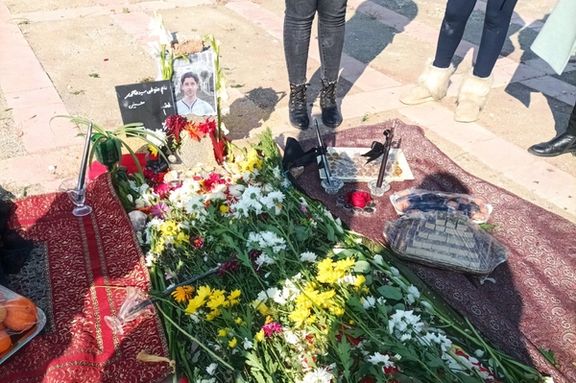
The grave of executed protester Mohammad Hosseini

Grieving over the execution of Iranian protester Mohammad Hosseini, several young women gathered at his grave to mourn his untimely death that has cast a somber gloom on the country. 

In a video sent to Iran International on Sunday, a woman is heard addressing Mohammad, who was hanged on January 7, telling him that he has numerous sisters now, while another woman is heard weeping in the background. 

"Dear Mohammed, my good brother, now you have so many sisters here, you are not alone anymore, we came from a far distance in this cold because you sacrificed your life for us, we all love you, you are in our hearts," the woman said. 

The 39-year-old – with no apparent family members -- was one of the loneliest victims of the regime’s crackdown, and his hanging drew massive reactions on social media, where Iranian can speak freely. Soon after his death, he became an icon of solitude in the face of the Islamic Republic’s oppression. His grave is regularly showered with flowers and people distribute food and sweets in the honor of their new hero, as is customary by bereaved families in Iran. There are numerous social media posts by people who visit his grave to show that he is not alone, saying all Iranians are his family.

The Tehran branch of the Islamic Republic Revolutionary court  (file photo)
100%
The Tehran branch of the Islamic Republic Revolutionary court

The regime hanged Hosseini along with Mohammad Mahdi Karami for allegedly killing a member of the security forces during nationwide protests that were triggered following the death of 22-year-old Kurdish woman Mahsa Amini in police custody in September. The convictions were not based on a criminal charge related to the murder per se, but they were charged with ‘moharebeh’, meaning “war against God”, a vague religious concept. The Islamic Republic applies the charge to people who might get into a confrontation with security forces during protests. 

The executions led to condemnation by many countries and summoning of Islamic Republic envoys in several capitals, as well as a global outcry by politicians and human rights activists. Moreover, lawyers of the two young protesters say the judiciary executed them so hastily that there was no chance for legal follow-up on their cases.

So far, the government has executed four protesters and eleven others have received the death penalty, some for less serious charges than murder, while at least 109 protesters face charges that could end in death sentences for them, an Iranian human rights group based in Oslo has reported. The Iran Human Rights Organization said in its latest report that this figure is a minimum estimate as most families are under pressure to stay quiet, and the real number is believed to be much higher. According to the US-based Human Rights Activists News Agency (HRANA), nearly 20,000 people have been arrested during the antigovernment rallies. 

While protests continue usually during the mourning ceremonies for the third, seventh and the 40th day after the death of protesters, the Islamic Republic is issuing death sentences, long prison terms and floggings to quell the revolt.

Earlier in the week, the judiciary announced that a court has sentenced three others to death for “war against God” in a case known in media as the "Khane-ye Esfahan." Three more were also sentenced to death in another case over antigovernment protests in the northern city of Nowshahr. One of them, Javad Rouhi, received three death sentences on charges of "corruption on earth" and "moharebeh" and "Apostasy through desecration of the Quran and other Islamic sanctities as well as burning the Quran.”

This week, branches of the revolutionary courts in different cities continued to issue heavy sentences against people detained during the protests. For example, Mehdi Sabzehparvar was given a five-year sentence, Nazli Saeedi was sentenced to two years ban from leaving the country as well as 15 months of prison, dentistry student Behzad Ghadiri was sentenced to 50 lashes in addition to more than three years of prison, and Amin Amanat was sentenced to four years on charges of "acting against national security" and "propaganda against the regime."


Most Viewed

100 days after carnage: Iran economy reels from war, inflation, unemployment
1
INSIGHT

100 days after carnage: Iran economy reels from war, inflation, unemployment

2
INSIGHT

Ghalibaf defends Iran-US talks amid hardline backlash

3
INSIGHT

A nation in limbo: 100 days after the massacre, has the world moved on?

4
ANALYSIS

From instability to influence: Pakistan’s pivotal role in US-Iran diplomacy

5
ANALYSIS

100 days on: why Iran’s January protests spread across social classes

Banner
Banner

Spotlight

  • War-hit homeowners feel abandoned as Iran’s reconstruction aid fades

    War-hit homeowners feel abandoned as Iran’s reconstruction aid fades

  • 100 days on: the anatomy of Iran’s January crackdown
    INSIGHT

    100 days on: the anatomy of Iran’s January crackdown

  • Ghalibaf defends Iran-US talks amid hardline backlash
    INSIGHT

    Ghalibaf defends Iran-US talks amid hardline backlash

  • 100 days on: why Iran’s January protests spread across social classes
    ANALYSIS

    100 days on: why Iran’s January protests spread across social classes

  • From instability to influence: Pakistan’s pivotal role in US-Iran diplomacy
    ANALYSIS

    From instability to influence: Pakistan’s pivotal role in US-Iran diplomacy

  • A nation in limbo: 100 days after the massacre, has the world moved on?
    INSIGHT

    A nation in limbo: 100 days after the massacre, has the world moved on?

•
•
•

More Stories

People Express Support For Summoned Sunni Leader In Northern Iran

Jan 15, 2023, 17:21 GMT+0

Protesters in northern Iran gathered outside the house of a prominent Sunni leader in Golestan province demanding the government cancel a summons for him.

Videos on social media show residents in Galikash held a gathering for Mowlavi Hossein Gorgij, the deposed Sunni Imam of Azadshahr on Sunday.

Mowlavi Gorgij has been summoned to the special court of clergy in provincial capital, Gorgan after his dismissal.

Reports say the deposed leader was summoned in a phone call on Wednesday, but he refused to present himself.

In December, Khamenei’s representative in Golestan province, with a large Sunni population, dismissed Gorgij, an outspoken and popular religious leader revered by his followers.

The dismissal led to public outrage and protests in the northeastern region in the city of Azadshahr, where Gorgij was the Friday Prayer Imam.

The decision to fire the Sunni cleric was announced as a reaction to some of his remarks that were deemed insulting to Shia sanctities. Gorgij, however, issued a statement afterwards to apologize, clarifying that his speech was misinterpreted, and he meant no disrespect towards the Shias.

The move against the Sunni Imam, who had earlier condemned the Islamic Republic's police brutality against citizens, has prompted several protests to Khamenei's decision across the province.

Iranian Spyware Steals People's Info Via VPN

Jan 15, 2023, 15:50 GMT+0
•
Iran International Newsroom

Private cybersecurity company Bitdefender has revealed information about an Iranian spyware that steals people's sensitive information through a VPN software.

The Romanian firm published reported on efforts by the Iranian regime to phish information about people who use virtual private networks – or VPNs -- to circumvent severe restrictions the government put on internet access.

Iran has been filtering Internet content for more than two decades but in the past four months amid antigovernment protests the government has regularly shut off access and blocked popular applications such as Instagram and WhatsApp. 

While most of the people around the world take access to Internet for granted, users in Iran have to try out dozens of apps and VPNs before they find a way to bypass ISP restrictions. And, while some VPNs are fake or blocked, there are some others that are deliberately laced with malware, such as the 20Speed VPN. This spyware enters the victim's computer as the user installs the filter-breaking file. 

Since 2020, when people have started to work remotely from home, a problem has come up for businesses to monitor the activities and productivity of their employees. The solution comes in the form of monitoring software. One of the companies that offers such services is SecondEye with numerous capabilities that are not limited to screen recording, logging keystrokes, and live screen viewing. The monitoring application was developed in Iran and distributed legitimately via the developer’s website.

Earlier in the year, Blackpoint Cyber, specialized in stopping cyberthreats, identified and responded to two identical suspicious File Transfer Protocol (FTP) events connected to a server in Iran within a two-month span. This server was determined to belong to SecondEye.

Researchers at Bitdefender, as well as at Blackpoint, discovered a malware campaign that uses components of SecondEye suite and their infrastructure -- a legitimate monitoring application -- to spy on users of Iranian-based VPN service 20Speed but through Trojan-like installers of the VPN software that installed the spyware components along with the VPN product. The software, as well as another of the products EyeSpy, has the ability to fully compromise online privacy via keylogging and stealing of sensitive information, such as documents, images, crypto-wallets, and passwords.

Screengrab from the main page of the 20Speed VPN, a spyware guised as a normal VPN that enters the victim's computer and steals its sensitive information
100%
Screengrab from the main page of the 20Speed VPN, a spyware guised as a normal VPN that enters the victim's computer and steals its sensitive information

The campaign started in May 2022, but detections peaked in August and September, as Iranians were rushing to use VPNs to get past the government’s restrictions. Most of the new detections originate from Iran, with a small pool of victims in Germany and the US.

The website of 20Speed is one of the most popular websites from which Iranians purchase their VPN subscriptions. The website has been active among Iranian users for about seven years. But if its VPN is laced with malware and collects personal information, the company cannot safeguard it from Iran’s intelligence services that can simply demand and receive access.

According to the data by the US company Similarweb -- which reviews and analyzes the statistics of the world's websites and provides behind-the-scenes analytics for every site online -- the main website of 20Speed had about one million visits during the three months ending in December 2022, most of them from Iran. Moreover, the Android version of this VPN, which is also available in the Google Play Store, has more than 100,000 active installations.

Earlier in January, the Islamic Republic decided to act against those selling VPNs and circumvention software to people, as a measure to further restrict access to the Internet. The Judiciary department in collaboration with the ministry of communications will take legal action against "unauthorized sellers of the VPNs and circumvention tools," local media reported. This is a measure to clamp down in real VPNs versus software that the government can have control over.

Almost all companies that sell VPN services inside Iran are affiliated with the government or state organizations. Most of these companies have increased their fees drastically during the past three months that Iranians have rushed to buy them to access the Internet. Many Iranians are unable to pay the higher prices for VPNs as the cost of food and other necessities have skyrocketed.

In the long run, if this trend continues, it is possible that people from the lower income will gradually lose their access to the global Internet, similar to what has taken place in China and these days in Russia. The security of such services is another problem as the Islamic Republic can easily acquire any data accessed by the users via VPNs.

Amid heightened restrictions on Internet access, Iranians’ use of VPNs rose over 3,000 percent in September, when Mahsa Amini was killed.

"Daily demand for VPN services in Iran is up over 3,000% compared to before the protests," Simon Migliano, the head of research at Top10VPN, told Axios, adding that "This is a massive spike, given that demand was already healthy before the social media shutdown."

Activist Doctor In Iran Sentenced To Four Years In Prison

Jan 15, 2023, 10:33 GMT+0

The Islamic Republic has sentenced a general surgeon to a four-year jail term for taking part in a protest by doctors in October government violence against protesters.

Hashem Moazenzadeh, surgeon and activist, was arrested by the IRGC intelligence during nationwide protests late October.

According to Human Rights Activists News Agency (HRANA), the sentence was issued at a preliminary court and if it is approved at the appeals court, Moazenzadeh could serve up to three years.

Based on HRANA’s report, a revolutionary court in Tehran tried Moazenzadeh for charges such as "holding gatherings and conspiring against the security of the country" and "propaganda against the establishment."

Also, "a two-year ban on leaving the country, membership in parties, political and social groups, and activities in cyberspace" has been considered as an additional punishment for him.

During the protests by doctors in Tehran on October 25, another general surgeon was shot in the head and killed by the security forces.

Doctor Parisa Bahmani, from Zanjan, was killed during the gathering of doctors in front of Tehran Medical Council, after government forces opened fire on demonstrators.

Doctors had held the protest rally against the government’s policies of preventing medical care for the wounded protesters, using ambulances to transport security forces, and militarizing the hospitals.

The regime has killed over 500 people including tens of children during the protests since mid-September.

Iranians Pressuring Europe To Designate IRGC As Terrorist

Jan 14, 2023, 20:55 GMT+0
•
Maryam Sinaiee

Iranian diaspora is preparing for a Solidarity Rally in Strasbourg to urge the European Union to list the Revolutionary Guard (IRGC) as a terrorist organization.

Thousands of Iranians from all over Europe who have pledged to participate in the Monday rally are passionately discussing ways to get to Strasbourg on social media to send a strong message to the European Parliament that has a plenary session on Tuesday.

Some social media users have urged Syrians, whose country has been a playground for the IRGC, and Ukrainians whose Russian enemy uses the Iranian-made drones against them, to join the rally and support their cause.

An underground alliance of protester groups in Iran has also welcomed and supported the diaspora’s initiative. “We wish to declare our full support for listing [the IRGC] as a terrorist organization by the international community,” United Youth of Iran, an underground alliance of revolutionary youth groups from various Iranian cities, said in a statement sent to Iran International Saturday.

The group has criticized the IRGC’s suppression of protests in Iran, direct and indirect violation of human rights in other countries including Syria and Ukraine, and economic corruption including alleged involvement in drug and arms trafficking and money-laundering by the Guards. “The IRGC’s actions bring nothing but pain, death and corruption to the Middle East and the world,” the statement said.

Dutch Prime Minister Mark Rutte Meeting with members of the Iranian community on January 10, 2023
100%
Dutch Prime Minister Mark Rutte Meeting with members of the Iranian community on January 10, 2023

Unlike the United States which in 2019 under President Donald Trump put the IRGC on its Foreign Terrorist Organizations (FTO) list, European countries avoided the designation in the past few years and prioritized diplomacy with the Islamic Republic in the hope of concluding a nuclear deal.

Talks in Vienna to revive the deal, officially known as the Joint Comprehensive Plan of Action (JCPOA) came to an abrupt stop in March 2022, reportedly for Iran’s insistence that the IRGC be removed from the US FTO list. Later talks elsewhere failed to bring about an agreement.

The US and European powers have shown much less interest in a deal following the Iranian government’s heavy-hand suppression of protests in the country in the past few months. As early as October, the US State Department spokesperson Ned Price said the deal was no longer the US government’s focus, and that focusing on supporting the protesters in Iran had taken priority.

News that Iran is supplying Russia with kamikaze drones also angered the West and added to the pressure to get tough with Tehran.

So far over 500 protesters have been killed by security forces, mainly consisting of the IRGC and its Basij militia. Four protesters have been executed so far by the state after hasty trials devoid of any regard for due process. Others are on death row.

Many politicians in France, Germany, and other European countries have been keen to pursue the IRGC’s designation by the EU and say that it has been long overdue.

“Let’s rally together, united, and with a common mind to label IRGC as a terrorist organization. Sanctioning criminals is not enough! We need a resolution! Let's make the world a safer place to live in!” Alireza Akhondi, Swedish-Iranian member of the Swedish parliament who has been campaigning for the EU designation of the IRGC tweeted on January 10.

In an interview with Iran International a week earlier, Akhondi said designation of the IRGC as a terrorist organization should be followed by tracing the organization’s money and blocking its money-laundering channels to weaken it.

Members of the UK House of Commons on Thursday unanimously voted for a motion urging the UK government to proscribe the IRGC by listing it as a terrorist organization.

Official Daily Accuses Iran’s Sunni Leader Of Leading ‘Riots’

Jan 14, 2023, 13:13 GMT+0

The official newspaper of the Iranian government has lashed out at Sunni religious leader of Zahedan, claiming that Mowlavi Abdolhamid is trying to lead “riots”.

Iran Daily, the formal government newspaper, leveled the accusation on Saturday, saying that the Friday Imam of Zahedan in the largely Sunni southeastern Sistan- Baluchestan province continues to play his “destructive role against national security and unity”.

The daily also claimed in an editorial note that the “CIA media arms have invested on Abdolhamid”.

After the Bloody Friday of Zahedan on September 30, in which tens of Baluch citizens were killed by the regime, Mowlavi Abdolhamid held Supreme Leader Ali Khamenei responsible and demanded the cancellation of death sentences for protesters. He has continued calling for justice and respect for the people, gaining support from non-Sunni Iranians.

Last week, Mohammad Javad Larijani, one of the political figures of the Islamic Republic, implicitly called for the destruction of Makki Mosque in which Mowlavi Abdolhamid makes critical sermons on Fridays.

Earlier in November, the hacktivist group Black Reward targeted the data servers of Fars news agency, a media network affiliated with the Islamic Republic's Revolutionary Guard, releasing several documents to media indicating that Khamenei is dismayed by Mowlavi Abdolhamid’s remarks, the most prominent religious leader of Iran's largely Sunni Baluch population.

The documents also revealed that instead of arresting or harming him, Khamenei ordered underlings to tarnish Abdolhamid’s reputation so that his influence would decrease among the Sunni population of the country.






