• العربية
  • فارسی
Brand
  • Iran Insight
  • Politics
  • Economy
  • Analysis
  • Special Report
  • Opinion
  • Podcast
  • Iran Insight
  • Politics
  • Economy
  • Analysis
  • Special Report
  • Opinion
  • Podcast
  • Theme
  • Language
    • العربية
    • فارسی
  • Iran Insight
  • Politics
  • Economy
  • Analysis
  • Special Report
  • Opinion
  • Podcast
All rights reserved for Volant Media UK Limited
volant media logo

EU To Take Even Firmer Stance On Islamic Republic
Iran International Newsroom
Jan 13, 2023, 17:09 GMT+0Updated: 17:39 GMT+1
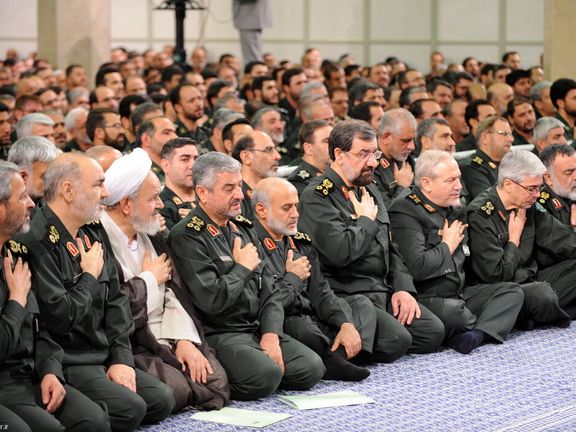
Senior members of the IRGC

As international consensus over designating Iran’s IRGC as a terrorist organization is growing, over 100 members of the European Parliament call for proscribing the Guards in its entirety. 

In a Thursday letter to Josep Borrell, the EU High Representative for Foreign Affairs and Security Policy and European Commission Vice-President, the signatories also urged the EU to expand its sanctions list with Supreme Leader Ali Khamenei, President Ebrahim Raisi, Prosecutor General Mohammad Jafar Montazeri and other individuals responsible for violations of human rights.

They also want coordinated efforts to facilitate measures to ensure the safety of the Iranian diaspora in the EU and restrict the access of sanctioned Iranian individuals’ family members to European facilities such as universities.

In the letter, they also asked Borrell to clearly communicate that further executions of Iranian protesters would lead to additional restrictive measures, including economic sanctions.

Stressing the necessity of the correct application and enforcement of the sanctions regime, they emphasized on the Islamic Republic's “despicable role” in the Russian invasion of Ukraine by supplying arms and other means of support. “This fact has to be taken into account, as Iran is thus aiding a criminal Russian state, which keeps on terrorizing the people of Ukraine through relentless bombing of civilians and critical infrastructure,” they said. 

Moreover, according to draft documents seen by POLITICO, the EU is considering fresh sanctions against nearly 40 Iranian individuals and entities. There are overall 27 EU documents which are called an “evidence pack,” as they include the information — mostly press reports — backing up the proposed sanctions. 

There are 17 people the EU is thinking of sanctioning, including regional governors, a lawmaker, a minister and a top official at the state broadcaster (IRIB) World Service, as well as several current and former officials in the IRGC over their key role in the government’s repression. The list also included Sports Minister Hamid Sajjadi Hazaveh, who the document says is “responsible for pressurizing Iran’s athletes into silence, to prevent them from speaking out internationally against repression in Iran.” “He was personally involved in the case of Elnaz Rekabi, an Iranian athlete climber that competed without hijab at the Asian Championship rock climbing competition in the fall of 2022,” read the document. 

Elnaz Rekabi
100%
Elnaz Rekabi

About 20 entities are also on the list, including Iran’s Communication Regulation Authority (CRA), which “enforces the Iranian government’s requirements to filter Internet content through a spyware called SIAM” and the Ravin Academy, a body that has trained hackers “involved in directly disrupting the communication of those protesting against the Iranian regime.” Twelve regional corps of the IRGC are also included. 

EU countries — led by Germany, France and the Netherlands — have separately been discussing whether to go ahead and label IRGC a “terrorist organization.” German Foreign Minister Annalena Baerbock tweeted in support on Monday, saying the move “is politically important and makes sense.” France has also kept the door open to the idea.

The United States has already designated the IRGC as a terrorist group and the UK is set to follow suit soon, as members of its House of Commons on Thursday unanimously voted for a motion that urges the government to designate IRGC as a terrorist organization. 

Most Viewed

Ghalibaf defends Iran-US talks amid hardline backlash
1
INSIGHT

Ghalibaf defends Iran-US talks amid hardline backlash

2
INSIGHT

Iran diplomacy wobbles as factions compete to avoid looking soft on US

3
VOICES FROM IRAN

Bread shortages, soaring prices strain households in Iran, residents say

4
ANALYSIS

The politics of pink: how Iran uses cuteness to rebrand violence

5

Scam messages seek crypto for ships’ safe passage through Hormuz, firm warns

Banner
Banner

Spotlight

  • Opposition to US talks grows in Tehran as ceasefire deadline nears
    INSIGHT

    Opposition to US talks grows in Tehran as ceasefire deadline nears

  • Tehran moderates see ‘no deal–no war’ limbo as worst outcome
    INSIGHT

    Tehran moderates see ‘no deal–no war’ limbo as worst outcome

  • The future has been switched off here
    TEHRAN INSIDER

    The future has been switched off here

  • Lights out, then gunfire: Witnesses recount Mashhad protest crackdown
    VOICES FROM IRAN

    Lights out, then gunfire: Witnesses recount Mashhad protest crackdown

  • Family told missing teen was alive, then received his body 60 days later
    EXCLUSIVE

    Family told missing teen was alive, then received his body 60 days later

  • Is Iran entering its Gorbachev moment?
    INSIGHT

    Is Iran entering its Gorbachev moment?

•
•
•

More Stories

UK Lawmakers Pass Resolution Urging Gov’t To Proscribe IRGC

Jan 12, 2023, 18:43 GMT+0
•
Iran International Newsroom

Members of the UK House of Commons on Thursday unanimously voted for a motion that urges the UK gov't to proscribe Iran's IRGC as a terrorist organization.

While the vote is not binding, it indicates British lawmakers' increasing pressure on the government to respond to violence against protesters in Iran by security forces mainly controlled by the Revolutionary Guard.

So far, a combination of IRGC personnel, their Basij militia, intelligence agents and regular police commanded by top IRGC generals have killed around 500 civilians and maimed hundreds of people. Four protesters have also been executed after sham trials.

Opening the discussion, Bob Blackman, a member of the ruling Conservative Party, said the IRGC should be added to the list of proscribed terrorist organizations.

"I urge UK government to proscribe IRGC as terrorist organization and work with counterparts to ensure further sanctions on Iran without delay... Suppression of speech against Iran's regime mimics the rise of the Nazis. We must act before it reaches such level."

Blackman said that the UK should “refer the [Iranian] regime’s appalling dossier of systematic violations of human rights and crimes against humanity to the United National Security Council for adoption of binding and deterrence measures.”

The IRGC should be proscribed “in its entirety,” Blackman added, echoing the words of then United States Secretary of State Mike Pompeo who announced the US listing of the IRGC as a ‘foreign terrorist organization’ as part of its ‘maximum pressure’ sanctions against Iran when the US in 2018 left the Iran nuclear agreement of 2015, the JCPOA (Joint Comprehensive Plan of Action).

‘A bunch of clerical fascists’

John Cryer, a Labour MP, called the IRGC “a bunch of clerical fascists who rape, kill, maim their way around Iran and outside Iran's borders.” Conservative Bob Stewart said that “if any of us were to make a speech like we've made this morning or this afternoon in Iran, we’d be dead meat very quickly.”

Labour MP Fleur Anderson said the UK should offer visas to female Iranian protest leaders and those given death sentences. John McDonnell, close associate of former Labour leader Jeremy Corbyn, called for closing the Iranian embassy and expelling Iranian diplomats.

The push in Europe to list the IRGC as a terrorist organization goes beyond the UK. Many German and Austrian politicians are keen to pursue the issue with the European Union, which will probably discuss it in a meeting next week.

Foreign Office minister Leo Docherty told MPs the IRGC was “already sanctioned as an organization,” as were some of its individual members, although it was not proscribed as a terrorist organization. Docherty said government consideration of the issue was “active” and refused to “pre-empt any formal announcement…”

A report to government from Jonathan Hall, a King’s Counsel, highlighted some of the issues involved in proscribing part of the armed forces of a sovereign state, Independent Online reported Thursday. Hall warned given the state is conventionally considered to “enjoy a monopoly over the legitimate use of violence,” this would “depart from consistent and decades-long UK policy.”

‘Upsetting the settled meaning of terrorism’

British legislation and implementation derives from the 2020 Terrorism Act, which defined terrorism as “serious violence against a person” or “serious damage to property” designed “to influence the government, or an international governmental organization or to intimidate the public” based “on a political, religious, racial or ideological cause.”

While Hall’s arguments rest on the difficulties of extending legislation based around non-state organization to state bodies, Amnesty International has long argued that the ‘terrorism’ definition is itself unworkable, and that its vagueness and breadth leave “scope for political bias in making a decision to bring a prosecution.” The UK’s current list of 78 proscribed terrorist organizations includes Hamas, Hezbollah, and the Kurdistan Workers Party (PKK). Listing, which is done extrajudicially by the interior minister (home secretary) makes membership, giving financial support, or displaying the group’s logo or flag a criminal offense. The MEK was removed from the list in 2008.

Europe Still Discussing Sanctions On Iran’s Guards

Jan 11, 2023, 14:24 GMT+0
•
Iran International Newsroom

With European Union foreign ministers meeting January 23 to discuss new Iran sanctions, some politicians and media want the Revolutionary Guards classified.

The push is mainly because of IRGC's role in using violence and lethal force to suppress protesters since September. Security forces mostly under its command have killed around 500 people during demonstrations and after arrest.

Anne-Claire Lengendre, the French Foreign Ministry spokesperson, said Tuesday that Paris was “working with its European partners on new sanctions measures, without excluding any.”

"Listing the Revolutionary Guard as a terrorist organization is politically important and makes sense," she said on Twitter, adding that legal hurdles still needed to cleared before it could be done.

But while France has been skeptical over the benefits of sanctioning a large part of a sovereign state’s armed forces, Germany’s Foreign Minister Annalena Baerbock tweeted Monday that “listing the Revolutionary Guard as a terrorist organization is politically important and makes sense.” Baerbock added that legal issues were being explored.

It has been widely reported that the United Kingdom is preparing to list the Revolutionary Guards (IRGC), with Foreign Secretary James Cleverly saying on at least two occasions that it had already sanctioned the corps “in its entirety.”

Some senior members of the IRGC (file photo)
100%
Some senior members of the IRGC

‘Acts of terror’

Designating the IRGC would mean any member’s assets could be seized, and that belonging to the group, attending its meetings, or even displaying its logo would be a criminal act. The EU and UK have both since October sanctioned individual IRGC commanders.

Iran’s Foreign Ministry Spokesman Nasser Kanaani said Monday that those accusing the IRGC of ‘terrorism’ had themselves “committed acts of terror and are accused of sponsoring it.” The spokesman cited the US drone strike in 2020 that killed IRGC general Qassem Soleimani, which the United Nations special rapporteur judged ‘unlawful killing.’

Soleimani was in charge of organizing militant groups in the region that attacked US and allied targets.

The United States designated the IRGC in 2019 as part of ‘maximum pressure’ sanctions against Iran launched as Washington withdrew from the 2015 Iran nuclear agreement, the JCPOA (Joint Comprehensive Plan of Action).

During great power talks in Vienna, which paused late summer, aimed at restoring the JCPOA, it was reported that Iran wanted the IRGC, or at least its construction and business operations, delisted. The US reportedly refused.

‘Maximum pressure’ was designed, according to Mike Pompeo, Secretary of State 2018-21, to force Iran to concede 12 demands including ending all uranium enrichment, scrapping missile defense, and breaking links with regional allies. The EU describes the aim of its sanctions more vaguely as a “change in policy or conduct.”

‘Reinforce the message’

In the right-wing Daily Telegraph January 5, veteran columnist Con Coughlan wrote that listing the IRGC would “help to reinforce the message to Iran that the West is no longer prepared to turn a blind eye to its nefarious activities.”

Supporters of listing have compared the IRGC, which includes many thousands of Iranians on ‘flag service,’ to virulently anti-Shia Sunni extremists. Kasra Aarabi, of the Tony Blair Institute, said in December that the IRGC was “no different from the likes of Isis [Daesh, the Islamic State group] or al-Qaeda.”

Others are less convinced. An editorial in the London Observer January 8 suggested killing Soleimani had fueled an “evolving, many-fronted threat to western security interests.” It pointed out that the US leaving the JCPOA, and Israel killing Iranian scientists, had just brought closer a “nuclear-armed Iran.”

Iranian officials have highlighted some US and European politicians, including Pompeo, supporting the Mujahideen-e Khalq, a militant Iranian opposition group that helped Saddam Hussein suppress the 1991 Iraqi uprising. The MEK was ‘delisted’ by EU in 2009 and by the US in 2012.

German Politicians Cross Swords Over Iran’s Guards

Dec 31, 2022, 23:45 GMT+0

Debate rages in Germany over listing Iran’s Revolutionary Guards as ‘terrorists,’ with opposition politician Norbert Rottgen tweeting “You have to Decide Now.”

Rottgen, a member of the Christian Democratic Union and parliamentarian, has been at loggerheads with Foreign Minister Annalena Baerbock, a Green, since Baerbock announced October 31 that the European Union was considering sanctioning the Guards (IRGC).

In October Rottgen charged in the federal parliament that “Germany was doing too little” in following a “policy of minimal pressure” over Iran that abandoned “protestors.” Baerbock responded by saying “we are not letting up…and would try to get more sanctions packages on the way.”

Rottgen this week returned to the attack, dismissing what he said was the German foreign office’s argument that a ‘terrorism’ listing required “investigations or a judgement on terrorist offenses in a member state of the EU.” Rottgen was quoted on ProSieben television that a designation could equally be based on a “judgement against the Revolutionary Guards for terrorism by an American federal court.” He said the German public was being “deceived.”

In his tweet Friday Rottgen wrote that designating the IRGC would be “against the mullah regime” and was overdue: “You have to decide now. Either you are for the revolution of freedom or you are for the regime.”

German Foreign Minister Annalena Baerbock, October 21, 2022
100%
German Foreign Minister Annalena Baerbock, October 21, 2022

The politics of sanctions

The EU earlier in December designated 20 people and Iran’s state media over alleged human rights abuses, including IRGC commanders, mainly in the Kurdish and Baluchi areas where violence and deaths have been concentrated in current unrest. But neither the EU nor Germany, as yet anyway, have sanctioned the IRGC as a whole. Neither, apparently, has the United Kingdom, despite claims to the contrary by James Cleverly, the foreign secretary.

The United States in 2019 put the IRGC on its list of ‘foreign terrorist organizations’ as part of the ‘maximum pressure’ sanctions first levied when Washington in 2018 left the 2105 Iran nuclear deal. The IRGC remains the only case of part of a sovereign state’s armed forces being listed as a ‘foreign terrorist organization.’

The EU began designating groups as ‘terrorist’ following the 2001 al-Qaeda attacks on New York and Washington, although the process has been criticized by civil liberty groups as being extra-judicial and politically motivated. The latest list of 21 has seven Palestinian groups, including Hamas, as well the Lebanese Shia party Hezbollah, the Kurdistan Workers Party, and the Tamil Liberation Tigers. It also includes the Iranian intelligence ministry’s internal security directorate.

Bikers and hit squads

While such listings have been questioned as “emotionally charged,” ineffective or counter-productive, some Iranian opposition groups and US hawks have long made a cause celebre of listing the IRGC. Recent media reports in both Europe and Israel – one of a German-Iranian biker directing ‘hit squads’ from Tehran – have help pump up their calls.

One German TV station has cited “security sources” detecting an IRGC hand in plots to attack Jews. The Jerusalem Post December 18, under a picture of Iranian Guards, bemoaned Germany exporting $1.2 billion in goods to Iran from January to October 2022 despite a “violent crackdown on protestors who are seeking the end of the theocratic state [in Iran].”

Despite bilateral trade close to €1.8 billion ($1.9 billion) in 2021, Berlin this month suspended export credit guarantees to Germany companies who had been trading with Iran despite the threat of punitive US actions under ‘maximum pressure.’ The German government claimed exceptions might be made on “compelling” humanitarian grounds.

British Foreign Secretary Again Says Iran’s IRGC Sanctioned

Dec 31, 2022, 11:21 GMT+0

James Cleverly, British foreign secretary, has again claimed that the United Kingdom has sanctioned Iran’s Revolutionary Guard Corps “in its entirety.”

In a tweet Friday, Cleverly highlighted UK sanctions on 47 Iranians, including Revolutionary Guard (IRGC) commanders, since the September 16 death of Kurdish woman Mahsa Amini after arrest by Tehran ‘morality police,’ and Iran’s removal from the United Nations Commission on the Status of Women. The UK would “continue to sanction the IRGC in its entirety,” Cleverly added.

The British foreign office tweeted December 27 a clip of Cleverly listing British sanctions against Iran including “the IRGC in its entirety.” Cleverly December 13 said in parliament: “We already sanction the IRGC in its entirety.”

Unconvinced by Cleverly’s assurances, opponents of a soft policy toward the Islamic Republic have demanded action. Kasra Aarabi, of the Tony Blair Institute, this week said the IRGC was “no different from the likes of Isis [Daesh, the Islamic State group] or al-Qaeda.”

When the United States in 2019 added the IRGC to its list of ‘foreign terrorist organizations’ as part of its ‘maximum pressure’ sanctions against Iran, it specifically cited the Corps “in its entirety.”

In Britain’s House of Lords October, Lord Palmer, vice-President of the Jewish Leadership Council, linked the IRGC to the “summer’s attempted murder of Sir Salman Rushdie, last year’s attempted kidnapping of…[activist] Masih Alinejad and numerous foiled plots…” The Rushdie case and the attempted kidnapping of Alinejad reported by US law enforcement, are both live legal cases with no link to the IRGC proven in court.

Four Disappeared Airbus A340s End Up In Iran

Dec 29, 2022, 12:58 GMT+0
•
Iran International Newsroom

Four Airbus A340s aircraft bound for Uzbekistan departed South Africa last week but diverted to Iran and now the country’s authorities say they have purchased them. 

Various flight trackers confirmed their whereabouts at Tehran’s Imam Khomeini International Airport during the week until Iranian aviation authorities confirmed the purchase of wide-bodied, long-range four-engine airliners on Wednesday. 

Hassan Khoshkhou, the spokesman for Iran's Civil Aviation Organization (CAO), said that the Airbus A340s are "made in France" and had arrived in the country "in recent days". He stopped short of providing further details on how the airliners were procured and who facilitated the purchase. 

The four A340-300 units – namely MSN 115, 180, 270, and 331 – were formerly operated by Turkish Airlines before their retirement in March and April 2019. The planes were bought by a company from Hong Kong -- AVRO Global – and were later transferred and stored at OR Tambo International Airport in Johannesburg until December. For the past few years, the planes have simply been parked at Johannesburg Airport, and were registered in Guernsey. There was not much sign of activity until recently, when the planes were re-registered in Burkina Faso with new registration codes — XT-AKA, XT-AKB, XT-AKK and XT-ALM. 

The planes started their journeys out of South Africa apparently headed for Uzbekistan but ended up in Iran. The A340s were all produced between 1996 and 2000, so they are 22-26 years old, as are most of the Islamic Republic’s dilapidated passenger fleet, because Iran is not allowed to buy any aircraft due to the US sanctions, which have prohibited companies from selling planes that include US-made parts. 

An Airbus 340 operated by Mahan Air  (file photo)
100%
An Airbus 340 operated by Mahan Air

This obviously presents a major challenge for Iran Air and Mahan Air, the country’s two largest airlines, which operate outdated fleets, as they can only get planes secondhand. Even the planes they get secondhand are largely acquired illegitimately through clandestine transactions to circumvent the sanctions. Rumor has it that these four Airbus A340s were purchased by Mahan Air, which already flies several Airbus A340s, most of which used to fly for Lufthansa and Virgin Atlantic back in the day. 

In September, an official of Iran’s air travel services said that the reason behind a lack of plane tickets and high prices are that more than half of the country’s aircraft are grounded. "Most of the planes owned by the airlines are grounded because they need parts and it is impossible to provide them due to the sanctions," he said. He added that only about 120 to 130 airplanes out of about 340 are operational.

Alireza Barkhor, the deputy chairman of the Association of Iranian Airlines, also said last year that more than 50 percent of passenger planes are not working due to lack of spare parts, particularly engines.

Iran has suffered from shortages of civilian airliners since the 1990s and used a variety of ways to lease older planes or buy spare parts through intermediaries, but the technical state of its fleet has been deteriorating.

The 2015 nuclear agreement (JCPOA) suspended sanctions on purchases of Western aircraft and Iran began talks to buy new planes from Boeing and Airbus. A few Airbus planes were delivered but the Trump administration never approved the sale of US planes until Washington withdrew from the JCPOA in May 2018.