• العربية
  • فارسی
Brand
  • Iran Insight
  • Politics
  • Economy
  • Analysis
  • Special Report
  • Opinion
  • Podcast
  • Iran Insight
  • Politics
  • Economy
  • Analysis
  • Special Report
  • Opinion
  • Podcast
  • Theme
  • Language
    • العربية
    • فارسی
  • Iran Insight
  • Politics
  • Economy
  • Analysis
  • Special Report
  • Opinion
  • Podcast
All rights reserved for Volant Media UK Limited
volant media logo

Saudi, Egyptian Ministers Vow Cooperation In All Fields, Including Iran
Iran International Newsroom
Jan 13, 2023, 08:15 GMT+0Updated: 17:35 GMT+1
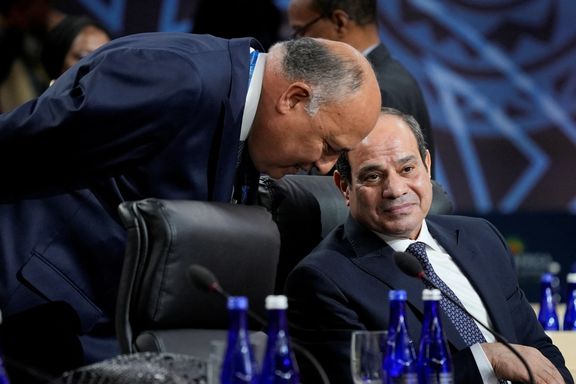
Egyptian President Abdel Fattah al-Sisi and Foreign Minister Sameh Shoukry attend the US-Africa Leaders Summit. December 15, 2022

Saudi and Egyptian foreign ministers meeting in Riyadh Thursday stressed the importance of Iran maintaining commitments not to develop nuclear weapons.

Prince Faisal bin Farhan al-Saud and Sameh Shoukry released a statement calling on Tehran to abide by its obligations under the Nuclear Non-Proliferation Treaty (NPT), which commits signatories to the solely peaceful application of nuclear technology.

While stressing its continued adherence to the NPT, Iran has breached the limits set by the 2015 nuclear agreement, the JCPOA (Joint Comprehensive Plan of Action), from which President Donald Trump withdrew the US in 2018. It has also substantially reduced monitoring of its nuclear facilities by UN’s International Atomic Energy Agency, the IAEA.

The Saudi energy minister Prince Abdulaziz bin Salman al-Saud announced Wednesday that Riyadh intended to use domestically sourced uranium to power its future nuclear industry, and that recent exploration had revealed rich deposits. Saudi Arabia, half of whose electricity currently comes from fossil fuels, is expanding solar energy but has also invited international interest in building its first nuclear power plant, with Russia’s Rosatom among those expressing interest.

Using domestic uranium for generating electricity would require enriching the naturally occurring material to 5 percent purity, the beginnings of a process that can produce ‘weapons grade’ uranium enriched to 90 percent. Saudi Arabia signed the NPT in 1988, but several leaders, including Crown Prince Mohammad bin Salman al-Saud, have said Riyadh would develop nuclear weapons if Tehran did.

While Iran find itself in more isolation in recent months, due to international condemnations over its deadly suppression of protests and supplying drones to Russia, officials in Tehran claimed earlier this month that there is a chance for improving ties with Egypt. However, Cairo has remained silent on the issue.

Saudi Arabia and Egypt have drawn closer politically since the ‘Arab spring’ revolts of 2010-13. The statement issued by the foreign ministers Thursday said the two countries had agreed to “support Arab efforts to urge Tehran to not interfere in the internal affairs of regional countries, preserve the principles of good neighborliness, and spare the region from all destabilizing activities, including supporting armed militias and threatening maritime navigation and international shipping lines,” the semi-official Arab News reported.

Riyadh last year extended Cairo a $5-billion aid package. Egypt faces a severe financial challenge including loss of tourism revenue and rising food prices resulting from the Ukraine war, with the International Monetary Fund recently identifying a $17 billion fiscal gap that will require international support in coming years. Public debt is around $400 billion and a third of Egyptians live in poverty.

Egypt, which has seen some US aid blocked over ‘human rights’ concerns, took part in the US-sponsored ‘Negev summit’ last year with Israel and the Arab states – Bahrain, Morocco, and the United Arab Emirates – that ‘normalized’ relations with Israel in 2020. Saudi Arabia has kept to the long-standing Arab League position that normalization requires recognition of a Palestinian state, a goal receding as the new government in Israel aims to speed up Jewish settlements on occupied land.


Most Viewed

Ghalibaf defends Iran-US talks amid hardline backlash
1
INSIGHT

Ghalibaf defends Iran-US talks amid hardline backlash

2
VOICES FROM IRAN

Bread shortages, soaring prices strain households in Iran, residents say

3
INSIGHT

Iran diplomacy wobbles as factions compete to avoid looking soft on US

4
ANALYSIS

The politics of pink: how Iran uses cuteness to rebrand violence

5
ANALYSIS

From instability to influence: Pakistan’s pivotal role in US-Iran diplomacy

Banner
Banner

Spotlight

  • Is Iran entering its Gorbachev moment?
    INSIGHT

    Is Iran entering its Gorbachev moment?

  • Iran crackdown reaches cemeteries as graves of slain protesters defaced
    EXCLUSIVE

    Iran crackdown reaches cemeteries as graves of slain protesters defaced

  • Iran diplomacy wobbles as factions compete to avoid looking soft on US
    INSIGHT

    Iran diplomacy wobbles as factions compete to avoid looking soft on US

  • The politics of pink: how Iran uses cuteness to rebrand violence
    ANALYSIS

    The politics of pink: how Iran uses cuteness to rebrand violence

  • Bread shortages, soaring prices strain households in Iran, residents say
    VOICES FROM IRAN

    Bread shortages, soaring prices strain households in Iran, residents say

  • Ghalibaf defends Iran-US talks amid hardline backlash
    INSIGHT

    Ghalibaf defends Iran-US talks amid hardline backlash

•
•
•

More Stories

Saudi Arabia Plans To Use Domestic Uranium For Nuclear Fuel

Jan 11, 2023, 12:25 GMT+0

Saudi Arabia plans to use domestically sourced uranium to build up its nuclear power industry, energy minister Prince Abdulaziz bin Salman said on Wednesday.

He added that recent exploration had shown a diverse portfolio of uranium in the Arab state, the world's top oil exporter.

Saudi Arabia has a nascent nuclear program that it wants to expand to eventually include uranium enrichment, a sensitive area given its role in nuclear weapons. Riyadh has said it wants to use nuclear power to diversify its energy mix.

It is unclear where its ambitions end, since Crown Prince Mohammed bin Salman said in 2018 that the kingdom would develop nuclear weapons if regional rival Iran did.

"The kingdom intends to utilize its national uranium resources, including in joint ventures with willing partners in accordance with international commitments and transparency standards," Abdulaziz bin Salman said.

He told a mining industry conference in Riyadh that this would involve "the entire nuclear fuel cycle which involves the production of yellowcake, low enriched uranium and the manufacturing of nuclear fuel both for our national use and of course for export".

Atomic reactors need uranium enriched to around 5% purity, but the same technology in this process can also be used to enrich the heavy metal to higher, weapons-grade levels.

This issue has been at the heart of Western and regional concerns about Iran's nuclear program and led to the 2015 deal between Tehran and global powers that capped enrichment at 3.67%.

The pact unraveled after then-President Donald Trump exited the deal in 2018, and efforts to salvage the agreement have stalled since September.

Reporting by Reuters

Left In Limbo? Has US Lost Focus On Iran, The Region?

Jan 10, 2023, 15:00 GMT+0
•
Iran International Newsroom

The United States’ proclaimed concentration on Ukraine and China at the expense of the Middle East has prompted criticism from various directions.

For several months, officials in the administration of President Joe Biden have stressed that US foreign-policy priorities, reflected in staff time, have been the Russia-Ukraine conflict and calibrating policy towards the rise of China.

With the Middle East, leading US officials have said for several months that efforts to restore the 2015 Iran nuclear deal are no longer a ‘focus,’ that the current ceasefire in Yemen is sustainable, and that the US can both co-operate with the new Israeli government of Benjamin Netanyahu and keep its commitment to a ‘two state solution’ for Palestine-Israel.

Ned Price, the State Department Spokesman, was asked at his Monday press briefing about Biden’s campaign-trail statement in November, which emerged December, that the Iran nuclear agreement (the JCPOA, Joint Comprehensive Plan of Action) was “dead.” Price insisted that Biden “did not say diplomacy is dead, not at all.”

Price was then asked about a “hypothetical” case of Iran accepting US conditions for JCPOA restoration. The spokesman said that as long as Tehran lacked “any real interest in diplomacy,” then Washington would “continue to keep our focus on supporting the Iranian people...[and] Iran’s security assistance to Russia.”

US Secretary of State Antony Blinken with his counterparts from Abraham Accords countries, March 29, 2022
100%
US Secretary of State Antony Blinken with his counterparts from Abraham Accords countries, March 29, 2022

Since great-power talks to revive the JCPOA floundered in late summer with Washington and Tehran unable to bridge gaps, the US has levied additional sanctions on Iran and those trading with Iran, while Tehran has continued a nuclear program that since 2019 has exceeded JCPOA limits. The US sanctions have come under various rubrics – violation of the ‘maximum pressure’ sanctions introduced by the US in 2018 on leaving the JCPOA, ‘human rights,’ and Iran’s supply of military drones to Russia.

Iran nuclear snapback – a ‘decision’ for Europe

Price said Monday that any decision over snapback – a JCPOA mechanism that could see multilateral sanctions on Iran snap back if it violated the 2015 agreement – was a “decision for our European partners,” referring to the trio of France, Germany and the United Kingdom. All three take the US view that Iran’s supply of drones to Russia violates a clause in United Nations Security Council Resolution 2231, which endorsed the JCPOA.

But the challenge of a new right-wing government in Israel seems more pressing. Both Secretary of State Antony Biden and National Security Adviser Jake Sullivan are due in Israel this month, with US officials stressing a common commitment to prevent Iran acquiring a nuclear weapon.

This, along with an emphasis on the potential of Israel’s US-sponsored 2020 ‘normalization’ agreements with four Arab states, sits uneasily with US concern that Benjamin Netanyahu’s government is already taking steps likely to enflame the volatile situation in the occupied West Bank. Price conceded at his Monday press briefing that normalization agreements were “not a substitute for Israeli-Palestinian peace.”

Under a headline dubbed ‘The Perils of Ignoring the Middle East,’ Walter Russell Mead, professor at Bard College, argued in his Wall Street Journal column Tuesday that a “15-year decline in America’s regional influence” could be reversed by “a resolute and effective US policy to disrupt Iran’s ability to threaten its Iran neighbors…[including] if all else fails…military action to block Tehran’s nuclear program…[and] put the US back at the center of the Middle Eastern order.”

Read, a staunch supporter of the US interventions in Iraq and Syria but not Libya, argued that Biden’s current approach rested on an “impotence” that was “more expensive in the long run.”

Iran’s ‘Persian Gulf’ Row Surfaces With Iraq This Time

Jan 10, 2023, 08:24 GMT+0
•
Iran International Newsroom

An old row between Iran and regional Arab countries over the name of the Persian Gulf has come to the fore again but this time between Tehran and Baghdad and in a sport event. 

Iran’s Foreign Ministry spokesman Naser Kanaani said on Monday that Tehran has expressed its objection to Baghdad over the use of the name of the Persian Gulf incorrectly, using the “fake” misnomer of “Arabian Gulf.”

He made the remarks after many Iranians criticized the government over its inaction when Iraq did not use ‘Persian Gulf’ for an Asian football (soccer) event. The Iraqi southern city of Basra is hosting the return matches of a local competition, and Iraq set up billboards to welcome the foreign teams to the “25th Arabian Gulf Cup.” 

Many Iranians oppose the Islamic Republic’s policy of spending money in the region to buy support, including in Iraq where Tehran has been supporting an array of Shiite militias and pretends to have a lot of political influence in Baghdad.

The dispute started in early 1960s, when the Egyptian Arab nationalist president Gamal Abdul Nasser began calling the Persian Gulf the “Arabian Gulf.”

The football cup was kicked off on Friday, January 6, with an extravagant opening ceremony attended by local and regional officials as well as FIFA President Gianni Infantino. “It was great to have attended the opening ceremony and the opening game of the 2023 Arabian Gulf Cup in Basra between Iraq and Oman,” said the FIFA president.

a map of the Middle East-Persian Gulf
100%

Kanaani said that the country’s diplomatic service protested the action but did not announce it, noting that “a lack of notification does not mean lack of action." “The Persian Gulf is the Persian Gulf, and as soon as we learned about the issue, we announced our protest to the Iraqi government,” he said, adding that the issue was in relation to a sports event, and the Sports Ministry and the Football Federation followed up on the issue. 

The Iranian football federation announced on Saturday that it will be delivering a protest statement to FIFA over the naming of the tournament, saying “Persian Gulf is a noble and historical name, which has been applied in all languages and various atlases, including ancient and historical maps.”

The issue was discussed during a session of the Iranian parliament Sunday, when MP Alireza Salimi said, “I want those who use the fake name Arab Gulf in Arab countries to study history. The Persian Gulf is, has always been, and will always be Persian.” Similar remarks were echoed by other members accusing the Arabic countries of trying to “falsify history.”

A billboard for the cup (January 2023)
100%
A billboard for the cup

Bayati called on Iraq’s Prime Minister Mohammed Shia’ al-Sudani and influential Shiite cleric Muqtada al-Sadr to apologize for the naming of the tournament. 

Sudani, who was himself present during the opening ceremony of the tournament at the Basra International Stadium, addressed the event and described it as a manifestation of the unity of the “Arab and Gulf brothers.” Iraqi local media said that Sadr and many other Iraqi figures have referred to the tournament as “the Arabian Gulf Cup” in their tweets and statements in the days leading up to the event’s launch. 

The tourney has been officially called “Arabian Gulf Cup” but often referred to simply as “the Gulf Cup,” neither of which satisfy Iran that insists on the use of Persian Gulf.”’ Iran’s national football team has never been part of the tournament. Saudi Arabia, Oman, Yemen, Bahrain, Kuwait, Qatar, the United Arab Emirates, and Iraq are the participants. 

US Speaks Of ‘Deep Engagement’ Over Iran

Jan 9, 2023, 22:29 GMT+0
•
Iran International Newsroom

Two top United States officials are due this month to visit Israel’s new government, but analysts are not expecting new US regional initiatives.

Jake Sullivan, the US National Security Advisor, said Monday in Mexico, accompanying President Joe Biden, that Iran would be a “substantial topic of conversation” for his trip. Dates were still being worked out, a US security spokesman said.

Sullivan said the two sides would have “the opportunity to engage deeply…on the threat posed by Iran.” Benjamin Netanyahu said it was “time for Israel and the US to be on the same page.”

Antony Blinken, the US Secretary of State, is also due in Israel this month, but officials up to Biden have intimated that their primary focus is not on the Middle East, but with the Russia-Ukraine war including the supply of Iranian drones to Russia and efforts to manage relations with China. Ben Shapiro, a former US ambassador to Israel, told the Jerusalem Post that the Sullivan and Biden visits did not “mean the Biden administration has changed its approach on where its highest priorities are – which is not in the Middle East.”

Jake Sullivan, the US National Security Advisor (file photo)
100%
Jake Sullivan, the US National Security Advisor

Sullivan reiterated Monday that while US policy aimed at reviving the 2015 Iran nuclear agreement, the JCPOA (Joint Comprehensive Plan of Action), this was not a focus for US officials. Some analysts argue US, while shifting energies elsewhere, has adopted a more militaristic approach inasserting a willingness – as the July joint statement with Israel put – to “use all elements of its national power” to ensure that “Iran does not acquire a nuclear weapon.”

Sullivan also said Monday that Iran could be contributing to war crimes in Ukraine by providing drones to Russia.

While this all lessens tension with Netanyahu, a vehement JCPOA opponent and supporter of President Donald Trump in pulling the US from the agreement in 2018, it suggests Washington is happy to offer Israel forms of military cooperation that may restrain any notions of a military attack on Iran while enabling the US, effectively, to ‘spy’ on Israel.

Clear nerves in Washington

At the same time, recent US statements of support for the ‘two state solution’ for Israel-Palestine show clear nerves that Netanyahu’s new right-wing government may both enflame the occupied West Bank and undermine the Washington-backed ‘normalization’ agreements Israel has signed with some Arab states.

Itamar Ben Gvir, the new ultra-Zionist security minister who controversially visited the al-Aqsa mosque in Israeli-occupied east Jerusalem on taking office, Sunday banned public displays of the Palestinian flag as showing “identification with a terrorist organization.”

The government also froze $40 million in revenue due to the Palestinian Authority (PA). Netanyahu defended both moves as a response to the late December United Nations vote asking for an International Court of Justice opinion on the 56-year Israeli military occupation. While Israeli police routinely remove the flag, especially at protests, it has officially been tolerated since the 1994 establishment of the PA, and the decision has sparked fears of continuing unrest and violence that saw 146 Palestinians killed in the West Bank in 2022.

Bahrain, Egypt, Morocco and the UAE turned up in Abu Dhabi Monday for a two-day steering committee of the ‘Negev Forum,’ under which the Arab states meet Israel and the US. But Jordan, whose ‘normalization’ with Israel goes back to 1994, stayed away. Bahrain, Egypt, Morocco and the UAE all voted for the US resolution – as did Iran.

IRGC Spokesman Talks Of Khamenei’s Role In Aiding Regional Proxies

Jan 7, 2023, 10:29 GMT+0

Iran's Revolutionary Guard spokesman Ramazan Sharif says Supreme Leader Ali Khamenei sought to support Palestinian militias against Israel through Quds Force. 

He said that Ali Khamenei had asked former commander of Qods (Quds) force Ghasem Soleimani to empower the resistant front, a term the Islamic Republic uses for its proxy groups across the region.

Sharif said in remarks this week that a wave of anti-Israeli sentiments in the third and fourth generation of Palestinians, not only in the Gaza Strip but also in the West Bank, was achieved "thanks to Soleimani," without elaborating on how.

However, many documented reports and statements by Iranian officials in the past show that Tehran is the main financial and military backer of Hezbollah and has also provided substantial support to Palestinian militant groups and the Houthis in Yemen.

He added that the Supreme Leader had also assigned Soleimani to supporting the Lebanese Hezbollah, which led to the “victories” of the group.

On January 3, 2020, the US military, on the order of former President Donald Trump, killed Soleimani in a drone strike near Baghdad International Airport, saying that he had been "actively developing plans to attack American diplomats and service members in Iraq and throughout the region."

In a tweet on the occasion of the third anniversary of the targeted killing of Soleimani by the US, the Iranian Foreign Ministry renewed the regime’s pledges to avenge his death, saying the US killing of the former IRGC's Quds Force commander in 2020 failed in bringing Washington its desired outcome.