• العربية
  • فارسی
Brand
  • Iran Insight
  • Politics
  • Economy
  • Analysis
  • Special Report
  • Opinion
  • Podcast
  • Iran Insight
  • Politics
  • Economy
  • Analysis
  • Special Report
  • Opinion
  • Podcast
  • Theme
  • Language
    • العربية
    • فارسی
  • Iran Insight
  • Politics
  • Economy
  • Analysis
  • Special Report
  • Opinion
  • Podcast
All rights reserved for Volant Media UK Limited
volant media logo

Critics Lash Out At Iran's Ideological Foreign Policy
Iran International Newsroom
Jan 12, 2023, 12:27 GMT+0Updated: 17:42 GMT+1
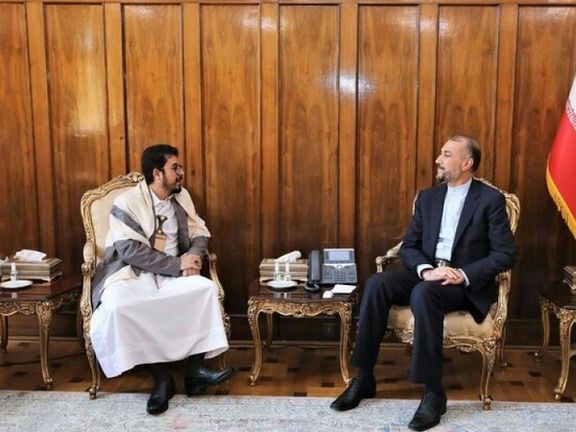
Iran's foreign minister Hossein Amir-Abdollahian (L) with a Houthi envoy in April 2022

An ultraconservative supporter of Iran's President Ebrahim Raisi has criticized his foreign policy for lack of agility, as the country faces more isolation.

Former lawmaker Hossein Naghavi-Hosseini added in an interview with Nameh News website in Tehran that Iran's foreign policy is passive and lacks dynamism. He stressed that the foreign ministry is absent in the Persian Gulf area. “There are many potentials for cooperation in this region, but the Iranian foreign ministry lacks the agility and dynamism to get positively involved in the region."

There are key reasons why Tehran suffers from a sense of isolation. Long negotiations with the West to revive the 2015 nuclear deal known as the JCPOA were suspended in September as Iran presented demands, which Washington rejected. This was followed by Tehran’s brutal suppression of protests and evidence that it was supplying kamikaze drones to Russia used against Ukraine. The West, and especially Europe, have reacted with disdain and adopted new sanctions against Tehran.

At the same time, Iran’s financial situation has deteriorated after years of US sanctions and its currency has dropped to unprecedented lows. All these have led to a mood of pessimism among regime insiders, and no prospect of a quick remedy.

Naghavi-Hosseini said in the interview that the ongoing protests in Iran have adversely affected the West's willingness to continue nuclear negotiations with Iran as social media activists portrayed Iran's situation in a way that the Islamic Republic is on the verge of collapse and the West should wait for the establishment of a new regime before resuming the talks.

Nevertheless, he claimed that "although Westerners are currently not keen to continue the talks, in fact, they need the JCPOA, and they have to come to terms with Iran in the long run."

Iranian conservative politician, Hossein Naghavi-Hosseini
100%
Iranian conservative politician, Hossein Naghavi-Hosseini

According to Nameh News, Raisi who came to power with promises of reviving the JCPOA, advancing the economy despite sanctions, implementing closer ties with China and Russia, and improving Iran's relations with its neighbors, has accomplished none of these in 18 months.

The Western parties in the JCPOA, the United States, United Kingdom, France and Germany say reviving the nuclear deal is not their focus now, meaning that US sanctions will continue.

China's President Xi Jinping signed a statement during a recent visit to Saudi Arabia, supporting Arab claims to three islands in the Persian Gulf, putting in doubt Tehran's 25-year cooperation contract with Beijing, and most recently Iraqi officials have been using the term Arabian Gulf rather than Persian Gulf to undermine Iran's long-standing characterization of the waterway.

In another development, international relations expert Mehdi Motaharnia told Rouydad24 website that the Iranian government is duty-bound to continue its "revolutionary" rhetoric and cannot make an agreement with America."

He said although Iranian and US officials use the same words such as "mutual respect, obligations, and commitments," when talking about the JCPOA, what they mean by these words are different. At the same time, both of them accuse each other of "government-sponsored terrorism."

"While the United States' rhetoric is based on liberal democracy and capitalism, the Islamic Republic of Iran's rhetoric is based on the ideology of Shiite Islam," Motaharnia said. At times both of them talk about returning to the JCPOA, but what they mean are two different things. This difference existed since 2015 when the nuclear deal was made.

"In other words, the United States is aware that the Islamic Republic will never give up the ideological aspect of its foreign policy," Motaharnia added.

Naghavi-Hosseini added that at the same "Iran is seriously following an approach to strengthen its ties with China and Russia, despite some hiccups.


Most Viewed

Ghalibaf defends Iran-US talks amid hardline backlash
1
INSIGHT

Ghalibaf defends Iran-US talks amid hardline backlash

2
ANALYSIS

From instability to influence: Pakistan’s pivotal role in US-Iran diplomacy

3
ANALYSIS

100 days on: why Iran’s January protests spread across social classes

4

War-hit homeowners feel abandoned as Iran’s reconstruction aid fades

5
INSIGHT

100 days on: the anatomy of Iran’s January crackdown

Banner
Banner

Spotlight

  • Bread shortages, soaring prices strain households in Iran, residents say
    VOICES FROM IRAN

    Bread shortages, soaring prices strain households in Iran, residents say

  • War-hit homeowners feel abandoned as Iran’s reconstruction aid fades

    War-hit homeowners feel abandoned as Iran’s reconstruction aid fades

  • 100 days on: the anatomy of Iran’s January crackdown
    INSIGHT

    100 days on: the anatomy of Iran’s January crackdown

  • Ghalibaf defends Iran-US talks amid hardline backlash
    INSIGHT

    Ghalibaf defends Iran-US talks amid hardline backlash

  • 100 days on: why Iran’s January protests spread across social classes
    ANALYSIS

    100 days on: why Iran’s January protests spread across social classes

  • From instability to influence: Pakistan’s pivotal role in US-Iran diplomacy
    ANALYSIS

    From instability to influence: Pakistan’s pivotal role in US-Iran diplomacy

•
•
•

More Stories

UK Foreign Secretary Urges Iran To Halt Execution Of Dual National

Jan 12, 2023, 12:02 GMT+0

The UK foreign secretary has called on the Iranian regime to stop the execution of a British-Iranian dual national accused and convicted in secrecy of spying for MI6.

In a tweet Wednesday, James Cleverly said the Islamic Republic “must halt the execution of British-Iranian national Alireza Akbari and immediately release him.”

He further called the move a “politically motivated act by a barbaric regime that has total disregard for human life.”

Akbari had been deputy defense minister under the reformist President Mohammad Khatami, from 1997 to 2005. He was also close to Ali Shamkhani, the secretary of the Supreme National Security Council of Iran.

He was an advocate for the Iran nuclear deal known as the JCPOA that was eventually signed in 2015 with world powers.

A source close to the Islamic Revolutionary Guard Corps has provided documents to Iran International showing that the death sentence for Alireza Akbari is an move to weaken Shamkhani’s position in the clerical regime.

It seems that President Ebrahim Raisi, Intelligence Minister Esmail Khatib and Interior Minister Ahmed Vahidi are exerting pressure to remove Ali Shamkhani from the post.

Iranian state media reported Wednesday that Alireza Akbari has been sentenced to death for allegedly spying for MI6.

In a statement published by Iran's Intelligence Ministry, Akbari was described as "one of the most important infiltrators in the country's sensitive and strategic centers".

He was detained more than three years ago and has been in the notorious Evin prison in Tehran since then.

Dual-National And Ex-Official Sentenced To Death In Iran

Jan 11, 2023, 21:35 GMT+0

A former Iranian defense ministry official, who holds dual Iranian-British citizenship, has been sentenced to death on charges of spying for the UK.

Iranian state media reported Wednesday that Alireza Akbari has been sentenced to death for allegedly spying for MI6.

In a statement published by Iran's Intelligence Ministry, Akbari was described as "one of the most important infiltrators of the country's sensitive and strategic centers".

He was detained more than three years ago and has been in the notorious Evin prison in Tehran since then.

Akbari had been deputy defense minister under the reformist President Mohammad Khatami, from 1997 to 2005. He was also close to Ali Shamkhani, the secretary of the Supreme National Security Council of Iran.

He was an advocate for the Iran nuclear deal known as the JCPOA that was eventually signed in 2015 with world powers.

Britain's Foreign Office has urged the Islamic Republic to immediately release the dual national.

However, Akbari's wife Maryam said an official asked her to visit her husband in jail for a 'final meeting' before his execution.

Reports say he has been moved to solitary confinement, indicating that his execution is imminent.

However, no details have provided about his specific charges and court proceedings.

"Our priority is securing his immediate release and we have reiterated our request for urgent consular access," a UK Foreign Office spokesperson said.

Nournews, which is affiliated to the country's top security agency reported that Akbari's death sentence has been upheld by Iran's Supreme Court.


Appeal Session For Former Iranian Jailor Begins In Sweden

Jan 11, 2023, 18:02 GMT+0

The first session of the court of appeal for a former Iranian official guilty of war crimes in connection with mass executions in Iran in 1988 was held Wednesday in Stockholm.

Hamid Nouri, 61, received a life sentence last July for his leading role in the massacre of large numbers of jailed opposition members.

Nouri’s life sentence by the primary court, can keep him in prison for 25 years according to Swedish law 25 years in prison in Sweden. He has appealed the court’s verdict.

According to Iran International’s correspondent from the court of appeal, during the Wednesday session, Nouri constantly complained about not being transferred to the general ward and his lack of access to ophthalmological examination.

However, the judge said this issue has nothing to do with the court and should be discussed with the prison authorities by Nouri's lawyers.

Earlier, Majid Nouri, his son, had complained about his father's glasses and had cited the interruption of serving him tea as examples of torture.

This comes while Nouri’s colleagues in Iran execute innocent young protesters for setting fire to a trash bin.

Sweden arrested Nouri upon his arrival at Stockholm Airport in 2019 and in 2021 put him on trial over the mass execution and torture of prisoners at Gohardasht Prison in July and August 1988.

Most victims were linked to the opposition group Mujahedin-e Khalq Organization (MEK) and also other leftist organizations.

Iran Passport Ranks Among Least Prestigious Ones in 2023

Jan 11, 2023, 16:22 GMT+0

The latest ranking of the Henley Passport Index shows that Islamic Republic’s passport ranked 99th in the world in terms of the access it grants the holder to other nations.

Based on the index’s data published on its website, Iran’s passport grants visa-free or visa-on-arrival access to 43 destinations in the first quarter of 2023.

It means that Iranians need a visa to access 156 countries globally.

Concerns about people fleeing Iran and possible destabilizing actions in other countries by Islamic Republic agents are prime reasons for widespread travel restrictions.

Visa-free countries include those where entry is possible without a visa, and with a visa on arrival.

The Henley Passport Index is the original, authoritative ranking of all the world’s passports according to the number of destinations their holders can access without a prior visa.

The index includes 199 different passports and 227 different travel destinations. Updated quarterly, the Henley Passport Index is considered the standard reference tool for global citizens and sovereign states when assessing where a passport ranks on the global mobility spectrum.

Before 1979 revolution which led to the ouster of Mohammad Reza Shah, Iranians could travel without visas throughout Western Europe, except Austria and Switzerland.

Meanwhile, according to the new report by Henley Passport Index, Japan ranks number one in the first quarter of 2023 with having access to 193 countries.

Singapore and South Korea shared second place in the world's most prestigious passport ranking.

Regime Insiders Attack Raisi For Indecision, Inefficiency

Jan 11, 2023, 10:46 GMT+0
•
Iran International Newsroom

Reports from Tehran indicate that regime insiders including conservatives in the government are fed up with the President Ebrahim Raisi’s government amid crises.

Reformist newspaper Shargh wrote in a January 10 article that Expediency Council members have also become critical of the Raisi administration's inability to prepare the country's annual budget bill and the related 5-year development plan, as well as rising inflation and the devaluation of Iran's national currency.

Shargh further asked whether the conservatives are going to lose their patience in the face of the government's indecision and inaction while the country's worst economic crisis continues with an ever-increasing momentum.

At the same time, “poverty has been spreading” to large parts of the Iranian society while the government has not introduced any plan to support the low-income strata and prevent further shrinking of Iran's middle class, the daily wrote.

Conservative economist and a member of the Expediency Council Ahmad Tavakoli has recently warned the Raisi administration and Iran's conservative-dominated parliament: You may not be too far from the day when the poor pour into the streets and put an end to the current situation." He further warned: "Please do not do something that might lead to a revolt by the poor."

Conservative politician and economist Ahmad Tavakoli
100%
Conservative politician and economist Ahmad Tavakoli

Tavakoli also criticized members of Iran's parliament for approving or rejecting economic issues including the bill about capital gains tax without having read at least two pages about the matter.

Meanwhile, another member of the Expediency Council, Gholamreza Mesbahi Moghaddam, who is also a member of the right-wing Militant Clerics Association, said in an interview with Khabar Online: "The structural problem of Iran's economy is that we do not produce wealth. We simply distribute the resources. People see the situation in other countries…about better living standards."

Mesbahi added: "Iranians need to spend more money than they earn and the Iranian government's expenses are more than its revenues. As a result, both Iranian families and the Iranian government have to constantly borrow money to make ends meet."

Member of the Expediency Council, cleric Gholamreza Mesbahi Moghaddam
100%
Member of the Expediency Council, cleric Gholamreza Mesbahi Moghaddam

He said, "Unfortunately the Iranian government lacks a strategic vision and does not have the right people to pursue a strategy. Raisi used to say during the 2021 presidential election that he has a 7000-page economic plan on his desk. I asked him to show me the plan, but he did not have anything. I offered him some suggestions, but he insisted on his opposition to the FATF saying that it will give the United States more pretext for sanctioning Iran."

The Financial Action Task Force, an inter-state watchdog has blacklisted Iran’s banking for lack of adherence to anti-terror financing rules and money laundering.

Mesbahi also criticized the government for not having a long-term plan and thus furthering its business on a day-to-day basis.

In yet another development, hardliner Students of Amir Kabir University in Tehran harshly criticized Raisi's justification for rising prices in Iran. They told him they expect him to have an effective hand to do things rather than a tongue to justify everything by words.

Hardliner cleric Naser Makarem Shirazi also criticized Raisi's economic policies. He said: "It is regrettable that the officials not only do not solve economic problems such as rial’s steep fall, but they tend to totally ignore the problem."

Meanwhile, conservative commentator Naser Imani has said recently: "Government officials have still not realized the country's situation and therefore, they cannot offer any solution for the problems. Their best defense often is to say that there is nothing wrong with their performance and it is the enemy who creates all the problems." However, Imani shied away from saying that two of those who always attribute Iran's problems to foreigners' conspiracies are Supreme Leader Ali Khamenei and President Ebrahim Raisi.





