• العربية
  • فارسی
Brand
  • Iran Insight
  • Politics
  • Economy
  • Analysis
  • Special Report
  • Opinion
  • Podcast
  • Iran Insight
  • Politics
  • Economy
  • Analysis
  • Special Report
  • Opinion
  • Podcast
  • Theme
  • Language
    • العربية
    • فارسی
  • Iran Insight
  • Politics
  • Economy
  • Analysis
  • Special Report
  • Opinion
  • Podcast
All rights reserved for Volant Media UK Limited
volant media logo

Islamic Republic Eying Plans To Ban Officials From Leaving Country
Iran International Newsroom
Jan 8, 2023, 13:20 GMTUpdated: 17:34 GMT+1

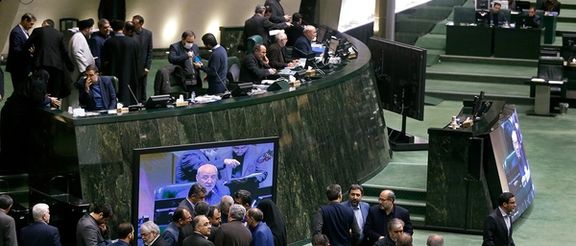
The Islamic Republic’s parliament is mulling over a plan to ban regime’s officials from leaving the country to stop them from moving capital out of Iran without accountability. 

Hardliner member of parliament Jalal Rashidi Kouchi said Saturday that banning the exit of senior officials, which is on the agenda of this parliament, is meant for the "protection of the assets and documents of the people and the country."

The plan is titled "Prohibition of the Islamic Republic of Iran's administrators from leaving the country after completing their duties" and will be discussed at the parliament next week, IRGC affiliated Tasnim news agency said. 

It is not clear if the timing of this proposal is related to nationwide antigovernment protests and the resulting political instability.

Referring to Iranian fugitive banker Mahmoud Reza Khavari, who was involved in an embezzlement scandal and fled the country to Canada, Rashidi Kouchi said such a plan would guarantee that officials cannot leave Iran with the money they obtained from embezzlement and bribery. 

Khavari was the chairman of Bank Melli Iran until September 2011 and chairman of Bank Sepah’s board of directors from December 2003 until March 2005. He was involved in a big embezzlement case worth approximately $950 million. Khavari, who became a Canadian citizen in 2005, is a fugitive wanted by the judicial authorities of the Islamic Republic. 

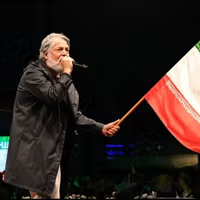
Member of parliament Jalal Rashidi Kouchi (file photo)
100%
Member of parliament Jalal Rashidi Kouchi

A certain time frame has been proposed for the plan. Officials would not be able to leave Iran in their last year of their service at a certain post and three years following the end of their job. Officials at a certain senior level must also register their properties in an existing system with the Judiciary and must refrain from any sale or transfer of properties during the four-year timespan. 

It is still not clear to what levels of seniority the law would apply, but most mid-to-high-level officials often have properties registered to family and friends.

Kouchi also said that according to the plan, the departure of former officials will be subject to the permission of regulatory and security entities, such as the judiciary, the Ministry of Intelligence, the Intelligence Organization of the IRGC and the intelligence division of the police. He added that the priority of implementing this plan is for officials who hold dual citizenships or have close relatives abroad. 

The move to adopt such measures can be seen as a sign that some Islamic Republic officials may be trying to relocate from Iran with their families and seek residence in other countries, while the regime wants to erect barriers. The pace of emigration by Iranians, officials and ordinary people alike, has accelerated since the current wave of protests. Many Iranians inside the country and abroad believe that the days of the clerical regime are numbered as the global community and international bodies have also started expressing support for the uprising and a serious financial-economic crisis is threatening stability. 

Official reports this week indicated that at least $10 billion capital has left the country in the past 9 months.

Late in October, unconfirmed reports suggested that Iranian officials were sending their family members and assets abroad amid antigovernment protests that show no sign of abating. According to a report on the website of UK’s Daily Express, top officials of the Islamic Republic are reportedly attempting to secure British passports for their families. Citing an unnamed Iranian source, the report also claimed that officials have been chartering up to "five flights a day" for their families, adding that some sections of “Tehran’s main airport” have been taken over as a fast-track area for their own family and friends to escape the country.



Most Viewed

Worst outcome is Islamic Republic’s survival, ex-CIA official says
1
PODCAST

Worst outcome is Islamic Republic’s survival, ex-CIA official says

2
ANALYSIS

Iran brings unusually broad team to US talks to blunt future blame

3
INSIGHT

Tehran sends tough message but keeps diplomacy door open

4

Zoroastrian religious figure arrested in Iran

Banner
Banner

Spotlight

  • What the US naval blockade would mean for Iran’s economy
    INSIGHT

    What the US naval blockade would mean for Iran’s economy

  • Tehran sends tough message but keeps diplomacy door open
    INSIGHT

    Tehran sends tough message but keeps diplomacy door open

  • Worst outcome is Islamic Republic’s survival, ex-CIA official says
    PODCAST

    Worst outcome is Islamic Republic’s survival, ex-CIA official says

  • Why the Iran-US truce is more likely to buy time than peace
    ANALYSIS

    Why the Iran-US truce is more likely to buy time than peace

  • Engaged but uncommitted: China watches Iran and US fight and talk
    ANALYSIS

    Engaged but uncommitted: China watches Iran and US fight and talk

  • A truce for the world, a reckoning for Iran’s economy
    ANALYSIS

    A truce for the world, a reckoning for Iran’s economy

•
•
•

More Stories

Hardliner Iran Students Demand Expulsion Of French Envoy Over Cartoons

Jan 8, 2023, 10:26 GMT

Hard-line student unions have called on Iran's foreign minister to expel the France's ambassador over “insulting cartoons” by French satirical magazine Charlie Hebdo.

In a letter published by ISNA in Tehran on Sunday, the student unions called on the foreign ministry to take “the most serious action against the new insult supported by the Elysée against the people of Iran and Muslims of other countries.”

“Considering the history of Charlie Hebdo in insulting the sanctities of about 2 billion Muslims around the world, we expect the foreign ministry not to accept any excuses by the French government,” reads the letter.

The Iranian foreign ministry on Wednesday summoned France's envoy to Tehran to protest "insulting" cartoons depicting Supreme Leader Ayatollah Ali Khamenei published by Charlie Hebdo.

The magazine said the series was part of a competition it launched to support anti-regime demonstrations in Iran. France has said media in free and the government cannot interfere with what they publish.

Foreign ministry spokesman Nasser Kanaani said the publication of the cartoons was an "insult to authority, sanctities, and religious and national values" of Iran and the Islamic Republic does not accept these insults.

Charlie Hebdo has been the target of three terrorist attacks: in 2011, 2015, and 2020. All of them were presumed to be in response to several cartoons that it published controversially depicting Islam’s Prophet Muhammad. In the 2015 attack, 12 people were killed.

Iran Politicians Racing For Elections While Protesters Want Regime Change

Jan 8, 2023, 09:23 GMT
•
Iran International Newsroom

Amid protests and economic crisis, top conservatives in Tehran are maneuvering to present themselves as viable alternatives for the presidency and the parliament.

A commentary in the January 7 edition of the reformist daily Etemad said that leading conservative politicians in the government are distancing themselves from the Raisi administration. Other politicians outside the government have broken their silence as the weakness of a government dominated by hardliners is being revealed.

Etemad wrote on Saturday that the neo-conservative Majles Speaker Mohammad Bagher Ghalibaf and ultraconservative presidential adviser Saeed Jalili have been lately trying to define new roles for themselves in the next decade.

While some politicians may be planning for the next decade, reformist columnist Abbas Abdi told Eghtesad Online on January 5 that the continuation of the current situation in Iran for another two years is inconceivable unending antigovernment protests and Tehran's international isolation.

In the meantime, former proreform presidential candidate Mohsen Mehralizadeh has harshly criticized the Raisi administration for failing to stand by its promises and reiterated that Raisi is not an educated man and that he made promises because he is not familiar with political and economic concepts.

Mohsen Mehrizadeh 'reformist' politician and for presidential candidate
100%
Mohsen Mehrizadeh 'reformist' politician and for presidential candidate

The Iranian media have interpreted all these developments as well as recent moves by former Majles Speaker Ali Larijani and remarks by former President Hassan Rouhani against the Raisi administration as attempts to prepare for next year's parliamentary and the 2025 presidential elections.

However, according to Etemad, Jalili's populist rhetoric against the 2015 nuclear agreement and a new deal with the West mark his dreams of establishing an even more hardliner administration. Etemad wrote that Jalili's denial of the looming threat of an international consensus against the Islamic Republic is part of his campaign for ultraconservative populist utopia.

Hardliner Jalili, a staunch opponent to a deal with the West speaking to president Raisi in August 2021
100%
Hardliner Jalili, a staunch opponent to a deal with the West speaking to president Raisi in August 2021

The daily added that Ghalibaf on the other hand has a dream of repeating former President Akbar Hashemi Rafsanjani's "reconstruction government". During the past weeks Ghalibaf has been talking about a new development-oriented governance, but his occasional support for suppression of protesters contradicts his agenda. Nonetheless, since the protests started in mid-September, Ghalibaf has been repeating his keywords of "neo-conservatism" and "new governance" in a bid to create his political brand ahead of the next elections in Iran.

Ghalibaf also went to Qom and met with Iran's top clerics who in his support criticized Raisi's economic policies.

Ghalibaf has been often complaining about the refusal of many conservatives to support him in the past presidential elections although all the polls showed he was in a better position than the main conservative contestant particularly in 2013 and 2017.

At the same time, while Iran's reformists seem to have little hope for a political comeback, moderate conservatives such as Rouhani and Larijani find themselves in a better position to compete with the ruling ultraconservatives and are making some moves.

Standing in the middle, Mehralizadeh, who has never been accepted by the public as a reformist or by the government as a conservative, has come up with a new tactic. He says a political party, The Nation's Path Party, has written to him and asked to stand as a candidate in the next election. As a response, Mehralizadeh has once again challenged Raisi's academic and political credentials and pointed out that the most important threat against the Islamic Republic is "the fire of anger and revenge" resulting from violent treatment of the protests and advised the government to "speak softly to the nation."

While all these figures are talking about the continuation of the Islamic Republic, protesters in Iran do not seem to settle for anything other than a regime change and executions that shook Iran Saturday, do not seem to change this.

Iranian Regime Mulling New Methods To Enforce Hijab

Jan 7, 2023, 16:13 GMT
•
Iran International Newsroom

Right when many say the Islamic Republic is showing signs of revisionism about mandatory hijab rules, the regime announces new methods to enforce them.

Following an ambivalent speech by Supreme Leader Ali Khamenei earlier this week, stopping short of clearly setting out a policy regarding the enforcement of hijab, Parliament Speaker Mohammad Bagher Ghalibaf (Qalibaf) criticized the police over their harsh treatment of women with loose hijab.

Describing hijab as the inevitable duty for all Muslim women, at the same time Khamenei had emphasized that no Iranian woman should be labeled as non-religious or anti-revolutionary if she fails to fully honor the Islamic dress code.

During a TV program that aired January 5, Ghalibaf said "What right do we have to say that we don't let a woman ride the subway when she is not wearing hijab properly?"

Describing the issue as polarizing, he said that both extremes of no Islamic dress code and harassing women for hijab “benefit the enemies.”

Signaling a sign of retreat, Ahmad Alamolhoda, a senior firebrand cleric who is President Ebrahim Raisi's father-in-law, said earlier in the week that people cannot be forced to adopt the culture of wearing hijab. It is certain that police measures will not do job because it is not possible to teach people what is right just by harsh and negative actions, he said, noting that it is not possible to make hijab a culture with threats and arrests, there should be a clear and comprehensive plan for that.

Last year in March, the staunch hardliner had urged people to reproach women with poorly-fitting hijab to stop “debauchery.” “If a woman in the street removes her headscarf, she must face the complaints of the people to see that she has no place…In such a case, you can be sure that she will wear even two scarves."

The hardliner cleric's apparent retreat from his harsh position seemed to come after Khamenei sounded a bit more lenient about those who are not observing hijab according to the ideals of the regime.

An Iranian woman walking behind security forces without hijab  (file photo)
100%
An Iranian woman walking behind security forces without hijab

It was forcible enforcement of hijab in the streets that triggered popular protests in September -- the boldest challenge the Islamic Republic has ever faced.

The Islamic Republic faces a dilemma: Allowing people to wear whatever they desire in public means the utmost failure of the regime's ideology, while enforcing hijab with strict punitive measures can only lead to further resentment in society. Now, the three branches of the Islamic Republic’s government are mulling over new methods to enforce hijab.

Reformist Shargh Daily said Thursday that new measures include banning those who unveil from leaving the country, imposing fines, denying employment, and community service as well as restrictions on using public services.

Apparently, these are parts of the measures that the parliament is considering for hijab enforcement.

On January 1, Fars news agency, affiliated with the hardliners and the IRGC, cited an unnamed police source as saying that a new phase of a plan to enforce hijab has started across the country. The news agency also confirmed reports that many people had received warnings via SMS about removing hijab in their cars.

Defending the decision, Interior Minister Ahmad Vahidi told Rouydad24 website Friday that “Observance of hijab is a legal issue and one of our religious values. Most of our women also observe this issue.”

A lawmaker said in December that the regime is making some decisions about hijab rules, explaining that the methods for enforcing hijab may change. He added “it is possible that women who do not observe hijab would be informed via SMS, asking them to respect the law. After notifying them, we enter the warning stage... and last, the bank account of the person who unveiled may be blocked."

One-Fifth Of Online Jobs Lost In Iran Due To Internet Restrictions

Jan 7, 2023, 14:12 GMT

New figures show that due to extensive internet and social network restrictions, 20 percent of people in Iran have lost their online jobs in the past four months.

According to Jobvision website, the restriction imposed on Iranians’ access to social networks following nationwide protests has resulted in a series of undesirable consequences such as cutbacks, increased uncertainty about the future, reduced salaries, and the suspension of development plans.

The website published a chart showing that 46 percent of organizations have suspended or postponed more than half of their recruitment programs due to the recent internet restrictions.

45% of companies or businesses that depend on the Internet have decided to reduce their payments or had to pay wages by delay.

The statistical findings of Jobvision show one out of every five people have lost their jobs, and 16% of those working in this area expect to be fired soon.

Restrictions on Instagram has had a deep impact on the lives of people who used to make a living on this popular social network.

The government often shuts of slows down access to the Internet and social media platforms, while President Ebrahim Raisi promised in his election campaign that he would not block Instagram because "it is the place of business for many Iranians".

Since the beginning of nationwide protests almost four months ago, the government has cracked down on protests violently, and officials have repeatedly blamed cyberspace and foreign media for provoking the protesters.

Iran’s Khamenei Appoints Infamous Figure As Police Chief

Jan 7, 2023, 09:55 GMT

Iran's Supreme Leader Ali Khamenei has appointed an infamous military figure as the country's new police chief to step up crackdown on protests.

On Saturday, Khamenei appointed Ahmadreza Radan, an IRGC officer who was transferred to police forces many years ago, as the country's new Commander-in-chief of Law Enforcement Force replacing Hossein Ashtari.

Sources had earlier told Iran International that Khamenei had "harshly scolded" Ashtari over his "incompetence" in quelling anti-regime protests.

Radan served as a deputy police chief from 2008 to 2014 and played a key role in the crackdown on protesters after the disputed 2009 presidential elections and in the formation of “morality police”.

Radan was heading the Center for Strategic Studies of the Law Enforcement Force.

He has been designated by the United States as a person who is, "among other things, responsible for or complicit in, or responsible for ordering, controlling, or otherwise directing, the commission of serious human rights abuses against citizens of Iran or their family members."

In 2007, Ahmad-Reza Radan launched a "Public Security Plan". The police arrested dozens of alleged criminals for what it called “increasing public security”. The people were sometimes beaten on camera in front of city inhabitants.

In his Saturday decree, Khamenei urged Radan to ensure that people are satisfied with the police's performance in providing security, a rhetoric indicating security for the regime amid protests.