• العربية
  • فارسی
Brand
  • Iran Insight
  • Politics
  • Economy
  • Analysis
  • Special Report
  • Opinion
  • Podcast
  • Iran Insight
  • Politics
  • Economy
  • Analysis
  • Special Report
  • Opinion
  • Podcast
  • Theme
  • Language
    • العربية
    • فارسی
  • Iran Insight
  • Politics
  • Economy
  • Analysis
  • Special Report
  • Opinion
  • Podcast
All rights reserved for Volant Media UK Limited
volant media logo

As EU Keeps 'Channels Open' With Iran, US Gives The Cold Shoulder
Iran International Newsroom
Dec 21, 2022, 11:19 GMT+0Updated: 17:43 GMT+1
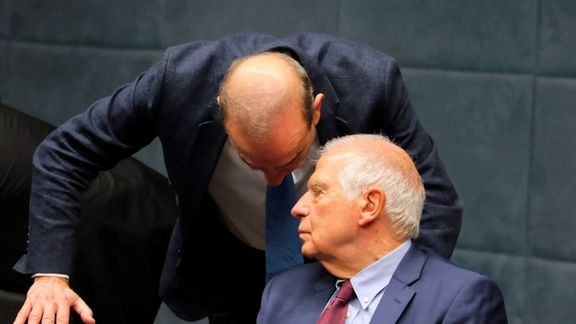
EU foreign policy chief Josep Borrell speaking with his top aide Enrique Mora during his meeting with Iran's foreign minister Amir-Abdollahian in Jordan on December 20, 2022

United States officials have played down but not contradicted remarks by President Joe Biden calling the 2015 Iran nuclear deal “dead.”

Shortly before European Union foreign policy chief Joseph Borrell met Iranian Foreign Minister Hossein Amir-Abdollahian in Jordan Tuesday a video emerged on social media late Monday of Biden making the remark on a walkabout November in California during Congressional elections.

Asked about the president’s comments in a press briefing Wednesday, Ned Price, the State Department spokesman, stopped short of endorsing them, saying it was “certainly the case that the Iranians killed the opportunity for a swift return to mutual compliance with the JCPOA.” Security spokesman John Kirby told journalists: “We simply don’t see a deal coming together anytime soon.”

Talks to revive the 2015 nuclear deal, the JCPOA (Joint Comprehensive Plan of Action) floundered in late summer with Iran and the US unable to agree over its restoration. The US, which left the agreement in 2018 and imposed ‘maximum pressure’ sanctions, rejected some Iranian demands as extraneous and unacceptable, without saying what these were.

JCPOA serves ‘security of the whole region’

With the three western European JCPOA signatories – France, Germany and the United Kingdom, the ‘E3’ – close to the US position, diplomatic effort has come from the European Union. Borrell tweeted Tuesday that he had agreed with Amir-Abdollahian on the importance of keeping communications open to restore the JCPOA. In a statement to the United Nations Security Council Monday, Silvio Gonzato, the EU Chargé d’Affaires, said “diplomacy and restoring the JCPOA’s full implementation” were “still the best option” over nuclear non-proliferation and that restoring the JCPOA was “instrumental to the security of the whole region…”

Borrell’s tweet also “stressed need to immediately stop military support to Russia and internal repression in Iran,” so acknowledging the difficulty faced by the EU in maintaining nuclear diplomacy given Iran’s supply of military drones to Russia and its domestic unrest.

The ‘E3’ states were at one this week with the US in arguing at the UNSC that Iran’s supply of military drones violates UNSC Resolution 2231, which in endorsing the JCPOA banned the transfer to and from Iran of certain categories of weapons. Russia and Iran both reject the argument, which the UN is considering.

Wednesday's high-profile visit to Washington of Volodymyr Zelenskyy will see the Ukrainian President argue for more US arms – beyond the $20 billion Washington has supplied. Russia’s use of Iranian-made drones, while not a decisive factor in the war, has strengthened Ukraine’s case for more Western support.

‘Slap Tehran down’

JCPOA opponents in Washington and Israel increasingly deploy Iran-Russia defense links and Iran’s unrest to bolster their case. Mike Pompeo, Secretary of State as the US left the JCPOA, attacked Biden Saturday for any talks with a “brutal and corrupt regime.”Pompeo, who may run for president in 2024, spoke at a conference of the ‘Organization of Iranian American Communities,’ which is allied to the Albania-based Mujahideen-e Khalq.

Yonah Jeremy Bob, senior military correspondent, wrote in the Jerusalem Post Tuesday that UN action against Iran over the drones “could bring back unilateral sanctions crashing down on Iran,” referring to the hope that the alleged JCPOA violation by Iran would trigger US sanctions. This would, Bob argued, “slap Tehran down” and “flip the Biden administration’s policy…in one fell swoop.”

In his press briefing Tuesday, Price said the JCPOA “hasn’t been on the agenda for us for months.” Since September US focus had been both on “Iran’s deepening military partnership with Russia” and on “standing up for the fundamental freedoms of the Iranian people,” the spokesman said.

He agreed that the arrest of actor and “cultural icon” Traneh Alidoost was “part of the regime’s effort to sow fear and to suppress these peaceful protests.” The US has in recent months imposed additional sanctions on Iran over petrochemical exports, ‘human rights,’ and the supply of drones to Russia.


Most Viewed

Ghalibaf defends Iran-US talks amid hardline backlash
1
INSIGHT

Ghalibaf defends Iran-US talks amid hardline backlash

2
INSIGHT

100 days after carnage: Iran economy reels from war, inflation, unemployment

3
INSIGHT

A nation in limbo: 100 days after the massacre, has the world moved on?

4
ANALYSIS

From instability to influence: Pakistan’s pivotal role in US-Iran diplomacy

5
ANALYSIS

100 days on: why Iran’s January protests spread across social classes

Banner
Banner

Spotlight

  • War-hit homeowners feel abandoned as Iran’s reconstruction aid fades

    War-hit homeowners feel abandoned as Iran’s reconstruction aid fades

  • 100 days on: the anatomy of Iran’s January crackdown
    INSIGHT

    100 days on: the anatomy of Iran’s January crackdown

  • Ghalibaf defends Iran-US talks amid hardline backlash
    INSIGHT

    Ghalibaf defends Iran-US talks amid hardline backlash

  • 100 days on: why Iran’s January protests spread across social classes
    ANALYSIS

    100 days on: why Iran’s January protests spread across social classes

  • From instability to influence: Pakistan’s pivotal role in US-Iran diplomacy
    ANALYSIS

    From instability to influence: Pakistan’s pivotal role in US-Iran diplomacy

  • A nation in limbo: 100 days after the massacre, has the world moved on?
    INSIGHT

    A nation in limbo: 100 days after the massacre, has the world moved on?

•
•
•

More Stories

Differences On Iran Flare At UN Security Council

Dec 20, 2022, 17:38 GMT+0
•
Iran International Newsroom

Monday’s meeting of the UN Security Council to discuss the 2015 resolution endorsing the Iran nuclear agreement exposed the complex divisions surrounding it.

Expressing irritation with United Nations Secretary-General Antonio Guterres over an investigation into Iran sending military drones to Russia, United States Deputy Ambassador Robert Wood told the meeting the UN was “apparently yielding to Russian threats” by not sending officials to Ukraine.

UNSC members France, the United Kingdom, and the US have argued that Iran supplying drones to Russia violates a clause in UNSC Resolution 2231, which endorsed the 2015 nuclear deal. The clause requires prior council approval (up to October 2023) for transferring to and from Iran of certain categories of weapons.

Amir Saeid Iravani, Iran’s UN ambassador, said any drones supplied to Russia before February were not banned by the council and were not “for use in the ongoing conflict in Ukraine.” He said the UN enquiry served only “to divert attention from the western states’ transfer of massive amounts of advanced sophisticated weaponry to Ukraine in order to prolong the conflict.” The US alone has sent $20 billion in arms to the Kyiv government.

Iran has not criticized Russia for its unprovoked attack on Ukraine, while the United States and its European NATO allies have strongly opposed Moscow on the issue and are helping Kyiv to reclaim its territorial integrity.

Vassily Nebenzia, Russia’s UN ambassador, told the council that UN officials “should not bow to pressure from western countries” and that “any results of this pseudo investigation [would be] null and void.”

The UNSC meeting marks a growing rift between, on one side, the US, France, and the UK, and on the other side Russia, who alongside China mainly blames Washington for undermining the 2015 agreement, the JCPOA (Joint Comprehensive Plan of Action), which the US unilaterally left in 2018 while imposing stringent sanctions on Iran.

A statement Monday from the three western European JCPOA signatories – France, Germany, and the UK – reiterated that the failure of talks to revive the agreement was solely due to Iran. Their statement said Tehran had “refused to take the deal tabled” by the “JCPOA co-ordinator in March and August,” referring to proposals made by the European Union chair of talks, which Iran regarded as unsatisfactory. The continuing expansion of Iran’s nuclear program was having “severe impacts on international security and the non-proliferation regime,” the ‘E3’ statement said.

JCPOA ‘still the best option’

The EU, whose officials have mediated not just multilateral JCPOA talks but also bilateral Iran-US contacts, now appears more proactive than the E3 over the JCPOA – flying in the face of US President’s Joe Biden just-revealed November proclamation that the JCPOA is “dead.”

EU foreign policy chief Josep Borrell met Tuesday in Jordan with Iranian Foreign Minister Hossein Amir-Abdollahian and chief nuclear negotiator Ali Bagheri Kani. Silvio Gonzato, the EU Chargé d’Affaires, told the UNSC Monday that “diplomacy and restoring the JCPOA’s full implementation” were “still the best option for preventing Iran from developing a nuclear weapon,” and that this was “instrumental to the security of the whole region and…in our fundamental common interest.”

While acknowledging that JCPOA restoration work had been “seriously challenged” by unrest in Iran and the drones supply, Gonzato said the EU “remains in close contact with all JCPOA participants and the United States.”

And while Gonzato noted Iran’s JCPOA infringements, including enriching uranium to 60 percent and limiting international inspectors’ access, Gonzato cited the “very serious negative economic consequences” Iran faced “following the US’s withdrawal from the JCPOA” its “re-imposition of previously lifted US unilateral sanctions, which we deeply regret.”

In Washington Saturday, Mike Pompeo, Secretary of State as President Donald Trump left the JCPOA told a conference there should be no diplomacy with “a brutal and corrupt regime.” Addressing the conference virtually, Maryam Rajavi, co-leader of the Mujahideen-e Khalq, the militant opposition group relocated by the US from Iraq to Albania, said “the current uprising in Iran is one of the world’s most important developments in 2022.”

Does Biden Calling Iran Nuclear Deal Dead Reveal Real US Thinking?

Dec 20, 2022, 12:41 GMT+0
•
Iran International Newsroom

A video of United States President Joe Biden saying the 2015 Iran nuclear deal is “dead” jars with US policy as reiterated recently by leading officials.

In the video clip, posted to social media Tuesday, shows Biden apparently at a campaign walk-about during November’s Congressional elections. Asked about the 2015 agreement, the JCPOA (Joint Comprehensive Plan of Action), the president clearly replies: “It is dead, but we’re not going to announce it.”

This is for “a lot of reasons,” Biden says. Replying to an apparently Iranian woman asking him about “mullahs,” he says he is aware the Iranian government “don’t represent you,” but he adds that if they acquire atomic weapons they will represent a nuclear Iran .

Formal diplomatic efforts to revive the JCPOA, from which President Donald Trump withdrew the US in 2018, have been suspended since late summer. US officials have said JCPOA revival is no longer their “focus,” and Iran envoy Rob Malley in a recent Foreign Policy magazine interview recognized “a series of vicious cycles” in which US sanctions triggered Iran to expand its nuclear program.

But, contrary to what Biden says in the video, US officials have continued to say they want to restore the agreement as the best way to cut off any Iranian path to a nuclear weapon.

Europe: ‘Continue engagement to revive deal’

A week after Josep Borrell said “we have to continue engaging as much as possible in trying to revive this deal,” the European Union foreign policy chief met Tuesday in Jordan with Iran’s Foreign minister Hossein Amir-Abdollahian and chief nuclear negotiator Ali Bagheri Kani. The meeting was at a conference sponsored by France and Iraq aimed at reducing regional tensions. “Necessary meeting…amidst deteriorating Iran-EU relations,” Borrell tweeted.

The European signatories of the JCPOA – France, Germany, and the United Kingdom – criticized the US leaving the 2015 agreement and imposing ‘maximum pressure’ sanctions. But the Biden administration has improved relations with Europe, including by in 2021 joining talks to revive the JCPOA. Contrary to China and Russia, the Europeans have blamed Tehran for failure to bridge US-Iran gaps, as Washington continues sanctions and Tehran seeks ‘guarantees’ to cushion its economy and nuclear program against another US withdrawal. A statement from France, Germany, and the UK issued Monday said Iran had made “unacceptable demands.”

The Ukraine crisis, and media coverage of unrest in Iran, have also pushed Europe closer to the US as both send billions of weapons to the Kyiv government. France, Germany, and the UK have joined Washington in arguing Iran sending drones to Russia contravenes a JCPOA clause barring the transfer of certain weapons to and from Iran.

While Western policy remains to prevent Iran from deciding to ‘go nuclear’ they also realize that at this juncture they cannot enter talks over the JCPOA.

Borrell mentioned two pre-conditions after meeting with the Iranian foreign minister: Tehran should immediately halt military support for Russia and internal repression, conditions the Islamic Republic can hardly meet in foreseeable future.

Nuclear Deal With Iran “Dead” But Can’t Be Announced: Biden

Dec 20, 2022, 12:25 GMT+0

A video published on social media shows US President Joe Biden saying the nuclear deal with Iran is “dead”, but his administration is unwilling to announce it.

This video, which was published on Twitter for the first time by Damon Maghsoudi, a software engineer living in the United States, was recorded on the sidelines of the November 4th election campaign in California.

In this video, an Iranian-American woman asks Biden to declare the West's nuclear agreement with Iran, known as the JCPOA, is “dead”.

In response, the US President clearly confirmed that the JCPOA is “dead”, but he he said he cannot announce it for “a lot of reasons”.

The Iranian woman than tells Biden, “We just don’t want any deals with the mullahs, they don't represent us,” and he replies, “I know they don't represent you, but they will have a nuclear weapon that they will represent.”

Although Biden does not give a direct answer about the “reasons” why Washington refuses to officially announce this, but concerns about Iran’s progress towards obtaining a nuclear weapon could be the main reason for leaving the door open with the Islamic Republic.

However, analysts have been saying for weeks that the nuclear negotiations between Iran and the West have reached an impasse.

IAEA Official Leaves Iran, No Sign Of Progress On Uranium Traces

Dec 19, 2022, 16:19 GMT+0

A senior official of the International Atomic Energy Agency left Tehran Monday after arriving Sunday, but there was no word of progress on a thorny issue.

Massimo Aparo, IAEA deputy director general, led a delegation billed by Iran as addressing “outstanding issues,” widely taken to refer to an impasse over uranium traces found by the agency in Iran in sites not declared as nuclear-related. The IAEA said Sunday it planned no public statement, and the Iranian news agency ISNA merely reported meetings – which included Mohammad Eslami, head of the Atomic Energy Organization of Iran – had addressed “future joint cooperation and programs, in addition to safeguarding issues.”

The IAEA has been seeking clarity over the uranium traces, found last year in sites linked to Iran’s nuclear work before 2003. The agency argues Tehran should provide satisfactory answers as part of its ‘safeguards’ obligations under the Nuclear Non-Proliferation Treaty.

But the IAEA probe has become entangled with efforts to restore the 2015 Iran nuclear agreement, the JCPOA (Joint Comprehensive Plan of Action). Tehran has said the IAEA should drop is enquiry which it says began only after Israel in 2018 made a raft of allegations during efforts to back United States President Donald Trump in withdrawing the US from the JCPOA and imposing draconian sanctions on Iran.

The 35-member IAEA board in June and November passed US-drafted motions condemning Iran over not satisfying the agency. Opposing the move, China and Russia said it would stymie talks to restore the JCPOA.

Former FM Says Iran Has Ability To Make Nukes But No Intention

Dec 19, 2022, 10:41 GMT+0
•
Iran International Newsroom

Iran has the ability to produce nuclear weapons, but it does not intend to do so, Iran’s former foreign minister Kamal Kharrazi said in Tehran on Monday.

Speaking at the third Tehran Dialogue Forum, Kharrazi who is the head of a foreign policy outfit at Supreme Leader Ali Khamenei’s office, referred to Iran’s “high-level” nuclear capabilities, but maintained that “we do not intend to produce an atomic bomb, because we do not regard it as a component of our security.”

Iran’s English-language media did not mention Kharrazi’s comments about the ability to build nuclear weapons, but semi-official Persian media covered it as headlines.

Kharrazi said that during his tenure as foreign minister (1997-2005) the European powers did not agree for Iran to have a few uranium enrichment centrifuges, but now Iran has a vast infrastructure to produce fissile material.

“With Iran’s resistance and the efforts of Iranian scientists, we now have 19,000 centrifuges working [to enrich uranium],” the former foreign minister said.

Kharrazi reiterated previous Iranian claims that the country’s ruler Khamenei is against the production of nuclear weapons because it will not bring security. He argued that if Iran becomes a nuclear weapons power, others in the region will start an “arms race and trying to produce nuclear weapons.”

While denying the intention to produce atomic bombs, Kharrazi said, “We are of course aware of the issue that having the nuclear technology in itself is a deterrent.”

Kharrazi then insisted that Iran is ready to return to its commitments under the 2015 nuclear deal, the JCPOA, if the West also honors its commitments. “Related to recent negotiations, the issue of inspections and claims by the agency [IAEA] remain,” he said and expressed hope that these can be resolved.

Iran began violating the terms of the JCPOA after the United States pulled out of the agreement in 2018 and imposed economic sanctions. It now enriches uranium up to the 60-percent level, which is short step away from the 90-percent enrichment it would need to produce nuclear weapons.

Iran’s economic situation is fast deteriorating, with its currency losing 50 percent of its value in the past 15 months, and especially since protests began in September.

Negotiations to revive the JCPOA also reached an impasse in late August, and this is a negative factor impacting the economy, as lack of an agreement leads to general pessimism in the country.

The harsh and deadly suppression of protests in the past three months has led to another complication in the nuclear talks, as Western governments have become less willing to renew a deal that would provide tens of billions of dollars to a regime which has killed nearly 500 people and jailed around 20,000.