• العربية
  • فارسی
Brand
  • Iran Insight
  • Politics
  • Economy
  • Analysis
  • Special Report
  • Opinion
  • Podcast
  • Iran Insight
  • Politics
  • Economy
  • Analysis
  • Special Report
  • Opinion
  • Podcast
  • Theme
  • Language
    • العربية
    • فارسی
  • Iran Insight
  • Politics
  • Economy
  • Analysis
  • Special Report
  • Opinion
  • Podcast
All rights reserved for Volant Media UK Limited
volant media logo

Iran Forcing Academics To Help Save Its Seat At UN Women Commission
Iran International Newsroom
Dec 13, 2022, 23:12 GMT+0Updated: 17:38 GMT+1
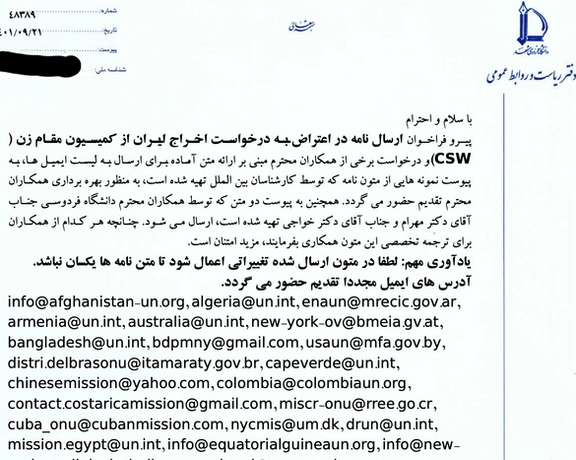
 A. sample letter with a list of email addresses of UN missions
A. sample letter with a list of email addresses of UN missions

On the eve of a vote to expel the Islamic Republic from the UN women’s commission, leaked documents reveal a behind-the-scenes campaign to stop the move. 

According to some documents obtained by Iran International, the Iranian regime is exerting pressure on academic figures to send letters to numerous global bodies to urge them to vote against the move. Among the documents are an official letter from an advisor of the head of Ferdowsi University of Mashhad to her colleagues with the list of emails of UN missions and a list of points to be mentioned in the correspondence by the professors.

The Commission on the Status of Women (CSW) is the principal global intergovernmental body exclusively dedicated to the promotion of gender equality and the empowerment of women. The 54-member UN Economic and Social Council (ECOSOC) will vote on whether to oust the Islamic Republic from the commission on December 14.

In the documents, a list of email addresses of UN missions of many countries as well as rights groups were provided, and university professors were asked to write to them in an attempt to prevent Iran’s expulsion initiated by the United States and supported by others. Samples letters were also given to the academics to use them as templates, but they were asked to change the wordings of the letters a bit so that it would not be obvious that they were part of a state-orchestrated campaign. 

The sample letters are a collection of the regime’s propaganda lines blaming foreign powers for the current wave of protests that began in mid-September following the death of 22-year-old Mahsa Amini in custody of hijab police. Such hackneyed lines include blaming other countries for instigating the rallies, blaming the US for using UN mechanisms as political tools, and blaming sanctions by Western countries as the main reason behind the country’s economic woes. 

The academics were also asked to mention the claims that women and men enjoy equal rights in the Islamic Republic and that Iranian women have been present in all economic fields and have made great achievements. Such bogus claims were also read out during a UN Human Rights Council meeting late in November held to discuss the deteriorating situation in Iran, especially with respect to women and children. 

A sample letter of the document given to academics to use in their correspondence (December 2022)
100%
A sample letter of the document given to academics to use in their correspondence

The equality of men and women in Iran is evidently untrue. The Islamic Republic’s constitution clearly states that women are considered as inferior to men in terms of inheritance, testifying in courts and in many other areas according to the Islamic law or sharia. Women in Iran are not allowed to travel abroad without the permission of a male guardian, their share in inheritance is half of what male family members receive -- the financial compensation paid to the victim or heirs of a victim in cases of death, is also half of that of a man. 

Among the other points that the academics were asked to mention in their letters to members of the commission is warning them that the expulsion of the Islamic Republic sets a precedent that may be used against other members in the future. 

The first step by the United Nations to hold the Islamic Republic accountable for its crackdown on protesters was creating a fact-finding mission by the Human Rights Council and the second move can be the vote to kick the regime off the Commission on the Status of Women. The Geneva-based UN Human Rights Council voted on November 24 to launch an independent investigation into the regime’s deadly repression of protests that has killed around 500 civilians, including about 60 children. 

Late in November, the United States circulated a draft resolution on the move, that denounces Iran's policies as "flagrantly contrary to the human rights of women and girls and to the mandate of the Commission on the Status of Women." The US-drafted resolution would "remove with immediate effect the Islamic Republic, which has just started a four-year term on the 45-member commission. 

In an interview with MSNBC Sunday US Special Envoy for Iran Robert Malley said, “it makes no sense for Iran to be sitting on a commission whose role is to promote the rights of women when they are doing exactly the opposite.”


Most Viewed

Ideology may be fading in Iran, but not in Kashmir's ‘Mini Iran'
1
INSIGHT

Ideology may be fading in Iran, but not in Kashmir's ‘Mini Iran'

2
INSIGHT

Hardliners push Hormuz ‘red line’ as US blockade tests Iran’s leverage

3
VOICES FROM IRAN

Hope and anger in Iran as fragile ceasefire persists

4

Iran International says it won’t be silenced after London arson attack

5

US sanctions oil network tied to Iranian tycoon Shamkhani

Banner
Banner

Spotlight

  • Hardliners push Hormuz ‘red line’ as US blockade tests Iran’s leverage
    INSIGHT

    Hardliners push Hormuz ‘red line’ as US blockade tests Iran’s leverage

  • Ideology may be fading in Iran, but not in Kashmir's ‘Mini Iran'
    INSIGHT

    Ideology may be fading in Iran, but not in Kashmir's ‘Mini Iran'

  • War damage amounts to $3,000 per Iranian, with blockade set to add to losses
    INSIGHT

    War damage amounts to $3,000 per Iranian, with blockade set to add to losses

  • Why the $100 billion Hormuz toll revenue is a myth
    ANALYSIS

    Why the $100 billion Hormuz toll revenue is a myth

  • US blockade targets Iran oil boom amid regional disruption
    ANALYSIS

    US blockade targets Iran oil boom amid regional disruption

  • Iran's digital economy battered by prolonged blackout
    INSIGHT

    Iran's digital economy battered by prolonged blackout

•
•
•

More Stories

Iran Taking Revenge On Dissent By Executions: Amnesty International

Dec 13, 2022, 21:08 GMT+0

Amnesty International says the Iranian regime is executing individuals to spread fear and take revenge on protesters who stand up against the Islamic Republic.

Responding to the Iranian authorities’ public execution of Majidreza Rahnavard, Diana Eltahawy, Amnesty International’s Deputy Director for the Middle East and North Africa, said Monday “the horrific public execution…exposes Iran’s judiciary for what it is: a tool of repression sending individuals to the gallows to spread fear and exacting revenge on protesters daring to stand up to the status quo.”

The Islamic Republic hanged a second protester, Majidreza Rahnavard in less than a week in public on Monday after charging him with the alleged killing two members of security forces.

Eltahawy further added that the arbitrary execution of the youth “lays bare the extent of the Iranian authorities’ assault on the right to life and their disregard for even maintaining a façade of meaningful judicial proceedings.”

Amnesty urged the international community to take all necessary measures to pressure the Iranian authorities to stop executions and annule death sentences.

The body has identified 20 people at risk of execution in connection with the protests among them 11 sentenced to death.

Three individuals, according to Amnesty, have undergone trials on capital charges and are either at risk of being sentenced to death or may have already been sentenced to death, with no publicly available information on their status.

Six others may be awaiting or undergoing trial on charges carrying the death penalty, stated the international human rights organization.

UK Sanctions On Tehran, Moscow ‘Taking The Wheels Off Russia’s War Machine’

Dec 13, 2022, 19:59 GMT+0
•
Iran International Newsroom

More than nine months into the Ukraine conflict, the UK Tuesday sanctioned an Iranian company and three people over supplying “second rate” drones to Russia.

The Oje Parvaz Mado Nafar, its director Yousef Aboutalebi were designated along with Brigadier General Abdollah Meehrabi, a military research head, and Afshin Khajeh Fard, head of Iran’s Aviations Industries Organization. A press release from the British foreign office cited James Cleverly, the foreign minister, saying that MADO was “the company responsible for manufacturing engines for the drones…used by Russia in Ukraine.”

Any assets held in the United Kingdom by those sanctioned can now be seized. The individuals will not be permitted to enter the UK, and no British citizen may transfer money to them.

The UK also designated 12 Russian military commanders, “including [those leading] units implicated in attacks on Ukrainian cities.” The press release noted that “directing attacks against civilians and civilian objects is a serious violation of international law – those responsible must be held to account.”

This followed the European Union Monday designating four individuals, including the head of Iran’s air force, over alleged drone supplies, as well four military contractors or design companies. This came in addition to two Iranian military commanders in November. Both the UK and the EU say the sanctions are intended to change the behavior of those sanctioned.

Cleverly said UK sanctions were “taking the wheels off the Russian war machine.” The press release referred to “information” released by the US December 9 - apparently a statement by White House Security spokesman John Kirby - showing Iran had become “one of Russia’s top military backers.”

Iranian Shahed-136 kamikaze drones Russia uses against Ukraine
100%
Iranian Shahed-136 kamikaze drones Russia uses against Ukraine

Kirby spoke mainly then of US “concern” that Russia “intended to provide Iran with advanced military components,” while senior US officials were widely quoted that Russia was ready to send Sukhoi SU-35 fighter jets to Iran, which has been unable to acquire modern fighters since the 1990s.

In other anonymous briefings, the Washington Post quoted a US “military official” December 9 that Russia had Iranian ballistic missiles, and that Tehran would receive “up to $1 billion” and “other, still unknown inducements” for setting up drone productions inside Russia. Kirby was one of two US officials saying on-the-record the same week that the US had no evidence of Iran transferring missiles to Russia.

‘Desperate need’

The UK press release explaining its latest sanctions reiterated that Iran sending “hundreds of drones to Russia” violated “its international legal obligations,” presumably referring to the US and UK argument this would violate a clause in United Nations Security Council Resolution 2231, which endorsed the 2015 Iran nuclear deal, an agreement the US left in 2018 imposing ‘maximum pressure’ sanctions on Iran to slash its international trade.

Cleverly said the “Iranian regime” was “isolated internationally” due to “brutal repression of its own people” and a “threat it poses in the Middle East” and was therefore “in desperate need of support from [Russian President Vladimir] Putin.”

Former British prime minister Boris Johnson called this week in the Wall Street Journal for Nato to give Ukraine longer-range missiles including ATACMS (surface-to-surface missiles with a 300km range), but he also suggested the war could end with Russian retaining regions held before February 24. Ukrainian President Volodymyr Zelenskyy rules this out, with the US saying publicly it’s up to him to decide.

UK and US officials maintain their approach - arming Ukraine but not sending the most offensive weapons Zelenskyy demands – is slowly degrading Russian capacities. British military aid to Ukraine has reached £2.3 billion ($2.84 billion) and US aid $20 billion. The EU agreed Monday €2 billion ($2.1 million) in addition to the €2 billion already sent.

“Defence Intelligence reports suggest that Russian armed forces are struggling to replenish their missile reserves,” Cleverly said, according to the British press release, “while they are increasingly forced to rely on second rate [sic] drones supplied by Iran to keep up their inhumane bombardments of the Ukrainian people.”

German MPs Sponsor Iranian Protesters In Danger Of Execution

Dec 13, 2022, 17:52 GMT+0
•
Maryam Sinaiee

Several members of the German parliament (Bundestag) are politically sponsoring Iranian political prisoners most of whom are in danger of imminent execution on bogus charges.

Ye-One Rhie, a member of the Bundestag who has undertaken political sponsorship of imprisoned dissident rapper Toomaj Salehi said in a series of tweets Monday that she has written this to the Iranian ambassador, the EU special representative for human rights, the council of Europe commissioner for human rights, and the high commissioner for human rights about Toomaj’s case and expressed her great concerns for his well-being.

The 32-year-old rapper who was violently arrested in late October and currently in detention in Dastgerd Prison is awaiting a verdict which many fear could be a death sentence for “corruption on earth”. In her tweets, Rhie underlined that the authorities have deprived Toomaj of any contact with the lawyer he and his family wish to represent him. His lawyer, Amir Raesian, says he has not been allowed access to the case files yet.

The number of German MPs taking political sponsorship of Iranian protesters is growing. Carmen Wegge has declared herself the sponsor of Armita Abbasi, a young woman of 20, who was missing since her arrest on October 10 before being taken to a hospital in Karaj on October 18 by security forces with multiple injuries including internal bleeding and evidence of repeated rape.

Political patronage or sponsorship (politische patenshaften in German) is a way for German parliamentarians to select a specific political prisoner and use their political weight to campaign for the prisoner’s freedom. This is mainly done by addressing the ambassador and the relevant government and international institutions dealing with human rights.

“It is the special responsibility of politicians to make the human rights situation around the world an issue – not just in their own. The violation of human rights must not be accepted anywhere, because all people are free and born with equal rights,” the International Society for Human Rights (ISHR) recently quoted Iran's Nobel Peace Laureate Shirin Ebadi as saying who added that politicians in other countries should actively raise human rights issues in bilateral talks with the Iranian government. 

Clara Anne Bünger, founder and board member of Equal Rights Beyond Borders, a Greek-German human rights organization enforcing the rights of refugees and asylum seekers in Greece, Germany, and throughout the EU, has taken on the political sponsorship of the 22-year-old Mohammad Ghobadlou who has been sentenced to death on the charge of “corruption on earth” by the notorious Revolutionary Court judge Abolghasem Salavati.

In a video message circulated on social media two weeks ago, Ghobadlou’s mother called for help for her son before it was too late. She said the court refused to allow his defense lawyer to attend the secret trial. “They sentence him to death in the first session of the court,” she said.

“The EU must ensure that judges like him never find a safe place in the EU,” Bünger said in a tweet.

Salavati and other judges of the Revolutionary Court are famous for harsh sentencing including many death sentences in high-profile trials of political figures and activists, journalists and others over the years and lack of due process in these cases.

Judge Salavati who has recently sentenced Ghobadlou and at least five other protesters to death was sanctioned by the European Union in 2011 and by the US Treasury Department in 2019 for human rights abuses.

Two other Bundestag representatives, Lukas Benner, and Maryam Blumental, have also jointly undertaken to politically sponsor Mahan Sadrat (spelled incorrectly as Sedarat in some sources). The 22-year-old who has been convicted of “waging war against God” in a sham trial and sentenced to death is at imminent risk of execution. Mahan denied being in possession of a knife in court which the prosecutor claims he used to “cause an environment of insecurity and fear” to the people.

Another young man, Mohammad-Mehdi Karami, is being sponsored by Helge Limburg. “The regime in Iran assumes that he was involved in a killing. In truth he should die because he stands up for democracy and human rights. His execution would be a judicial killing,” Limburg tweeted Monday.

Mostafa Nili, a well-known lawyer who has represented many activists, prisoners of conscience and protesters in the past is being sponsored by Norbert Röttgen. Nili was arrested on November 7 by the Revolutionary Guards (IRGC) Intelligence Organization (SAS) along with Hassan Younesi, another human rights lawyer.

France Summons Iranian Diplomat Over Protests Crackdown

Dec 13, 2022, 16:40 GMT+0

France's foreign minister says Iran’s charge d’affaires has been summoned over the supply of weapons to Russia used in Ukraine and crackdown on protesters.

Catherine Colonna told Reuters that the Iranian diplomat was also questioned over the treatment of seven French nationals who are currently in custody in Iran.

France’s foreign ministry on Monday also condemned the public execution of an Iranian who was sentenced to death following his participation in the protests currently under way in Iran.

The Islamic Republic hanged a second protester, Majidreza Rahnavard in less than a week in public on Monday after charging him with killing two members of security forces.

In a statement the Ministry of Europe and Foreign Affairs of France stated, “this execution, the second in less than a week, comes in addition to the many other serious, unacceptable violations of fundamental rights and freedoms committed by the Iranian authorities.”

The statement also added that demonstrators must not be executed in response to the current protests in Iran, stressing France calls on Iranian authorities to halt these executions and to listen to the legitimate aspirations of the Iranian people.

Meanwhile, Foreign Secretary of the United Kingdom said Tuesday that Iran and Russia's sordid deals threaten global security.

James Cleverly said in a tweet that “We are holding their desperate alliance to account.”

He also noted that London has just sanctioned high-level Russian and Iranian figures in response to the “abhorrent strikes against civilian targets.”

Top Sunni Cleric Warns About Execution Of Iranian Protesters

Dec 13, 2022, 10:36 GMT+0

Leading Iranian Sunni cleric Mowlavi Abdolhamid has once again warned about the consequences of executions and suppression of protesters in Iran.

In a tweet on Monday, Abdolhamid, the religious leader of Iran’s largely Sunni Baluch population, asked the authorities of the Islamic Republic to listen to the voice of the protesters.

His comments came after the Iranian regime hanged a second protester, Majidreza Rahnavard in less than a week in public on Monday after charging him with killing two members of security forces.

“Arbitrary executions and repression have no result other than God’s displeasure, public hatred, and igniting the nation’s anger,” reads his tweet.

He further asked the government to “see the facts and hear the voice of the people.”

During his trial, Majidreza Rahnavard was denied the right to choose a lawyer, and his execution was carried out only 23 days after his arrest, which has raised many questions about the trial process and judicial justice.

Abdolhamid had previously said in reaction to the execution of Mohsen Shekari, who was the first protester hanged by the regime December 8, “it is not correct from the viewpoint of the Quran and Sharia to execute a person who did not kill anyone and only blocked the road and used a knife.”

Mohsen Shekari, the 23-year-old protester was only accused by the judiciary of blocking a street and injuring a Basij militia.