• العربية
  • فارسی
Brand
  • Iran Insight
  • Politics
  • Economy
  • Analysis
  • Special Report
  • Opinion
  • Podcast
  • Iran Insight
  • Politics
  • Economy
  • Analysis
  • Special Report
  • Opinion
  • Podcast
  • Theme
  • Language
    • العربية
    • فارسی
  • Iran Insight
  • Politics
  • Economy
  • Analysis
  • Special Report
  • Opinion
  • Podcast
All rights reserved for Volant Media UK Limited
volant media logo

Walls Falling Under Weight Of Anti-Regime Graffiti In Iran
Iran International Newsroom
Dec 6, 2022, 19:11 GMT+0Updated: 17:37 GMT+1
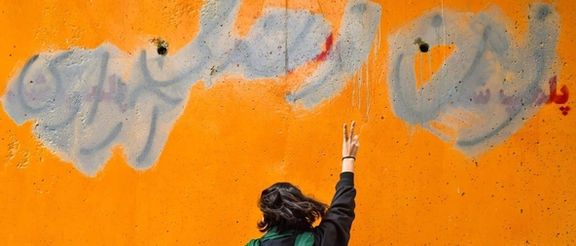
An Iranian woman standing in front of a wall with the main slogan of the ongoing protests – Women, Life, Liberty – seen despite the government’s attempts to cover it

Walls of cities have always been places where people express their opinions; from the ancient city of Pompeii to Zanjan, north-west of Iran’s capital Tehran.

Iranians are well acquainted with the concept of political graffiti and used it extensively during the days that led to the Islamic Revolution in 1979, but these days they are using the medium to overthrow the Islamic regime. 

According to documents released by hacktivist group Black Reward last week, the authorities are gravely concerned about the propagation of the phenomenon on the backdrop of nationwide protests and strikes that have rocked the foundations of the clerical regime during the past 80 days. 

The confidential briefing papers to the office of Supreme Leader Ali Khamenei and ranking members of the Revolutionary Guard, acquired by hacking into the database of IRGC-affiliated Fars News Agency, revealed that the authorities seem unable to deal with the enormous number of political slogans on walls and the persistence of protesters to renew them after they are painted over by the cities’ sanitation departments or volunteer members of Basij paramilitary force. In one of the documents, the city of Zanjan was mentioned as an example where almost all its walls are covered with slogans against the regime. Something especially worrying for the regime is the slogans directly targeting Supreme Leader Ali Khamenei, referring to him as a “bloodthirsty dictator” or a “despot” whose days are numbered. 

A graffiti in support of protests predicting the fall of the clerical regime   (undated)
100%
A graffiti in support of protests predicting the fall of the clerical regime

Iranians know the significance of slogans against Khamenei, whose zealot supporters are prepared to kill anyone for even criticizing him, let alone wishing death for him. But now, according to the leaked documents, even schoolchildren are using slurs to talk about him. Profanities against the Supreme Leader which were only chanted in the worst protest-riot situations in the past have become mainstream, while protesters are continuously coming up with new and ingeniously rhyming slogans with even stronger profanities. This degree of profanity is unprecedented in Iran where four-letter words are normally avoided in most social and even private contexts, particularly in the presence of women and children. 

The regime’s agents are busy everywhere painting over the slogans or doodling over them to conceal the zeitgeist of society, but people are greater in numbers and bolder in action. For every graffiti that is painted over, more or bigger graffiti appear the following day. The most frequently used slogan is the motto of the uprising: Women, life, liberty – words that describe people’s aspiration that no amount of paint can hide them. 

Walls have become a new frame for people to make their voices heard. As American linguist George Lakoff explains in his book Don't Think of an Elephant!, that when you frame the debate, you have already won. Its rough translation on street walls of Iran is that however the regime paints over its walls, it cannot change the fact that most Iranians do not want the regime. 

According to an article in Etemad newspaper, the calls on Tehran’s municipality's service requesting to remove writings from walls have recently increased 60-fold. The paper cited sociologist Hossein Imani Jajarmi as saying that such an increase “is directly tied to the recent unrest.” Describing political graffiti as a common tool to express economic and political woes as well as racial and gender discrimination, he said the spread of graffiti during the past few months can be a sign of ineffectiveness of the regime’s coercive and military measures. 

Over 1,500 instances of political graffiti were found at Pompeii, offering a glimpse into the workings of Roman politics at the local level. Similar to how graffiti shed light on how politics was in the city of Pompeii until it was buried under volcanic ash and pumice in 79 AD, the walls of Iranian cities testify as to how the people fought their way to “Women, life, liberty.”


The main motto of the protests in Iran: Women, Life, Liberty
100%
The main motto of the protests in Iran: Women, Life, Liberty
artwork-woman-life-freedom-liberty-Iran-protests
100%
artwork-woman-life-freedom-liberty-Iran-protests
100%
artwork-woman-life-freedom-liberty-Iran-protests
100%
artwork-woman-life-freedom-liberty-Iran-protests
100%
artwork-woman-life-freedom-liberty-Iran-protests
100%

Most Viewed

Ghalibaf defends Iran-US talks amid hardline backlash
1
INSIGHT

Ghalibaf defends Iran-US talks amid hardline backlash

2
ANALYSIS

From instability to influence: Pakistan’s pivotal role in US-Iran diplomacy

3
ANALYSIS

100 days on: why Iran’s January protests spread across social classes

4

War-hit homeowners feel abandoned as Iran’s reconstruction aid fades

5

Iran says no decision yet on talks as Pakistan prepares to host US team

Banner
Banner

Spotlight

  • The politics of pink: how Iran uses cuteness to rebrand violence
    ANALYSIS

    The politics of pink: how Iran uses cuteness to rebrand violence

  • Bread shortages, soaring prices strain households in Iran, residents say
    VOICES FROM IRAN

    Bread shortages, soaring prices strain households in Iran, residents say

  • War-hit homeowners feel abandoned as Iran’s reconstruction aid fades

    War-hit homeowners feel abandoned as Iran’s reconstruction aid fades

  • 100 days on: the anatomy of Iran’s January crackdown
    INSIGHT

    100 days on: the anatomy of Iran’s January crackdown

  • Ghalibaf defends Iran-US talks amid hardline backlash
    INSIGHT

    Ghalibaf defends Iran-US talks amid hardline backlash

  • From instability to influence: Pakistan’s pivotal role in US-Iran diplomacy
    ANALYSIS

    From instability to influence: Pakistan’s pivotal role in US-Iran diplomacy

•
•
•

More Stories

Iran Regime Plans To Pursue Mandatory Hijab By New Methods

Dec 6, 2022, 14:45 GMT+0
•
Iran International Newsroom

Conflicting statements abound by Iranian officials about measures to enforce hijab amid ongoing protests ignited by the death of Mahsa Amini by hijab patrols.

Following the recent propaganda stunt by the government that the so-called ‘morality police’ has been disbanded, foreign and Iranian media are full of interpretations of how the regime plans to both enforce the dress code regulations and at the same time appease protesters.

On Tuesday, hardliner lawmaker and member of parliament’s cultural committee Hossein Jalali said that hijab enforcement will never be abolished, ensuring that “veils will be back on women’s heads within two weeks.” His remark shows that a growing number of Iranian women who are appearing in public without hijab since protests began in mid-September.

Confirming that the regime is making some decisions about hijab rules, the lawmaker explained that the methods for enforcing hijab may change, adding that “it is possible that women who do not observe hijab would be informed via SMS, asking them to respect the law. After notifying them, we enter the warning stage... and in the third stage, the bank account of the person who unveiled may be blocked."

Jalali did not elaborate on how the government intends to identify the people who unveil in public to send them text messages. However, there were earlier reports that the Islamic Republic was about to start using cameras in the metro to track and identify women. Such measures had been announced as part of efforts by President Ebrahim Raisi’s hardliner administration to intensify pressures on women in society throughout the year which culminated in the beating to death of Mahsa Amini by hijab enforcers.

On Monday, Ali Khan-Mohammadi, the spokesperson of Iran’s Headquarters For Enjoining Right And Forbidding Evil, tasked with promoting the Islamic Republic’s interpretation of Islamic laws, echoed some reports about the end of the hijab police, saying that "the mission of the morality and social safety patrols (the official name for the hijab police) is over."

He added that new measures will be implemented "in a more modern framework, using the technologies that already exist for this purpose and with an atmosphere that is not one-sided."

Iran's police have so far declined to confirm Prosecutor General Mohammad-Jafar Montazeri’s claim on December 3 that the notorious "morality police" has been disbanded, as international media trumpeted the report. Shargh daily reported Monday that it had contacted the head of public relations of the Greater Tehran Law Enforcement, Colonel Ali Sabahi, to verify the claim but the official refused to make any comments.

The news about disbandment of ‘morality police’ was widely covered by Persian and foreign media as a measure by the Islamic Republic to calm the unrest. However, state-run media immediately cast doubt on any substantial change in hijab enforcement.

Montazeri’s suggestion made headlines in many major international media and even made US Secretary of State Antony Blinken cautiously comment on it in an interview with the CBS.

Many activists, such as US-based Masih Alinejad, have debunked Montazeri’s claim as a sheer publicity stunt or even misinformation spread by a dictatorial regime that is about to fall. However, there are some journalists such as Negar Mortazavi and Farnaz Fassihi of the New York Times who called the measures a victory for Iranians, eliciting condemnations by Iranian activists.

Human rights group Amnesty International has issued a statement regarding the issue, urging the international community not to be “deceived by dubious claims of disbanding morality police.”

“The Prosecutor General’s statement was deliberately vague and failed to mention the legal and policy infrastructure that keeps the practice of compulsory veiling against women and girls firmly in place,” said Heba Morayef, Amnesty International’s Regional Director for the Middle East and North Africa. “The international community and global media must not allow the Iranian authorities to pull the wool over their eyes. Compulsory veiling is entrenched in Iran’s Penal Code and other laws and regulations that enable security and administrative bodies to subject women to arbitrary arrest and detention and deny them access to public institutions including hospitals, schools, government offices and airports if they do not cover their hair.”

General Strike Staged Across Iran For Second Day

Dec 6, 2022, 13:14 GMT+0

Protests and strikes in Iran continue for the second day in response to calls from underground activists for a three-day nationwide action until December 7.

Numerous reports and videos from all over Iran show that retail businesses in many cities are in shutdown mode as shops and markets remain closed.

Despite threats by security forces, shop owners kept their doors shut in many provinces including Tehran, Azarbaijan, Ardebil, Kerman, Zanjan, Esfahan, Kordestan, Kermanshah and several others to play their role in toppling the clerical rulers.

Iran has been rocked by nationwide protests following the death of Mahsa Amini on September 16 in police custody, posing one of the toughest challenges to the Islamic regime since the 1979 revolution.

In addition to the markets and shops, industrial workers also joined the strikes; among them, some 500 contractors of Mahshahr Petrochemicals Company.

Regime officials downplayed the extent of strikes and threatened people to stop the protest movement.

The Judiciary on Tuesday said five more protesters have been sentenced to death seemingly to intimidate the demonstrators.

Tasnim News Agency, IRGC’s mouthpiece, reported that only few strikes were staged on Monday. Meanwhile, Judiciary Chief Gholam Hossein Mohseni Ejei Monday ordered to identify, arrest, and prosecute organizers of the strikes “quickly and decisively,” claiming that some protesters force business owners to close their shops.

IRGC Agency Official’s Arrest Confirms Authenticity Of Leaked Files

Dec 6, 2022, 12:47 GMT+0
•
Maryam Sinaiee

The arrest of the deputy head of IRGC’s Fars news agency for “forging briefing reports” confirms the authenticity of documents a hactivist group released last week.

The state-run television (IRIB) confirmed the arrest of Abbas Darvish-Tavangar, a high-profile hardliner journalist and politician in its Monday evening 20:30 program, hours after rumors of his arrest were reported by a reformist newspaper.

Mentioning Darvish-Tavangar only by initials, the program said as a journalist who often participated in meetings with top officials and had access to some news but had “forged” reports and created false briefing papers “without authorization”.

“Unauthorized” reports and newsletters refers to a series of document that a hactivist group, Black Reward, said on November 25 it had acquired by hacking into the database of Fars News Agency claiming it had obtained confidential newsletters sent by the news agency to the office of Supreme Leader Ali Khamenei and other top officials.

Black Reward made scandalous documents as well as recordings of some confidentially held meetings available to the public and media. Several of the documents and recordings contain material that are highly damaging to the image of the regime and its officials including Supreme Leader Khamenei.

Iran International published a report at the time on a sensitive document that showed pervasive concern among officials over ongoing anti-regime protests.

IRIB’s 20:30 is known for being largely produced by security organizations. The program often contains so-called “confessions” of those arrested on security charges and propaganda against opposition and dissident figures and spreads unsubstantiated accusations political groups and activists and even ordinary citizens.

Hossein Salami (R) among other IRGC commanders in a ceremony on April 14, 2022
100%
Hossein Salami (R) among other IRGC commanders in a ceremony on April 14, 2022

Some social media users have suggested that the regime has taken action against Tavangar, a quite controversial figure, to portray the documents as written by a rogue person and unused by officials.

Abdollah Ganji, the former editor of the IRGC-linked Javan newspaper who is now chief editor of Tehran municipality’s Hamshahri newspaper, in a tweet on December 2 claimed that as a former member of Fars News Agency’s policymaking council he had never seen any such briefing reports. “This sort of work is done by someone who, incidentally, worked at Fars,” he wrote while trying to attribute the leaked papers only to Tavangar.

Tavangar, apparently, also secretly recorded some meetings, including a meeting between a Revolutionary Guard general and a group of media managers or representatives from outfits affiliated with the IRGC. The audio file obtained by the hactivist group revealed IRGC and its Basij militia’s concern about security forces’ capability to quell the unrest widely spread across the country.

One of the documents quoted Khamenei as saying that he did not expect anti-government protests that have engulfed the country in the past three months to end soon. The newsletter claimed Khamenei had ordered security and intelligence bodies to issue a joint statement about the protests.

The leaked material show Khamenei plays a major role in decisions that lead to the violation of human rights and the secret operations of intelligence agencies against dissidents including the order to “disgrace” a top dissident Sunni leader, Mowlavi Abdolhamid Esmail-Zehi, in the restive Sistan-Baluchestan Province instead of arresting him. This could be interpreted as a character assassination order.

The IRIB program that confirmed Tavangar’s arrest was produced by Ameneh-Sadat Zabihpour who critics often refer to as “interrogator-journalist” for her alleged direct role in forcing detainees to make false self-incriminating “confessions” under duress to be used in the program. She and her colleague Ali Rezvani were recently designated by the US treasury for violation of human rights and other collaboration with security forces.

Iran Issues Death Sentence For Five Accused Of Killing Agent

Dec 6, 2022, 11:07 GMT+0

An Iranian official says five people have received death sentences for “killing a member of Basij plainclothes militia” during protests near Tehran in November.

Judiciary Spokesman Masoud Setayeshi said Tuesday that 16 people had been arrested in the case, among them three minors.

Members of Basij paramilitary are armed and deployed to crack down on protesters, often killing civilians in the streets.

He went on to say that five of them, whose names were not released, are accused of killing Rouhollah Ajamian in the city of Karaj west of Tehran on November 3.

Setayeshi stated that 11 others, including three children will face long prison terms on charges of “corruption on earth” and disrupting national security.

However, he said the verdicts are not final and the sentences can be appealed.

Iran’s Judiciary can frame people for crimes they did not commit, as multiple cases have demonstrated in the past. It can define what “disruption” means and sentence any protester to death for causing an ill-defined act of disruption.

One of the biggest challenges to Iran's clerical leaders since the 1979 Islamic Revolution, the twelve-week-old demonstrations have persisted despite a deadly crackdown and severe warnings from security forces.

Iran’s use of the death penalty for protesters has been sharply criticized by the United Nations while some countries and many right groups have also condemned the move.

According to Amnesty International at least 28 inmates currently face execution for participation in the demonstrations.

Concerns Grow As Iran Executes More Political Prisoners

Dec 6, 2022, 10:13 GMT+0

Following the re-broadcast of coerced confessions from four Kurdish political prisoners on Iran’s state television, concerns about their execution have mounted.

The political prisoners are identified as Pejman Fatehi, Vafa (Wafa) Azarbar, Mohsen Mazloum and Hajir (Hazhir) Faramarezi whose forced confessions were recently broadcast for the second time on state TV.

Regime’s judiciary also announced that four other people will be hanged on charges of “kidnapping as well as intelligence cooperation with the Mossad.”

Mizan news agency, affiliated with the judiciary, later announced the four people named Hossein Urdukhanzadeh, Shahin Imani Mahmoudabad, Milad Ashrafi Atbatan and Manouchehr Shahbandi Bajandi were executed Sunday morning.

Oslo-based Iran Human Rights Organization says with the execution of the four citizens, the number of executions this year exceeded 500.

In late October, the judiciary of the Islamic Republic announced the indictment of ten people, who were introduced as “Mossad-related agents,” saying that four of them were accused of “corruption on earth;” a charge that leads to death penalty.

The judiciary did not reveal their identity and the date of their arrest, but only announced they were detained in West Azarbaijan province.

Previously, the intelligence ministry had claimed to have arrested operatives of Komala organization “who were Mossad agents,” but the Komala Party of Iranian Kurdistan rejected the claim, confirming that several of its members have been apprehended in Iran.





