• العربية
  • فارسی
Brand
  • Iran Insight
  • Politics
  • Economy
  • Analysis
  • Special Report
  • Opinion
  • Podcast
  • Iran Insight
  • Politics
  • Economy
  • Analysis
  • Special Report
  • Opinion
  • Podcast
  • Theme
  • Language
    • العربية
    • فارسی
  • Iran Insight
  • Politics
  • Economy
  • Analysis
  • Special Report
  • Opinion
  • Podcast
All rights reserved for Volant Media UK Limited
volant media logo

Iranians Ready For 3-Day Action As Regime Pulls Publicity Stunt
Dec 5, 2022, 00:11 GMT+0
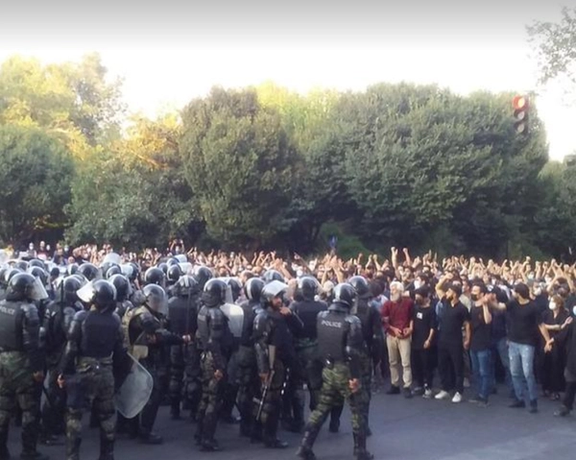
Riot police against protesters in Tehran

While Iranians were bracing themselves for three-day nationwide strikes and protests starting Monday, several cities on Sunday were scenes of antigovernment rallies. 

People in several neighborhoods of the capital Tehran, including Ekbatan and Naziabad, held gatherings on Sunday night chanting slogans against the regime and its ruler Ali Khamenei. “Khamenei listen to the sound of revolution,” rang out in the darkness of night.

According to videos posted on social media, protesters in the northwestern city of Qazvin torched the Intelligence Ministry's banner which called on citizens to call 113 and submit their "security reports" ahead of the three-day nationwide protests and strikes. 

Rallies and clashes were also reported in several other cities across the country. Clashes were particularly violent in Murmuri and Abdanan, two small towns in Ilam province, where security forces and Revolutionary Guards were attacking homes and arresting people door-to-door. 

Since the current wave of protests began following the death of Mahsa Amini in custody of hijab or the so-called “morality” police, the number of Iranian women who are appearing in public without hijab is growing. But on Sunday, in a move that many people described as a publicity stunt by the Islamic Republic, reports emerged that the hijab police force has been disbanded. The news was widely covered by Persian and foreign media as a measure by the Islamic Republic to calm the unrest. "The same authority which had established this police has shut it down," Iran's Prosecutor General Mohammad Jafar Montazeri was cited as saying by state news agencies. 

However, state-run media reported later in the day that the news was not correct. Al-Alam state television said foreign media were depicting Montazeri’s comments as "a retreat on the part of the Islamic Republic from its stance on hijab and religious morality as a result of the protests", but all that could be understood from his comments was that the morality police were not directly related to the judiciary.

Iranian lawmaker Nezamoddin Mousavi, however, signaled a less confrontational approach toward the protests following a closed meeting with several senior Iranian officials, including President Ebrahim Raisi. “Both the administration and parliament insist that paying attention to the people’s demand that is mainly economic is the best way for achieving stability and confronting the riots,” he said.

Numerous grassroot groups have called for protests on December 5, 6, and 7. December 7 is Student Day in Iran and marks the anniversary of the 1953 murder of several students at University of Tehran. It is a traditional day of nationwide rallies. To coincide with Student Day, protesters are calling for strikes by businesses and a rally towards Tehran's Azadi (Freedom) Square, according to posts shared on Twitter.

A statement released to the media by one such grassroot group claimed that people in at least 30 cities have announced that they will hold protests on the set dates.

Similar calls for strike action and mass mobilization have in past weeks led to an escalation of the revolt which has convulsed the country -- the biggest anti-government protests since Iran's 1979 Islamic Revolution.

The activist HRANA news agency said 470 protesters had been killed as of Saturday, including 64 minors. It said 18,210 demonstrators were arrested and 61 members of the security forces were killed.


Most Viewed

100 days after carnage: Iran economy reels from war, inflation, unemployment
1
INSIGHT

100 days after carnage: Iran economy reels from war, inflation, unemployment

2
INSIGHT

Ghalibaf defends Iran-US talks amid hardline backlash

3
EXCLUSIVE

Iranian assaulted in London amid concern over threats to regime critics

4

IRGC fires at Indian vessel in Hormuz

5
INSIGHT

A nation in limbo: 100 days after the massacre, has the world moved on?

Banner
Banner

Spotlight

  • War-hit homeowners feel abandoned as Iran’s reconstruction aid fades

    War-hit homeowners feel abandoned as Iran’s reconstruction aid fades

  • 100 days on: the anatomy of Iran’s January crackdown
    INSIGHT

    100 days on: the anatomy of Iran’s January crackdown

  • Ghalibaf defends Iran-US talks amid hardline backlash
    INSIGHT

    Ghalibaf defends Iran-US talks amid hardline backlash

  • 100 days on: why Iran’s January protests spread across social classes
    ANALYSIS

    100 days on: why Iran’s January protests spread across social classes

  • From instability to influence: Pakistan’s pivotal role in US-Iran diplomacy
    ANALYSIS

    From instability to influence: Pakistan’s pivotal role in US-Iran diplomacy

  • A nation in limbo: 100 days after the massacre, has the world moved on?
    INSIGHT

    A nation in limbo: 100 days after the massacre, has the world moved on?

•
•
•

More Stories

Politician Urges Iran's Top Security Man To Change Constitution

Dec 4, 2022, 22:11 GMT+0
•
Iran International Newsroom

A reformist female politician says she urged Iran's top security official, Ali Shamkhani in a meeting on Sunday to pursue reforms and change the constitution.

Azar Mansouri, the secretary general of Unity of the Nation Party, a coalition of so-called reformists, was quoted by a local media outlet that she and others were invited by national security council secretary Shamkhani to a meeting Sunday. She did not name the other participants, but it is safe to assume many were also reformist politicians.

Mansouri said that she urged Shamkhani to start short-, medium- and long-term reforms in governance,” first by releasing all protesters who have been detained since September, followed by constitutional changes through a “founding assembly”, as a path to emerge from the current political crisis.

The female politician also demanded a policy that would end sanctions against Iran and would help end the current economic crisis, that she said could bring “40 million people” to the streets.

The Islamic Republic leaders should first acknowledge their mistakes and “bridge gaps with the people” by listening to their grievances, Mansouri told Shamkhani.

Hardliners in charge of Iran’s ruling institutions have said time and again that there could be no constitutional changes and no “retreat from principles.” Raising the specter of constitutional change and forming a potentially unpredictable assembly will certainly be viewed by regime hardliners as a challenge to the principle of having a Supreme Leader and the person of Ali Khamenei.

Secretary of Iran's Supreme National Security Council, Ali Shamkhani
100%
Secretary of Iran's Supreme National Security Council, Ali Shamkhani

Iran’s reformists are blamed by regime opponents for long pursuing the idea that the Islamic Republic can be reformed and thus giving false hope to the people. Some reformists in the past two months have acknowledged that their thinking has proven wrong, as the extent of deadly violence and untold cruelties against protesters has proven the regime incapable of reforming itself.

In fact, young protesters see little difference between regime hardliners and reformists who want to make incremental changes but keep the Islamic Republic. All slogans and announcements by protesters demand an end to clerical rule.

But according to her own account, Mansouri seems to have also said things that would be annoying to the regime. First, she upheld the memory of all those who were killed during protests since September. She also told Shamkhani that if the regime wants to hold talks with politicians as an attempt at window dressing and as a tool, the whole idea is bound to fail. Discussions to solve the political crisis should be based on “strategic rationality.”

But she was also cautious in her approach by not mentioning the absolute power Khamenei exercises or raise the issue of holding those who are responsible for the killing of hundreds of civilians responsible.

She also did not demand an immediate end to mandatory hijab, and just reminded Shamkhani that having a ‘morality police’ is a bad idea. The issue of systemic discrimination against women, she said, is an issue to be addressed in the long term.

However, she told the top security chief that Iranian women are asking “What has the Islamic society accomplished that would make us proud to use its hijab?”

Despite these remarks, many would still see reformists meeting with security officials as a non-starter, because they believe that now the regime finds itself in deep trouble and wants to save the situation. If protests end and the pressure is lifted, all talk of reform and gestures of pluralism will also end and the clerical-military rulers will go back to what they know best, monopolizing power by relying on force.

Iran Accuses ‘Enemies’ Of Funding Protesters To Harm Security

Dec 4, 2022, 16:48 GMT+0

An Iranian official claims “enemies” have offered a lot of money to protesters to attack security agents or chant anti-regime slogans.

Deputy Interior Minister Majid Mirahmadi alleged “some girls were assigned to suggest to young protesters to sleep with them for a few nights in return for anti-security acts,” without providing any documents for his claims.

In an interview with state TV, he claimed that an amount of around $1500 was offered to attack a security agent and about 100 dollars to chant slogans.

Using the term “enemies” is a favorite of Supreme Leader Ali Khamenei to refer to the United States, Israel, US allies in the region and in Europe.

Mirahmadi further alleged that some protesters have received asylum offers in other countries for killing a law enforcement agent.

Following Supreme Leader Ali Khamenei’s lead, Iranian officials claim that the ongoing antigovernment protests across Iran – ignited by death in custody of 22-year-old Mahsa Amini -- are instigated by foreign enemies.

The Washington Post on Thursday quoted some Western officials as saying that the Islamic Republic’s intelligence and security services depend largely on proxies to carry out their plans to kill and kidnap its opponents abroad, “offering hundreds of thousands of dollars to jewel thieves, drug dealers and other criminals in murder-for-hire schemes.”

The Revolutionary Guard Intelligence Organization and the IRGC Quds Force have been mentioned as two main actors in designing these plots.

Leaked Audio: 80 Iran Protesters Face Execution On Trumped-Up Charges

Dec 4, 2022, 16:32 GMT+0
•
Iran International Newsroom

A leaked audio file from a meeting of Iranian regime insiders indicates that at least 80 people detained during nationwide protests are in danger of execution.

The recording is from a recent meeting of the Coalition Council of Islamic Revolution Forces, a conservative coalition of parties that endorsed a joint electoral list for the 2020 Iranian parliament and city council election. 

The parliament, elected in a non-competitive election in February 2020, is packed with hardliners and Revolutionary Guard officers, most of whom, including its speaker Mohammad-Bagher Ghalibaf, are members of this coalition. 

During the session, Gholam-Ali Haddad-Adel, the head of the coalition and a hardliner politician very close to Supreme Leader Ali Khamenei, asks the secretary, Reza Davari, to brief members about recent developments in the country. In his report, Davari said 80 people have been charged with "Moharebeh" and "corruption on earth.” Mohareb (muharib), which means warrior in Arabic is a term in Iran’s Islamic law that means an "enemy of God” or “war against God,” which carries the death penalty. “Corruption on earth” is also another term that carries the death penalty. 

He said that Khamenei preferred the detained protesters be executed based on the principle of "qisas" -- or punishment in kind, which in the Islamic criminal code can be applicable in cases of bodily harm – for killing of Basij paramilitary forces. The regime has on many occasions used the Quranic principle -- similar to “an eye for an eye” or the law of talion – to execute protesters after charging them with killing security agents.

Secretary of the Coalition Council of Islamic Revolution Forces Reza Davari (file photo)
100%
Secretary of the Coalition Council of Islamic Revolution Forces Reza Davari

Davari added that if the authorities wanted to execute the protesters based on qisas, they could only issue death sentences for about 10 people, therefore they decided to charge the protesters with “moharebeh” and “corruption on earth” that ensure the execution of more prisoners. He noted that the largest number of such indictments were issued in the provinces of Tehran, Alborz, Fars, Khorasan Razavi and Esfahan.

Any act of defiance can be arbitrarily interpreted as ‘war against god’ in a judicial system that ignores due process and is controlled by the authoritarian ruler Khamenei.

According to recent reports, at least 10 underage protesters are also facing death sentences for the “moharebeh” and “corruption on earth”. During the popular uprising in Iran, over 18,000 citizens have been arrested and it is not clear how many of them were accused of “corruption on earth” and “war against God”. 

Davari went on to say that for some of the protesters arrested in Kurdish-majority cities “terrorism” charges were issued so that they could be sentenced to death. 

In November, a group of 227 parliament members called on the Judiciary to issue death sentences for people arrested during the ongoing antigovernment protests.

Among other things that were discussed during the session, records of which Iran International obtained, was the brutal crackdown on protesters in Zahedan, the provincial capital of Sistan-Baluchestan, known as the Bloody Friday. It took place September 30, when security forces killed close to 100 people, including women and children. The Islamic Republic never acknowledged the killings of ordinary people and always claimed that security forces only opened fire at those who wanted to attack a police station in the city. However, in the leaked audio, Davari admitted that one of the officers who was stationed on the roof of the police building “made a grave mistake and shot at people” who were not even near the police station, killing some men, women, and children who were not even protesting.

Repeated leaks by hackers and insiders in recent days has unmasked the inner thinking and unpleasant secrets of the Islamic Republic, putting the regime in an uncomfortable situation. 

Over 100 Military Personnel Arrested During Iran Protests

Dec 4, 2022, 11:21 GMT+0

Leaked documents from Iran’s Fars news agency say the at least 115 military personnel have been arrested on charges of participating in the ongoing protest movement.

The files hacked by the Black Reward group reveal that as many as one percent of all those arrested during the protests after the death of Mahsa Amini were military personnel.

Earlier, Parliament Speaker Mohammad Bagher Ghalibaf, President Ebrahim Raisi and Judiciary Chief Gholamhossein Mohseni Ejei had announced at a joint meeting that such “baseless” reports are not “valid”.

However, as reports of the defections among armed forces continued, Hossein Rahimi, the police chief of Tehran, called for more financial support for security agents.

Reports say the regime forces have also arrested a former IRGC commander in an attack on his home, confiscating his personal belongings.

General Mohammad Bagher Bakhtiar had earlier published an audio file, accusing the Islamic Republic of hiding the reason behind Mahsa Amini’s death, who was killed in police custody in mid-September, stating that reliable sources have found out Mahsa Amini succumbed to the “injuries to her skull.”

The government never took responsibility for her death, claiming that she passed away due to a pre-existing illness.

He also stated the authorities of the Islamic Republic are “ambitious” saying if “common sense” had been exercised by accepting responsibility and apologizing for the incident, perhaps there would have been "fewer consequences.

Regarding the slogans by protesters against Supreme Leader Ali Khamenei, Bakhtiar emphasized that “the people are chanting slogans directly against the Leader. People do not want you. Understand this!”

Iran Official Claims End Of ‘Morality Police’, To Appease Protesters

Dec 4, 2022, 10:13 GMT+0
•
Iran International Newsroom

Iran’s Attorney General says the Islamic Republic has disbanded the “morality police” adding that it had nothing to do with the judiciary since its creation.

Mohammad Jafar Montazeri made the comments in a meeting Saturday, stressing however, that the judiciary continues to monitor behavioral conduct among the people, a hint that hijab rules are not scrapped and only special patrols in streets are disbanded.

It is not clear if Montazeri's remark is an official decision endorsed by other top officials or a publicity stunt to show flexibility on the part of the authorities. So far, there is no word from law enforcement that controls the hijab police, or the presidential administration.

Earlier in the week Montazeri had mentioned that the Parliament and the Supreme Council of the Cultural Revolution would announce their opinion on the issue of forced hijab within two weeks, signaling that the mandatory hijab rule might be modified or revoked.

The recent protest movement in Iran was triggered by the death of Mahsa Amini, a 22-year-old woman, when she was arrested by the ‘morality police’ for ‘improper attire.’ During the nationwide protests, women removed the mandatory hijab and set their headscarves on fire in the streets as a sign of protest.

Western governments, including the United Kingdom, the United States, and Canada, added the hijab law enforcement unit to their list of sanctioned entities.

Many women in Iran are now appearing in public without the mandatory veil and regular police is not interfering in a sign that authorities are either unwilling to risk further confrontation with the public or find it impossible to deal with so many women undermining the rule at the same time. Police forces have also become over-stretched during protests and many have resigned or have applied for early retirement.

The first woman who defiantly removed her headscarf in a main Tehran street in December 2017
100%
The first woman who defiantly removed her headscarf in a main Tehran street in December 2017

The ‘morality police’ was officially launched in the summer of 2006 during the presidency of then-president Mahmoud Ahmadinejad, a conservative. Ahmadreza Radan, the former police chief of Tehran during this time described the mission of ‘morality police’ as “fighting against improper hijab.”

The apparent end of the controversial and violent institution has been announced by a top Iranian judiciary official in a situation that people on social media say the decision would not persuade them to give up protests since they have fundamental demands, including an end to the Islamic Republic.

They say the mandatory hijab itself is an apartheid policy against women which is still in force. It also symbolizes broader demands for fundamental political and economic reforms like a free and independent judiciary, freedom of speech, free elections, etc.

The Islamic Republic is far from accepting such demands because that would mean its demise if officials became accountable through democratic institutions.

While people on social media generally call for the ouster of the regime, it seems the end of morality police is an insufficient concession to protesters.

Iranian women’s fight against state-imposed hijab started as early as in 1979 shortly after the Islamic Republic was established. Ayatollah Ruhollah Khomeini, the first leader of the clerical regime announced immediately announced that women would be allowed in their workplaces only if they observe compulsory hijab.

Soon after his comments, thousands of Iranian women poured into the streets to protest but they were brutally suppressed by pro-regime forces that would later form the Revolutionary Guard, Basij paramilitary and the ‘morality police.’

This led to years of socioeconomic marginalization of women who rejected the imposition of compulsory hijab and a host of other discriminatory statues and practices. Many well-educated Iranian women, including doctors, nurses, and teachers, lost their jobs and a large number emigrated.





