• العربية
  • فارسی
Brand
  • Iran Insight
  • Politics
  • Economy
  • Analysis
  • Special Report
  • Opinion
  • Podcast
  • Iran Insight
  • Politics
  • Economy
  • Analysis
  • Special Report
  • Opinion
  • Podcast
  • Theme
  • Language
    • العربية
    • فارسی
  • Iran Insight
  • Politics
  • Economy
  • Analysis
  • Special Report
  • Opinion
  • Podcast
All rights reserved for Volant Media UK Limited
volant media logo

Iran Threatens US, Israel, Saying ‘They Will Be Buried’
Iran International Newsroom
Nov 27, 2022, 19:09 GMT+0Updated: 17:59 GMT+1
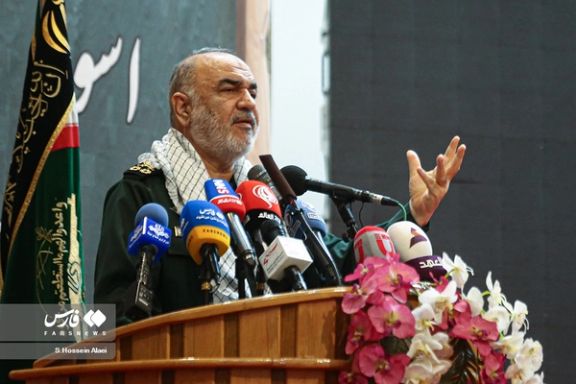
Revolutionary Guard Commander Hossein Salami

Iran has once again threatened the United States, Israel and their allies saying that “they will be defeated in the World War they have waged against Iran.”

Revolutionary Guard Commander Hossein Salami said Sunday that “We are determined to stand against them. We will turn this new battle scene, this huge sedition scene, and this world war into a burial ground for America, Israel and their allies,” singling out Saudi Arabia, the United Kingdom, France and Germany.

During his visit to Zahedan in the southeast after weeks of antigovernment protests in the mostly Sunni region, Salami once again upped the ante against Israel saying the “Zionist” regime would collapse.

“We will bury plots to target Iran, just as we've buried Israeli and American plots in the past,” he added.

Salami’s visit to Sistan and Baluchestan province comes at a time the regime has been in hot water there within the past weeks after killing least 100 people,including a nine-year-old girl during anti-government protests.

The hardliner commander labeled protesters as “non-believers”, saying, “Today on one side is the Front of Kufr [disbelief] with all its might and on the other is the Front of Islam, one cannot stand in the middle, the lines are clear, one side is led by America and Israel and the other side is led by the Supreme Leader of the revolution [Ali Khamenei] and believers and revolutionaries.”

His remarks come a day after Khamenei warned demonstrators to bring the movement to an end and showed a green light for more crackdown.

However, some believe Salami’s comments on “unity” in a region with Sunni majority is the last attempt by the government to pacify the situation there while it is already under pressure with the situation in the northwest Kordestan province.

In early November the leader of Iran’s largely Sunni Baluch population in the southeastern province of Sistan and Baluchestan strongly criticized the authorities for their brutality in the province, holding Supreme Leader Khamenei responsible for the violence against Sunnis and other protesters.

“A government with which people are dissatisfied is no good and has to be toppled,” Molavi Abdolhamid stated, demanding the release of all those arrested in the protests across the country.

Top Sunni cleric Molavi Abdolhamid (file photo)
100%
Top Sunni cleric Molavi Abdolhamid

He also blasted more than 200 members of Iran’s parliament who demanded the death sentence for some protesters. “In Khamenei’s rule there is no freedom. Which political party or group is free? We have neither freedom of speech, nor freedom of media,” he added in unprecedented criticism against the 83-year-old ruler.

The influential Friday Prayer Imam of Zahedan also called for an internationally monitored referendum, saying by killing and crackdown the government cannot push back a nation.

Worried by the developments in the province, Khamenei sent his representatives to hold talks with local Sunni leaders.

State media said Mohammad-Javad Haj-Ali Akbari was carrying “Supreme Leader’s greetings to the people of Sistan and Baluchestan” and to let them know that the recent events in the province have “saddened and upset him”.

However, what some media in Tehran reported about Haj-Ali Akbari’s statements, showed that his remarks had double meaning. While he spoke about resolving misunderstandings, he also said he delivered “serious messages to some” to be careful about their behavior.

With Abdolhamid clearly expressing the demands of the Baluch people and condemning the brutal killing of citizens in the visit with Khamenei’s representative, it seems Khamenei this time has sent his hardliner IRGC Commander to show an iron fist to the people, signaling if they continue protests, more clampdowns are on the way.


Most Viewed

100 days after carnage: Iran economy reels from war, inflation, unemployment
1
INSIGHT

100 days after carnage: Iran economy reels from war, inflation, unemployment

2
INSIGHT

Ghalibaf defends Iran-US talks amid hardline backlash

3
INSIGHT

A nation in limbo: 100 days after the massacre, has the world moved on?

4
ANALYSIS

From instability to influence: Pakistan’s pivotal role in US-Iran diplomacy

5
ANALYSIS

100 days on: why Iran’s January protests spread across social classes

Banner
Banner

Spotlight

  • War-hit homeowners feel abandoned as Iran’s reconstruction aid fades

    War-hit homeowners feel abandoned as Iran’s reconstruction aid fades

  • 100 days on: the anatomy of Iran’s January crackdown
    INSIGHT

    100 days on: the anatomy of Iran’s January crackdown

  • Ghalibaf defends Iran-US talks amid hardline backlash
    INSIGHT

    Ghalibaf defends Iran-US talks amid hardline backlash

  • 100 days on: why Iran’s January protests spread across social classes
    ANALYSIS

    100 days on: why Iran’s January protests spread across social classes

  • From instability to influence: Pakistan’s pivotal role in US-Iran diplomacy
    ANALYSIS

    From instability to influence: Pakistan’s pivotal role in US-Iran diplomacy

  • A nation in limbo: 100 days after the massacre, has the world moved on?
    INSIGHT

    A nation in limbo: 100 days after the massacre, has the world moved on?

•
•
•

More Stories

US Slams Rocket Attack On Its Base In Northeastern Syria

Nov 27, 2022, 11:47 GMT+0

The Pentagon late Friday denounced a rocket attack on a US base in northeastern Syria which had no casualties or damage to the base.

US Central Command, CENTCOM, said in a press release that two rockets were fired at the base in al-Shaddadi, Syria, while a third unfired rocket was found at the rockets’ origin site.

“Attacks of this kind place coalition forces and the civilian populace at risk and undermine the hard-earned stability and security of Syria and the region,” spokesman Col. Joe Buccino said in a statement.

The attacks come as the Turkish military has launched a wave of air raids on Kurdish forces in both Syria and Iraq in retaliation for a bombing in Istanbul on November 13 which left six people killed and 80 injured.

Turkey blames the banned Kurdistan Workers Party (PKK) and the YPG Kurdish forces for the attack, but they deny any involvement.

However, there is a suspicion the rockets were launched by Iranian-backed Shia militias who had previously hit the same area east of the Euphrates River.

Earlier, the US Department of Defense expressed concern about attacks in northern Syria, Iraq and Turkey, saying that it could threaten progress made to defeat the ISIS.

“The recent air strikes in Syria have directly threatened the safety of US personnel who are working in Syria with local partners to defeat the Islamic State,” stressed Pentagon spokesman General Patrick Ryder.

EU-Made Bullets Fired At Iranian Protesters: France 24

Nov 27, 2022, 09:31 GMT+0

Research has revealed that security forces in Iran widely used shotgun cartridges manufactured by a European company against unarmed protesters, killing and injuring dozens.

An investigation published by the FRANCE 24 Observers showed that the cartridges made by French-Italian manufacturer Cheddite have been used to crack down on demonstrators in Iran.

To conduct the investigation, the team called on Iranians to send photos of ammunition recovered from protests after the death of Mahsa Amini on September 16.

Over 100 photographs and videos showing tear gas canisters, rifle bullets, paintball projectiles and cartridges from shotguns which have been widely used by Iran’s security forces have been analyzed by the team.

While most of the shotgun shells photographed were made in Iran, 13 shells recovered from eight different Iranian cities bore Cheddite logos, says France 24.

Cheddite has factories in Italy and France, with headquarters in Livorno and Bourg-lès-Valence. The company claims to be the world’s largest maker of empty shotgun cartridges and firing caps, producing more than a billion empty cartridges every year.

While the Islamic Republic is under an arms embargo, the use of ammunition made by two Western countries by its security forces has raised the question of how these bullets reached Iran. Such transactions are considered a clear violation of EU laws.

EU Council Regulation passed on April 12, 2011, prohibits the “export, directly or indirectly, [of] equipment which might be used for internal repression” in Iran, including “firearms, ammunition and related accessories.”

Azeri President Launches Broadside Against Iran

Nov 25, 2022, 20:05 GMT+0
•
Iran International Newsroom

Iran is dangerously implicated in regional tensions centered on Azerbaijan-Armenia that are exacerbated by fall-out from Russia’s war in Ukraine.

Citing Interfax Friday, Iran’s semi-official news agency ISNA reported that Azerbaijan’s President Iham Aliyev cancelled a December 7 meeting in Brussels with Armenian Prime Minister Nikol Pashinyan aimed at easing tensions after September-October clashes killed around 200 Armenian and 80 Azerbaijani soldiers.

Earlier Friday, at a Baku conference ‘Along the Middle Corridor,’ Aliyev launched a broadside against Iran, his toughest so far since relations soured over Iran’s role in the 2020 Azerbaijan-Armenia war, when adjacent Iranian military exercises followed the Azerbaijanis capturing areas around the disputed Nagorno-Karabagh enclave and along the Iran border.

Stepping Friday on ground he previously avoided, Aliyev said his government would do “our best to preserve our secular lifestyle…as well as Azerbaijanis living in Iran,” whom he called “part of our people.” The president said that in Azerbaijan 340 schools taught in Russian and ten in Georgian, while none in Iran taught in Azeri. Around a quarter of Iran’s population is Azari, with analysts and activists disagreeing over the closeness of their cultural-linguistic links to their neighbors to the north.

“We worked with three presidents of Iran, [Mohammad] Khatami, [Mahmoud] Ahmadinejad, and [Hassan] Rouhani,” Aliyev said. “For all these years there was no situation similar to the current one. Never has Iran had two military exercises near our borders within a few months. There have never been such hateful and threatening statements against Azerbaijan.”

‘Hateful statements’ referred to warnings from President Ebrahim Raisi and other leaders against any border changes or threats to Iran’s transit route to Armenia, which is vulnerable since 2020 changes. Iran carried out more military drills along the border October, when Foreign Minister Hossein Amir-Abdollahian also visited Yerevan.

Vladimir Putin meeting with the Azerbaijani and Armenian president on October 31, 2022
100%
Vladimir Putin meeting with the Azerbaijani and Armenian president on October 31, 2022

But Tehran-Baku tensions have simmered since the 2020 war, when Iran moderated its past support for mainly Christian Armenia due partly to domestic pressures from both ethnic Azeri and Shia clerics supporting fellow Muslims.

Brussels mediation meeting cancelled?

Armenia’s frustration at what they feel is a lack of support from Russia – which has been engrossed in the Ukraine war – lay behind the news early Friday that Pashinyan had involved French President Emmanuel Macron as a possible mediator to build on the current ceasefire.

This prompted Aliyev’s announcement refusing a French role – and Kremlin spokesperson Dmitry Peskov to immediately offer Moscow’s support as a broker.

Analysts generally see the Azerbaijan-Armenia balance tilting in Baku’s favor since 2020. This has come with Aliyev making statements seen as provocative in Tehran. On November 11, at a summit of Turkic states of central Asia, the president said the “geographical borders of the Turkic world are wider than the Turkic states.” In Baku, state media has recently referred to north-western Iran, where most Iranian Azari live, as ‘south Azerbaijan.’

‘Persian fascist mullah regime’

Mahmudali Chehregani, Washington-based leader of the South Azerbaijan National Awakening Movement, appeared on Azerbaijani state television November 4 to promise the end of the “Persian fascist mullah regime.” Once considered persona not grata in Baku, Chehregani has lately criticized relations between Tehran and Yerevan, the “enemy of Azerbaijanis,” and said that an Armenian consulate due in Tabriz would be “razed to the ground.”

Iran’s options are limited. In mid-November, it summoned ambassador Ali Alizadeh over “unfriendly statements” by leading Baku officials, referring for example to Aliyev November 8 warning Iran, indirectly, against further military exercises.

While Iran’s main concern is fragile land corridor to Armenia – and fears a move to connect Turkey with mainland Azerbaijan and on to central Asia – it may also see Aliyev as exploiting protests in Iran. Such edginess might explain an Iranian suggestion of Azerbaijani involvement in the October 26 attack in Shiraz claimed by the Islamic State group (Isis-Daesh).

Raisi is unlikely, as yet, to take the advice from some commentators, including Shargh newspaper November 12, to downgrade relations with Baku or introduce trade sanctions. But Iran’s recent targeting of Iranian Kurdish groups in northern Iraq may be in part a message to Baku.

Ceyhun Sadlinski at a conference organized by Azerbaijan’s Security Council, where he is first deputy chairman, said Thursday Iran’s “special services are actively carrying out intelligence and subversive activities” against Baku, the official Azerbaijani Press Agency reported. “Drastic measures” were being taken in response, Sadlinski said.

We Must Kill Iranians Who Help Russia’s Invasion – Ukraine Top Official

Nov 25, 2022, 11:33 GMT+0
•
Iran International Newsroom

Ukraine’s top security official has confirmed that several Iranian military advisers have been killed during a Ukrainian military strike in Crimea last month, warning that his country will target more. 

During an interview with The Guardian from Kyiv published on Thursday, the secretary of Ukraine’s national security and defense council, Oleksiy Danilov, said that the military personnel who were killed were in Crimea to help Russia pilot the Shahed-136 kamikaze drones supplied by the Islamic Republic. 

He did not disclose the exact number of casualties but added that any other Iranians on occupied Ukrainian territory supporting the Russian invasion would also be targeted. In October, Israeli media said that 10 were killed in Ukrainian strikes in occupied Crimea.

“You shouldn’t be where you shouldn’t be. They were on our territory. We didn’t invite them here, and if they collaborate with terrorists and participate in the destruction of our nation, we must kill them,” Danilov said. 

100%

Russia has been using Iranian drones and missiles in its air attacks against the Ukrainians. In October, it targeted Ukraine’s civilian energy infrastructure, plunging it into blackouts as the winter cold has begun to fall across the country. Amid international outcry over the Islamic Republic’s supply of drones and ballistic missiles for the Russian invasion, Ukrainian President Volodymyr Zelenskiy told a meeting of UN security council late November 23, that the attacks are “an obvious crime against humanity” adding that Kyiv would put forward a resolution condemning “any forms of energy terror”.

On the same day, Ukranian intelligence agencies reported that the Islamic Republic is set to deliver more than 200 Shahed-136 and Arash-2 kamikaze drones, and Mohajer-6 reconnaissance and combat UAVs later in November. 

The United States and its European allies have strongly objected to the Iranian move, which is one of the factors in keeping nuclear talks with Tehran dormant.

The United Kingdom defense ministry also said Wednesday that Russia had used hundreds of Iranian-made drones in Ukraine but none since around November 17, suggesting that supplies have run out and Moscow is looking for more Iranian drones. Although the use of Iranian-made drones had met with “limited success”, with most of those launched neutralized, the British ministry said Moscow would “probably seek resupply” as “Russia can probably procure UAVs from overseas more rapidly than it can manufacture new cruise missiles domestically.”

Ukrainian policemen use their assault rifles to fire at drones over Kyiv. October 17, 2022
100%
Ukrainian policemen use their assault rifles to fire at drones over Kyiv. October 17, 2022

“It is known that the supply of these UAVs will be carried out over the Caspian Sea to the port of Astrakhan,” the Ukrainian intelligence agency said, adding that “The drones will arrive disassembled. Later, on the territory of Russia, they will be assembled, repainted and applied with Russian markings,” the report says. Russia applies its own markings to the Shahed-131 and the Shahed-136, dubbing them the Geran-1 and Geran-2 respectively – apparently to obscure their Iranian origins.

According to a report by CNN, Tehran is preparing to send approximately 1,000 additional weapons, including surface-to-surface short range ballistic missiles and more attack drones to Russia to use in its war against Ukraine.

Iranian foreign minister Hossein Amir-Abdollahian said earlier in the week that Tehran had “sold very few Iranian drones in the framework of defense cooperation with Russia 11 months before the start of the Ukraine war.” Amir-Abdollahian said Iran and Ukrainian military officials had met in a third country to discuss the issue, and that “we are continuing our investigations.”


Iran Sending Armored Units To Iraqi Border Against Kurds

Nov 25, 2022, 09:25 GMT+0

Iran is reinforcing its military on the border with Iraq adjacent to the Kurdistan autonomous region with armored unites, the commander of IRGC ground forces announced Friday.

Mohammad Pakpour emphasized that reinforcing border troops is meant to prevent “infiltration by teams of Kurdish parties based in Iraqi Kurdistan.”

Iran has deployed military firepower against Iranian Kurdish civilian protesters in western Iran, killing at least 12 people since November 16. It has also repeatedly shelled bases of Iranian Kurdishinsurgent groups in Iraq, portraying the popular protests as a separatist movement.

Iran International reported earlier that Iran was sending troops to its Kurdish-majority regions. It is not clear if these reinforcements will be used against civilian protesters or are solely meant to intimidate Kurdish groups in Iraq, that have so far stayed out of the popular protests in Iran and there have been no signs of separatist agitation.

The Iraqi government that has protested Iranian missile attacks on its soil, decided Thursday to work on a plan to boost its own border troops. A member of the Iraqi parliament, who preferred to remain anonymous, told Iran International that Kurdish lawmakers have been putting pressure on the central government to act.

Pakpour said that armor and “special units of ground forces” is being dispatched to the Iraqi border.

Mohammad Esmail Kowsari, a former IRGC commander and currently a member of the Islamic Republic parliament, also confirmed that military units were being dispatched to deal with Kurdish insurgents in Iraq.





