• العربية
  • فارسی
Brand
  • Iran Insight
  • Politics
  • Economy
  • Analysis
  • Special Report
  • Opinion
  • Podcast
  • Iran Insight
  • Politics
  • Economy
  • Analysis
  • Special Report
  • Opinion
  • Podcast
  • Theme
  • Language
    • العربية
    • فارسی
  • Iran Insight
  • Politics
  • Economy
  • Analysis
  • Special Report
  • Opinion
  • Podcast
All rights reserved for Volant Media UK Limited
volant media logo

Upheaval Worsens Media Landscape In Iran
Iran International Newsroom
Nov 21, 2022, 08:50 GMT+0Updated: 17:34 GMT+1
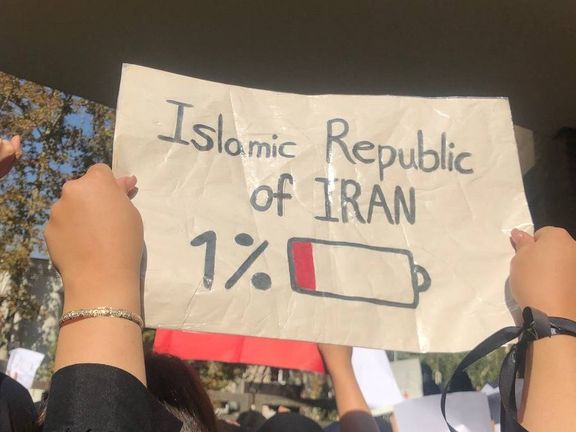
A university student in Tehran in November holding up a sign showing government power in decline

Media specialist Saeed Arkanzadeh Yazdi in Tehran has noted that Government-controlled media has become much more reactionary amid the current upheaval in Iran.

He argued in a report in the reformist Etemad newspaper November 17 that before the uprising started in mid-September, the state television, as well as all news agencies were already exclusively trumpeting the government's unilateral ideas. He added that other than some relatively independent newspapers and websites other news outlets also belong to the government.

Journalists were facing many restrictions including an extremely limited access to Internet content and slow connections. Nearly all social media platforms were filtered and made inaccessible, Arkanzadeh noted, adding that the scene changed dramatically after the start of protests in September.

Several journalists were arrested to intimidate others. Access to the Internet was however possible through using virtual private networks (VPN). The arrests of journalists and incriminating accusations against them nearly put an end to journalism in Iran, although the state television and government-owned media outlets continued their unilateral reporting with renewed vigor.

As professional domestic media were rendered ineffective, people were inevitably pushed toward foreign-based Persian media and using VPNs to access social media and news and information from the independent sources.

The headquarters of Iran's state TV in Tehran
100%
The headquarters of Iran's state TV in Tehran

In the meantime, the elderly who were not able to use the VPNs, were deprived of news and information. Arkanzadeh wrote that two months after the uprising, statements made by the country's officials and even military commanders such as the IRGC Commander in Esfahan blamed foreign and social media for the ongoing unrest. This could lead to imposing even more restrictions on the media.

In the meantime, despite a show of openness on the state TV at the beginning of the protest movement, allowing debates between hitherto neglected proreform figures, the television is back to its old routine of debates between very hardliner and ultra-hardliner figures.

This, says Arkanzadeh, is likely to further push viewers to social media and foreign-based Persian TV stations where there is no censorship and what they broadcast is in sharp contrast to what is aired on national television.

According to sociologist Taqi Azad Armaki, "the state television in Iran is currently not even under the control of the government. Instead of being impartial, it supports the government's side of the argument about the current upheaval. So instead of calming down the situation, it fans the fire of the ongoing bipolar situation."

Amid these changes, in a series of eight tweets on November 17, US Special Envoy for Iran Robert Malley wrote that the United States the previous day sanctioned senior leaders and key staff of Iran's state television. Naming interrogator-reporters Ameneh Sadat Zabihpour and Ali Rezvani and State TV Chief Peyman Jebelli as three of those individuals, Malley added: "These individuals personify the Islamic Republic’s efforts to intimidate journalists and spread disinformation." Malley further noted that the "IRIB regularly airs forced confessions of journalists, dual nationals, activists and political prisoners."

Mentioning the reporters' role in incriminating Iranian reports such as Rouhollah Zam and religious minorities such as Bahais though their fabricated reports, Malley added that Jebelli was sanctioned "for his role in Iran’s censorship activities," and noted that the "IRIB broadcasts the forced confessions at his direction."


Most Viewed

100 days after carnage: Iran economy reels from war, inflation, unemployment
1
INSIGHT

100 days after carnage: Iran economy reels from war, inflation, unemployment

2
INSIGHT

Ghalibaf defends Iran-US talks amid hardline backlash

3
EXCLUSIVE

Iranian assaulted in London amid concern over threats to regime critics

4

IRGC fires at Indian vessel in Hormuz

5
INSIGHT

A nation in limbo: 100 days after the massacre, has the world moved on?

Banner
Banner

Spotlight

  • War-hit homeowners feel abandoned as Iran’s reconstruction aid fades

    War-hit homeowners feel abandoned as Iran’s reconstruction aid fades

  • 100 days on: the anatomy of Iran’s January crackdown
    INSIGHT

    100 days on: the anatomy of Iran’s January crackdown

  • Ghalibaf defends Iran-US talks amid hardline backlash
    INSIGHT

    Ghalibaf defends Iran-US talks amid hardline backlash

  • 100 days on: why Iran’s January protests spread across social classes
    ANALYSIS

    100 days on: why Iran’s January protests spread across social classes

  • From instability to influence: Pakistan’s pivotal role in US-Iran diplomacy
    ANALYSIS

    From instability to influence: Pakistan’s pivotal role in US-Iran diplomacy

  • A nation in limbo: 100 days after the massacre, has the world moved on?
    INSIGHT

    A nation in limbo: 100 days after the massacre, has the world moved on?

•
•
•

More Stories

Iranian Government Appoints Military Commander As Tehran Governor

Nov 20, 2022, 22:04 GMT+0

Iran’s President Ebrahim Raisi has appointed another Revolutionary Guard commander to a civilian post as Tehran governor.

In a decision of the cabinet on Sunday, Alireza Fakhari, Islamic Revolution Guard Corps (IRGC) commander was appointed governor of Tehran province.

Fakhari was suggested by Interior Minister Ahmad Vahidi, who is another high-ranking IRGC officer.

Raisi’s move in effect changed the civilian governorship in Tehran into a military governorship.

Alireza Fakhari was the deputy coordinator of Khatam al-Anbiya Construction Headquarter of the IRGC until earlier this year.

Khatam al-Anbiya Construction Headquarter is the IRGC's major engineering arm and one of Iran's largest contractors in industrial and development projects. Khatam al-Anbiya was created during the 1980–88 Iran–Iraq War to help rebuild the country and has diversified over the years into companies dealing with mechanical engineering, energy, mining, and defense.

Alireza Fakhari replaced Mohsen Mansouri who has been appointed executive vice president.

The appointment of a military commander amid the daily protests of capital residents may mean more crackdown on demonstrators. Raisi has filled many civilian posts with IRGC officers.

The policy of hardline supporters of Supreme Leader Ali Khamenei, backed by IRGC, in pushing many other loyal regime elements to the margins of politics has opened more vistas for Revolutionary Guard officers. The military force already is perhaps the biggest economic player in Iran with hundreds of companies in all sectors.

Protests In Iran Turning Into A Full Revolution

Nov 20, 2022, 16:48 GMT+0
•
Maryam Sinaiee

In the past two months Iranian protesters have made it quite clear they consider the regime unreformable and are pursuing its demise, without a clear leader.

Protesters have so far almost completely ignored President Ebrahim Raisi -- whose government has failed to deliver on most of his campaign promises including improvement of people’s livelihoods. They are not asking the president to improve the economy or build public housing. The slogans they chant in the streets, in universities, and from their windows and rooftops are addressed to someone else.

Often containing derogatory expressions and profanities, protesters chant against Supreme Leader Ali Khamenei whom they hold responsible for all their grievances including Raisi’s presidency.

Protests have intensified and become more frequent in most major cities, spreading to smaller towns across the country, even to some remote and generally quiet areas. This is a sign that what is taking place resembles more a revolution than demand for reforms.

Anti-government protests in many small cities and towns, often considered traditional and conservative, where everyone knows everyone else, were very rare if not non-existent in the past but the recent protests seem to show that people in these places have overcome their fear of retribution from the establishment and probably consider the days of the Islamic Republic numbered.

Protesters in Tehran chant, "Our target is the whole regime"

Reports of extensive protests in Murmuri, a small town of less than 4,000 in Ilam Province and Evaz, a town of 14,000 in Fars Province, for instance, surprised many Iranians who had not even heard the names of these places before. Videos posted on social media November 15 showed a large crowd of men and women, who had flouted their hijab, chanting together “Mullah should be banished!” in Evaz. In Abadeh, a town of around 50,000 last week they chanted “This is the last message: Our target is [to topple] the whole system!”.

The Islamic Republic, and its leadership, have nearly wiped out all opposition political groups including those who never wanted anything more than reforms, hugely limited the media, and even marginalized many insiders such as former presidents -- reformist Mohammad Khatami, hardliner Mahmoud Ahmadinejad, and moderate Hassan Rouhani – and former parliament speaker Ali Larijani, a conservative.

Former Crown Prince Reza Pahlavi
100%
Former Crown Prince Reza Pahlavi

Nevertheless, for protesters, these former regime insiders, including Khatami who was once the most popular political figure in Iran, are not an alternative. The situation has led many to look outside Iran, among the diaspora, for figures who could at least lead the period of transition to a secular, democratic system.

Activist Masih Alinejad with US national security adviser Jake Sullivan
100%
Activist Masih Alinejad with US national security adviser Jake Sullivan

Several names have been suggested as leaders or members of an interim government in the post-Islamic Republic era by both protesters in Iran and the huge diaspora that has supported the movement with regular weekly rallies in major world cities.

Canadian-Iranian activist Hamed Esmaeilion
100%
Canadian-Iranian activist Hamed Esmaeilion

These include the former Crown Prince Reza Pahlavi, activists Masih Alinejad, Hamed Esmaeilion, Nazanin Bonyadi, and footballer Ali Karimi all of whom live abroad. There are also other possible candidates, such as Nobel laureate Shirin Ebadi, but no one currently residing in Iran.

Activist Nazanin Bonyadi with US national security adviser in October 2022
100%
Activist Nazanin Bonyadi with US national security adviser in October 2022

Thousands of people inside and outside the country, have used social media to call on these figures, whose political views are diverse, to form a coalition to lead the revolution. The hashtag “FormCoalition” created to reflect this wish is quickly gaining popularity.

“There’s no ideology behind this revolution. I think we will go to the end this time... The difference [with previous protests] is that there is great hope this time, the hope that the end of the Islamic Republic has come,” said Canada-based Esmaeilion at the Halifax International Security Forum Saturday which several others including Alinejad and Bonyadi also attended.

Iran’s Khamenei, Supporters Make Strange Claims Amid Protests

Nov 20, 2022, 09:20 GMT+0
•
Iran International Newsroom

Although Ali Khamenei has for the first time acknowledged that "riots" are sweeping across Iran, he and many of his officials continue to make absurd remarks.

In a speech on Saturday, Khamenei accused the enemies of trying to slow down Iran's progress but stopped short of explaining what progress he was referring to.

Under his authoritarian rule Iran’s economy has been ruined in the past decade, with tens of millions falling into poverty. Except for some military hardware, the Islamic Republic has little to show as progress, with protesters across the country demanding regime change.

Individuals such as former parliament speaker Gholamali Haddad-Adel, a close relative of Khamenei, followed suit blaming foreign countries for the protests that have been going on since mid-September after a young woman was murdered in custody of ‘morality police’ in Tehran.

Haddad-Adel claimed during a meeting with hardliner politicians in Tehran on Saturday, [Nov. 18,] that he had evidence to prove "47 countries have an Iran desk in their government and spend budget" to monitor the Islamic Republic. Haddad Adel, however, did not mention that the Iranian government has several centers to monitor events in other countries. Those include an American Studies Center at the University of Tehran, and several Strategic Studies Centers at the Iranian Foreign Ministry and other offices that work on Iran's neighbors and countries as far asway as in South America.

Iran's neighbors and others have every reason to watch a country that threatens them. The Islamic Republic also threatens navigation and trade in the strategic Persian Gulf and Sea of Oman and only two weeks ago, regional countries and the United States were alerted about possible Iranian military action against Saudi Arabia and warned Tehran against it.

Haddad-Adel sitting next to Khamenei in an undated photo
100%
Haddad-Adel sitting next to Khamenei in an undated photo

Add to that the West's long-standing concern about Tehran's support for terror groups in the region and beyond. During the past two weeks, Iran has threatened to destabilize Europe, and threatened journalists in the United Kingdom. The authorities and security and anti-terrorism experts in London have taken Tehran's threats seriously.

Haddad-Adel also claimed that the United States is destabilizing Iran because it is the only country in the world that does not surrender to domination. But Iran has signed long-term agreements with China that some former Iranian officials including former President Mahmoud Ahmadinejad have described as “colonial.”

Nonetheless, there are other Iranian politicians whose remarks about foreign intervention in Iran are even more outlandish. According to Jamaran News, a proreform website in Tehran, Javad Nikbin, an Iranian lawmaker from Kashmar, a small town in Khorasan Province, claimed on November 17 that it was the United States that set fire to Tehran's Evin Prison in mid-October.

Nikbin quoted Iran's Foreign Minister Hossein Amir Abdollahian as having told him about the October 16 Fire at Evin Prison in Tehran: "The night when Evin Prison was set on fire, the US Secretary of State Antony Blinken called me as soon as I arrived at my home and was taking off my jacket. The secretary said that the US has four prisoners in Evin who were supposed to be swapped with Iran's prisoners in the United States and he was worried that something could happen to them. I told him nothing had happened." A comment under the Jamaran News tweet said jokingly: "Blinken could have waited for our foreign minister to take off his jacket. It was certainly difficult for him answering the phone with his hand still in the sleeve."

Nikbin further claimed that "The United States used its men in Tehran to set fire to the prison," and claimed that "The US secretary of state knew about the fire 40 minutes before we found out about it." Nonetheless, the most interesting part of the report is that the Iranian foreign ministry denied any such conversation between the foreign minister and Nikbin, and of course a phone conversation between the Iranian and the US chief diplomats.

But even that is not the end of the story. On November 19, some Iranian newspapers published Nikbin's rather funny account of the conversation as news. The Islamic Republic needs controversial stories to distract attentions from the ongoing violent crackdown on protesters.

Iranian Boxing Federation Head To Defect In Spain

Nov 20, 2022, 08:26 GMT+0

Reports say the head of Boxing Federation of the Islamic Republic, who travelled to Spain with his team, has no intention of returning to Iran.

Hossein Suri is currently in La Nucía accompanying the Iranian team to participate in the IBA Youth Men’s and Women’s World Boxing Championships.

According to the reports received by Iran International, Suri has raised harsh criticisms against the Islamic Republic announcing that from now on he considers himself the “Head of Boxing Federation of Free Iran.”

Hossein Suri, who is from Sistan and Baluchestan province, had repeatedly criticized the killing and suppression of citizens by the government on his Instagram page.

Based on information received from the national team's camp, passports, cell phones and the money of all members of the national team have been confiscated by the accompanying Iranian security guards. Suri has also said that members of the team are also free to defect.

Around 30 Iranian athletes have defected in recent years, seeking asylum in other countries.

In addition to dress code restrictions, another issue forcing Iranian athletes to defect is Tehran’s policy of not allowing them to compete against Israelis.

Many Iranian athletes have also displayed solidarity with 2022 protest movement at international games despite threats of punishment.

Authorities have made serious threats against athletes and other celebrities to stop them from public displays of solidarity with protesters but to no avail.

Iran’s Khamenei Blames Protests On Everyone Except Himself

Nov 19, 2022, 15:15 GMT+0
•
Iran International Newsroom

While Iran has been witnessing nationwide protests for over two months, Supreme Leader Ali Khamenei says the organizers of “riots” failed to mobilize the people.

The authoritarian ruler claimed Saturday that the “riots” will come to an end, saying that the protesters “are too inferior to be able to harm the establishment.”

In a speech during a meeting with a group of people from the central city of Esfahan, Khamenei said “now that the organizers failed to bring the people to the scene, they want to tire the officials, but they are wrong because these mischiefs make the people hate them more.”

Khamenei’s strange denial of reality of the nationwide uprising and his unfounded accusations are manifestations of his usual tactic of blaming others and refusing to take responsibility. While he endorsed the 2015 nuclear accord with world powers, he immediately condemned it as soon as former US president Donald Trump withdrew from the deal.

While over 400 people have been killed by regime’s security forces since the start of the uprising, Khamenei failed to utter a single word about the victims, but said “rioters” have killed government forces, which he claimed will anger the nation.

Trying to link the popular protests to attempts to undermine the religious beliefs of the people he stated, “Enmity with all the wishes and sanctities of the Iranian nation means enmity with Islam.”

“Burning the holy Quran, setting fire to mosques, torching the national flag and disrespecting the national anthem revealed the real identity of the perpetrators,” he added.

Khamenei banner splashed with black paint by protesters. Photo from Oct. 24, 2022
100%
Khamenei banner splashed with black paint by protesters. Photo from Oct. 24, 2022

Officials have been making similar unfounded claims about protesters burning mosques or the Quran, although many do reject the Islamic Republic’s flag and anthem.

Khamenei’s remark about the national anthem referred to athletes refusing to sing the Islamic Republic’s anthem during matches following the death of Mahsa Amini, the young woman whose killing in police custody triggered the unrest.

Many athletes have expressed solidarity with the people either in bold public statements or through different forms of disobedience.

Authorities have made serious threats against athletes and other celebrities to stop them from public displays of solidarity with protesters, but many have defied the warnings.

Stressing that those “deceived” must be differentiated from those “perpetrating” the protests, Iran’s ruler went on to say that “the perpetrators of crimes, murders, and those who threatened to set fire to shops and cars should be punished accordingly.”

“Of course, the punishment should be meted out by a strong, healthy and motivated judiciary, and no one has the right to punish arbitrarily and at will,” he added. However, the Judiciary Khamenei referred to is only accountable to him and disregards due process of law during trials of dissidents.

Khamenei’s call for punishing demonstrators comes as thousands have been arrested in the last two months, with some being at risk of receiving the death sentence for security-related charges, such as “enmity against God and corruption on earth” in sham trials at Revolutionary Courts.

While Iran has been in economic crisis for more than a decade, Khamenei again blamed the protests on “enemies” who cannot see the Islamic Republic’s “progress.”

However, in part of his comments, he also blamed the current situation on officials who did not pay attention to his advice for resolving economic vows.

Khamenei’s advice has been isolation and self-reliance instead of resolving foreign policy issues and improving ties with the West.

“From an economic point of view, the past decade was not a good one and if they [officials] had followed those recommendations and taken the necessary measures, the situation of the country and people would have been different,” he claimed.

This remark was also a misleading statement, as Khamenei alone is responsible for pushing on with Iran’s nuclear program that has brought on sanctions, harming the economy for more than a decade.