• العربية
  • فارسی
Brand
  • Iran Insight
  • Politics
  • Economy
  • Analysis
  • Special Report
  • Opinion
  • Podcast
  • Iran Insight
  • Politics
  • Economy
  • Analysis
  • Special Report
  • Opinion
  • Podcast
  • Theme
  • Language
    • العربية
    • فارسی
  • Iran Insight
  • Politics
  • Economy
  • Analysis
  • Special Report
  • Opinion
  • Podcast
All rights reserved for Volant Media UK Limited
volant media logo

Iran Hardliners Attack Top Sunni, Shiite Clerics For Defying Khamenei
Iran International Newsroom
Nov 18, 2022, 08:28 GMT+0Updated: 18:00 GMT+1
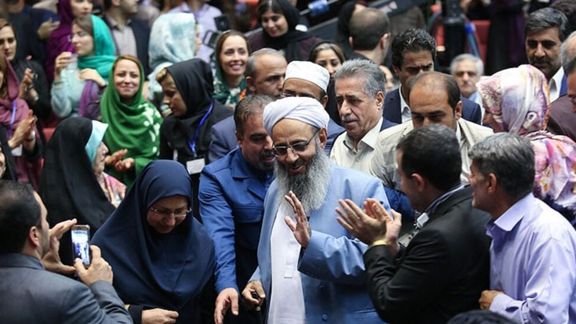
Mawlana Abdolhamid, senior Sunni cleric in public and among supporters

Prominent Sunni and Shiite clerics in Qom and Zahedan have come under attack by Supreme Leader Ali Khamenei's aides and supporters during the past days.

Tehran Friday prayers Leader Mohammad Javad Haj Ali Akbari went to Zahedan this week as Khamenei's envoy to try to pacify growing opposition among Sunnis after two attacks by the IRGC on Friday prayers in Zahedan and Khash where more than 100 Sunnis were killed. Following his meeting with prominent Sunni Leader Mawlana Abdolhamid, Akbari harshly criticized him and other Sunni clerics for being ungrateful for what he said the Islamic Republic has done for them.

Reports from Tehran said that during the meeting Abdolhamid complained about government discrimination against Sunnis and said that Khamenei has not replied to several of his letters.

Finally, the Sunni leader spoke publicly. Abdolhamid wrote in a November 16 tweet: "We expected the Leader's envoy to see the realities on the ground, condemn the crimes that were committed in Zahedan's bloody Friday, and appease the family members of those who have been killed or wounded in the attacks and to uphold their rights rather than threatening and intimidating the oppressed people."

Before haj Ali Akbari's visit, some reports said that Abdolhamid had refused to see him. Regardless of this, there have been no photos published and it remains a mystery whether the meeting took place or not. What is certain, however, is that Khamenei's envoy threatened the Sunni leader. Abdolhamid's tweet was liked by more than 22,000 users and it was retweeted over 3,000 times.

Haj Ali Akbari during a Friday sermon in Tehran. Undated
100%
Haj Ali Akbari during a Friday sermon in Tehran. Undated

Social media activists have posted a video of a long motorcade of SUVs escorting Abdolhamid and said threatening or arresting the Sunni leader was impossible.

In another development, on November 9, the picture of a fatwa [religious decree] issued by Iranian reformist religious leader Ayatollah Assadollah Bayat-Zanjani was posted on social media. In the fatwa, Zanjani, who is a "source of emulation" [one of the highest ranks among Shiite Clerics in Iran] stated that "It is obligatory for every Muslim to defend against plainclothes agents who attack protesters with guns or knives." The fatwa was issued in response to a question about what Iranian protesters should do if they are attacked by armed plainclothes officers.

Subsequently, the Cultural Council of the Qom Seminary sent a letter to Ayatollah Bayat Zanjani and Ayatollah Alavi Brooujerdi and a number of other Shiite clerics and threatened them for defying Khamenei's orders and rule.

The letter said that the clerics have ignored Khamenei's previous order to submit to his rule and compensate for their mistakes.

The rude letter further told the Ayatollahs they deserved this warning for the untimely opening of their mouths. It further told the clerics not to be deceived by the enemies who might praise their actions in order to take advantage of them.

"During the recent sedition, you have once again proven with your untimely statements to lack insight and intuition. We hope that as Supreme Leader Khamenei has said, your action is the product of your ignorance. You should repent your divisive and provocative statements that have given way to riot and insecurity and made many families mourn for their loved ones," the letter said.

The letter further called on the clerics “to take a lesson from the fate of the revolution's enemies.” It then listed a number of state officials and clerics who were sent to exile or house arrest because of their opposition to the Islamic Republic and its leaders. The letter warned that the window of opportunity for repenting will not remain open for long.

This is the first time in the history of the Islamic Republic that such threats are made openly, publicly and without reservations against senior ayatollahs.


Most Viewed

100 days after carnage: Iran economy reels from war, inflation, unemployment
1
INSIGHT

100 days after carnage: Iran economy reels from war, inflation, unemployment

2
INSIGHT

Ghalibaf defends Iran-US talks amid hardline backlash

3
EXCLUSIVE

Iranian assaulted in London amid concern over threats to regime critics

4

IRGC fires at Indian vessel in Hormuz

5
INSIGHT

A nation in limbo: 100 days after the massacre, has the world moved on?

Banner
Banner

Spotlight

  • War-hit homeowners feel abandoned as Iran’s reconstruction aid fades

    War-hit homeowners feel abandoned as Iran’s reconstruction aid fades

  • 100 days on: the anatomy of Iran’s January crackdown
    INSIGHT

    100 days on: the anatomy of Iran’s January crackdown

  • Ghalibaf defends Iran-US talks amid hardline backlash
    INSIGHT

    Ghalibaf defends Iran-US talks amid hardline backlash

  • 100 days on: why Iran’s January protests spread across social classes
    ANALYSIS

    100 days on: why Iran’s January protests spread across social classes

  • From instability to influence: Pakistan’s pivotal role in US-Iran diplomacy
    ANALYSIS

    From instability to influence: Pakistan’s pivotal role in US-Iran diplomacy

  • A nation in limbo: 100 days after the massacre, has the world moved on?
    INSIGHT

    A nation in limbo: 100 days after the massacre, has the world moved on?

•
•
•

More Stories

Exclusive: Document Shows Iran’s Army Worries About Loyalty Of Troops

Nov 17, 2022, 21:26 GMT+0

A new document received by Iran International shows that Iranian Army staff and their families have been supporting the popular antigovernment protests since September.

In a letter issued by a high-ranking army commander, he demanded daily reports on the arrest of army personnel and their families during protests, as well as paying attention to "subversive actions" against military facilities.

Hossein Safaralizadeh, commander of an army base in the southern city of Shiraz, has also mentioned that the army’s inspectorate has also warned other commanders in three provinces of Esfahan, Yazd and Charmahal-Bakhtiari to follow up on such cases on daily basis.

This letter may suggest that the number of army personnel who are showing sympathy toward the protest movement, or family members participating in protests is on the rise and top military officials are concerned about it.

“The presence of army personnel and their families in riots, their arrest by the security, writing anti-government slogans on the walls of the barracks, and the amount of possible damage to the barracks and army housing units must be reported daily… through text, phone, or reports,” reads the letter.

Iran’s traditional Army, as distinct from the Revolutionary Guard, is widely criticized for not acting against the brutality of Basij militiamen, IRGC forces, and police who are ruthlessly killing innocent people during the uprising.

Analysts believe that, in the past years, the Islamic Republic has provided key positions of the army to the members of the Revolutionary Guard to eliminate the possibility of forming an opposition within the army.

Most Iranians Support Protesters, Says Tehran Pundit

Nov 16, 2022, 10:45 GMT+0
•
Iran International Newsroom

A reformist commentator in Iran says the country's silent majority supports the ongoing protests although a majority of the people do not take part actively.

At the same time, the conservative camp appears to be divided over the impact of the protests and the sustainability of changes that have already occurred in Iranian society because of more than two months of nationwide protests.

In a commentary in the reformist daily Etemad, leading reformist commentator Abbas Abdi wrote that although some simple-minded individuals still believe that the protests will come to an end soon, the situation warrants more careful analysis.

Abdi asserted that most of Iranians are not happy about existing conditions and support the protests as without their support the movement would not have started in the first place or would have already ended. He argued that the reason why the majority of Iranians do not actively take part in the protests is because they fear the consequences and do not see a promising prospect for the movement. He said the latter is a more important reason.

"The majority believes there is no guarantee that the movement will succeed so they hesitate in the interest of preserving the status quo although they do not like it. Some protesters, on the other hand, believe that whatever happens in the future cannot be worse than the current situation," Abdi argued. He added that unlike some hardliners who have said there will be hell after the Islamic Republic, this is not true because "the current government is unable to function normally and ensure economic growth, control inflation, boost employment and build houses for the people."

Iranian 'reformist' commentator Abbad Abdi
100%
Iranian 'reformist' commentator Abbad Abdi

Abdi added that "hardliners hope people will be tired of the situation and will give up. "He maintained that "Iran will never return to the situation before protests started. What has happened is irreversible, so we must go on." He argued that change is the only way forward, but it is with positive steps on the part of the government that a breakthrough could happen. Otherwise, the people might choose open-ended uncertainty."

In the meantime, while moderate conservative politician and commentator Mohammad Mohajeri has said that Iranian women might continue defying hijab no matter what comes up in the future, Hamshahri daily, the mouthpiece of Tehran Municipality and the hardliners who run it, assured likeminded ultra-conservatives that "pious people should rest assured the situation will not remain like this."

Mohajeri noted that "as the problems of [compulsory] hijab and the morality police have remained unresolved, the presence of a large number of women without headscarves has become routine in many cities and this is likely to become the new normal for society." However, he noted that this state of indecision could last longer as the government is used to leaving problems unresolved.

Mohajeri agreed that the problem goes beyond hijab as there is a general dissatisfaction in Iran about the way the country is being governed.

On the other hand, Hamshahri wrote that the way women dress now is not likely to continue in the future, arguing that the protests have not led to more women taking off their headscarves, a claim clearly refuted by photos and videos showing many women without hijab.

Hamshahri added that some women take off their scarf as an act of protest and when the protests are over, rationality will also prevail. But there is a big "if" about the end of protests. With three days of more rigorous strikes and protests until Friday, and further plans for next week, the prospect Hamshahri envisages seems to be wishful thinking.

Iran Calls New EU, UK Sanctions ‘Baseless’

Nov 15, 2022, 12:57 GMT+0

Iran has dismissed sanctions imposed this week by the United Kingdom and the European Union against Iranian individuals and entities claiming they are “baseless”.

Foreign Ministry Spokesperson, Nasser Kanaani called the new round of sanctions “illegal and interventionist.”

He also added that the European parties have lost their “rationality” as such a “wrong approach” would restrict their “scope of interactions.”

Kanaani also threatened that Tehran will take countermeasures against such actions based on its national interests.

The European Union sanctioned 29 Iranians and three entities Monday over what it said was human rights violations related to suppression of ongoing protests.

A statement issued in Brussels, where foreign ministers met, said the move was over “their role in the death of Mahsa Amini and the violent response to the recent demonstrations in Iran.”

Germany’s Foreign Minister Annalena Baerbock told reporters that the new sanctions would “send a clear message to those who think they can suppress, intimidate and kill their own people without consequences.”

Britain also slapped a new round of sanctions on 24 Iranian officials who played a role in cracking down on protests after the death of Mahsa Amini in police custody.

In a press release on Monday the United Kingdom announced the “sanctions target officials within the Iranian regime who are responsible for heinous human rights violations.”

Reformist Figures Shun Regime Change Fearing ‘Uncertainty’

Nov 15, 2022, 01:02 GMT+0
•
Iran International Newsroom

Leading reformist figures in Iran have recently made statements that reveals their interest in preserving the status quo despite popular protests aimed at changing the political system.

In several articles over the past weeks, reformist commentators expressed concern that the situation is going toward a revolution while they claimed the nation wanted only to reform the system and warned that a dramatic change may lead to undesirable uncertainty.

On November 14, two reform figures, former President Mohammad Khatami and former vice president Massoumeh Ebtekar broke their silence after more than 8 weeks about a possible demise of the regime and voiced their opposition to dramatic changes in the Iranian political system.

Khatami, revealed his opposition to regime change by saying that it was "neither possible, nor desirable." Nonetheless, he warned that if the current state of affairs continues, the ground is paved for a looming social collapse.

Khatami called on the regime "to reform itself," but at the same time acknowledged that "a large part of the society shares the protesters' dissatisfaction" of the current political system.

Former vice president Massoumeh Ebtekar and former president Hassan Rouhani (file photo)
100%
Former vice president Massoumeh Ebtekar and former president Hassan Rouhani

On the same day, Ebtekar said in a commentary in the reformist daily Etemad in Tehran, "The new generation of Iranians believes it is not only the Iranian government, but the entire Iranian political system that is inefficient."

She added, "The Iranian government has been lagging behind the society for several years now. By not recognizing natural social developments, the Iranian government has created the current crisis for itself."

Ebtekar said elsewhere in her commentary: "the Iranian state television and other organizations with hefty government budgets which are responsible for keeping the public informed have failed to listen to young Iranians and their demands." She added that "Unfortunately, many religious and propaganda organizations deny the pluralism that exists in Iranian society and wish to dictate whatever that serves their interests."

Former president and the de-facto leader of Iran’s reformists Mohammad Khatami (file photo)
100%
Former president and the de-facto leader of Iran’s reformists Mohammad Khatami

The new generation that has grown up with the Internet and social media, believes to be a citizen of the world and cannot tolerate the traditional guidelines, Ebtekar said, adding that this has created a generational gap in Iran.

In an article carried by Etemad newspaper, Iranian American author and sociologist Asef Bayat wrote in a response to reformist commentator Abbas Abdi who had opposed regime change and expressed concern that the current protests might lead to a tragic end for Iranian society, "The tragedy of reformism in Iran is that Iranian reformists cannot further any reforms because they have been pushed out of the power circle, and at the same time they cannot agree with radical changes in Iran because by definition they are reformers and not revolutionaries." 

Bayat wrote that "individuals like Abdi fear the cost of a revolution. They fear violence, instability and damage to the country's infrastructure. Ordinary people are also afraid of the cost of a revolution, but they risk everything when they see that all roads to reform are blocked.

"However, some people talk about the risks involved in a revolution as though the current situation is risk-free like a paradise," Bayat said adding that the costs of the current situation include an average 20 percent inflation, high unemployment particularly among educated Iranians, high recession in the 2010s, the collapse of the middle class and pushing 45 percent of the population under the poverty line, destruction of the country's environment and many of its villages, and the decline of Iranians' status in the world because of the government's adventurist policies.

Bayat argued that Mahsa Amini, the young woman murdered in custody of morality police, the workers in Assalouyeh oil and gas fields and millions of Iranian men and women are being constantly humiliated, losing their hopes and their lives. But those who have chosen not to submit to this gradual death have taken collective action to change the status quo.

Tehran, Beijing Hire Detectives To Spy On Dissidents On US Soil: NYT

Nov 14, 2022, 21:37 GMT+0

Iran and China hired private investigators to spy on opposition figures living in the United State, the New York Times reported Sunday.

The NYT said that authoritarian regimes like the Islamic Republic and China increasingly hire detectives to “surveil, harass, threaten and even repatriate dissidents living legally in the U.S.”

Law enforcement officers have told the Times that during the past two years several complaints have been filed in which private investigators, “mostly unwittingly,” were involved in such schemes in different states.

In one case, the New York-based investigator Michael McKeever,71, received a request on his website to track down a debtor who had fled from Dubai to Brooklyn. However, when McKeever started his task by surveilling a house and taking photos of the people coming and going, the FBI warned him that his clients are “bad people and are up to no good.”

At this point McKeever realized he had been used by the intelligence agents of the Iranian regime to kidnap Masih Alinejad, a well-known Iranian-American activist who has been criticizing Iran’s human rights abuses.

“We were afraid they were going to look to snatch and grab her, bring her home and probably kill her,” said James E. Dennehy, the former head of the FBI’s counterintelligence and cyber division in New York, who now runs the bureau’s Newark office.

The report also reveals some other cases in which PIs unwittingly were used by Chinese agents to set up espionage networks, often focusing on national security targets or on individual dissidents.