• العربية
  • فارسی
Brand
  • Iran Insight
  • Politics
  • Economy
  • Analysis
  • Special Report
  • Opinion
  • Podcast
  • Iran Insight
  • Politics
  • Economy
  • Analysis
  • Special Report
  • Opinion
  • Podcast
  • Theme
  • Language
    • العربية
    • فارسی
  • Iran Insight
  • Politics
  • Economy
  • Analysis
  • Special Report
  • Opinion
  • Podcast
All rights reserved for Volant Media UK Limited
volant media logo

Islamic Republic Tries To Downplay Strikes In Steel Companies
Iran International Newsroom
Nov 16, 2022, 18:00 GMT+0Updated: 17:39 GMT+1
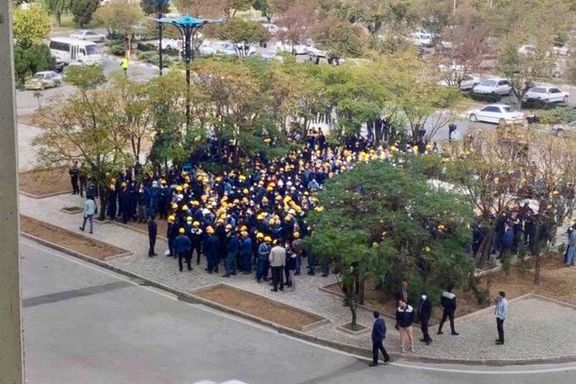
A gathering of striking workers at Esfahan Steel Company  (November 15)
A gathering of striking workers at Esfahan Steel Company (November 15)

Employees of one of Iran’s largest steel company have joined many other steel and oil workers going on strike in solidarity with the current wave of protests.

Wednesday was the second day of strikes by the workers of Esfahan Steel Company, directly controlled by the country’s Ministry of Industries and Mines, but authorities deny the reports, saying the firm is functioning as normal. Esfahan Steel Company – or Zob Ahan -- is Iran's third largest steel producer and is the largest factory producing steel for construction.

100%

Videos and photos on social media on Tuesday showed a large crowd of workers holding a gathering at the premises of the firm, but the Iranian government insists that there is no strike, claiming that the photos of the gathering were taken from an angle to make viewers believe they are holding a protest. 

The head of the company’s public relations said that Esfahan Steel Company has about 14,000 employees, and such crowds of workers are normal during shift changes, and there have been no gatherings. 

The state broadcaster even aired a video from the company, showing employees at work but people on social media say the video was recorded a few years ago and many of the workers in the video have retired. 

The strikes in the country’s steel companies are important because in addition to being one of the most important materials for building and infrastructure, steel is the enabler of a wide range of manufacturing activities, widely being used in other sectors. Iranian steel exports are also an important source of revenues in hard currency.

People on social media have been calling for strikes in companies that provide raw materials for smaller businesses and merchants at Iran’s traditional markets, arguing that if they join the protests, the Islamic Republic will be crippled. Activists say if the guilds and merchants do not go on strike, they will boycott their goods and products.

Strikes are also costly in companies producing oil, gas and petrochemicals, key revenue generators for the government that directly or indirectly controls most of big businesses.

Last week, reports said employees of Iran’s Oil Ministry at dozens of oil rigs in the south had gone on strike to show anger at government mismanagement and unfair wages. According to civil rights activist, Atena Daemi, the workers of at least 37 rigs in a symbolic action refused to receive food at canteens.

Workers of several companies -- such as South Pars Gas-Condensate field, Bushehr Petrochemical Company and Hengam Petrochemical Company, Abadan Petrochemical company and refinery, Mahshahr’s refinery and Pipe Mill Plant, and Neyriz Ghadir Steel Complex as well as others in oil-producing regions on the Persian Gulf coast-- have been on strikes in solidarity with the protests across Iran, ignited by the death in custody of 22-year-old Mahsa Amini.

Hundreds of striking employees have been arrested in the past few weeks while many are threatened with being fired or replaced by other workers, notably Chinese workers, if they do not break their strikes.

Wednesday was also the second day of a three-day protest to mark the third anniversary of ‘Bloody November’ in 2019, when the government killed at least 1,500 protesters.


Most Viewed

Ghalibaf defends Iran-US talks amid hardline backlash
1
INSIGHT

Ghalibaf defends Iran-US talks amid hardline backlash

2
ANALYSIS

From instability to influence: Pakistan’s pivotal role in US-Iran diplomacy

3
ANALYSIS

100 days on: why Iran’s January protests spread across social classes

4

War-hit homeowners feel abandoned as Iran’s reconstruction aid fades

5
INSIGHT

100 days on: the anatomy of Iran’s January crackdown

Banner
Banner

Spotlight

  • The politics of pink: how Iran uses cuteness to rebrand violence
    ANALYSIS

    The politics of pink: how Iran uses cuteness to rebrand violence

  • Bread shortages, soaring prices strain households in Iran, residents say
    VOICES FROM IRAN

    Bread shortages, soaring prices strain households in Iran, residents say

  • War-hit homeowners feel abandoned as Iran’s reconstruction aid fades

    War-hit homeowners feel abandoned as Iran’s reconstruction aid fades

  • 100 days on: the anatomy of Iran’s January crackdown
    INSIGHT

    100 days on: the anatomy of Iran’s January crackdown

  • Ghalibaf defends Iran-US talks amid hardline backlash
    INSIGHT

    Ghalibaf defends Iran-US talks amid hardline backlash

  • From instability to influence: Pakistan’s pivotal role in US-Iran diplomacy
    ANALYSIS

    From instability to influence: Pakistan’s pivotal role in US-Iran diplomacy

•
•
•

More Stories

Google Play Removes Iranian Regime’s Apps

Nov 16, 2022, 17:09 GMT+0

Google has removed three Iranian native messengers and two smart transportation applications controlled by the government from its digital distribution service Google Play.

Iranian website Digiato announced on Wednesday that the applications are Snap, TAPSI, Soroush, Bale, and iGap, and their accounts have been removed from Google Play.

Digiato claimed that based on its inquiries it has found out the applications are removed because of the sanctions on Iran.

The removal of Iranian applications from Apple and Google Store platforms is not a new thing and dates to 2017. Due to US sanctions against the authoritarian regime, Apple widely removed Iranian applications from the Apple Store.

Iranian regime has shut down two popular applications WhatsApp and Instagram since the beginning of popular antigovernment protests in September to restrict the free circulation of information about events taking place around the country.

Telegram, Twitter, and YouTube are also banned by the Iranian government while the top officials of the country have access to these platforms to spread their propaganda.

The clerical rulers say people are only entitled to use home-grown application like Soroush, iGap, and Bale which are now banned by Google.

Recently, social activists have launched a campaign to put pressure on Twitter to remove the account of Iran’s Supreme Leader Ali Khamenei who is ultimately responsible for human rights violations and the of killing the protesters.

Alumni Denounce Professors’ Call For Suppressing Students

Nov 16, 2022, 15:45 GMT+0

Graduates of the University of Science and Technology in Tehran have slammed a letter written by some professors asking security to deal with dissident students.

In a statement on Wednesday, hundreds of alumni called it “the most disgraceful incident” in the history of the University of Science and Technology, saying that the suppression of students is the result of “the silence of most of the professors” and the support of “a few professors” for the crackdown.

“The shameful statement by a number of professors, in which they implicitly supported the current security measures and asked for the start of normal activities at the university regardless of the students' conditions, is definitely one of the most shameful events in the 90-year history of this university,” reads the letter.

Security and intelligence organizations attacked students on several occasions during campus protests since September and arrested dozens, most of whom are still in prison.

The alumni also warned against attempts by some university officials who have threatened and intimidated students upon government orders.

Earlier, 267 faculty members of the University of Science and Technology had signed a letter demanding “decisive” action against those who are holding protests or sit-ins in solidarity with the current antigovernment protests.

100%

Since the beginning of nationwide protests in September, Iranian universities have been scenes of protest gatherings and massive student strikes to show anger at the Islamic Republic and its crackdown on unarmed protesters.

But at the same time other professors did defend students and urged the government to act with restraint.

More than 120 professors of Amirkabir University of Technology in Tehran had published a letter warning against the government officials’ plan to “harshly deal with students.”

The professors at Amirkabir University emphasized that intensifying the repression against students is “against logic” and will further fuel the protests.

Universities in Iran remain in chaos as nationwide student protests have entered their ninth week.

This new academic year in Iran started amid public anger over the death of 22-year-old Mahsa Amini in the custody of morality police on September 16.

University students have been at the forefront of the movement against the regime.

Violent repression at universities such as Tehran’s Sharif Industrial University, University of Tehran and Babol Noshirvani University of Technology has not silenced the angry students.

According to Iranian law, military and law enforcement forces are banned from entering university grounds or making arrests on campuses, but in the past few weeks plainclothes agents have attacked student gatherings and dormitories in several universities across the country, arresting several hundred people often using violence.

Students have for several times announced they would not attend classes, demanding the release of all arrested students and lifting of academic suspensions as well as the withdrawal of the security forces from campuses.

Iran Claims It Arrested French Intelligence Agents In Protests

Nov 16, 2022, 12:07 GMT+0

The Islamic Republic says it has arrested several French "intelligence agents" in relation to the ongoing antigovernment rallies, reiterating claims of foreign involvement in protests. 

Interior Minister Ahmad Vahidi told state TV on Wednesday, "People of other nationalities were arrested in the riots, some of whom played a big role. There were elements from the French intelligence agency and they will be dealt with according to the law."

Islamic Republic is outraged over Paris voicing solidarity with Iranian protesters and dissidents. Last week, President Emmanuel Macron met Iranian female activists and hailed the protests as a “revolution”.

Since the beginning of the current wave of protests, ignited by the death in custody of 22-year-old Mahsa Amini, the Islamic Republic has accused several Western countries of stoking nationwide protests.

Last week, France's Foreign Minister Catherine Colonna said a total of seven French nationals were detained in Iran.

In early October, France accused the Iranian regime of “dictatorial practices” after Iran’s state TV aired the forced confessions of two French nationals arrested in the Middle Eastern country ruled by its 83-year-old anti-West ruler, Ali Khamenei.

Human rights organizations accuse Iran of a systematic policy of hostage taking over four decades from the earliest period of the Islamic Republic after the ouster of the Shah, starting with the 1979-1981 siege at the US embassy in Tehran.

Tehran denies any policy of hostage taking and insists all foreigners are arrested and tried according to legal process. However, it has frequently shown readiness for prisoner exchanges and participated in swaps in the past.

Iran Issues More Death Sentences For Protesters Amid Intl. Outcry

Nov 16, 2022, 11:26 GMT+0

Iran has issued more death sentences for detainees arrested during antigovernment protests amid international outcry to stop death penalty for peaceful demonstrators.

On Wednesday, three more death sentences were issued by Tehran’s revolutionary court. The new rulings are not final and can be appealed, the judiciary said.

According to allegations by the court, one of the defendants ran over securityforces with his car and killed one person and injured several others. Another one was claimed to have set fire to the governor's office of Pakdasht, a town in Tehran province, and attackedsecurity forces with cold weapons. The third defendant allegedly tried to block a street and damaged public property.

Iran’s Judiciary announced Tuesday a revolutionary court sentenced to death another defendant accused of “terrorizing people in the street using a bladed weapon, setting fire to the motorcycle of a citizen, and attacking a person with a knife.”

Within the past four days the Islamic Republic has handed several death sentences to protesters arrested during demonstrations sparked by the death of Mahsa Amini in September.

On Sunday, the first death penalty was issued against a protester and another court sentenced five others from five to 10 years in jail each.

The Iranian Judiciary has not named the prisoners but claimed that the verdicts have been issued by a "court of first instance" and may be changed if those convicted refer the case to a court of appeal.

No one knows when and where the trials were held or if the accused had a chance to defend themselves. In most similar cases the government does not allow defendants to choose their own lawyers and there is no due process of law.

These sentences are issued after lawmakers called for the execution of some protestors.

Several countries and international organizations, including Canada, Germany and the United Nations, have urged the Iranian government to refrain from issuing death sentences for protesters.

Most Iranians Support Protesters, Says Tehran Pundit

Nov 16, 2022, 10:45 GMT+0
•
Iran International Newsroom

A reformist commentator in Iran says the country's silent majority supports the ongoing protests although a majority of the people do not take part actively.

At the same time, the conservative camp appears to be divided over the impact of the protests and the sustainability of changes that have already occurred in Iranian society because of more than two months of nationwide protests.

In a commentary in the reformist daily Etemad, leading reformist commentator Abbas Abdi wrote that although some simple-minded individuals still believe that the protests will come to an end soon, the situation warrants more careful analysis.

Abdi asserted that most of Iranians are not happy about existing conditions and support the protests as without their support the movement would not have started in the first place or would have already ended. He argued that the reason why the majority of Iranians do not actively take part in the protests is because they fear the consequences and do not see a promising prospect for the movement. He said the latter is a more important reason.

"The majority believes there is no guarantee that the movement will succeed so they hesitate in the interest of preserving the status quo although they do not like it. Some protesters, on the other hand, believe that whatever happens in the future cannot be worse than the current situation," Abdi argued. He added that unlike some hardliners who have said there will be hell after the Islamic Republic, this is not true because "the current government is unable to function normally and ensure economic growth, control inflation, boost employment and build houses for the people."

Iranian 'reformist' commentator Abbad Abdi
100%
Iranian 'reformist' commentator Abbad Abdi

Abdi added that "hardliners hope people will be tired of the situation and will give up. "He maintained that "Iran will never return to the situation before protests started. What has happened is irreversible, so we must go on." He argued that change is the only way forward, but it is with positive steps on the part of the government that a breakthrough could happen. Otherwise, the people might choose open-ended uncertainty."

In the meantime, while moderate conservative politician and commentator Mohammad Mohajeri has said that Iranian women might continue defying hijab no matter what comes up in the future, Hamshahri daily, the mouthpiece of Tehran Municipality and the hardliners who run it, assured likeminded ultra-conservatives that "pious people should rest assured the situation will not remain like this."

Mohajeri noted that "as the problems of [compulsory] hijab and the morality police have remained unresolved, the presence of a large number of women without headscarves has become routine in many cities and this is likely to become the new normal for society." However, he noted that this state of indecision could last longer as the government is used to leaving problems unresolved.

Mohajeri agreed that the problem goes beyond hijab as there is a general dissatisfaction in Iran about the way the country is being governed.

On the other hand, Hamshahri wrote that the way women dress now is not likely to continue in the future, arguing that the protests have not led to more women taking off their headscarves, a claim clearly refuted by photos and videos showing many women without hijab.

Hamshahri added that some women take off their scarf as an act of protest and when the protests are over, rationality will also prevail. But there is a big "if" about the end of protests. With three days of more rigorous strikes and protests until Friday, and further plans for next week, the prospect Hamshahri envisages seems to be wishful thinking.