• العربية
  • فارسی
Brand
  • Iran Insight
  • Politics
  • Economy
  • Analysis
  • Special Report
  • Opinion
  • Podcast
  • Iran Insight
  • Politics
  • Economy
  • Analysis
  • Special Report
  • Opinion
  • Podcast
  • Theme
  • Language
    • العربية
    • فارسی
  • Iran Insight
  • Politics
  • Economy
  • Analysis
  • Special Report
  • Opinion
  • Podcast
All rights reserved for Volant Media UK Limited
volant media logo

Iran's Currency In Freefall As Protests Sweep The Country

Mardo Soghom
Mardo Soghom

Iran International

Nov 5, 2022, 17:27 GMT+0Updated: 17:59 GMT+1
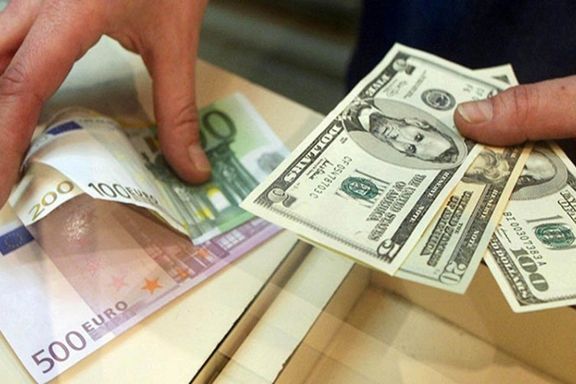
A currency dealer in Tehran handles dollars and euros

Iran's battered currency, the rial, was in a freefall on Saturday, hitting a historic low of more than 360,000 against the US dollar amid continuing protests.

Since August, when there were some hopes for a nuclear deal with the United States, the rial has lost more than 20 percent of its value, hit by the double impact of an impasse in the negotiations and nationwide protests.

The Iranian currency fell almost 20,000 points after the Friday weekend, from around 340,000 on Thursday to 360,000 when the markets reopened on Saturday. By evening, the rial made slight gains in what could have been a central bank intervention, but the fate of the currency remains bleak.

It is not clear how much foreign currency the government has injected into the market since the first week of September when the rial began to fall. Often, the Central Bank of Iran (CBI) withholds such information.

There have been unconfirmed reports that people associated with the government have been sending their capital out of the country as protests show no signs of stopping. Unlike past nationwide unrest, this time it is clear that protesters want an end to the clerical regime of the Islamic Republic and will not be easily satisfied with minimal concessions, even if the hardliner core of the regime decides to offer an olive branch.

The government insists that it is successfully circumventing US sanctions on its oil exports, selling more than one million barrels of crude per day, mostly shipped to China that silently ignores Washington's threat to penalize third parties for buying Iranian oil.

However, it is not clear how much discount Tehran is offering Chinese buyers and how much foreign currency it receives despite parallel US banking sanctions. Some have argued that most of Iran's oil is shipped in lieu of goods in illicit barter trades, which according to former Tehran officials costs the country more than 20 percent in lost value.

The freefall in the exchange value of the rial signals insufficient CBI resources to effectively intervene in the market. A relatively stable rial is politically vital for a government under siege by growing protests.

During the 1979 Iranian revolution the rial stayed at 70 to the dollar until after the overthrow of the monarchy when the currency began its 43-year-long decline, which has surpassed a 5,000-fold loss of value.

The unprecedented currency crisis will have a direct impact on inflation and especially food prices, which can lead to more people joining the protests and severely destabilizing the government. Annual inflation is already around 50 percent and food prices have risen by 100 percent since last year.

While the clerical regime still has hundreds of thousands of Revolutionary Guard troops, Basij militia and vigilantes to confront the people on the streets, and no major defections have been reported so far, the currency crisis will contribute to an image of a government in disarray, facing its most serious crisis in 43 years.

So far, hardliners in charge of the military, the presidency and parliament have shown no willingness to compromise with the populace, but even major concessions may prove to be insufficient to quell the young generation that has tasted success in defying a fearsome suppression machine fore almost 7 weeks.

The government is talking about a 20-percent raise for workers in its sprawling state-sector economy, but the rial's steep fall has already eaten away at any benefit for workers who make less than $200 a month.

On the contrary a big raise at this point would mean that the CBI has to print more money and push the inflation rate higher.


Most Viewed

Ideology may be fading in Iran, but not in Kashmir's ‘Mini Iran'
1
INSIGHT

Ideology may be fading in Iran, but not in Kashmir's ‘Mini Iran'

2
INSIGHT

Hardliners push Hormuz ‘red line’ as US blockade tests Iran’s leverage

3
VOICES FROM IRAN

Hope and anger in Iran as fragile ceasefire persists

4

Iran International says it won’t be silenced after London arson attack

5

US sanctions oil network tied to Iranian tycoon Shamkhani

Banner
Banner

Spotlight

  • Hardliners push Hormuz ‘red line’ as US blockade tests Iran’s leverage
    INSIGHT

    Hardliners push Hormuz ‘red line’ as US blockade tests Iran’s leverage

  • Ideology may be fading in Iran, but not in Kashmir's ‘Mini Iran'
    INSIGHT

    Ideology may be fading in Iran, but not in Kashmir's ‘Mini Iran'

  • War damage amounts to $3,000 per Iranian, with blockade set to add to losses
    INSIGHT

    War damage amounts to $3,000 per Iranian, with blockade set to add to losses

  • Why the $100 billion Hormuz toll revenue is a myth
    ANALYSIS

    Why the $100 billion Hormuz toll revenue is a myth

  • US blockade targets Iran oil boom amid regional disruption
    ANALYSIS

    US blockade targets Iran oil boom amid regional disruption

  • Iran's digital economy battered by prolonged blackout
    INSIGHT

    Iran's digital economy battered by prolonged blackout

•
•
•

More Stories

Iran Tests Satellite-Carrying Rocket - State TV

Nov 5, 2022, 16:29 GMT+0

Iran's Revolutionary Guards tested a new satellite-carrying rocket on Saturday, state media reported, a development likely to anger the United States.

Washington fears the same long-range ballistic technology used to put satellites into orbit could also be used to launch nuclear warheads. Tehran has regularly denied having any such intention.

"The flight test of this satellite carrier with a solid-fueled engine ... was successfully completed," state news agency IRNA reported.

The Ghaem 100, Iran's first three-stage launch vehicle, will be able to place satellites weighing 80 kg (176 lb) in an orbit of 500 km (310 miles) from the earth's surface, IRNA said.

Amirali Hajizadeh, head of the Revolutionary Guards' aerospace division which developed the Ghaem 100, said the rocket would be used to launch Iran's Nahid satellite for the telecommunications ministry, state media reported.

Saturday's operation tested the first sub-orbital stage of the rocket, the reports added.

Iran, which has one of the biggest missile programs in the Middle East, has had several failed satellite launches in the past few years, blamed on technical issues.

A UN resolution in 2015 called on Iran to refrain for up to eight years from work on ballistic missiles designed to deliver nuclear weapons following an agreement with six world powers.

Iran says it has never pursued the development of nuclear weapons and, therefore, the resolution does not apply to its ballistic missiles, which Tehran had described as an important deterrent and retaliatory force.

Reuters Report

Iran’s Hardliners Attack Sunni Cleric For His Criticism

Nov 5, 2022, 15:32 GMT+0

The Islamic Republic has upped the ante against the Sunni cleric of Zahedan for his harsh criticism of the brutal and non-democratic approach of the government to protests.

Tasnim News Agency, affiliated to the Islamic Revolutionary Guard Corps (IRGC), called Molavi Abdolhamid the source of insecurity in Sistan and Baluchestan, telling him to ask his “dictator Saudi friends to hold a referendum.”

Molavi Abdolhamid, who called for a plebiscite in Iran during his Friday prayer sermon November 4, wrote in a statement the same day, “Unfortunately, another crime was committed in Baluchestan and this time an unfortunate incident took place in the city of Khash in which protesters were killed in cold blood.”

His statement confirmed the “martyrdom of at least 16 people” and dozens of more injuries while teenagers and young people were chanting slogans and throwing stones at governor’s office in Khash, but they were “directly targeted by live rounds.”

He further called the “bloody tragedy in Khash” as well as the “Bloody Friday in Zahedan [September 30]” as the epitome of “the extent of oppression and discrimination” that he had warned against many times in the past.

The Sunni cleric asked the seminaries of Qom and the authorities to listen to the voice of the people and to “acquiesce to nation’s request, which is the main criterion.”

Iran Finally Admits Providing Drones To Russia

Nov 5, 2022, 10:15 GMT+0

The Islamic Republic has at last admitted it has provided drones to Russia claiming that they were sent to Russia months before the Ukrainian war.

Iran’s Foreign Minister Hossein Amir-Abdollahian said Saturday Tehran provided Moscow with a limited number of drones months before the war in Ukraine, but if it is proven that Russia has used them in the war against Ukraine, the Islamic Republic will not be indifferent to it.

Previously, he had said, "Iran has not provided any weapons to Russia for the war in Ukraine," implying that some arms were transferred, without referring to drones.

Amir-Abdollahian’s statement admitting supplying drones to Moscow came as Europe joined the United States on condemning Iran’s support for the Russian invasion of Ukraine.

The G7 foreign ministers meeting in Germany this week issued a statement demanding that Iran and Russia to be held accountable for “balatant violations” of UN Security Council Resolution 2231, which endorsed the 2015 Iran nuclear deal. The US, France, Germany, and the United Kingdom – G7 members along with Canada, Italy and Japan – have argued that any Iranian supply of military drones to Russia is a breach of the agreement, the JCPOA (Joint Comprehensive Plan of Action).

Iran's foreign minister Hossein Amir-Abdollahian. March 24, 2022
100%
Iran's foreign minister Hossein Amir-Abdollahian. March 24, 2022

Iran’s supply of military hardware and reportedly technicians to help in their deployment to battle fields has further put in doubt further negotiations to restore the JCPOA. After 18 months of multilateral talks, the diplomatic effort reached an impasse in August, with the US saying that Iran was presenting demands outside the scope of the 2015 deal.

Washington has pledged more sanctions related to Tehran supplying weapons to Russia as fierce popular protests have rocked Iran since mid-September, further plunging its weakened economy into crisis.

The engine of a drone launched by Russia and shot down in Ukraine said to be Iran's Shahed 136. October 6, 2022
100%
The engine of a drone launched by Russia and shot down in Ukraine said to be Iran's Shahed 136. October 6, 2022

On the sidelines of a meeting in Tehran, Iran’s top diplomat also rejected supplying missiles to Russia saying, “we agreed with the foreign minister of Ukraine that if they have any documents on Russia’s use of Iranian drones in Ukraine, they should provide them to us.”

He further added that Iran’s position regarding the war in Ukraine “is to stop the war, return the parties to negotiations and return the refugees to their homeland.”

Ukraine has reported a spate of Russian attacks using Iranian-made Shahed-136 drones in recent weeks. Iran was so far denying supplying the drones to Russia, and this week, Iran’s Ambassador to the United Nations Amir Saeid Iravani rejected the accusations saying they are “totally baseless”.

Amir-Abdollahian’s comments come after the United States and its allies urged the UN to probe if Moscow has used Iran-made drones to attack Ukrainian infrastructure and civilian targets.

Ukraine’s Intelligence Directorate said Tuesday that the Islamic Republic is going to deploy over 200 combat drones to Russia in early November including Shahed-136, Arash-2 kamikaze drones, and Mohajer-6 reconnaissance and combat UAVs.

CNN also reported on Tuesday that Western officials believe Tehran was preparing to send nearly 1,000 additional weapons, including ballistic missiles and

Islamic Republic Seeks To Export Oil To India

Nov 4, 2022, 22:06 GMT+0

The Islamic Republic’s envoy to India Iraj Elahi said Friday that Tehran wants to sell oil to India and is ready to deliver it, despite US sanctions.

In an interview with Asian News International, Ambassador Elahi said, “We always express our readiness to increase our economic ties with India. It's up to India, we are ready to deliver oil.”

Noting that the US sanctions have been an obstacle for the export of oil to India, he said that “India and Iran should find a way to solve this problem according to their national interests, and not according to illegal US sanctions.” The Islamic Republic’s independence is the “best guarantee for India,” he added. 

India abided by US sanctions when former US president Donald Trump withdrew from the 2015 nuclear agreement known as JCPOA and gradually imposed a full ban on purchase of Iranian oil by third countries. But China continued buying small volumes until November 2020 when it began noticeably increasing imports of illicit Iranian shipments.

However, according to an analysis published by Reuters in July, China’s growing imports of Iranian oil has made India not follow Western sanctions on Russian crude as it did regarding the Islamic Republic. 

Indian officials said, “New Delhi wants to avoid repeating what it sees as the mistakes of the past: abiding by sanctions on Iran and winding down oil imports, only to see its main regional rival China continue unpunished and benefit economically.” 

US, Germany Draw Close Over Iran, Ukraine

Nov 4, 2022, 21:58 GMT+0
•
Iran International Newsroom

Iran sits amid a crowded agenda at the G7 meeting in Munster, Germany, as the bloc grapples with multiple challenges centered on Ukraine.

After tensions during the Donald Trump presidency, the two-day gathering concluding Friday shows a tight relationship between the United States and Germany, currently chairing the G7 bloc that also includes Canada, France, Italy, Japan and the United Kingdom.

German foreign minister Annalena Baerbock, from Alliance 90/The Greens, has spoken out over protests in Iran since mid-September, and Thursday Berlin warned citizens in Iran to leave due to a “concrete risk of being arbitrarily arrested.” In another sign of deteriorating relations, Iran-Iraq war veterans gathered outside the German embassy in Tehran this week to highlight German firms helping Saddam Hussein with chemical weapons.

At a US-German Futures Forum Friday in Munster with Antony Blinken, Baerbock described the US Secretary of State, whom she has met ten times since taking office ten months ago, as a friend. Blinken praised as “extraordinary” the “the leadership of the German foreign minister.”

Blinken said that in setting “rules for how technology is used,” the US and Germany had to “make sure that the values we stand for…carry the day.” He noted that the “vast democratization of information technology” and highlighted recent US decisions to lift any threat of sanctions against those supplying internet-access technology to Iran.

Baerbock referred to opportunities for online education she had recently seen in Egypt, where the COP27 United Nations climate conference begins Sunday. The German foreign minister said the G7 meeting had linked information technology to “democracy and freedom,” which she said underlay Berlin’s approach to Iran.

Baerbock pledged to bring “atrocities” to UN bodies and said “democratic economic powers” needed a majority on UN human rights bodies. The US has called for Iran to be removed from the UN Commission on the Status of Women.

In recognition of recent blows to Germany and European Union expectations of trade bringing states together politically – which underlay both Russian energy supplies and the 2015 Iran nuclear agreement – Baerbock said “we have learned” this was not always true.

Tanks, jets, drones

The US and Germany, respectively the largest and second largest arms supplier to Kyiv, appear to be the same page over Ukraine. Wary of Russian escalation, both have resisted calls for advanced weapons, with Ukraine seeking Leopard 2 tanks and Marder armored infantry vehicles from Berlin, and F-16 jets from Washington.

The US and Germany, along with France and the UK, have raised the issue of Iranian-made drones at the UN Security Council, arguing that any supply contravenes the 2015 Iran nuclear agreement and justifies ‘snapback’ of UN sanctions on Tehran. Given vagaries over ‘snapback,’ and experts’ disagreements as to whether drones as relatively light weapons violate the 2015 agreement, the move may be intended to deter Iran from sending missiles.

In an interview with Dubai-based al-Arabiya published Friday, Rob Malley, the US Iran special envoy, said Iran was “embarrassed” as it had become “clear to the world” that it had “sided with Russia and its war of aggression against Ukraine.”

Domestic criticism

Further underlying US-Germany cooperation is shared experience of center-left governments facing domestic criticism. With US aid to Ukraine at $50 billion so far, House minority leader Kevin McCarthy last month ruled out a “blank check,” and some Republican candidates in November 8 Congressional elections are critical of such support for Ukraine when Americans face rising bills. In Germany opposition politicians have queried the €200 billion allocated to citizens and companies over energy price hikes due to the Ukraine war.

A further complication facing both the German-US relationship and the G7, is the rise of China. While the US has cautioned other countries over Beijing’s involvement in key sectors, German Chancellor Olaf Scholz, a Social Democrat, arrived in China Saturday seeking “economic ties as equals, with reciprocity.” Chinese-made parts in globally manufactured items may include some, alongside European and US components, in Iranian drones, the Institute for Science and International Security said in a recent report.