• العربية
  • فارسی
Brand
  • Iran Insight
  • Politics
  • Economy
  • Analysis
  • Special Report
  • Opinion
  • Podcast
  • Iran Insight
  • Politics
  • Economy
  • Analysis
  • Special Report
  • Opinion
  • Podcast
  • Theme
  • Language
    • العربية
    • فارسی
  • Iran Insight
  • Politics
  • Economy
  • Analysis
  • Special Report
  • Opinion
  • Podcast
All rights reserved for Volant Media UK Limited
volant media logo

G7 Calls On Iran To Abide By International Law
Iran International Newsroom
Nov 4, 2022, 16:59 GMT+0Updated: 17:55 GMT+1
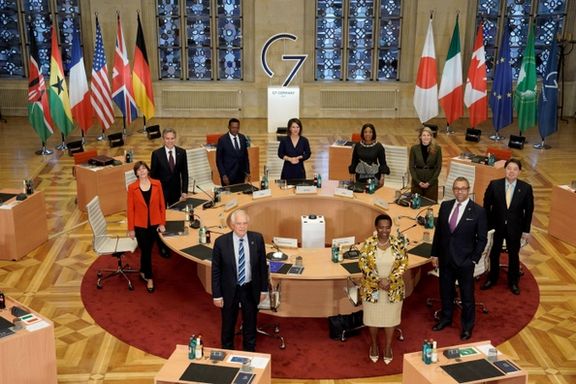
G7 foreign ministers in a working meeting in Germany on November 4, 2022

The G7 foreign ministers meeting in Germany concluded its busy two-day agenda Friday with a 3,500-word statement including a 500-word section on Iran.

Stressing the importance of universal human rights, the bloc called on Iran to honor international law, including the International Covenant on Civil and Political Rights, the General Assembly resolution adopted in 1966 and in force since 1976.

The wide-ranging G7 statement expressed support for efforts at the United Nations to hold both Iran and Russia accountable for “blatant violations” of UN Security Council Resolution 2231, which endorsed the 2015 Iran nuclear deal. The US, France, Germany, and the United Kingdom – G7 members along with Canada, Italy and Japan – have argued that any Iranian supply of military drones to Russia would breach the agreement, the JCPOA (Joint Comprehensive Plan of Action).

As the G7 statement held Iran responsible for not making the “necessary decisions” needed in international talks to restore the JCPOA, the American network CNN Friday cited “US intelligence officials” claiming Tehran had sought Russian help in acquiring “additional nuclear materials and with nuclear fuel fabrication” should JCPOA talks fail.

Russia has consistently expressed support for the JCPOA, and alongside China and three western European signatories criticized the US over its 2018 withdrawal, prompting Iran by 2019 to begin expanding the program. CNN gave no details of the assistance Iran had reportedly sought, nor why it needed Russian help given it is already enriching uranium to 60 percent and has stockpiled uranium well in excess of JCPOA limits.

German Foreign Minister Annalena Baerbock, British Foreign Secretary James Cleverly, Italy's Foreign Affairs Minister Antonio Tajani, U.S. Secretary of State Antony Blinken and French Foreign Minister Catherine Colonna attend a working session during the meeting of the G7 Foreign Ministers as part of the German G7 Executive Committee, at the City Hall in Muenster, Germany November 4, 2022
100%
Germany's Annalena Baerbock, Britain's James Cleverly, Italy's Antonio Tajani, US Secretary of State Antony Blinken and French Foreign Minister Catherine Colonna attend a working session during the meeting of the G7 Foreign Ministers, at the City Hall in Muenster, Germany November 4, 2022

While not confirming the CNN story, National Security Council spokesperson Adrienne Watson told the network the US was “working with partners to expose the growing ties between Iran and Russia – and hold them accountable.” She said that while “the JCPOA is not on the agenda… we will be firm in countering any cooperation that would be counter to our non-proliferation goals.”

‘Unabated expansion’

While the G7 statement expressed concern at the “unabated expansion of Iran’s nuclear program, it made no specific reference to the JCPOA while calling on Iran to “fulfill its legal obligations and political commitments in the field of nuclear non-proliferation without further delay.”

The statement pledged to continue work between the G7 and “other international partners…to address Iran’s nuclear escalation and insufficient cooperation with the IAEA [International Atomic Energy Agency] regarding its [Nuclear] Non-Proliferation Treaty (NPT) safeguards agreement.” One of the issues holding up progress in JCPOA talks has reportedly been Iran’s demand that the IAEA drop a probe into unexplained uranium traces found in sites related to Iran’s nuclear work before 2003.

The G7 statement also condemned Iran “destabilizing activities in and around the Middle East,” including “transfers of…advanced weaponry to state and non-state actors,” apparently a reference to Iran’s links with Syria’s President Bashar al-Assad, Hezbollah in Lebanon, armed Palestinian groups, and Ansar Allah in Yemen.

The statement deplored “the Iranian government’s erosion of civil space, and independent journalism, its targeting of human rights defenders, including by shutting down the internet and social media.” It urged Iranian authorities to “treat women as equal, respecting the universal rights provided to them under the relevant international human rights treaties.” It called for the release in Iran of “unjustly detained prisoners, including recently arrested protesters, children, journalists and human rights defenders, and... accountability for perpetrators of human rights violations and abuses.”


Most Viewed

100 days after carnage: Iran economy reels from war, inflation, unemployment
1
INSIGHT

100 days after carnage: Iran economy reels from war, inflation, unemployment

2
INSIGHT

Ghalibaf defends Iran-US talks amid hardline backlash

3
INSIGHT

A nation in limbo: 100 days after the massacre, has the world moved on?

4
ANALYSIS

From instability to influence: Pakistan’s pivotal role in US-Iran diplomacy

5
ANALYSIS

100 days on: why Iran’s January protests spread across social classes

Banner
Banner

Spotlight

  • War-hit homeowners feel abandoned as Iran’s reconstruction aid fades

    War-hit homeowners feel abandoned as Iran’s reconstruction aid fades

  • 100 days on: the anatomy of Iran’s January crackdown
    INSIGHT

    100 days on: the anatomy of Iran’s January crackdown

  • Ghalibaf defends Iran-US talks amid hardline backlash
    INSIGHT

    Ghalibaf defends Iran-US talks amid hardline backlash

  • 100 days on: why Iran’s January protests spread across social classes
    ANALYSIS

    100 days on: why Iran’s January protests spread across social classes

  • From instability to influence: Pakistan’s pivotal role in US-Iran diplomacy
    ANALYSIS

    From instability to influence: Pakistan’s pivotal role in US-Iran diplomacy

  • A nation in limbo: 100 days after the massacre, has the world moved on?
    INSIGHT

    A nation in limbo: 100 days after the massacre, has the world moved on?

•
•
•

More Stories

Ukraine Asks For Information On Russia-Iran Weapons Trade Logistics

Nov 4, 2022, 14:06 GMT+0

Ukraine is seeking logistic information regarding the Moscow-Tehran weapons trade, while Israel is softening its opposition to providing military aid to Kyiv.

The Ukrainian Defense Ministry issued a public notice on its website Wednesday requesting information on logistical routes used to facilitate weapons trade between Russia and the Islamic Republic, including delivery points, warehouses railway stations, military officers and other infrastructure. 

“We remind you that all persons involved in the supply of Iranian weapons for use in the war against Ukraine violate international law and become complicit in crimes committed by the Russian Federation on the territory of Ukraine,” the ministry stated. 

Meanwhile, Bloomberg reported on Friday that Israel is apparently changing it long-maintained policy of strategic neutrality regarding the Russian invasion of Ukraine after months of reluctance, implying that it may start selling weapons, including air defense systems, to Ukraine.

According to the report, a turning point came late last month, when Israeli Defense Minister Benny Gantz took a long-requested call from his Ukrainian counterpart Oleksii Reznikov, in which Israel committed to help Ukraine develop an early-warning system, similar to one that alerts Israelis to incoming fire from the Gaza Strip.

Israel has also begun to share its intelligence, Ukrainian President Volodymyr Zelenskiy said late in October, welcoming what he called a “positive” trend. 

The cooperation, however, is harshly criticized by Russian officials, such as former President Dmitry Medvedev who warned Israel in October against sending weaponry to Ukraine, saying it would destroy all diplomatic relations between Jerusalem and Moscow.

As FIFA Says ‘Avoid Politics’, Iranian Players Ask For Boycott

Nov 4, 2022, 12:55 GMT+0
•
Iran International Newsroom

While FIFA urged teams to avoid political battles, a former Iran national footballer has called on fans not to travel to Qatar to watch FIFA World Cup matches.

Sosha Makani, the ex-goalkeeper of Iran’s national team said in a video on his Instagram on Thursday that it’s wrong to go to Qatar to watch football matches because the Iranian regime will exploit their presence in stadiums to tell the world they are support the Islamic Republic.

Referring to the brutal killing of Nika Shakarami by government security forces, he stressed that Iranians must use every chance to tell the world the Islamic Republic is a “child killer”.

“This government and its filthy supporters murder a 16-year-old girl and to evade the consequences throw her off a building, so don’t you think they will exploit your slogans at the World Cup? Use your tribunes to shout, “Death to the Child-killing Islamic Regime,” he added.

Nika Shakarami’s body was found in suspicious circumstances ten days after she left home to take part in a protest rally against compulsory hijab on September 20. Authorities claimed that she was thrown off a roof or jumped to her death after taking part in the protests.

FIFA President Gianni Infantino on Thursday wrote to the World Cup teams asking them to concentrate on soccer in Qatar and not let ideological “battles” be dragged into football fields.

FIFA President Gianni Infantino pictured on October 18, 2022
100%
FIFA President Gianni Infantino pictured on October 18, 2022

“We know football does not live in a vacuum and we are equally aware that there are many challenges and difficulties of a political nature all around the world… [but] at FIFA, we try to respect all opinions and beliefs, without handing out moral lessons to the rest of the world,” Infantino said in his letter.

As 2022 World Cup kicks off in almost two weeks, a group of Iranian sportspeople said due to regime’s violence and discrimination they have no other choice but turn their backs to their national team.

Theses former karate, wrestling, and judo champions sent a letter to FIFA last week urging that the Islamic Republic be expelled from the tournament.

Ex-wrestling champion Sardar Pashaei who was one of the signatories said, “Iran is different from any other country. A football federation should be independent, but in Iran, it's a joke.”

“Everything is controlled by the Revolutionary Guards. Enough is enough. We believe that Iran is killing protesters. They should be banned until we have a democratic country like any other country in the world,” underlined Pashaei.

Former and current Iranian national football players including Ali Karimi, Ali Daie, Medhi Mahdavikia, Merhrdad Pouladi, Sardar Azmoun, Hossein Mahini, Voria Ghafouri and Aref Gholami were among the athletes raising their voice against the government crackdown on protesters.

Ali Karimi was one of the first celebrities who condemned the death of Mahsa Amini. Since then, Karimi has voiced support for protesters on social media becoming an icon for them.

Soccer legend Ali Daei also called on the government to “solve the problems of the Iranian people rather than using repression, violence and arrests.”

He also rejected the narrative of the regime regarding the death of a 15-year old girl in her birthplace Ardabil saying he does not believe Asra Panahi had died of heart failure and dismissed as “rumors” that she had taken her own life.

Mehdi Mahdavi Kia, on Friday lashed out at the government on his Instagram page saying “Shame on those who divided the country into insiders and non-insiders.”

Australia Warns Of A Jump In Iran-Sponsored Cyberattacks

Nov 4, 2022, 11:16 GMT+0

Australia says cyberattacks by state-sponsored groups from China, Russia and Iran have grown significantly, estimating that one attack occurs every seven minutes. 

In a report published on Friday, Prime Minister Anthony Albanese said the Australian Cyber Security Centre (ACSC) received 76,000 cybercrime reports last financial year, up 13 percent from the previous corresponding period. 

Describing the attacks as a "huge wake-up call," he said they have made cyberspace a “battleground.” "It's a huge wakeup call, and companies need to get their act together...we need to do much better," he said, adding that "The government has stepped up, the private sector needs to step up in the interest of their customers but also their own interest."

Business losses attributable to cybercrime rose on average 14 percent over the period, with the average crime costing a small business A$39,000 ($24,540).

“It’s not just about the frauds or the texts that you or I might receive, but real issues around the security of our country going forward,” Cybersecurity Minister Clare O’Neil said in reference to the report. “It is a national security focus of the government.”

As part of efforts to intensify reactions to cyber threats by the Islamic Republic, the FBI warned late in October that the Iranian cyber group Emennet Pasargad is conducting hack-and-leak operations involving a combination of hacking and theft of data. In November 2021, the Treasury Department sanctioned six Iranian officials as well as the company for their involvement in the planned cyberattack.


Raisi's Tough Reaction To Biden Saying 'We Will Free Iran'

Nov 4, 2022, 08:52 GMT+0

US President Joe Biden on Thursday vowed to "free" Iran and said that protesters who oppose the Islamic Republic would soon succeed in freeing themselves.

"Don't worry, we're gonna free Iran. They’re gonna free themselves pretty soon," Biden said during a wide-ranging campaign speech in California, as dozens of demonstrators gathered outside holding banners supporting Iranian protesters.

Biden did not expand on his remarks or specify what additional actions he would take during the remarks at MiraCosta College near San Diego.

Iran’s President Ebrahim Raisi reacted on Friday during a pro-government rally on the anniversary of the occupation of the US embassy in Tehran in November 1979 that resulted in taking dozens of Americans hostage for 444 days. In harsh anti-US remarks, Raisi said that he came across Biden’s statement “that he might have uttered in a state of wackiness.”

Raisi responded to Biden’s remark saying that “He said standing behind the official podium that they are supposed to free Iran. Mr. President, Iran was freed 43 years ago and vowed not to be enslaved by you.”

Raisi went on to mock US attempts to block Iran’s oil exports, saying that Washington’s plans were defeated. “Today we have influence in the region and no equation can succeed without Iran’s agreement, and America also knows this very well.”

The White House's National Security Council did not immediately respond to a request for comment.

Iranian Americans opposed to the clerical regime in Tehran have viewed the Biden Administration as weak and ready to make deals with Tehran. Before his election in 2020, Biden announced that he would seek to restore the 2015 nuclear deal, known as JCPOA, that his predecessor had abandoned.

Eighteen months of negotiations before the current upheaval started in September failed to produce a result, and Iran even began supplying drones to Russia to use in Ukraine, the administration has said.

Seven weeks of demonstrations in Iran were ignited by the death of a 22-year-old woman, Mahsa Amini, in the custody of Iran's morality police.

The protests triggered by Amini's death on September16 have shown the defiance of many young Iranians in challenging the clerical dictatorship, overcoming fear that has stifled dissent in the wake of the 1979 Islamic Revolution.

Demonstration on Thursday in many cities once again shocked the clerical regime which does not know how to end the nationwide protests that have become a daily occurrence. Its security forces cannot be everywhere at all times and protesters rejecting the whole political system are becoming bolder, attacking police, anti-riot forces and government vigilantes called Basij.

The United States on Wednesday said it will try to remove Iran from the 45-member U.N. Commission on the Status of Women (CSW) over the government's denial of women's rights and brutal crackdown on protests.

Iran is just starting a four-year term on the commission, which meets annually every March and aims to promote gender equality and the empowerment of women.

Iran’s Khamenei Feels Lonely, Isolated, Says Pundit

Nov 3, 2022, 16:59 GMT+0
•
Iran International Newsroom

While only three weeks ago Iran’s ruler Ali Khamenei described the ongoing uprising as a "riot”, on Wednesday he said it is a "hybrid war" led by the "enemies”.

Speaking on the Student Day, Khamenei said that school children taking part in the uprising are led by their emotions. "These are our children and I do not have anything to say to them," adding his usual conspiracy theories that state media and security forces should deal with those who pull the strings behind the scenes.

Conspirators in his view include the United States, Israel, Europeans, regional countries and any Iranian who is not loyal to him.

Iranian analyst Mehdi Mahdavi Azad told Iran International TV that "This is the first time during the past four decades that Ali Khamenei and his government have not been able to control protests after 45 days, because they are not simply facing a protest. “What we are seeing is a social revolution the government can hardly accept."

"It is hard for the government to admit that a majority of Iranians do not want compulsory hijab, clerical rule, economic crisis and the government's intervention in the Middle east and its support of international terrorism," he said.

Mahdavi Azad added: "What Khamenei said today was not disappointing because no one expected him to say anything else. However, Khamenei and what he said showed that the structure of the Islamic Republic is more rigid and vulnerable than what we imagine."

A hundred-thousand-strong Iranian rally in Berlin, Germany on October 22, 2022
100%
A hundred-thousand-strong Iranian rally in Berlin, Germany on October 22, 2022

He went on to say that while Khamenei praised the Iranian intelligence community, everyone knows that the joint statement issued last week by the Iranian these agencies offered one of the most banal and conspiracy theory-based analysis of the ongoing developments."

He added: "This analysis showed that the Islamic Republic is no longer able to conduct even a tactical retreat. In fact, Khamenei was saying: I am not changing my position, destroy me or accept me as I am."

Meanwhile, Khamenei warned state officials not to send out message that would be taken advantage of by foreigners. Mahdavi Azad said: "Ali Khamenei is so lonely. His former presidents such as moderate conservative Hassan Rouhani and populist Mahmoud Ahmadinejad have not said a word to support him. The reformists also do not support him. At the same time, Iranians appear to hate him and you can find this out by listening to slogans in various parts of the country. All the rude slogans target him."

The analyst went on to say: "He is also isolated in the world and international public opinion. Inside the country, he is trying hard to rally at least traditional conservative politicians behind him, but even they are clever enough not to align themselves with a notorious character such as Khamenei."

Meanwhile, another Iranian analyst, Alan Tofighi told Iran International: "As you see in the videos of police brutality against the protesters, Khamenei is directly facing the people in what looks like a war. How can anyone beat his fellow country man before shooting him in the head? Those who see those scenes will put Khamenei next to the world's biggest criminals such as Hitler."

Inside Iran, reformist activist Mohammad Ali Namazi has said that "The government has refused to take even one step to restore people's trust." He added that at the starting point of the protests, the government could have disbanded the morality police and amended the compulsory hijab law to calm down the situation, but it refused to offer an olive branch.

Others, including former lawmaker Abouzar Nadimi told reporters that "We need reforms to meet the society's expectations." He pointed out that those who have been thinking about such reforms have reached conclusions about changing the distribution of political power in Iran, but there is no room for such changes in the Iranian constitution.