• العربية
  • فارسی
Brand
  • Iran Insight
  • Politics
  • Economy
  • Analysis
  • Special Report
  • Opinion
  • Podcast
  • Iran Insight
  • Politics
  • Economy
  • Analysis
  • Special Report
  • Opinion
  • Podcast
  • Theme
  • Language
    • العربية
    • فارسی
  • Iran Insight
  • Politics
  • Economy
  • Analysis
  • Special Report
  • Opinion
  • Podcast
All rights reserved for Volant Media UK Limited
volant media logo

Serious Government Revenue Shortfall Continues In Iran

Mardo Soghom
Mardo Soghom

Iran International

Nov 3, 2022, 13:15 GMT+0Updated: 17:41 GMT+1
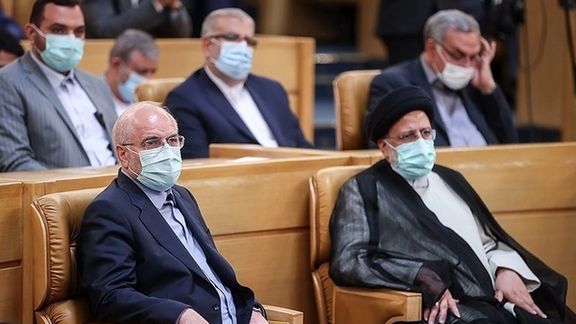
Parliament Speaker Ghaibaf (L) and President Raisi on April 2, 2022

Amid six-weeks of political upheaval in Iran, officials and media speak little about the economy, but the government struggles with an epic revenue shortfall

Mohsen Zanganeh, a member of parliament’s budget committee, who is an engineer and an economist, told Tasnim news website that Supreme Leader Ali Khamenei has agreed to more oil income to be spent for the budget instead of being deposited in the country’s National Development Fund (NDF).

Both President Ebrahim Raisi and Parliament Speaker Mohammad Bagher Ghalibaf are loyal followers of Iran's ruler Ali Khamenei, who has hand picked both officials.

By law Iran must save 40 percent of its oil revenues in the NDF, “for future generation,” but since 2018, successive governments have withdrawn money from the fund to bridge their budgets, with Khamenei’s permission. Now, Zanganeh says that the Supreme Leader has allowed the government to reduce the 40-percent rate of savings to 30 percent and use the 10 percent help with its large budget deficit.

Zanganeh who spoke with Tasnim on Thursday did not mention any numbers, as Iran keeps exact oil revenue figures and the size of the NDF secret. But by most accounts, Iran is exporting anywhere between 750,000 to one million barrels of crude oil daily, mostly to China. But how much discount it offers and how much foreign currency it receives remain secret.

One thing which is clear is that Iran’s $40 billion budget had a deficit of around 70 percent earlier this year. While 79 percent of tax revenues were collected from March 21 to May 20 this year, just 15 percent of official oil revenues in the budget were realized.

There could be two explanations for the huge difference between amount of oil shipped amid high prices earlier this year and what was collected by the government.

One possibility is that Iran is not receiving cash for the oil exports. Many have mentioned barter trade, whereby Iran receives good in lieu of the oil sent to China. The other possibility is that Beijing is keeping the money for now, given United States’ banking sanctions on Iran.

However, oil minister Javad Owji claimed on July 4 that Iran is receiving 80 of oil proceeds in cash and only 20 percent in barter. If this is true, then one can wonder where the money is and how it happened that the government got only 15 percent of what it expected.

This brings us to the second possibility. Cash collected from oil exports does not end up in government coffers and instead it is distributed to secret military projects and among ‘revolutionary’ entities in Iran and abroad whose existence and operations are deemed essential for the regime, controlled by Supreme Leader Ali Khamenei and his hardliner followers.

It has always been known that the official government budget pertains to routine operations, such as civilian ministries and the large public-sector industrial companies, banks, etc.

In the meantime, sporadic protests have gripped the oil and petrochemical sectors since September and the non-stop protests have reduced business activities, especially in the retail sector.

The government must be also printing money, because the inflation rate hovers around 50 percent and the national currency this week hit an all-time low of 340,000 rials to the US dollar.

Ebtekhab website in Tehran reported on Thursday [November 3] that cooking oil prices increased by 377 percent and rise by 207 percent since last year. It was reported in July that food price annual inflation is around 100 percent.


Most Viewed

Hardliners push Hormuz ‘red line’ as US blockade tests Iran’s leverage
1
INSIGHT

Hardliners push Hormuz ‘red line’ as US blockade tests Iran’s leverage

2

Iran International says it won’t be silenced after London arson attack

3
VOICES FROM IRAN

Hope and anger in Iran as fragile ceasefire persists

4

US sanctions oil network tied to Iranian tycoon Shamkhani

5

Iran halts petrochemical exports to supply domestic market

Banner
Banner

Spotlight

  • Hardliners push Hormuz ‘red line’ as US blockade tests Iran’s leverage
    INSIGHT

    Hardliners push Hormuz ‘red line’ as US blockade tests Iran’s leverage

  • Ideology may be fading in Iran, but not in Kashmir's ‘Mini Iran'
    INSIGHT

    Ideology may be fading in Iran, but not in Kashmir's ‘Mini Iran'

  • War damage amounts to $3,000 per Iranian, with blockade set to add to losses
    INSIGHT

    War damage amounts to $3,000 per Iranian, with blockade set to add to losses

  • Why the $100 billion Hormuz toll revenue is a myth
    ANALYSIS

    Why the $100 billion Hormuz toll revenue is a myth

  • US blockade targets Iran oil boom amid regional disruption
    ANALYSIS

    US blockade targets Iran oil boom amid regional disruption

  • Iran's digital economy battered by prolonged blackout
    INSIGHT

    Iran's digital economy battered by prolonged blackout

•
•
•

More Stories

Is US Using ‘Every Appropriate Tool’ Over Iran-Russia Links?

Nov 2, 2022, 12:59 GMT+0
•
Iran International Newsroom

The administration of President Joe Biden struggles to maintain a coherent Iran policy under different pressures heightened by the Ukraine war.

In a press briefing Tuesday United States State Department spokesman Ned Price faced questions as to what the US planned to do over alleged Iranian arms supplies to Russia. His answer over US options at United Nations led to a Twitter feed where his claims were rejected by Gabriel Naronha, Iran advisor 2019-21 during the Trump administration.

Price argued that the US was pursuing “every relevant and appropriate tool in our tool kit” to curb Iran’s reported supply of military drones, including sanctioning Iranian commanders and defense companies.

Price was less than enthusiastic over pushing at the UN Security Council (UNSC) for the ‘snapback’ of UN sanctions against Iran on the basis that such arms supplies violate UNSC resolution 2231, passed in 2015 to endorse the 2015 Iran nuclear agreement, the JCPOA (Joint Comprehensive Plan of Action).

“You know as well as anyone,” Price told a journalist, “that any effort to…stitch together a coalition in the UN Security Council, where you have the belligerent Russia as a permanent member with a veto – that any effort to stitch back together what has expired probably would not fare too well in the UN Security Council.”

The spokesman also suggested US options over snapback were compromised by leaving the JCPOA in 2018. But Price’s description of the mechanics of ‘snapback’ was contradicted by Naronha saying Russia would not hold a veto in such circumstances.

US State Department spokesperson, Ned Price. FILE PHOTO
100%
US State Department spokesperson, Ned Price

However technical the arguments, any linkage between the Ukraine war and the JCPOA weakens the contention of supporters of the 2015 agreement that nuclear proliferation measures should be dealt with separately.

Pledged to revive the JCPOA, the Biden administration has conducted over a year of talks with Iran without reaching agreement. With negotiations currently frozen, Biden officials – including special envoy Rob Malley in a Carnegie Endowment discussion Monday – have insisted that their intention remains JCPOA restoration.

At the same time, the US is keen that the Ukraine war not escalate. Despite sending at least $17 billion in military aid to Kyiv, Washington has refused advanced weapons. Price said Tuesday that Russia’s military position had been “significantly degraded,” with its “sophisticated weaponry and technology” curbed both through battlefield loses and US restrictions on its international access to chips and sensors needed for drones and missiles.

On the ‘same page’ with Europe

Another US vista, over both Ukraine and Iran, is its relationship with Europe. Malley stressed in his Carnegie Endowment talk on the way the Biden administration had overcome divisions with the Europeans left by the Trump presidency.

While Malley said Monday that reviving the JCPOA was “not our focus now,” he argued that Trump’s maximum pressure “didn’t work” and was “a real-life experiment that failed.” By contrast, he argued “there is nothing we are not doing now because of a possible nuclear deal in the future” and that “we and Europe are completely on the same page when it comes to reacting to Iran's nuclear program.”

The US and Europe, Malley said were “standing together shoulder-to-shoulder and expressing support for the Iranian people at this time when they are confronting the violence of the regime…we really have succeeded in re-stitching what is so crucial if we want to have a common front to push back against Iran's destabilizing activities, human rights violations, or nuclear program.”

Iran-Russia ‘Relationship Of Convenience’ May Redraw Regional Alliances

Nov 1, 2022, 16:26 GMT+0
•
Iran International Newsroom

Tehran is preparing the dispatch of surface-to-surface missiles to Russia for use in Ukraine, CNN said Tuesday, citing “officials from a western country.”

CNN described the shipment as the “first instance of Iran sending advanced precision guided missiles to Russia.” It suggested the weapons “could give the Kremlin a substantial boost on the battlefield.”

A senior US defense official said Monday that Washington had no information of Iran preparing to send the missiles. The Washington Post had reported Monday that Tehran planned to send missiles as well as additional military drones.

Robert Malley, the US Iran envoy, on Monday repeated US insistence that Tehran had sent UAVs (unmanned aerial vehicles), saying “those drones have been used to target civilians and civilian infrastructure” in Ukraine while Iran “in the face of all of this evidence, keeps lying and denying that it’s happening.”

The Post suggested that a “relationship of convenience” between Russia and Iran could “redraw regional alliances for decades to come” and that Tehran’s alleged arms sales to Moscow marked “a seismic shift,” while “fears of a new world war have never been greater.”

The newspaper traced Iranian-Russian military cooperation back to fighting to save President Bashar al-Assad in Syria, when their coordinated intervention enabled Assad by 2016 to begin regaining territory from opposition forces, including both the Islamic State group (Daesh) and the US-backed mainly Sunni Free Syrian Army.

Iranians who live in Ukraine, attend a protest against Iran's government and deliveries of Iranian drones to Russia, in central Kyiv, October 28, 2022
100%
Iranians who live in Ukraine, attend a protest against Iran's government and deliveries of Iranian drones to Russia, in central Kyiv, October 28, 2022

But the Post also noted Moscow’s vote December 2006 at the United Nations Security Council to impose sanctions on Iran over its nuclear program, and the two states’ current rivalry over selling oil to China. It attributed today’s closer Tehran-Moscow relationship to shared experience of US and European sanctions.

Intense use of UAVs

With Ukraine deploying drones supplied by the US and Turkey to defend against the Russian invasion, the use of UAVs has been more intense than in many recent conflicts, due in part to drones’ relatively low costs and ability to breach defense systems designed to stop missiles.

But Iran’s large scale export of missiles and drones is seen by the West as a dangerous turn of events because Tehran could use future opportunities to arm countries opposed to NATO or the United States

Russia Saturday suspended a UN-brokered arrangement allowing grain shipments through the black sea after a drone attack on at least one Russian warship near Sebastopol. Moscow said the strike had been planned with British involvement. The UN initiative facilitates the export of both grain and fertilizer, especially to Africa and the Middle East.

An additional $275-million US military package announced by the Pentagon Friday was smaller than earlier packages, with disquiet in the Republican Party shown in objections to plans to fund Ukraine with seized Russian assets.

The British defense ministry said Friday Moscow had adopted a “long-term, defensive posture,” while Vitali Klitschko, Kyiv mayor, said people would freeze to death if western counties did not supply blankets and generators. Associated Press reported Monday that Russia was hiring US-trained Afghan special forces to fight in Ukraine.

Armenian PM Visits Iran Amid Border Disputes With Azerbaijan

Nov 1, 2022, 15:32 GMT+0

Amid territorial tensions between Armenia and Azerbaijan, the Iranian president hosted Armenia’s premier in Tehran on Tuesday to strengthen relations with Yerevan. 

Nikol Pashinyan and Ebrahim Raisi held a joint press conference following their meeting, reiterating their goal to improve bilateral relations and sign documents for strengthening cooperation.

Raisi said he was sure the visit by the Armenian official will be a turning point in enhancement of bilateral relations, claiming that their trade exchanges have grown by 43 percent over the past few months. 

100%

In October, the Islamic Republic opened a consulate in Armenia's Syunik province, which includes Armenia’s narrow southern strip called Zangezur where it has a land border with Iran. 

Azerbaijan, backed by Turkey, demands a transit corridor through Syunik province to have access to its Nakhichevan Autonomous region without Armenian checkpoints.

However, Yerevan objects to the concept saying that it is a breach of the ceasefire signed after the 2020 Nagorno-Karabakh war, that Azerbaijan won, taking back vast territories that Armenia had conquered in the Nagorno Karabakh conflict in the early 1990s.

Iran supports Yerevan in this dispute as it might lose its only joint border with its de facto ally Armenia and Caucasus. In mid-September, Iran warned that it would not tolerate any seizure of territory from Armenia by Azerbaijan. 

Armenia accuses Azerbaijan of attacking its towns to avoid negotiations over the status of the mainly Armenian-populated enclave of Nagorno-Karabakh in Azerbaijan, an enclave which is inside Azerbaijan but populated mainly by ethnic Armenians.

Tehran in the past has also expressed alarm at alleged Israeli military presence in Azerbaijan.

Iran’s Currency Drops To Historic Low Amid Protests, Lack Of Diplomacy

Nov 1, 2022, 13:56 GMT+0

The Iranian currency, rial, has lost more than 12 percent of its value since the beginning of September as nuclear talks stopped and protests rocked the country.

The rial Tuesday touched a historic low, dropping to 335,000 against the US currency, with nothing on the horizon to prevent further devaluation. In late August the US dollar stood at 295,000 rials.

The rial had regained some of its lost value at the time with intense diplomacy taking place to forge a nuclear agreement with the United States. But as it became apparent by early September that the talks to restore the 2015 nuclear accord had reached an impasse, the rial began to lose value.

The start of antigovernment protests in mid-September put the rial under further pressure, and government interventions apparently failed to defend the currency.

Although officials rarely admit they sold dollars in the local market to help the rial, signs indicted during October that Iran’s central bank was intervening on daily basis, trying to keep its currency under 330,000 to the dollar.

There are also unconfirmed reports that regime insiders might be liquidating assets and possibly trying to transfer funds abroad.

Iran’s currency has fallen tenfold since the end of 2017, when it became apparent that former US President Donald Trump might withdraw from the nuclear deal and impose sanctions on Tehran. Trump abandoned the accord, known as the JCPOA, in May 2018 and the rial steadily lost value.

Iranians Withdrawing Capital From Stock Exchange Market

Oct 31, 2022, 11:16 GMT+0

Amid nationwide antigovernment protests, over 36 trillion rials (over $120 million) has been withdrawn from Tehran’s Stock Exchange market only in the past 10 days. 

The amount of capital withdrawal from the stock market and the fall of the total index has been accelerating in the past few weeks as protests and strikes have been intensifying especially after mid-September, when a 22-year-old woman was killed in police custody.

The withdrawn money may seem meager compared with international stock exchanges, but TSE is the most important and biggest Iranian stock exchange market, and considering the currency rate, it amounts to a huge sum in rials. 

TEDPIX, the main index of Tehran Stock Exchange (TSE), lost 69,000 points in the previous Iranian calendar week, which ended on Friday, October 28. 

Since mid-May, the index has been in constant decline due to political uncertainties, with a few small insignificant peaks when the hopes for reviving Iran’s 2015 nuclear deal were high momentarily. 

The future of Iran’s exchange market will depend on political stability, structural reforms and restoring the Joint Comprehensive Plan of Action (JCPOA), all of which seem improbable as the current wave of protects shows no sign of abating and more and more countries are intensifying their punitive measures against the regime and its officials. 

On October 18, United States’ officials reiterated their support for the ongoing protests in Iran with Special Envoy Robert Malley saying that the talks to revive the nuclear deal are no longer on the agenda.