• العربية
  • فارسی
Brand
  • Iran Insight
  • Politics
  • Economy
  • Analysis
  • Special Report
  • Opinion
  • Podcast
  • Iran Insight
  • Politics
  • Economy
  • Analysis
  • Special Report
  • Opinion
  • Podcast
  • Theme
  • Language
    • العربية
    • فارسی
  • Iran Insight
  • Politics
  • Economy
  • Analysis
  • Special Report
  • Opinion
  • Podcast
All rights reserved for Volant Media UK Limited
volant media logo

Who Are The Plainclothesmen Attacking Protesters In Iran?

Iran International Newsroom
Oct 19, 2022, 09:37 GMT+1Updated: 17:44 GMT+1
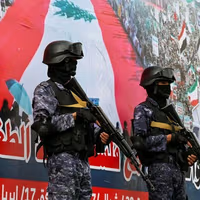
Plainclothes elements mingling with uniformed forces ready to storm a university in Tehran on October 3, 2022

Many Iranians taking part in nationwide protests in the past month have complained that they have been beaten, shot at, or arrested by thuggish plainclothesmen.

Others have complained about unknown non-uniformed agents in the streets carrying shotguns who sometimes even boss around uniformed officers.

During the past decades, Iranian activists have called them Hezbollahis, thugs, or simply Lebas-shakhsi [plainclothesmen]. Whatever their name, it is obvious that despite their appearance, they are well-organized, are linked to uniformed security forces or sometimes their members who have put on ordinary outfits in the interest of anonymity.

Most are members of the Basij paramilitary forces under the command of the Revolutionary Guard, the IRGC.

Whoever they are, the Iranian government assumes no responsibility for their crimes, claiming they are protesters engaging in provocations.

Sometimes when they cannot deny the facts, Officials claim that these elements are not armed and do not attack anyone unless they come under attack by protesters. However, people have often photographed or filmed them carrying weapons and attacking and arresting individuals in the streets.

Plainclothes agents assaulting a woman trying to make an arrest

Iranian lawmaker Hossein Noushabadi told reporters on October 17, that "Plainclothes officers have nothing to do with women or protesters in general unless they come under attack." However, he did not say why these officers do not wear uniforms so that everyone recognizes them as official agents. Noushabadi, however, did not rule out the presence of "rouge elements" among the plainclothes officers and acknowledged that some of the protesters have been killed or wounded by these rouge elements.

During the protest that followed the disputed presidential election in 2009, IRGC General Hossein Hamadani organized thousands of prisoners and street thugs to attack protesters and suppress a movement that demanded a fair counting of votes.

"We identified around 5,000 thugs who were present in the riots but were not linked to political parties. We usually controlled them by not allowing them to come out of their homes in sensitive junctures. I recruited them and organized them in three battalions. I knew that we need to train and use individuals who were familiar with knives and daggers and swords," Hamadani told reporters.

Plainclothesmen attacking protesters in Mashhad, second largest city in Iran

During the recent round of protest that started in mid-September social media reports and victim’s families revealed how the plainclothes elements operate. BBC Persian interviewed a Kurdish woman who said that thugs stormed her son's house and arrested him. She said that the incident led to her daughter-in-law's miscarriage.

According to a report posted on the Twitter account of Iran Human Rights (IHR NGO) aTehran University Student in late September revealed that plainclothes officers had wounded him because of assault and battery.

In fact, some of the officers involved in the death of Mahsa Amini were plainclothes elements. Her death after being arrested by the ‘morality police’ triggered the current protests.

In another development, Iranian journalist Milad Pour Isa tweeted on Tuesday that plainclothes officers arrested around 20 Mazandaran University students.

According to Rouydad24 news website in Tehran, when people produce evidence that they were beaten or arrested by plainclothes individuals or even when videos of plainclothes officers arresting, beating or shooting at protesters emerge, the government always claims that they were "rogue elements."

As long as all law enforcement officers in Iran do not wear uniforms, the government can always get away with criminal acts committed by them. Since 1999, when plainclothes officers violently suppressed a student uprising in Tehran killing several students, some regime insiders have been trying to convince the security forces to issue uniforms to all law enforcers, to no avail. Security forces are under the command of Iran’s ruler Ali Khamenei who needs the plainclothes agents to save the regime from the people.

Most Viewed

State media slam Araghchi's Hormuz tweet, say it let Trump claim victory
1

State media slam Araghchi's Hormuz tweet, say it let Trump claim victory

2

Iran International says it won’t be silenced after London arson attack

3
INSIGHT

How Tehran bends its own red lines to boost state rallies

4
VOICES FROM IRAN

Hope and anger in Iran as fragile ceasefire persists

5

Iran halts petrochemical exports to supply domestic market

Banner
Banner

Spotlight

  • Too early to tell who is winning Iran war, experts say
    PODCAST

    Too early to tell who is winning Iran war, experts say

  • How Tehran bends its own red lines to boost state rallies
    INSIGHT

    How Tehran bends its own red lines to boost state rallies

  • Iran blackout cripples freelancer, small business incomes
    VOICES FROM IRAN

    Iran blackout cripples freelancer, small business incomes

  • Ideology may be fading in Iran, but not in Kashmir's ‘Mini Iran'
    INSIGHT

    Ideology may be fading in Iran, but not in Kashmir's ‘Mini Iran'

  • US blockade enters murky phase as tankers spoof signals and buyers hesitate
    ANALYSIS

    US blockade enters murky phase as tankers spoof signals and buyers hesitate

  • Why the $100 billion Hormuz toll revenue is a myth
    ANALYSIS

    Why the $100 billion Hormuz toll revenue is a myth

•
•
•

More Stories

As Unrest, Strikes Continue Iran Activists Call For New Protests

Oct 18, 2022, 23:27 GMT+1
•
Iran International Newsroom

The five-week-old antigovernment protests in Iran continued Tuesday with university students staging demonstrations across the country.

Students at various universities in Tehran, Shiraz, Gilan and Mazandaran gathered and chanted slogans against the Islamic Republic.

Reports say in Tehran's Kharazmi University, officials prevented male and female students from eating together at the canteen, but the students took their food to the courtyard to show their anger at gender discrimination.

Students at Beheshti University in northern Tehran also defied the Islamic Republic's rules and ate lunch together. Gender segregation in many public places has been a hallmark of the clerical regime’s enforcement of its interpretation of Islamic rules.

A video received by Iran International shows that the students of Allameh University in northern Tehran chanted “Shameless, Shameless” against the government spokesman Ali Bahadori Jahromi who was there to give a speech.

In Gilan University, students gathered and chanted “No headscarves, No discrimination, Freedom and Equality.”

Similar protests were also reported in Shiraz and Mazandaran provinces.

Meanwhile, the school students kept up with their routine protests on Tuesday. A video from a school in Tehran shows the students ask drivers in the streets to chant their slogans instead.

Reports said oil and petrochemical sector workers continued their strikes in Assaluyeh, Bandar Abbas, Abadan, Bushehr, and South Pars Petrochemical Companies as well as Haft-Tappeh Sugar Company, Kangan refinery, and Neyriz Ghadir Steel Complex in Fars province.

Despite regime threats of more clampdown on protesters on Tuesday, young anonymous activists defied the government and called for mass demonstrations on Wednesday.

“We ask businessmen, workers, and older generations to accompany us and stop the oppression and killing of young people,” reads one of these announcements calling on people to show up everywhere they can in their neighborhoods at 6 P.M. on Wednesday.

The youth committees of Mahabad, Sanandaj and Kermanshah in western Iran have supported the call for street protests on Wednesday.

In the northwestern city of Tabriz activists have called for protests on Thursday, which coincides with the birth anniversary of Sattar Khan who is considered a national hero by the Iranians and revered in his birthplace, East Azarbaijan province. Sattar Khan was a military hero of Iran’s constitutional movement in early 1900s.

Reports on social media suggest that the government has deployed additional forces in great numbers to Tabriz to be prepared for a brutal crackdown.

Deputy Commander of Police Force Qassem Rezaie said on Tuesday that “chaos, unrest and damage to the people” is a redline for the police and law enforcement agents will no longer show restraint against “norm breakers, rioters and the dissent.”

According to the Oslo-based NGO Iran Human Rights Organization, at least 230 people, including 27 children have been killed with excessive and lethal force during the current protests.

Rezaie repeated the cliché remarks of the clerical regime's officials, especially Supreme Leader Ali Khamenei, blaming the protests on the “sworn enemies.” He said they are after creating “sedition” in the country by “exaggerating the problems” to “deceive” some people.

However, Interior Minister Ahmad Vahidi claimed on Tuesday that the regime is open to criticism and protesters can express their views.

During his trip to the southern province of Bushehr, the Iranian hardliner minister, who is wanted by the Interpol in connection with the murder of 85 people at a Jewish center in Argentina back in 1994, linked the current protests to “enemies” and their “calculation errors”.

He once again blamed the riots on “the adversary news channels”, referring to Persian speaking foreign-based television stations beaming programs into Iran, claiming they are trying “to create chaos, but to no avail.”

Shutting down the Internet, jamming satellite signals of foreign TV channels, and many other tactics suggest that Iranian regime is desperately afraid of media and social media impact.

In a similar statement, Commander of Tehran Revolutionary Guard Ahmad Zolghadr also said Tuesday that now “instead of bombs and mortars, signals enter through cyberspace and deceive some people.”

Amnesty Calls For Prompt Probe Into Evin Prison’s Deadly Fire

Oct 18, 2022, 21:44 GMT+1

Rights group Amnesty International has called on the Islamic Republic to immediately allow independent international monitors unhindered access to Iranian prisons. 

In a statement on Tuesday, Amnesty International urged a probe into “the harrowing use of unlawful force by security forces at Tehran’s Evin prison on 15 October 2022,” when a mysterious fire broke out at the prison, killing at least eight inmates and injuring over 60.

Calling for protection of prisoners from further unlawful killings, torture and other ill-treatment, the group said, “This latest deadly incident once again brings into sharp focus the urgent need to address the litany of crimes being committed by the Iranian authorities through an independent investigative, reporting and accountability mechanism.”

The group condemned the government who blamed prisoners for the fire that engulfed areas of Evin prison, saying “evidence gathered by Amnesty International raises serious concerns that the authorities sought to justify their bloody crackdown on prisoners under the guise of battling the fire and preventing prisoner escapes.”

According to testimonies obtained by Amnesty International from prisoners, victims’ relatives, journalists and human rights defenders with contacts inside Evin, prison officials fired teargas and metal pellets at hundreds of prisoners, and subjected many to brutal beatings with batons, particularly on their heads and faces. 

The group also expressed grave concern about eyewitness accounts indicating that security forces pointed guns to the heads of several women prisoners and may have also fired live ammunition towards some male prisoners.

Following the massive blaze, some journalists and people on social media accused the Islamic Republic of setting the prison on fire intentionally. 

Iranian Lawmakers Divided Over How To Treat Protesters

Oct 18, 2022, 20:05 GMT+1
•
Iran International Newsroom

As protests in Iran are well into their fifth week, some Iranian lawmakers are diagonally divided over the government's approach to handling the unrest.

While the protests have gone far beyond the issue of hijab and turned into full-fledged antigovernment demonstrations and clashes with security forces, some lawmakers defiantly insist on hard-line approaches to hijab and call for heavy-handed crackdown on protests while others seem to be seeking ways to pacify the situation by trying to convince others to accept peaceful demonstrations.

Ultraconservative cleric Mojtaba Zolnouri a member of the Iranian parliament from Qom told Asr Iran website that "women who do not cover their hair should be sentenced to 74 lashes." He claimed that "A notice served by the morality police will not be enough for women who take off their hijab."

Zolnouri, who is a member of parliament's National Security Committee, criticized other lawmakers for questioning the morality police and said that Iranians should not question the rationale behind its mission. He charged that lawmakers who criticize the morality police are disturbing the public's peace of mind.

According to Asr Iran, the morality police has filed complaints at the Judiciary to take critics at the parliament to court over their condemnation of its performance.

In another development, hardliner lawmaker Mousa Ghazanfarabadi told ISNA that that women who violate compulsory hijab rules should be identified using face recognition technology and subsequently deprived of social rights. Ghazanfarabadi further tried to justify use of force in "dealing with women who violate compulsory hijab rules outrageously."

An Iranian woman shot by 'bird shots' fired by security forces from a shotgun had 187 pellets in her body
100%
An Iranian woman shot by 'bird shots' fired by security forces from a shotgun had 187 pellets in her body

Meanwhile, as most of the complaints about violent behavior of security personnel have been about plainclothes agents, lawmaker Hossein Nushabadi said in an interview with Rouydad24 website that "Plainclothes officers have nothing to do with women or protesters in general unless they come under attack." However, he did not say why these officers do not wear uniforms so that everyone knows who they are.

Although Noushabadi claimed that plainclothes officers do not attack people, he did not rule out the presence of "rouge elements" among them and acknowledged that some of the protesters have been killed or wounded by these rouge elements. However, he refused to say how can people differentiate between plainclothes officers and rouge elements. Armed plainclothes officers are seen in many videos of the protests on social media.

In his defense of the protesters, however, Noushabadi called on the government to determine certain places where people can go for peaceful protests without fearing repression by security forces or plainclothes officers. Calls like this have been made time and again during the past 30 years, but no practical measure has been taken by the government.

In another development, lawmaker Mohammad Hassan Asafari told ILNA in an interview on Monday that "No permission from the government is needed for holding protest gatherings. He said that the Majles has tabled a motion to make the officials accountable for the security forces' mistreatment of the protests.

The right to protest is recognized in Article 27 of the Iranian Constitution but various Iranian governments in the past four decades have refused to uphold this right and respect the Constitutional Law. The only conditions set in the law for taking part in protest movements are that demonstrators should not be armed, and the protest should not be against the essence of Islam.

According to Asafari, it is difficult to convince the government about the people's right to protest unless powerful political parties are formed in Iran.

US Reiterates Support For Protests In Iran, Says JCPOA Not ‘On Agenda’

Oct 18, 2022, 19:45 GMT+1

US officials have reiterated their support for the ongoing protests in Iran with Special Envoy Robert Malley saying that the talks to revive the nuclear deal are no longer on the agenda. 

“This is grass roots, this is bottom up,” Antony Blinken, the Secretary of State said in remarks tweeted by the State Department Tuesday, referring to protests that began mid-September. “This is a reflection of huge frustration and anger towards the direction of their country and their leadership. This is not made in the USA, it’s not made anywhere else…”

Malley told CNN on Monday that "Right now the talks on revival of JCPOA are not on the US agenda; the focus is on what's happening in Iran as the talks are stalled," adding that “Iran has taken a position in those talks for the past two months, which is simply inconsistent with a return to the deal.”

However, he insisted that “diplomacy is the way” to prevent Iran from acquiring a nuclear weapon, noting that “We will see whether this is a government that is interested in reaching a deal.”

Malley said Iran’s leaders should “stop pointing the finger at external actors who have nothing to do with what’s happening in their country and listen to their people…” President Ebrahim Raisi Sunday said the US was “inciting chaos,” while Iranian politicians have generally denounced foreign-based media and social-media operations.

Malley went on to say that in a struggle of “peaceful protestors” against “a government using brutal repression” there was “no doubt” where the US stood. Malley denied that the US sought “regime change [in Iran] instigated in the US.” He said Washington supported human rights in Iran “just as we support human rights of citizens across the globe.”

Malley also defended the approach of President Joe Biden in seeking to revive the 2015 Iran nuclear agreement, the JCPOA (Joint Comprehensive Plan of Action), arguing the talks were “stalled” because Tehran was “making demands that have nothing to do with the JCPOA.”

Australia Must Act To Remove Iran From UN Commission - Lawmaker

Oct 18, 2022, 16:42 GMT+1

An Australian MP says Canberra must designate Iran's Revolutionary Guard as a terrorist organization and cooperate with UN states to remove Iran from the women commission.

Monique Ryan told Iran International’s correspondent that the government of Prime Minister Anthony Albanese should also work with other UN states to remove Iran from United Nations Commission on the Status of Women (CSW) amid the Islamic Republic's crackdown on the current uprising spearheaded by Iranian women and ignited by the death in custody of 22-year-old Mahsa Amini. 

Expressing grave concern over “what has been done to young people in Iran by the government,” she praised the courage of people “for standing up for their rights.” She added, “Being physically punished for that is deeply shocking and very concerning for all Australians.” 

Referring to a letter to the Albanese Government signed by her as well as several other lawmakers, she said they called on Canberra to act “more forcefully to express the repugnance felt by the Australian people towards the recent treatment of peaceful demonstrators."

She said they specifically requested Magnitsky-style targeted sanctions including financial asset freezes and travel bans against members of the Revolutionary Guards (IRGC), key security officials and the so-called morality police. “We also asked the government to declare the IRGC as a terrorist force as has been done in the US and Canada,” she said, adding that they also called on the government to join other states to remove Iran from the UN Commission on the Status of Women.