• العربية
  • فارسی
Brand
  • Iran Insight
  • Politics
  • Economy
  • Analysis
  • Special Report
  • Opinion
  • Podcast
  • Iran Insight
  • Politics
  • Economy
  • Analysis
  • Special Report
  • Opinion
  • Podcast
  • Theme
  • Language
    • العربية
    • فارسی
  • Iran Insight
  • Politics
  • Economy
  • Analysis
  • Special Report
  • Opinion
  • Podcast
All rights reserved for Volant Media UK Limited
volant media logo

Government Owes 'Billions Of Trash Cans' To Iranians
Iran International Newsroom
Oct 16, 2022, 12:44 GMT+1Updated: 17:47 GMT+1
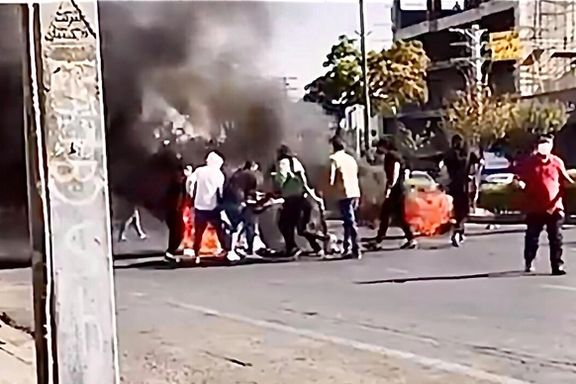
Protesters setting fire to trash bins in a street in October

A website in Tehran has asked if burning street trash bins by protesters is a bigger damage to public property than large-scale systematic government corruption.

Protesters in the past four weeks have been routinely setting fire to large street garbage bins to block streets and prevent security forces from approaching demonstrators, and to protest themselves against tear gas.

A host of top officials have called this a costly destruction of public property, with the chairman of Tehran City Council warned recently that the government cannot replace the trash bins so quickly as each cost around $500.

Aftab News, a reformist website has taken issue with these officials, saying that in the first place, the price quoted is almost four times higher than the retail price for these large, square containers.

In an article on Sunday, Aftab News has then listed a series of large-scale corruption cases linked with government officials, regime insiders, banks and pension funds in the past three decades, arguing that these cases cost taxpayers the equivalent of billions of trash bins.

Iran’s economic system is controlled by the government, large religious and military conglomerates, largely based on political influence networks, nepotism and corrupt arrangements. Although the country has exported well above one trillion dollars of oil in this period, economic growth has been anemic and people have become poorer, especially in the past decade.

Hossein Hedayati, a government banker who was one of the few corrupt officials arrested in 2018 for embezzling $350 million
100%
Hossein Hedayati, a government banker who was one of the few corrupt officials arrested in 2018 for embezzling $350 million

Aftab News argued that in contrast to officials criticizing protesters, some reformists and others argue that many top figures have remained silent throughout the years regarding government corruption and what people in the streets do is nowhere as destructive as what officials have done. The website pointed out that in the 2021 global corruption ranking Iran was in the bottom quarter, ranking 150 among 180 countries.

Some regime insiders recently have raised their voice saying that corruption has become alarmingly systematic. Ahmad Tavakoli a member of a constitutional body and Mahmoud Sadeghi a former lawmaker are among those who have raised the alarm.

Aftab News quotes others as saying corruption cases that reach the government-controlled media are “the tip of the iceberg,” pointing out that in one $60-billion state “charity” organization not even one employee has been fired or reprimanded over four decades, while the conglomerate is not accountable to parliament or the government.

It also points to one corruption case in government petrochemical exports that reached the courts in recent years and totaled $7.4 billion, equivalent to more than 60 million trash bins.

Aftab News then goes on listing a dozen other large corruption cases, including a decade-old case of $3 billion disappearing from the central bank and the perpetrator now living in Canada. It mentions the case of Babak Zanjani, an insider businessman tasked with exporting oil during international sanctions in 2010-2013, who pocketed at least $2.7 billion and is now in prison sentenced to death.

Just this year in August, a $3 billion case was revealed in the semi-public Mobarakeh steel plant and after two months no one has been arrested, let alone indicted.

Aftab news says that funds lost in just a few of these corruption cases could buy more than 50 billion trash bins, while high-ranking officials, including Foreign Minister Hossein Amir-Abdollahian make a fuss about a few hundred set on fire by protesters.


Most Viewed

Ghalibaf defends Iran-US talks amid hardline backlash
1
INSIGHT

Ghalibaf defends Iran-US talks amid hardline backlash

2
INSIGHT

A nation in limbo: 100 days after the massacre, has the world moved on?

3
ANALYSIS

From instability to influence: Pakistan’s pivotal role in US-Iran diplomacy

4
ANALYSIS

100 days on: why Iran’s January protests spread across social classes

5

War-hit homeowners feel abandoned as Iran’s reconstruction aid fades

Banner
Banner

Spotlight

  • Bread shortages, soaring prices strain households in Iran, residents say
    VOICES FROM IRAN

    Bread shortages, soaring prices strain households in Iran, residents say

  • War-hit homeowners feel abandoned as Iran’s reconstruction aid fades

    War-hit homeowners feel abandoned as Iran’s reconstruction aid fades

  • 100 days on: the anatomy of Iran’s January crackdown
    INSIGHT

    100 days on: the anatomy of Iran’s January crackdown

  • Ghalibaf defends Iran-US talks amid hardline backlash
    INSIGHT

    Ghalibaf defends Iran-US talks amid hardline backlash

  • 100 days on: why Iran’s January protests spread across social classes
    ANALYSIS

    100 days on: why Iran’s January protests spread across social classes

  • From instability to influence: Pakistan’s pivotal role in US-Iran diplomacy
    ANALYSIS

    From instability to influence: Pakistan’s pivotal role in US-Iran diplomacy

•
•
•

More Stories

Insider Opposition Grows To Khamenei’s Intransigence

Oct 15, 2022, 14:34 GMT+1
•
Iran International Newsroom

Opposition to Supreme Leader Ali Khamenei from within his own government appears to be on the rise one month after the start of an anti-government uprising.

During this period, Khamenei has made it clear at least twice that he wants the protests to be crushed and protesters punished heavy-handedly. Although a few officials including Interior Minister Ahmad Vahidi and Mashhad Friday prayers Imam Ahmad Alamolhoda have echoed Khamenei’s call for violent crackdown, several politicians including one government minister, a senior aide, and several lawmakers and former state officials have pointed out that the regime needs to make compromises on some of its values in order to peacefully curb the dissent.

Khamenei’s senior aide Ali Larijani, a former speaker of the Iranian parliament, said in an October 12 interview with Ettela’at Newspaper, which is owned and maintained by Khamenei’s office, that the regime’s “insistence on its social values will elicit violent reactions on the part of the protesters.” Quoting another state official as saying that more than 50 percent of Iranian women do not observe the government-imposed dress code, Larijani said: “When a behavior is so widely prevalent in the society it is wrong to involve the police in a bid to curb that behavior.”

Meanwhile on October 11, referring to the government and Iranian hard-liners’ attempt to impose a rekigious lifestyle on modern Iranian women, Tourism Minister Ezzatollah Zarghami asked in a tweet that “what should the people do if they do not wish to be guided by the morality police?”

Khamenei in an undated photo with Ali Larijani
100%
Khamenei in an undated photo with Ali Larijani

On Friday, Khamenei’s representative and the Friday prayers imam of Mashhad, accused the critics, including the minister, of undermining the holy Koran and Iran’s constitutional law. He also accused the protesters of not believing in God and his prophet; an accusation that could entail the death sentence for the protesters.

On the same day, Iranian lawmaker, Gholamreza Montazeri, who is the deputy chairman of the Cultural Committee of the Iranian parliament, expressed his opposition to a violent crackdown on protests and called for understanding the new generation which comprises a majority of protesters.

However, instead of addressing Khamenei, which could have endangered his position as a lawmaker, he chose to address the Interior Minister who had echoed Khamenei’s statement. He said: “If you deprive Iranian protestors of voicing their criticism of the system, they will turn to strangers and talk to them.”

Earlier in this week, former labor minister Ali Rabiei and former presidential chief of staff Mohamad Ali Abtahi warned the government, and in fact Khamenei, that “if the dissatisfactions are not addressed properly, dissent will remain active and sooner or later it will find its way into the streets.” They added that "the world is listening to the voice of Iranians' protest and stressed that this voice should be also heard inside Iran."

On Thursday, the editor of Jomhouri Eslami newspaper, Masih Mohajeri and senior cleric Ayatollah Abdollah Javadi Amoli called on the government, as they too shied away from addressing Khamenei for fear of repression, to understand the protesters and the causes of dissent and bring about changes that would make the government efficient in dealing with the country’s problems.

However, regardless of all the criticism and advice from regime insiders, Khamenei finds it hard to listen to anyone. Earlier this week, when Judiciary Chief Gholamhossein Mohseni Ejei called for a dialogue between the government and the protesters, he was forced in less than a day to change his words and order the courts of law under his jurisdiction to deal with protesters with utmost firmness and not to ignore the slightest wrongdoing.

Iran Threatens To Retaliate Against Any Additional EU Sanctions

Oct 15, 2022, 10:35 GMT+1

Iran’s Foreign Minister Hossein Amir-Abdollahian has threatened to retaliate if the European Union imposes further sanctions on the country because of crackdown on protests. 

In a phone call with Portuguese Minister of Foreign Affairs João Gomes Cravinho, Amir-Abdollahian criticized the “interventionist” statements and measures by other countries, saying that they provoke people and instigate unrest in Iran. 

He claimed that some countries consider “riots and terrorist activities” as a form of protest, denouncing the move by European countries that put the issue of additional resolutions or sanctions on the agenda of the upcoming meeting of the Council of Ministers of the European Union.

Despite numerous reports by the Ukrainian military about the use of the Iranian drones by the Russian forces, Amir-Abdollahian repeated claims that “The Islamic Republic of Iran has not and will not provide any weapon to be used in the Ukraine war.”

According to unconfirmed reports, the EU is set to sanction four entities and 11 high-ranking Iranian military and security officials for their roles in the repression of the uprising, ignited by the death in custody of 22-year-old Mahsa Amini.

During a phone conversation with Amir-Abdollahian on Friday, EU Foreign Policy Chief Josep Borrell urged the Islamic Republic to stop the repression of protesters and to release those detained since the uprising began in mid-September.

A senior EU official said Friday that the EU foreign ministers will meet in Luxembourg on Monday also to discuss the transfer of Iranian drones to Russia, noting that the ministers will not take any decisions on additional Iran sanctions but could reach a political agreement on future sanctions linked to a transfer of drones.

Despite reports that Tehran is sending out letters to EU diplomats, claiming that "bilateral relations may not survive" as the EU moves to penalize Iran for killing protesters, the uprising is garnering more and more support among Western government officials and politicians.

Iranian Regime Insiders Look For Half-Measures To End Protests

Oct 14, 2022, 12:59 GMT+1
•
Iran International Newsroom

While many top officials in Iran are adamant that the protests must be crushed violently, some regime insiders are beginning to explore peaceful alternatives.

This comes while the protesters who take to the streets daily, risking their lives, freedom and property insist that the uprising should continue until the Islamic Republic is toppled.

On Thursday, October 13, the editor of the Islamic Republic newspaper, Masih Mohajeri, wrote in an editorial that "protesters may end the uprising and get closer to state officials if they see that their economic problems are solved and their citizenship rights are respected by those officials."

Without explaining how that would be possible, the editorial stressed that the protesters' demands must be met. Also, without mentioning the government's inefficiency, the editorial pointed out, "There are many individuals in the country who are ready to serve the people, but radical elements have kept them away from the government for various reasons. So, they are isolated, and their capabilities are not used in the management of the country."

Meanwhile, senior cleric, Ayatollah Abdollah Javadi Amoli called on the government "to solve the country's economic problems as everybody issuffering from the painful poverty that is imposed on the people." He further stressed: "There is no whip more painful than poverty." He warned that economic problems will not be solved as long as there are embezzlements and astronomical salaries.”

However, neither Mohajeri, nor Javadi Amoli mentioned that the current government and to a great extent its predecessor were unable to tackle the economic problems which are largely the outcome of counter-productive decisions made by Supreme Leader Ali Khamenei, his hard-line followers and inner circle.

Cleric Masih Mohajeri editor of Islamic Republic daily
100%
Cleric Masih Mohajeri editor of Islamic Republic daily

They did not say how can Iran's economic problems be solved without an effective foreign policy that can end the country's international isolation and lift international sanctions that have paralyzed the country's economy. They also ignored the fact that without abiding by international financial regulations banning sponsorship of terrorism and money laundering, the country's economy will not be linked to global markets.

Insiders who give some constructive advice, however, often do not cross the regime’s red line of calling out Khamenei for imposing an anti-US and anti-West foreign policy on the country. They do not say that without coming to terms with the United States, limiting its nuclear program and stripping it of military dimensions, promising not to intervene in the affairs of regional states and stopping ballistic missile development, Iran will have no future.

Individuals such as Javadi Amoli and Mohajeri, regardless of their goodwill, keep forgetting that there is no visible sign in Khamenei's remarks and other officials' statement to respect citizens’ rights. Instead, there are plenty of defiant and arrogant remarks in the daily news from Iran that show neither Khamenei nor any other official has the slightest inclination to respect civil right. Many analysts have noted that their behavior is similar to those who have occupied a country and are exerting pressure on its residents.

Regardless of the severity of Iranians' financial hardship in recent months, not even a single slogan has been chanted in four weeks of uprising calling for improvement in people's livelihood. Instead, nearly all of the slogans chanted point out that what Iranians want is an end to clerical rule and Khamenei's dictatorship.

Khamenei Delivers Speech Without Mentioning Current Protests

Oct 14, 2022, 12:06 GMT+1

Iran’s Supreme Leader Ali Khamenei delivered a speech to an Islamic gathering in Tehran on Friday speaking about regional issues without mentioning the current protests.

Marking the birthday of Prophet Mohammed, Khamenei spoke at an Islamic conference that Tehran organizes annually by inviting clerical and religious figures from its orbit of influence in different countries.

Khamenei who has twice recently mentioned the nationwide protests rocking Iran saying that they were “minor events”, focused on the issue of Islamic unity from the perspective of the Islamic Republic.

The 83-year-old cleric who has ruled Iran for 33 years, said the establishment of relations with Israel by some Arab countries was “the biggest treason” and it is not possible to create unity with them.

Khamenei who is presented by his clerical regime as “the leader of Muslims” has some influence among Shiites who are a small minority among Muslims, but not among Sunnis, many of whom regard the Shia sect as a deviation from the true religion.

Khamenei also praised Iran’s efforts in helping Palestinian groups confronting Israel and said that the Islamic Republic stood up against world powers and can be an example to other Muslims.

He reiterated his support for the “Resistance Front”, a term coined by Tehran to refer to militant groups in Iraq, Syria, Yemen, Lebanon and elsewhere that enjoy its financial and military assistance.

Iran Portests, A United Movement Without A Leader

Oct 13, 2022, 15:24 GMT+1
•
Maryam Sinaiee

Antigovernment protests in Iran are in their fourth week but the movement which many now refer to as a revolution has not yet found a leader the majority can trust.

Since the early days of the Islamic Republic, the clerical leadership has consistently eliminated political parties, free media, and anyone who could possibly be in a position to lead the opposition. This has manifested itself in the biggest characteristic of the current movement which is spontaneous and has no leader.

Some pundits warn that without a leadership the movement which has chosen “Women, Life, Liberty” as its motto may fail to achieve its goal of overthrowing the Islamic Republic, and to sustain its achievement if it succeeds. Others say lacking a known leader makes it much harder for the establishment to suppress the movement.

Unlike the politically driven protests in 2009, and economic protests between 2016 and 2019, the driving force of the current movement is the people’s determination to restore their social rights by getting rid of clerical rule.

“The center of gravity of the society’s immediate demands has changed from politics to citizen’s rights,” prominent reformist theoretician Saeed Hajjarian said in an analysis published Thursday while stressing that the movement should not ignore the political playground to be able to ensure long-term irrevocability of its gains.

What appears to be uniting the protesters is dislike and even hatred of the clerical regime.

A large and fierce protest in Tehran's Nazi Abad district Wednesday night.

Protests – on the streets, in universities, and schools -- are now taking place in nearly a hundred large and small cities and towns. Despite the growth of the movement, Islamic Republic’s ruler Ali Khamenei and his officials continue to deny the authenticity of the current movement and insist that foreign “enemies” including the United States, Britain, Israel, and Saudi Arabia, are fomenting the unrest.

Authorities also insist that protesters are only a small minority. The government mouthpiece, Iran newspaper, claimed Thursday that only 80,000 have taken part in the protests across the country.

The footage that finds its way to social media despite serious Internet disruption appears to confirm their claim as these usually show smaller groups of people protesting. However, this is because protesters’ flash-mob-style tactic that confuses security forces and reduces their vulnerability to attacks by government forces.

There have been exceptions too, when thousands have gathered in one area such as the protests Saturday and Wednesday in the working-class Nazi Abad neighborhood in Tehran, where overwhelmed by the sheer numbers, security forces largely remained on the side-lines.

In the past few years ultra-hardliners, whose sway on all forces and institutions of the state was completed with the ascension of Ebrahim Raisi to presidency, have intensified social restrictions.

More interference in people’s lifestyles and popular resentment of the political and religious establishment is so bluntly felt now that even some former and current officials find themselves incapable of defending it.

“The ruling system has clearly broken into two. You can see this in officials’ remarks and attitude,” a political analyst who asked not to be named said referring to remarks by two prominent establishment figures in the past couple of days.

“What should people do if they don’t want to be led to enjoining good?” the minister of cultural heritage and tourism, Ezzatollah Zarghami, said in a tweet Tuesday referring to the Islamic concept of promoting moral goodness and forbidding evil according to Sharia. For ultra-hardliners enforcing hijab is following that edict. Former speaker Ali Larijani in remarks Wednesday in also criticized hijab policing.

Zarghami and Larijani both hail from the Revolutionary Guard (IRGC) and both have served at the helm of the Islamic Republic’s biggest propaganda machine, the state broadcaster (IRIB) for many years.