• العربية
  • فارسی
Brand
  • Iran Insight
  • Politics
  • Economy
  • Analysis
  • Special Report
  • Opinion
  • Podcast
  • Iran Insight
  • Politics
  • Economy
  • Analysis
  • Special Report
  • Opinion
  • Podcast
  • Theme
  • Language
    • العربية
    • فارسی
  • Iran Insight
  • Politics
  • Economy
  • Analysis
  • Special Report
  • Opinion
  • Podcast
All rights reserved for Volant Media UK Limited
volant media logo

Iranians Keep Up Antigovernment Protests For The 28th Day
Iran International Newsroom
Oct 13, 2022, 22:56 GMT+1Updated: 17:41 GMT+1
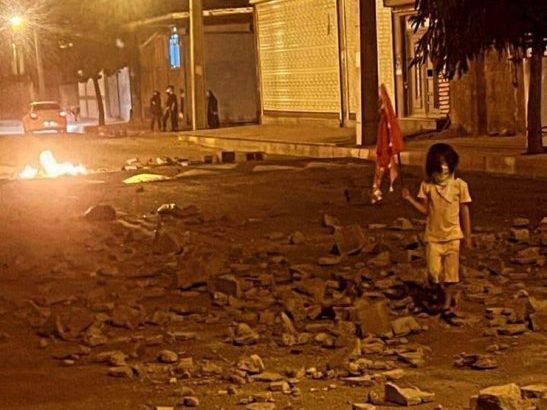
A small girl during the protests in Sanandaj, Kordestan province

Antigovernment protests continued across Iran on Thursday with clashes reported mainly in provinces with Kurdish majority populations and western parts of the country. 

Thursday marked the 28th consecutive night of protests in Iran with videos on social media showing people blocking roads to stop the movement of riot police in the city of Mahabad, in West Azarbaijan province, and gunshots and teargas reported in Ahvaz in the southwestern Khuzestan province, while several neighborhoods in capital Tehran are scenes of violent skirmishes between people and government forces. 

The protest rallies in Tehran were not limited to a specific area as people from the northern or southern neighborhoods were participating in the demonstrations with slogans against the regime and the Supreme Leader while many people were chanting slogans from rooftops. 

The Youth of Tehran Neighborhoods, an anonymous group that helped organize rallies in the capital in the past four weeks, called for another nationwide protests on Saturday, October 15.

Sporadic clashes were also reported from Karaj, a city near Tehran known for its youths’ resistance against the security forces. 

Security forces were present in huge numbers in the streets of Kermanshah and Sanandaj, which were witnessing violent clashes in the past few days, with reports of several casualties from both sides. 

“Death to Khamenei” written on the door of the office of the Supreme Leader’s representative in the city of Rafsanjan in Kerman province (October 2022)
100%
“Death to Khamenei” written on the door of the office of the Supreme Leader’s representative in the city of Rafsanjan in Kerman province

According to videos, protests have also been held in the cities of Arak, Ilam and Bukan in West Azarbaijan province. Baneh and Saqqez – the hometown of Mahsa Amini -- in Kordestan province were also hotbeds of protests on Thursday night with people having built up big fires on main streets, although little footage is available from due to internet disruption by the government. 

While Internet access was shut off or significantly slowed down in many cities, SpaceX CEO Elon Musk – who had earlier promised to activate satellite internet system Starlink for Iranians – said “there are some active terminals” in Iran.

As the uprising -- sparked by the death in custody of 22-year-old Mahsa Amini, is entering its second month -- the movement, which many now refer to as a revolution, has not yet found a leader the majority would recognize. Since the early days of the Islamic Republic, the clerical leadership has consistently eliminated political parties, free media, and anyone who could possibly be in a position to lead the opposition. This has manifested itself in the biggest characteristic of the current movement which is spontaneous and has no leader.

Some pundits warn that without a leadership the movement which has chosen “Women, Life, Liberty” as its motto may fail to achieve its goal of overthrowing the Islamic Republic, and to sustain its achievement if it succeeds. Others say lacking a known leader makes it much harder for the establishment to suppress the movement.

In addition to protests in Iran, there are large rallies outside the Islamic Republic’s missions around the world, with people in some cities trying to enter the consulates and embassies to remove the flag of the Islamic regime and in some cases, police were forced to intervene. 

Despite reports that Tehran is sending out letters to EU diplomats, claiming that "bilateral relations may not survive" as the EU moves to penalize Iran for killing protesters, the uprising is garnering more and more support among Western government officials and politicians.

“If Europe misses taking the nuances of the current situation into consideration, the ramification will be grave and the bilateral relations may not survive it,” warned one letter — sent to a group of EU ambassadors and seen by POLITICO. EU foreign policy chief Josep Borrell on Wednesday received a similar letter from Iranian Foreign Minister Hossein Amir-Abdollahian.

According to the Center for Human Rights in Iran, the arrests and interrogations of school children accused of joining nationwide protests in Iran and their detention in so-called “psychological centers” has raised fears of more child killings while at least 28 children were reported to be killed by the Islamic Republic’s repression machine since the protests began in mid-September.
Most Viewed

Ghalibaf defends Iran-US talks amid hardline backlash
1
INSIGHT

Ghalibaf defends Iran-US talks amid hardline backlash

2
ANALYSIS

From instability to influence: Pakistan’s pivotal role in US-Iran diplomacy

3
ANALYSIS

100 days on: why Iran’s January protests spread across social classes

4

War-hit homeowners feel abandoned as Iran’s reconstruction aid fades

5
INSIGHT

100 days on: the anatomy of Iran’s January crackdown

Banner
Banner

Spotlight

  • The politics of pink: how Iran uses cuteness to rebrand violence
    ANALYSIS

    The politics of pink: how Iran uses cuteness to rebrand violence

  • Bread shortages, soaring prices strain households in Iran, residents say
    VOICES FROM IRAN

    Bread shortages, soaring prices strain households in Iran, residents say

  • War-hit homeowners feel abandoned as Iran’s reconstruction aid fades

    War-hit homeowners feel abandoned as Iran’s reconstruction aid fades

  • 100 days on: the anatomy of Iran’s January crackdown
    INSIGHT

    100 days on: the anatomy of Iran’s January crackdown

  • Ghalibaf defends Iran-US talks amid hardline backlash
    INSIGHT

    Ghalibaf defends Iran-US talks amid hardline backlash

  • From instability to influence: Pakistan’s pivotal role in US-Iran diplomacy
    ANALYSIS

    From instability to influence: Pakistan’s pivotal role in US-Iran diplomacy

Tweet unavailable

Tweet unavailable

Tweet unavailable

•
•
•

More Stories

Paris Mulling Response To Reported Use Of Iran Drones By Russia

Oct 13, 2022, 20:52 GMT+1
•
Iran International Newsroom

France said Thursday that supply of Iranian armed drones to Russia would breach UN Security Council Resolution (UNSC) 2231 endorsing the 2015 Iran nuclear deal.

Foreign Ministry spokesperson Anne-Claire Legendre made the claim in an online briefing, saying Paris had noted “a great deal of information that reports the use of Iranian drones by the Russian armed forces in Ukraine, in bombardments that were aimed at civilian targets…”

With European Union foreign ministers due to consider Monday plans for sanctions on Iran over treatment of domestic protests, Legendre said Paris was also coordinating with “European partners” on how to respond to the “potential transfer” of Iranian drones to Russia.

Iran has denied supplying drones to Russia, and there was no immediate explanation of the French claim. Following the terms of United Nations Security Council (UNSC) Resolution 2231 and the 2015 Iran nuclear agreement, the JCPOA (Joint Comprehensive Plan of Action), a UN arms embargo on Iran expired in 2020 with a remaining ban on “any activity related to ballistic missiles designed to be capable of delivering nuclear weapons” in place until October 2023.

Reuters news agency cited “a diplomatic source” explaining Legendre’s claim in terms of drones violating UNSC Resolution 2231 because they came under the Missile Technology Control Regime (MTCR), which is a non-binding political understanding among states, including Russia and the United States, limiting proliferation of missiles and missile technology. Reuters did not explain the relevance of the MTCR nor whether it would similarly cover the current supply of drones to Ukraine from Turkey.

NATO counties seem to be taking seriously reports that Russia is using Iranian-made Shahed 136 delta-wing ‘kamikaze’ drones, which are a cheap alternative to missiles. Ukrainian officials claimed Thursday Iranian drones were responsible for explosions near the capital Kyiv early that day, with Russian strikes across the country killing 13 people in attacks on “critical infrastructure.” Associated Press reported from Kyiv that it was not clear if any of these casualties were due to drones.

Oleksiy Kuleba, head of the Kyiv military administration, said last week that explosions at a military base 75km south of the city wounding one, had been carried out by Shahed-136 drones.

Military supplies, escalation

The reported use of Iranian drones comes as Ukraine lobbies Washington for advanced weapons, including F-16 jets and long-range drones. Ukraine is meeting opposition from senior US officials concerned that striking targets well inside Russia would escalate the current conflict. There are also other reasons why sending more advanced weapons would not be easy. US officials recently told the New York Times that Ukraine, despite denials, was responsible for the August 20 bomb killing Darya Dugin, 29-year-old daughter of the Russia conservative commentator Aleksandr Dugin.

The US has so far sent $16.8 billion in military supplies to Ukraine, and the European Union $2.5 billion. Ankara has supplied Ukraine since 2019 with advanced Bayraktar TB-2 drones, while also acting in the current conflict as a mediator between Moscow and Kyiv.

Meanwhile, Republican and some Democrat critics of the JCPOA argue that protests in Iran require tougher US sanctions. Pressed by journalists Wednesday, Ned Price, the State Department spokesman said efforts to renew the JCPOA were “not our focus right now.” The US, like the three Western European JCPOA signatories – France, Germany, and the United Kingdom – say they want the JCPOA restored but that Tehran has thwarted talks by making demands beyond the 2015 agreement, which the US left in 2018 imposing ‘maximum pressure’ sanctions.

Several People Killed In Iran’s Kurdish Majority Cities In 24 Hours

Oct 13, 2022, 18:25 GMT+1

As antigovernment protests continue across Iran, right groups said Thursday at least seven people were killed during protests in Kurdish regions overnight. 

Kurdish rights group Hengaw said protesters in at least 10 cities had confronted "security forces' intense violence" on Wednesday night. It added that in the city of Kermanshah, direct fire from security forces killed two people. Three members of the security forces were also killed in Kermanshah and around 40 more injured, the group said, adding a fourth member of the security forces was killed in Mahabad.

According to Norway-based Iran Human Rights organization, at least 201, including 23 children, have been killed so far during the government’s crackdown on the protests in at least 18 Iranian provinces.

The figure does not account for those possibly killed in Sanandaj and other cities with Kurdish population where the clashes have been particularly intense in the past three days.

Nearly four weeks have passed since the death in custody of 22-year-old Mahsa Amini that sparked the boldest challenge to Iran's clerical regime, but it seems the protests are getting stronger and garnering support from inside Iran and abroad, with workers from different industries staging strikes. 

A source in Sanandaj, the provincial capital of Kordestan province, said riot police were searching houses and arresting dozens of young people. "We have information from Baneh and Saqqez as well. They have arrested dozens of young people since yesterday, including teenagers," added the source, who spoke to Reuters on condition of anonymity.

Canada Blacklists More Iranian Officials, Including Ex-FM Zarif

Oct 13, 2022, 17:51 GMT+1

Canada imposed a new set of sanctions against 17 Iranian individuals and three entities that have participated in or enabled gross human rights violations.

The foreign ministry said in a statement on Thursday that additional sanctions were imposed under the Special Economic Measures Regulations in response to the government's human rights abuses and destabilizing actions.

Former Iranian Foreign Minister Javad Zarif was in the new list as well as former prosecutor Saeed Mortazavi, Khamenei's representative in Kayhan Hossein Shariatmadari, former president Hassan Rouhani's defense minister Amir Hatami, the current state broadcaster chief Peyman Jebelli and former parliament speaker Ali Larijani.

Canadian Foreign Minister Melanie Joly said, “The actions of the Iranian regime speak for themselves – the world has watched for years as it has pursued its agenda of violence, fear and propaganda," adding that "Canada will continue to defend human rights and we will continue to stand in solidarity with the Iranian people, including women and youth, who are courageously demanding a future where their human rights will be fully respected."

On October 3, Canada slapped sanctions on 34 Iranian officials and entities, including the Islamic Revolutionary Guard Corps (IRGC) and morality police, over the crackdown on current protests, sparked by the death of Mahsa Amini, a 22-year-old Iranian Kurdish woman who died while in custody of Iran's "morality” police.

Iran Portests, A United Movement Without A Leader

Oct 13, 2022, 15:24 GMT+1
•
Maryam Sinaiee

Antigovernment protests in Iran are in their fourth week but the movement which many now refer to as a revolution has not yet found a leader the majority can trust.

Since the early days of the Islamic Republic, the clerical leadership has consistently eliminated political parties, free media, and anyone who could possibly be in a position to lead the opposition. This has manifested itself in the biggest characteristic of the current movement which is spontaneous and has no leader.

Some pundits warn that without a leadership the movement which has chosen “Women, Life, Liberty” as its motto may fail to achieve its goal of overthrowing the Islamic Republic, and to sustain its achievement if it succeeds. Others say lacking a known leader makes it much harder for the establishment to suppress the movement.

Unlike the politically driven protests in 2009, and economic protests between 2016 and 2019, the driving force of the current movement is the people’s determination to restore their social rights by getting rid of clerical rule.

“The center of gravity of the society’s immediate demands has changed from politics to citizen’s rights,” prominent reformist theoretician Saeed Hajjarian said in an analysis published Thursday while stressing that the movement should not ignore the political playground to be able to ensure long-term irrevocability of its gains.

What appears to be uniting the protesters is dislike and even hatred of the clerical regime.

A large and fierce protest in Tehran's Nazi Abad district Wednesday night.

Protests – on the streets, in universities, and schools -- are now taking place in nearly a hundred large and small cities and towns. Despite the growth of the movement, Islamic Republic’s ruler Ali Khamenei and his officials continue to deny the authenticity of the current movement and insist that foreign “enemies” including the United States, Britain, Israel, and Saudi Arabia, are fomenting the unrest.

Authorities also insist that protesters are only a small minority. The government mouthpiece, Iran newspaper, claimed Thursday that only 80,000 have taken part in the protests across the country.

The footage that finds its way to social media despite serious Internet disruption appears to confirm their claim as these usually show smaller groups of people protesting. However, this is because protesters’ flash-mob-style tactic that confuses security forces and reduces their vulnerability to attacks by government forces.

There have been exceptions too, when thousands have gathered in one area such as the protests Saturday and Wednesday in the working-class Nazi Abad neighborhood in Tehran, where overwhelmed by the sheer numbers, security forces largely remained on the side-lines.

In the past few years ultra-hardliners, whose sway on all forces and institutions of the state was completed with the ascension of Ebrahim Raisi to presidency, have intensified social restrictions.

More interference in people’s lifestyles and popular resentment of the political and religious establishment is so bluntly felt now that even some former and current officials find themselves incapable of defending it.

“The ruling system has clearly broken into two. You can see this in officials’ remarks and attitude,” a political analyst who asked not to be named said referring to remarks by two prominent establishment figures in the past couple of days.

“What should people do if they don’t want to be led to enjoining good?” the minister of cultural heritage and tourism, Ezzatollah Zarghami, said in a tweet Tuesday referring to the Islamic concept of promoting moral goodness and forbidding evil according to Sharia. For ultra-hardliners enforcing hijab is following that edict. Former speaker Ali Larijani in remarks Wednesday in also criticized hijab policing.

Zarghami and Larijani both hail from the Revolutionary Guard (IRGC) and both have served at the helm of the Islamic Republic’s biggest propaganda machine, the state broadcaster (IRIB) for many years.

Iran’s Judiciary Vows Tough Sentences For Protesters After Call For ‘Dialogue’

Oct 13, 2022, 14:18 GMT+1

Just days after Iran's judiciary chief called for dialogue with people, he ordered judges Thursday to issue tough sentences for the "main elements of riots," ignited after the death in custody of a young woman. 

Gholam-Hossein Mohseni Ejei said, "I have instructed our judges to avoid showing unnecessary sympathy to main elements of these riots and issue tough sentences for them while separating the less guilty people."

In a show of leniency on Tuesday, October 11, Ejei had said “I’m ready. Let’s talk. If we’ve made mistakes, we can amend them,” however, hardly any Iranian believed the soft tone which came for the first time in 43 years from the Islamic Republic’s authorities.

The current uprising sparked by the death of 22-year-old Mahsa Amini while in the custody of Iran's hijab or “morality” police on September 16 have turned into one of the boldest challenges to the clerical leadership since the 1979 revolution.

On Wednesday, a large number of defense attorneys and people held a protest outside Tehran Bar Association demanding fair trial for thousands of protesters arrested since mid-September. The government denies access to a lawyer for many detainees or appoints its own attorneys who follow instructions by the notorious Judiciary.

Later, a leading attorney, Saeed Dehghan was quoted as saying that three attorneys participating in the protest were detained.