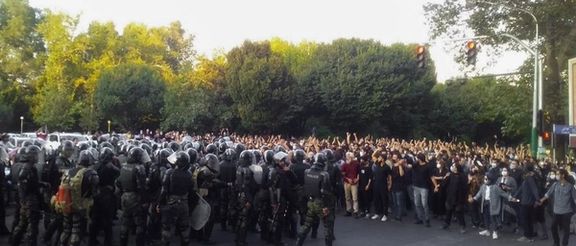
The first day of large protests in Tehran, September 19, 2022
Iranian activists and university professors have called for nationwide rallies on Saturday, October 8, as street protests have become sporadic in recent days.
Small and isolated flashmob protests continued Wednesday evening in several places as well as rooftop chanting and car horn honking. Some people say this is a sign the regime’s repressive methods are working. Nevertheless, others have urged Iranians to rally and protest in city squares across the country Saturday to demonstrate the might of the movement which they say now is the prelude to a revolution to overthrow the system rather than merely protesting its repressive policies.
In a statement Thursday, professors at the prestigious Sharif University of Technology in Tehran also urged all students and professors to rally in universities across the country Saturday in protest to the plainclothes security forces’ brutal attack on their university’s studentsOctober 2.
The European Parliament Thursday condemned the death of Mahsa Amini, the young girl whose death in custody sparked the recent protests in Iran, and asked for EU sanctions against her killers and those involved in quashing the ensuing street protests while the United States imposed sanctionson seven Iranian officials over the shutdown of internet access and the crackdown on peaceful protesters.
Authorities have arrested dozens of students and student activists protesting peacefully inside their university campuses, where the law bans armed forces from entering. Many students were arrested also at other locations including their homes.
Both calls to protest have been made only on social media as the extremely tight state censorship does not even allow media reporting of the protests, let alone publishing calls for demonstrations.
Students, mostly girls, in secondary schools, which only opened a few days ago for the new academic year, rebelled this week in many areas, refusing to attend classes, protesting inside their schools and chanting slogans on their way home. Students often burn the headscarves they are forced to always wear, in protest to hijab laws and the killing of Mahsa Amini who was arrested in Septamber for her ”improper hijab”..
Iranian authorities have clamped down on the protesters with such heavy methods that even some of their own supporters find it hard to digest.A regime insider, hardliner filmmaker Javad Moguei, has given a harrowing account of the brutality of the security forces in some Instagram posts. Moguei was shot with 14 plastic bullets and beaten up for objecting to security personnel attacking a young female protester on a Tehran street.
According to the Oslo-based Iran Human Rights Organization (IHR) at least 1,200, including 29 journalists, 20 rights activists, and 19 teachers, have been arrested since the protests began nearly three weeks ago. IHR said Tuesday that at least 154 protesters, including nine children have been killed by security forces during the recent protests.
Amnesty International said in a statement Thursday that Iranian security forces killed at least 66 people, including children, and 16 more in separate incidents in Zahedan, Sistan and Baluchistan province, amid an ongoing clampdown on ongoing protests in the province which brings the death toll in the province to 82. Local rights groups say the death toll has risen to 91.
Security forces fired live ammunition at Zahedan protesters, bystanders and worshippers after Friday prayers but claim the incident was provoked by armed separatist groups. Leading Baluchi Sunni cleric Molavi Abdolhamid who has refuted the authorities’ claimscondemned the killing of protesters calling it a “massacre” Wednesday.
Authorities blame foreign ‘enemies’ for the unrest in the country. On Thursday the state media aired a trailer of purported confessions by two French citizens as proof that protests are being instigated and led from outside the country. France has strongly rejected the allegations and the airing of forced confessions by its citizens.
Authorities have imposed curfew-style internet shutdowns to break communication among protesters and prevent footage from leaking to social media, but some images continue to trickle out. They have also resorted again to orbital jamming of international satellite transmissions to stop the flow of news from foreign-based Persian televisions such as Iran International, BBC Persian, and Manoto TV.
French satellite operator Eutelsat said Thursday that Iran had jammed two of its satellites since September 26, adding that it is in contact with relevant authorities to stop the interference.
The Paris-based operator said in a statement that it had reminded the Iranian authorities that intentional jamming is "explicitly prohibited" by the International Telecommunication Union (ITU) Radio Regulations.
"The interferences harmfully affect the transmission of several digital TV and radio channels broadcasting in Persian from outside of Iran, as well as other channels," it said, adding that "Eutelsat's technical experts have been working around the clock with affected customers to mitigate the impact of the interference on service as much as possible.”
After the Islamic Republic resorted to orbital jamming to limit access to Iran International, the news network launched a lawsuit to legally pursue the case through international bodies.
The signals directed at satellites are beamed into space from a site near Karaj, west of Tehran, amid escalation of the protests – sparked by the death of Mahsa Amini, the 22-year-old woman who was killed in custody of hijab police.
Earlier in the day, hacktivist group Anonymous said it is jamming about 48 of the Islamic Republic’s radio and television networks, and will continue disrupting channels affiliated with state broadcaster IRIB as long as the Islamic Republic jams signals to Persian-language satellite channels.
Tens of millions of people In Iran watch satellite TV channels such as Iran International because television in Iran is government-owned, echoing official propaganda.
A bronze seal for the Department of the Treasury is shown at the US Treasury building in Washington
The United States on Thursday imposed sanctions on seven Iranian officials over the shutdown of internet access and the crackdown on peaceful protesters.
The US Treasury Department in a statement said it imposed sanctions on Iran's minister of interior, Ahmad Vahidi; Communications Minister Eisa Zarepour; and Vahid Mohammad Naser Majid, the head of the Iranian Cyber Police, among others.
"The United States condemns the Iranian government’s Internet shutdown and continued violent suppression of peaceful protest and will not hesitate to target those who direct and support such actions," Under Secretary of the Treasury Brian Nelson said in the statement.
The nationwide unrest sparked by Mahsa Amini's death in hijab police custody has spiraled into the biggest challenge to Iran's clerical leaders in years, with protesters calling for the downfall of the Islamic Republic founded in 1979.
Rights groups say thousands have been arrested and hundreds injured in the crackdown waged by security forces including the Basij, a militia affiliated with Iran's Revolutionary Guards. Rights groups put the death toll at over 150.
The United States last month imposed sanctions on Iran's morality police over allegations of abuse of Iranian women, saying it held the unit responsible for the death of Amini, an Iranian Kurd who died after being detained in Tehran on Sept. 13 for "inappropriate attire."
Authorities have reported numerous deaths among the security forces, accusing foreign adversaries, including the United States, of meddling to destabilize Iran, without providing any tangible evidence.
Part of the clashes in the city of Zahedan on September 30, 2022
Rights group Amnesty International said Thursday that at least 82 Baluchi people have been killed in Zahedan, the provincial capital of Iran’s Sistan and Baluchistan since last Friday.
The group said Iranian security forces killed at least 66 people, including children, and injured hundreds of others after firing live ammunition, metal pellets and teargas at protesters, bystanders and worshippers during a violent crackdown after Friday prayers on September 30. Since then, another 16 people were killed in separate incidents in Zahedan amid an ongoing clampdown on protests.
Local Baluchi sources said, however, that the real death toll from Zahedan is at least 91 while images and videos of the protests suggest the real number is likely to be higher.
Despite state media’s claims that Jaish al-Adl Salafi jihadist militant group had claimed responsibility for the attack in Zahedan, local Sunni cleric Molavi Abdolhamid rejected "any involvement of Jaish al-Adl or any other group."
Widely referred to as “Bloody Friday” on social media, the onslaught marked the deadliest day on record since nationwide protests started across Iran three weeks ago, after the death of Mahsa Amini in custody of hijab police.
“The Iranian authorities have repeatedly shown utter disregard for the sanctity of human life and will stop at nothing to preserve power. The callous violence being unleashed by Iran’s security forces is not occurring in a vacuum. It is the result of systematic impunity and a lackluster response by the international community,” said Agnes Callamard, Amnesty International’s Secretary General.
“It is particularly abhorrent that nearly three years after the November 2019 protests, in which hundreds of people were unlawfully killed, the Iranian authorities have shamelessly continued their ruthless assault on human life,” she added.
Iranians have revolted against the Islamic Republic regime many times and have been suppressed each time, but the past is not necessarily a guide to the present.
Regime sympathizers in the West, who want the Islamic Republic to remain in power do not actually verbalize their desire. Instead, they declare that the regime’s survival is not in doubt. They base their rationale for spreading seeds of despair on how forcefully previous unrests were crushed. As such, they suggest we must resign to the notion that the past is irrefutably prologue.
But this revolt is different. Let us review some of the realities in a “then and now” schematic.
Dealing with the Repressive Machinery
The world is dealing with a new generation of Iranians. Iranian generations Y and Z are different from the nondescript and timid generations of the past. They are especially distinct from that of the "reform" period. This was my generation. When we came to the streets, we would listen to the words of self-appointed reformist leaders and protest in silence. When the riot police beat us with batons, we would chant, "Police force! Support us! Support!" Instead, a girl of generation Z sets her headscarf ablaze in front of the security forces and the boy saves his friend from the clutches of the regime’s plainclothes mercenaries with a Bruce Lee-style high kick.
The very basic right of any human being - the right to protect one’s own life - is now a rule vastly acknowledged by the Iranian people. If you punch, you will get kicked. If you lift a baton, a flowerpot will descend upon your head from the balcony. This retaliatory policy has stunned the regime’s repressive forces and instilled fear in the hearts of mercenaries, rendering their authority and the Islamic Republic’s historically brutish force a bit ineffective.
The sanctification of struggle has been replaced by the will for triumph. Anger has substituted grief. Crying over the death of comrades has given way to trying to achieve the goal for which they died. Students at universities now bravely confront the regime’s henchmen and shout, “Death to the Dictator!” When their comrades at Sharif (Aryamehr) University of Technology in Tehran are brutalized by the Islamic Republic’s mercenaries, students from universities around the country protest. Even high school students have joined the movement.
International Attention
During the November 2019 protests, the regime shut down the internet and embarked on a mission to slaughter the people. In the West, this massacre was hardly covered in the media, as if it was not happening. No Western celebrity uttered a word. The Iranian people’s need for the internet became a paragraph in the annual reports of Western think tanks. The hacker group Anonymous was not aware of the atrocity unfolding in Iran. The tweets asking Elon Musk to help get internet for Iran were probably never read by him. President Donald Trump and his foreign policy team expressed verbal support for the people. The silence from the rest of the politicians was deafening. To this day, US Democrats know little to nothing about what was dubbed as Iran’s “Bloody November.” They conveniently ignored the tragedy because, Heaven forbids, they would find themselves on the same side with Trump.
Now, Anonymous has unleashed its fury on the Islamic Republic. Elon Musk agreed to activate Starlink for Iran. Almost immediately, the US Government issued the license for him to proceed. All this is not perfect and has limitations, but it is a ray of hope for the Iranian people that the world is hearing them. Indeed, they have found their own methods to circumvent the regime’s internet shutdown. In the diaspora, Iranians from around the world have taken to social media and to the streets to express solidarity with their compatriots. In Toronto alone on October 1, 2022, an estimated 50,000 people rallied in protest to the Islamic Republic. Hundreds of thousands more joined these rallies in the US, Europe, Asia, and Oceania.
Western celebrities on social media condemned the brutal murder of 22-year-old Mahsa Amini by regime’s mercenaries for “inadequate hijab.” Her name became a codeword for women-inspired protests. Artists, athletes, and other celebrities began competing in praising the bravery of Iranian women and men. Politicians in the West, one-by-one began making official statements in support of the uprising.
A woman burning her hijab headscarf in Lahijan, a provincial town, September 2022
US Democrats who were at best lukewarm towards previous protests and flagrant human rights violations in Iran, have announced solidarity with the Iranian people, especially women. Even the progressive Democrats who are influenced by the Islamic Republic’s lobby found themselves in the awkward position of having to voice a semblance of support. Senator Chris Murphy (D-CT), who is an advocate of appeasing the oppressive regime in Iran, acknowledges in an interview with CNN that “this time is different.”
Most astonishing of all was Biden’s National Security Adviser, Jake Sullivan, admitting that the US, during Barack Obama’s presidency, made a miscalculation by not supporting the Iranian people during the 2009 uprising.
Unity
During the 2009 uprising, the streets of Tehran and a few other Iranian metropolitans saw an enormous turnout of people. In November 2019, there were protests everywhere except for Tehran, apart from some suburbs and peripheral townships. This time the heart of Tehran is ablaze. Affluent neighborhoods in Tehran are packed. Simultaneously, there are large demonstrations in other urban and rural areas on Iran. This has created a conundrum in transposition for the regime’s mercenaries and repressive forces. The middle class, which was silent in November 2019 and the winter of 2020, finally united with the rest of society. It is indeed a national uprising.
Artificial ethnic divisions, likely created by the regime itself or by fringe ultranationalist “opposition” groups outside Iran, were blurred. A nation rose in reaction to the slaying of a young Kurdish Iranian woman. In Tehran, people shouted "Kordestan, Kordestan, the eye and light of Iran.” Women of Tabriz shouted, "Azarbaijan is awake, it stands with Kordestan.” Everywhere else in Iran they chanted, "I will kill he who murdered my sister.” After the Islamic Revolutionary Guards massacred more than 40 Sunni compatriots in Sistan and Baluchistan province, people in the Shiite religious center Mashhad shouted, “Mashhad, Zahedan, my life is for Iran.”
Iranian opposition groups of various political persuasions, set their differences aside by and large. Those who did not join this movement with goodwill were rejected and repudiated.
The Islamic Republic’s unofficial lobby groups in the US and Canada that historically dominated the headlines with their “analyses” were also marginalized. Regime-affiliated journalists who largely wrote for English-language publications and spread disinformation in favor of the regime were ignored. Most interestingly, regime’s unofficial lobby in the US was explicitly told that they were not welcome in the October 1 rallies. In those rallies, placards were held by Iranians condemning these organizations and individuals.
Woman, Life, Freedom
The slogan of the Kurds who were fighting the Islamic State in Syria has become the slogan of the Iranians battling the Islamic State in Iran. “Woman, life, freedom” represents the paragon of liberty and social justice. Women, who were oppressed for 43 years following the Islamic Revolution, have become a symbol of human rights. Longing for a normal life and vitality, which the Iranian people were robbed of is celebrated. And freedom, it needs no elucidation.
You can call this movement an uprising, a rebellion, or a revolution. Whatever it is, it has a gratifying scent of victory. This time is different, in all respects.
The opinions expressed by the author are not necessarily the views of Iran International.
The European Parliament on Thursday called on the European Union for additional sanctions on the Islamic Republic over its bloody clampdown of protests.
The European Parliament on Thursday adopted a resolution that condemns the death of Mahsa Amini at the hands of Iran's morality police in September and asked for EU sanctions against her killers and those involved in quashing ensuing street protests.
The resolution calls for an "impartial and independent" probe into Mahsa's ill-treatment and killing, and "strongly condemns widespread and disproportionate use of force by Iranian security forces against the crowds which has so far resulted in many casualties." Parliament further called on the United Nations, and in particular its Human Rights Council, to initiate an investigation into recent events in Iran.
EU foreign policy chief Josep Borrell told reporters in Prague on Thursday that EU foreign ministers will discuss further sanctions on Iran at their next meeting. The EU foreign ministers are set to convene on October 17.
In a tweet, Borrell said he spoke with Iran’s Foreign Minister Hossein Amir-Abdollahian, asking for accountability for the death of Amini. He added that he also called on Tehran “to stop violence against demonstrators and to release those detained.” The EU foreign policy chief said he also urged Iran to cooperate with the UN nuclear watchdog.
Borrell underlined that the “right to protest and free flow of information must be allowed," adding that “EU is considering all options.”
A German foreign ministry source said October 3, that Germany, France, Denmark, Spain, Italy and the Czech Republic have submitted 16 proposals for new measures by the European Union against Iran. "We are now working flat out to implement these proposals," the source added.