• العربية
  • فارسی
Brand
  • Iran Insight
  • Politics
  • Economy
  • Analysis
  • Special Report
  • Opinion
  • Podcast
  • Iran Insight
  • Politics
  • Economy
  • Analysis
  • Special Report
  • Opinion
  • Podcast
  • Theme
  • Language
    • العربية
    • فارسی
  • Iran Insight
  • Politics
  • Economy
  • Analysis
  • Special Report
  • Opinion
  • Podcast
All rights reserved for Volant Media UK Limited
volant media logo

‘Actively Neutral’ Iran Faces Fresh Drone Allegations From Ukraine
Iran International Newsroom
Oct 6, 2022, 14:59 GMT+1Updated: 17:27 GMT+1
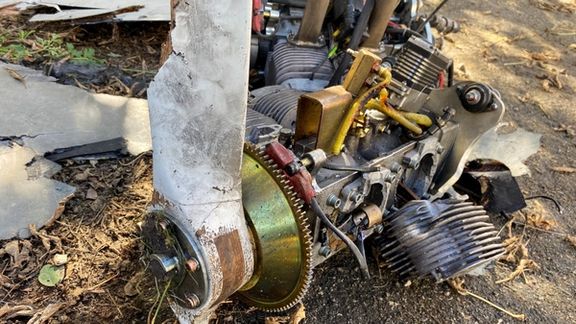
The engine of a reported Iranian drone used against Ukrainian targets, October 6, 2022

Tehran this week denied reports about supplying military drones to Russia, while the Kyiv region was targeted apparently by several Iranian-made drones.

Oleksiy Kuleba, head of the Kyiv military administration, said that six explosions 75km south of the city early Wednesday, wounding one in a military base at Bila Tserkva, had been carried out by Iranian-made Shahed 136 delta-wing ‘kamikaze’ drones.

Air force spokesman Yuriy Ihnat told Ukrainian television the drones had been launched from Russian-held territory to the south, with six others shot down. In remarks widely picked up by international media, Ihnat called the threat signaled by the attack “serious,” while Ukrainian President Volodymyr Zelensky reportedly discussed with commanders the “new types of weapons that the aggressor has begun to use.” Ukrainian officials earlier suggested the drones offer Moscow an easily-assembled, cheap alternative to high-precision missiles.

Iran’s foreign ministry spokesman Nasser Kanaani had said October 3 that media reports were “baseless” and that Tehran was committed to “active neutrality and opposition to war and the need for a political settlement of the differences between the two sides and away from violence.”

A Shahed drone on display in Iran in 2021
100%
A Shahed drone on display in Iran in 2021

US National Security Advisor Jake Sullivan in July warned Iran had agreed to supply drones to Russia after a visit by commanders to an Iranian air base, although US National Security Council spokesperson John Kirby said July 29 there were still “no signs of purchase.” Subsequent claims by US officials over Iran supplying drones have been anonymous.

Bombs, lobbyists, and air defenses

Ukraine has lobbied heavily in Washington, including recently sending a troop of female soldiers, and now argues that Russia’s use of Iranian drones justifies the US supplying more advanced weapons, a call echoed by some advocates of Ukraine and commentators.

An electronic piece from reportedly an Iranian drone used in Ukraine. October 6, 2022
100%
An electronic piece from reportedly an Iranian drone used in Ukraine. October 6, 2022

Despite the Iranian foreign ministry’s insistence that Tehran is neutral in the conflict, its Supreme Leader Ali Khamenei praised Vladimir Putin for his “initiative” of invading Ukraine, during their meeting in Tehran on July 19. Iran has long been a “strategic ally” of Russia, having supplied the ground troops in Syria to save President Bashar Assad’s government in the civil war.

Without an effective air-force due to decades of sanctions, Iran has developed domestic drone production, beginning with surveillance in the 1980-88 war with Iraq and progressing into carrying munitions. Some analysts argue Russia’s own development of drones has been hampered by air-force commanders’ preference for piloted airplanes.

Regional leaders in drone production are Israel and Turkey. Ankara has supplied Ukraine since 2019 with the advanced Bayraktar TB-2 while also acting in the current conflict as the main mediator between Moscow and Kiev. Despite being a top-ten global arms exporter and a leader in UAVs, kamikaze drones and precision-guided missiles, Israel has been criticized by Ukraine for not supplying weapons.

Ukrainian President Volodymyr Zelenskyy said in September he was “in shock because I don’t understand why they couldn’t give us air defenses.” Politicians of various hues in Israel, where around 15 percent of voters are Russian-speakers, are loath to undermine good relations with Moscow.


Most Viewed

Ghalibaf defends Iran-US talks amid hardline backlash
1
INSIGHT

Ghalibaf defends Iran-US talks amid hardline backlash

2
VOICES FROM IRAN

Bread shortages, soaring prices strain households in Iran, residents say

3
ANALYSIS

From instability to influence: Pakistan’s pivotal role in US-Iran diplomacy

4
ANALYSIS

100 days on: why Iran’s January protests spread across social classes

5

War-hit homeowners feel abandoned as Iran’s reconstruction aid fades

Banner
Banner

Spotlight

  • Is Iran entering its Gorbachev moment?
    INSIGHT

    Is Iran entering its Gorbachev moment?

  • Iran crackdown reaches cemeteries as graves of slain protesters defaced
    EXCLUSIVE

    Iran crackdown reaches cemeteries as graves of slain protesters defaced

  • Iran diplomacy wobbles as factions compete to avoid looking soft on US
    INSIGHT

    Iran diplomacy wobbles as factions compete to avoid looking soft on US

  • The politics of pink: how Iran uses cuteness to rebrand violence
    ANALYSIS

    The politics of pink: how Iran uses cuteness to rebrand violence

  • Bread shortages, soaring prices strain households in Iran, residents say
    VOICES FROM IRAN

    Bread shortages, soaring prices strain households in Iran, residents say

  • Ghalibaf defends Iran-US talks amid hardline backlash
    INSIGHT

    Ghalibaf defends Iran-US talks amid hardline backlash

•
•
•

More Stories

France Rejects Iran’s Claims That Detained Citizens Are Spies

Oct 6, 2022, 14:48 GMT+1

France's Foreign Ministry has reacted to a video of forced confessions of two French nationals detained in Iran, accusing Tehran of the practices of "worst dictatorial regimes". 

In order to build a narrative of foreign engendered protests, Iranian state media on Thursday released a trailer of an apparently longer program featuring forced confessions of Cécile Kohler, an educator who heads the teachers’ union National Federation of Education, Culture and Vocational Training (FNEC FP-FO) and her husband Jacque Paris.

In the short clip, they say they are agents of the French intelligence service, and were sent to Iran to prepare grounds for riots. State TV said the two French citizens had entered Iran with "chunks of money ... which was meant to fund strikes and demonstrations." "Our goal at the French security service is to pressure the government of Iran," said Paris in the video.

The French Foreign Ministry categorically denied that the two citizens were intelligence agents, saying it will do its utmost to secure their release.

Iran's Intelligence Ministry announced the detention of the two in May, alleging that they met with members of the Coordination Council of Iranian Teachers’ Trade Associations, which has been the organizer of several rounds of nationwide protests since last year.

According to information obtained by Iran International, the couple arrived in Tehran's on April 29 and stayed for two days, followed by visits to Kashan and Esfahan. They were returning to Paris on May 8 when they were arrested.

Their trip coincided with intensification of Iran’s crackdown on teachers’ protests and union activists over their rallies on May 1, the international Labor Day.

Iranian Protest Victim’s Family Forced Into Televised Confessions

Oct 6, 2022, 12:44 GMT+1
•
Maryam Sinaiee

Authorities in Iran have again resorted to airing forced confessions of family members to dodge responsibility in the suspicious death of a teenage protester.

The 16-year-old Nika Shakarami’s body was found ten days after she left home to take part in an anti-government protest on September 20. The last time she spoke to anyone she was running away from security forces chasing her on motorbikes.

Activists had warned Wednesday on social media that Nika’s family were under pressure to say she had committed suicide. Later in the evening, the state-run television’s infamous 8:30 news bulletin aired short excerpt of so-called “confessions” of Nika’s uncle and aunt as proof that she had committed suicide and security forces had no role in her death as many in Iran say.

Nika’s aunt and uncle were arrested a few days ago after publicizing her suspicious death on social media.

The program has aired forced ‘confessions’ of imprisoned activists, politicians, and social media celebrities many times, often using such ‘confessions’ as proof that dissent in Iran is only the result of foreign plots as the country’s Supreme Leader Ali Khamenei says in almost every public speech.

Many on social media have accused the IRIB program of pushing a script written by security forces and pointed out various discrepancies in the story as it was told by the authorities.

They have pointed out that Nika was wearing dark trainers in a photo released by the authorities of her body on the ground in the backyard of a house after “falling from a height”.

Nika's aunt, Atash Shakrami shown during her televised 'confession', October 5, 2022
100%
Nika's aunt, Atash Shakrami shown during her televised 'confession', October 5, 2022

In CCTV footage shown in the same program the woman they say is Nika entering the same building a few hours before her death is wearing white trainers. The program shows a man, apparently an interrogator, who indicates the woman entering the building on a laptop screen with his finger and asking who she is. “Nika,” the clearly distressed aunt, Atash Shakarami, replies without further comment.

The program also shows Nika’s uncle, Mohsen Shakarami, saying the family would follow the case through legal channels and did not approve of any “violent moves that cause damage to public property.”

Social media users have pointed out that in the video shown by IRIB the shadow of a man is seen on the wall behind Nika’s uncle while he is speaking, whispering something to him, apparently instructing him what to say.

On Thursday the official news agency (IRNA) released a video showing two French citizens, Cecile Kohler and her partner Jacque Paris, who were arrested in May on charges of espionage. IRNA called the French couple who are unionists associated with France’s National Federation of Education, Culture and Vocational Training “intelligence officers who came to Iran with bags of money”. The IRNA report did not say when the video was made.

In one of the scenes in the video Kohler describes herself as an “intelligence and operation agent of French foreign security service” saying she and her partner had come to Iran to fund strikes and antigovernment protests.

In reaction to forced confessions of its citizens, France's Foreign Ministry accused Iran Thursday of the practices of "worst dictatorial regimes". The ministry categorically denied that its citizens were intelligence agents, saying it will do its utmost to secure their release.

In a tweet Thursday Abdollah Ganji, the former editor of the IRGC-linked Javan newspaper who is now chief editor of Tehran municipality’s Hamshahri newspaper, claimed that Nika’s death was not related to the protests and merely a “coincidence” which protesters are using as a “spare fuel tank for the riots”.

A political analyst who asked not to be named, told Iran International, “What matters in this case, irrespective of who is telling the truth, is that nobody is convinced by what the authorities say because nobody trusts the system. People will believe the exact opposite of what the government says,” and added “Even the authorities know that everything is collapsing.”

EU Mulling New Sanctions On Iran Over Mahsa Amini, Protests Crackdown

Oct 6, 2022, 12:32 GMT+1

The European Parliament on Thursday called on the European Union for additional sanctions on the Islamic Republic over its bloody clampdown of protests.

The European Parliament on Thursday adopted a resolution that condemns the death of Mahsa Amini at the hands of Iran's morality police in September and asked for EU sanctions against her killers and those involved in quashing ensuing street protests.

The resolution calls for an "impartial and independent" probe into Mahsa's ill-treatment and killing, and "strongly condemns widespread and disproportionate use of force by Iranian security forces against the crowds which has so far resulted in many casualties." Parliament further called on the United Nations, and in particular its Human Rights Council, to initiate an investigation into recent events in Iran.

EU foreign policy chief Josep Borrell told reporters in Prague on Thursday that EU foreign ministers will discuss further sanctions on Iran at their next meeting. The EU foreign ministers are set to convene on October 17. 

In a tweet, Borrell said he spoke with Iran’s Foreign Minister Hossein Amir-Abdollahian, asking for accountability for the death of Amini. He added that he also called on Tehran “to stop violence against demonstrators and to release those detained.” The EU foreign policy chief said he also urged Iran to cooperate with the UN nuclear watchdog. 

Borrell underlined that the “right to protest and free flow of information must be allowed," adding that “EU is considering all options.”

A German foreign ministry source said October 3, that Germany, France, Denmark, Spain, Italy and the Czech Republic have submitted 16 proposals for new measures by the European Union against Iran. "We are now working flat out to implement these proposals," the source added.

Exiled Queen Calls On Military Forces To ‘Stand With Nation’

Oct 6, 2022, 10:47 GMT+1

Iran’s exiled queen Farah Pahlavi has once again called on military forces not to allow the Islamic Republic’s authorities to use them as “tools of repression.” 

In an audio message on her twitter account on Wednesday, Pahlavi addressed police forces, the army, the Revolutionary Guard, paramilitary Basij forces and plainclothes agents to imagine their own sisters, brothers, fathers and mothers before their eyes, urging them not to let the leaders to make them a tool to suppress people. 

Describing the regime’s crackdown on popular protests – sparked by the death of 22-year-old Mahsa Amini in police custody -- as "brutal and inhumane," she said people from different walks of life and with different ideologies “have risen up to eliminate the oppression."

"You are also from this nation, so be with this nation," she noted. 

Late in September, she released another similar message, lauding popular protests against “forces of darkness” and decried “the harrowing savage crackdown” on the nationwide rallies. 

Her son, exiled Prince Reza Pahlavi, said on Tuesday that “Multiple reports indicate the spread of strikes from cultural and educational sectors to the service and industry sectors,” calling it “a step in the right direction.” “Nationwide strikes alongside nationwide protests will bring this regime to its knees,” he added.

He also called on US President Joe Biden not to enter an agreement with Tehran that would financially benefit the Islamic Republic’s repression machine.

As protests in Iran continue well into their third week, pundits and politicians speculate that Iranians are more angry than scared, warning that suppression will make the protests more violent.

Iran International Pursues Legal Action Against Tehran’s TV Jamming

Oct 5, 2022, 20:54 GMT+1

After Iran resorted to orbital jamming to limit access to Iran International, the news network has launched a lawsuit to legally pursue the case through international bodies.

Iran International said in a statement on Tuesday that the Islamic Republic has, in recent days, resumed orbital jamming of international satellite transmissions, which is against international law.

The signals directed at satellites are beamed into space from a site near Karaj, west of Tehran, amid escalation of the protests – sparked by the death of Mahsa Amini, the 22-year-old woman who was killed in custody of hijab police. 

Iran International CEO said that Tehran’s move is a blatant violation of international treaties and regulations of satellite broadcast rights, noting that the Islamic Republic had barely resorted to orbital jamming after 2009 and only used terrestrial jamming to prevent people from watching satellite TV channels.

Tens of million of people In Iran watch satellite TV channels such as Iran International because television in Iran because only the government owned TV is allowed to broadcast, echoing official propaganda.

A non-profit Iranian American organization the National Union for Democracy in Iran (NUFDI), called on US Secretary of State Antony Blinken Tuesday to revoke the current waiver of secondary sanctions relating to dealings with the Islamic Republic’s state Broadcaster – or IRIB -- and implement sanctions on Tehran’s propaganda apparatus.

The Obama administration struck a deal in 2013 with Iran that waived existing sanctions on the IRIB as part of an agreement reached under the International Telecommunications Satellite Organization, or ITSO.