• العربية
  • فارسی
Brand
  • Iran Insight
  • Politics
  • Economy
  • Analysis
  • Special Report
  • Opinion
  • Podcast
  • Iran Insight
  • Politics
  • Economy
  • Analysis
  • Special Report
  • Opinion
  • Podcast
  • Theme
  • Language
    • العربية
    • فارسی
  • Iran Insight
  • Politics
  • Economy
  • Analysis
  • Special Report
  • Opinion
  • Podcast
All rights reserved for Volant Media UK Limited
volant media logo

France Says EU To Impose Sanctions On Iranian Officials
Iran International Newsroom
Oct 4, 2022, 17:59 GMT+1Updated: 17:35 GMT+1
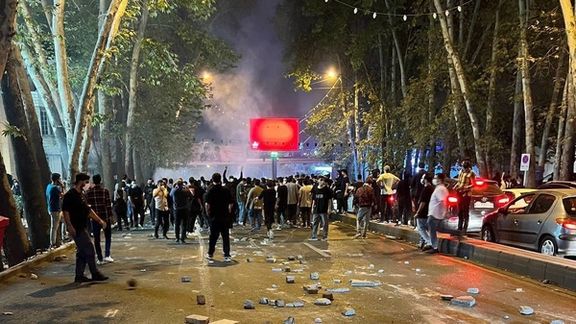
Protests in Tehran on September 24, 2022

France's foreign minister said Tuesday that the European Union was looking to impose sanctions on several Iranian officials involved in the crackdown on protesters.

"France's action at heart of EU ... (is) to target those responsible for the crackdown by holding them responsible for their acts," Catherine Colonna told lawmakers in parliament, adding that the EU was looking at asset freezes and travel bans.

The bloc last agreed human rights sanctions on Tehran in 2021. No Iranians had been added to that list since 2013, however, as the bloc has shied away such measures in the hope of reviving a nuclear accord with Iran after the United States withdrew in 2018. Those talks have now stalled.

It currently has an array of sanctions on about 90 Iranian individuals which have been renewed annually every April.

Colonna suggested the new measures could target repressive regime figures who send their children to live in Western countries. Diplomats say the measures are expected to be rubber-stamped at an EU foreign ministers meeting on October 17.

The United States and Canada have already imposed sanctions on Iran's morality police over allegations of abuse of Iranian women, saying they held the unit responsible for the death of a 22-year-old Mahsa Amini in police custody.

President Joe Biden issued a statement on Mondaysaying he is “gravely concerned about reports of the intensifying violent crackdown on peaceful protestors in Iran, including students and women, who are demanding their equal rights and basic human dignity.” He added that Washington will impose more sanctions this week on certain Iranian officials.

Amini, a Kurdish woman, was arrested by the morality police in Tehran for wearing "unsuitable attire" and fell into a coma while in detention. The authorities have said they would investigate the cause of her death, but so far, no police officer has been named, held responsible or arrested.

CT scans obtained by Iran International showed that Amini received hard blows to her head causing a fracture to her skull and brain damage. Hospital staff told us that she had no hope of being revived when she was brought in on September 13. She died three days later September 16.

Her death triggered nationwide protests that quickly turned into anti-regime unrest with mostly young protesters calling for an end to the Islamic Republic, freedom for women and equality.

Iran's Supreme Leader Ali Khamenei on Monday gave his full backing to security forces confronting protests ignited by the death of Amini, comments that could herald a harsher crackdown to quell unrest more than two weeks since she died.

Protesters have been chanting “Death to Khamenei” and “Death to the dictator” ever since demonstrations began.

He blamed the United States and Israel for “planning” the protests and claimed Iranian people did not initiate the unrest. Iran often blames “enemies” for similar incidents.

Iran Human Rights, a Norway-based group, has said nearly 150 people have been killed. Iranian authorities have not given a death toll, while saying many members of the security forces have been killed by "rioters and thugs backed by foreign foes".

Around 50 people were gunned down by security forces just in the Sunni Baluch populated region of southeast Iran near Pakistan since Friday according to local sources.

With reporting by Reuters

Most Viewed

Ghalibaf defends Iran-US talks amid hardline backlash
1
INSIGHT

Ghalibaf defends Iran-US talks amid hardline backlash

2
VOICES FROM IRAN

Bread shortages, soaring prices strain households in Iran, residents say

3
ANALYSIS

From instability to influence: Pakistan’s pivotal role in US-Iran diplomacy

4
ANALYSIS

100 days on: why Iran’s January protests spread across social classes

5

War-hit homeowners feel abandoned as Iran’s reconstruction aid fades

Banner
Banner

Spotlight

  • Is Iran entering its Gorbachev moment?
    INSIGHT

    Is Iran entering its Gorbachev moment?

  • Iran crackdown reaches cemeteries as graves of slain protesters defaced
    EXCLUSIVE

    Iran crackdown reaches cemeteries as graves of slain protesters defaced

  • Iran diplomacy wobbles as factions compete to avoid looking soft on US
    INSIGHT

    Iran diplomacy wobbles as factions compete to avoid looking soft on US

  • The politics of pink: how Iran uses cuteness to rebrand violence
    ANALYSIS

    The politics of pink: how Iran uses cuteness to rebrand violence

  • Bread shortages, soaring prices strain households in Iran, residents say
    VOICES FROM IRAN

    Bread shortages, soaring prices strain households in Iran, residents say

  • Ghalibaf defends Iran-US talks amid hardline backlash
    INSIGHT

    Ghalibaf defends Iran-US talks amid hardline backlash

•
•
•

More Stories

Use Of VPNs In Iran Surge 30-Fold Since Start Of Protests

Oct 4, 2022, 15:48 GMT+1

Amid heightened restrictions on Internet access following nationwide antigovernment protests, Iranians’ use of VPNs has risen over 3,000 percent in the previous month. 

"Daily demand for virtual private network (VPN) services in Iran is up over 3,000% compared to before the protests," Simon Migliano, the head of research at Top10VPN, told Axios, adding that "This is a massive spike, given that demand was already healthy before the social media shutdown." 

Many countries and companies are helping Iranians get easier access to information since the authorities have increased their restrictions. The US Treasury Department has given the greenlight to SpaceX CEO Elon Musk to activate satellite Internet service Starlink for Iranians and Google has just launched a VPN service for Iranians, but using such methods are not simple enough for ordinary people and still not many have managed to access the Internet via them. 

Google says its Jigsaw subsidiary's open-source Outline tool – which allows third parties to set up secure VPNs that are resistant to disruption and censorship efforts -- has seen a spike in demand from Iran this week. One such third party, Nthlink, reported that its VPN saw a massive surge in use from 40,000 users a day to nearly a million at peak and continues to see usage at ten times a typical level.

People tend to circumnavigate cyber crackdowns by downloading virtual private networks, which allows them to get around restrictions to certain blocked sites, but such tools do not work when countries shut off basic internet completely, as is the case for several regions across Iran.

Iran's Clerical Regime Faces A Hopeless, Rebel Generation

Oct 4, 2022, 14:59 GMT+1
•
Iran International Newsroom

The ongoing protests in Iran have given rise to debates about the significance and implications of Iran's Generation Z that is defying rules and restrictions.

This is a generation that is also called the social media generation who were born after the year 2000, although teenagers as young as 12 now are protesting in Iran.

They are absolutely different from the previous generations in Iran. For the first time in the history of the Islamic Republic, this is a generation that has not been affected by state propaganda and enforced lifestyle. On the contrary, thanks to the Internet and satellite television, they know how other young people live elsewhere in the world and they find life under the restrictions imposed by the clerical regime humiliating.

As the current protests began more than two weeks ago, people noticed youngsters between the ages of 15-25 leading demonstrations in the streets carrying their backpacks and mostly dressed in black. They were not so afraid of Iran’s security forces as previous generations had been and were ready to break taboos.

Already, many girls and women among them walk around without hijab, while the protests started when a 22-year-old woman, Mahsa Amini was arrested by the hijab police and died in their custody with severe head injuries.

Schoolgirls without hijab driving out an education ministry official who came to convince the to "behave".

In an interview with Iran's leading economic daily Donyaye Eqtesad, Iranian sociologist and author Maghsoud Farastkhah tried to explain what is it that Iran's Generation Z wants. The interview was published on October 3, on the same day that Iran's high school and junior high school students joined the nationwide uprising.

According to Farasatkhah, to put it simply, Iran's new generation wants the right to live a normal life. However, they cannot not express their demands in the closed political system. The academic added that for the first time in Iran, the new generation's parents sympathize with them.

"Generation Z sees itself in a dystopian atmosphere," said the academic, adding that out of despair, they wish to express themselves by opting to resist the status quo even at the price of their lives. What Farasatkhah explains can be possibly best described as hopelessness. The reason why they act boldly and courageously is because they received a lot of attention by their parents and are self-confident.

This is a society suffering from inefficient governance, chaos and trauma. Everyone feels to have been victimized and overwhelmed by violence and accumulated shortcomings.

Farasatkhah further explained that the generation of the 2000s wants social freedoms, but it is not allowed to choose the lifestyle it likes. When the government imposes its own traditional lifestyle, it tends to resist, and this resistance is stronger among women because there are always more challenges for them than for men.

In a nutshell, Farasatkhah said that Generation Z has no epic to uphold and no hope for the future.

Another sociologist Taqi Azad Armaki said in an interview that Generation Z knows what it wants and it also knows that it is difficult to get it. Nonetheless, they will not become anarchists. Armaki added that Generation Z is not idealist. They simply want to live a normal life characterized by welfare, freedom and human rights. "But we have deprived them of this life. We have sent them to schools and universities, but we cannot give them a job. So, they have skills that they cannot use," Armaki explained.

The sociologist said: "We should stop calling them decadent, illiterate and morally corrupt. “These labels will prompt them to react in a radical way. We need to talk to them, but this needs to be done by intellectuals and social leaders."

Meanwhile, conservative politician and commentator Mohammad Mohajeri acknowledged that "it is difficult to deal with Generation Z." They do not care what traditions say about everything. The new generation has a different concept of freedom. On the other hand, while the previous generation got ideas from books, the new generation gets its ideas from social media. Mohajeri also pointed out that Generation Z has no leader and does not want to have leaders. They work like a tsunami and surprise the officials who have no idea about how to deal with them. Their only solution is to introduce more restrictions so that they can control the society. And this further annoys the new generation.

Popular Iranian Footballer Charged In Absentia For Supporting Protests

Oct 4, 2022, 13:37 GMT+1

A popular Iranian former football (soccer) player has been charged in absentia for supporting ongoing antigovernment protests, Iran International has learned.

Ali Karimi who is currently abroad has been charged with unlawful “assembly and collusion with the intention of acting against national security.” This is an accusation the Islamic Republic regularly uses against dissidents and critics, with the slightest comment by an individual as grounds for a political crime.

Ali Karimi was one of the first celebrities who condemned the death of Mahsa Amini, who was killed while in the custody of Iran’s hijab police in September. Since then, Karimi has voiced support for protesters on social media becoming an icon for them. His tweets regularly generate more than 100,000 ‘likes’.

Iran International obtained the copy of a court document showing that Karimi has been charged. Although he is not in Iran, but his assets can be seized by the authorities.

Last week, security agents sealed the entrance of a villa near Tehran which was Karimi’s house, but later they removed the seal as they realized he had sold the property to someone else.

The popular protests in Iran do not have a clear leadership structure and are driven by teenagers and young people. Many celebrities who cooperate with the government to preserve their privileges in an authoritarian system, are careful not to praise the protesters. But those who side with them easily become more popular.

Iranian Officials Blame 'Enemies' As The Youth Rebellion Contiues

Oct 4, 2022, 11:58 GMT+1
•
Maryam Sinaiee

Following Supreme Leader Ali Khamenei’s lead, Iranian officials alleged on Tuesday that protests are instigated by foreign enemies while the unrest continues.

President Ebrahim Raisi on Tuesday accused “enemies of the Islamic Republic” of fomenting the protests, echoing what Khamenei said on Monday. Parliament Speaker Mohammad-Bagher Ghalibaf in turn vowed the parliament would take action to change the ways of the morality police in a bid to calm the protesters.

Protest rallies in universities continued Tuesday. A video shows students in their white uniforms staging a sit in on the campus of Rasht Medical Sciences University and holding placards silently. A video from Azad University in Najaf Abad, a conservative city in Esfahan Province, shows students clapping and chanting “Freedom, Freedom, Freedom”.

Social media users have also posted more videos of school children, particularly girls, refusing to attend classes and chanting in school yards and outside on Tuesday in various cities and towns including Tehran and Sanandaj. A video shows boys at a gifted students’ high school in Isfahan refusing to attend classes for a second day.

In many schools girls are refusing to wear their headscarves both in and outside the school. Girls and boys are also protesting by chanting, burning headscarves, writing graffiti, tearing down the photos of Khamenei and his predecessor, Ruhollah Khomeini, burning and trampling on the photos which are displayed in every classroom and government office.

Schoolgirls chanting "Women, Life, Freedom" on Tuesday, October 4

“We can’t study when the lives of our youth are being cut short, our brothers, our sisters,” a boy speaking at a student rally at a boys’ school says in a video posted on Twitter Tuesday.

In Esfahan, Iran's fourth most populous city, businesses went on strike Tuesday on one of the city’s major streets, Taleghani Ave, where most of the electronics shops are located. Several videos on social media show nearly all shops are closed or with shutters half-down.

There were no major late-night protests in Tehran and other cities Monday evening but in some areas of Tehran people continued to chant from their windows and rooftops and honked their horns in protest on busy roads.

“Don’t be mistaken. We’ll be out every night not just tonight!” people chanted Monday evening from their windows In Tehran’s western Ekbatan neighborhood, a massive apartment complex, while a group of youth marched from one apartment block to another chanting slogans such as “Death to Khamenei!”

“This system is being defeated because it has never had a theory about its own defeat. It only theorizes about its victory … You cannot contain this generation and interact with it with the same methods and thoughts as in the past,” Mohsen Renani, a renowned reformist economist and professor at Esfahan University, warned in a statement Monday. “Beware! Beware not to think that you can suppress [the protests] and all will be fine… It will remain like burning ambers under the ashes and reignite,” he added.

The IRGC which has so far not used overwhelming military force against protesters on the streets, continued its mortar and drone attacks on the positions of Kurdish Iranian insurgent groups in Iraqi Kurdistan for the eleventh consecutive day.

Islamic Republic’s Misogyny Sparked Women-Led Uprising In Iran – US Envoy

Oct 4, 2022, 11:53 GMT+1

US envoy for battling antisemitism says the entire world as well as the Iranian people know that Islamic Republic’s inherent misogyny has sparked the current women-led uprising.

Special Envoy to Monitor and Combat Antisemitism Deborah E. Lipstadt said late Monday that Supreme Leader Ali Khamenei "can blame ‘Zionists,' the US, or anyone else, but it’s clear to the world and the Iranian people that his regime’s violent misogyny ignited these women-led protests.”

She was referring to Supreme Leader Ali Khamenei’s first reaction to ongoing unrest on Monday, saying that the protests were planned and not staged by "ordinary Iranians…I am saying explicitly and clearly, riots and insecurity were planned by America and the usurper, fake Zionist regime,” said the aging 83-year-old Khamenei who has ruled for 33 years. 

Echoing Khamenei’s remarks, Iran’s President Ebrahim Raisi said on Tuesday the ongoing protests – triggered by the death in custody of 22-year-old Mahsa Amini -- are a riot organized by the US and Israel in order to prevent the Islamic Republic’s progress.

Also on Monday, US Congressman Brad Sherman (D-Calif) said that “Today the Ayatollah erroneously tried to blame the US and Israel for Iran’s protests.”

Referring to a bipartisan and bicameral resolution to commemorate Mahsa Amini's death and to convey US support for the protests, the representative added that “through resolutions like this, the world is showing that the truth behind the protests is clear, and that the support behind those calling for equality and justice in Iran is resolute.”