• العربية
  • فارسی
Brand
  • Iran Insight
  • Politics
  • Economy
  • Analysis
  • Special Report
  • Opinion
  • Podcast
  • Iran Insight
  • Politics
  • Economy
  • Analysis
  • Special Report
  • Opinion
  • Podcast
  • Theme
  • Language
    • العربية
    • فارسی
  • Iran Insight
  • Politics
  • Economy
  • Analysis
  • Special Report
  • Opinion
  • Podcast
All rights reserved for Volant Media UK Limited
volant media logo

Over 75 Protesters Reportedly Killed In Iran

Maryam Sinaiee
Maryam Sinaiee

Iran International

Sep 27, 2022, 12:10 GMT+1Updated: 18:11 GMT+1
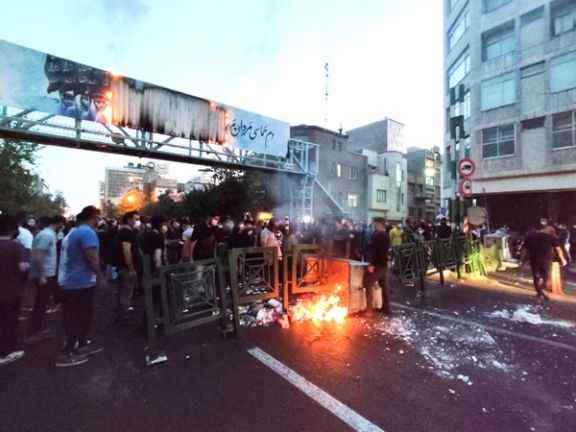
Protesters in Tehran on September 21, 2022

Iran remained in the grip of anti-government protests in many cities on Monday, for the tenth consecutive day, with the death toll now rising to over seventy.

Iran Human Rights (IHR), a monitoring group based in Oslo, Norway, said Monday at least 76 protesters have been killed by security forces so far. According to IHR, in many cases, handing over the bodies of the victims to their families was made contingent on agreeing to secret burials. Iran Wire said Tueday at least 2,000 protesters have been arrested in Tehran alone over the past ten days.

The state broadcaster, IRIB, had reported a death toll of 41 until Monday but said this included both protesters and security forces.

Protesters took to the streets again across the country including in Tehran, Tabriz, Yazd, and Sanandaj in different neighborhoods Monday evening chanting slogans against the Islamic Republic, security forces, clerics, and Supreme Leader Ali Khamenei and often clashing with security forces.

More videos have emerged of security forces brutally beating protesters. In one such video from Shiraz in southern Iran several anti-riot police are seen beating up a protester with batons.

In some neighborhoods of Tehran such as Ekbatan, a massive housing development with a middle class population of over 100,000 in the west of the capital with, residents have been displaying their support by shouting slogans from their windows after nightfall.

Chief Justice Gholamreza Mohseni-Ejei on Monday threatened celebrities who have supported the protests of retribution. Dozens of celebrity athletes and artists of every walk as well as some university professors have been expressing support for the protesters and announcing their departure from the national team, the state broadcaster, or their jobs.

“Get this into your heads, you murderers! We have lived on this land for thousands of years and seen what happened to Mongols [invaders]. We will stand on your graves, too! You can’t silence us!” Mohammad Khodabandehlou, a footballer with Sirjan Golgohar FC wrote on Instagram.

The local prosecutor’s office Monday impounded the luxury villa of soccer legend Ali Karimi, in Lavasan, a resort area only kilometers from Tehran, for his candid and continued display of solidarity with the protests immediately after they began.

Photos of the villa’s entrance were published on social media with signs saying the property had been sealed by judicial order “until further notice” but these were removed later without any explanation.

The Revolutionary Guard (IRGC)-linked Fars news agency had earlier accused Karimi, who is currently in the UAE, of being an “agitator” and “leader of rioters” and a hardliner former lawmaker, Hamid Rasaei, demanded confiscation of his properties in Iran.

Karimi, known as the ‘Asian Maradona’, who is followed by over 12 million on Instagram reacted by saying “A house has no value without the homeland”.

Instagram, the only major social media platform not blocked in Iran in the past few years, was filtered after protests began. The decision has a huge impact on hundreds of thousands of small businesses and millions of people who relied heavily on the platform for making a living

University classes are held online to prevent student protests on campuses as intermittent Internet blackout continues. In many cities such as Shiraz and Qazvin as well as Alborz province, authorities closed schools Monday “due to air pollution” but in other areas classes convened as usual.

For a fourth consecutive day Monday, the IRGC shelled the camps of opposition Iranian Kurdish parties in the border areas of the neighboring Kurdistan region of Iraq. The operations started after rallies in Erbil and Sulaymaniyah in solidarity with Iranian protesters, particularly in the western Kurdish areas.

Most Viewed

Ghalibaf defends Iran-US talks amid hardline backlash
1
INSIGHT

Ghalibaf defends Iran-US talks amid hardline backlash

2
INSIGHT

A nation in limbo: 100 days after the massacre, has the world moved on?

3
ANALYSIS

From instability to influence: Pakistan’s pivotal role in US-Iran diplomacy

4
ANALYSIS

100 days on: why Iran’s January protests spread across social classes

5

War-hit homeowners feel abandoned as Iran’s reconstruction aid fades

Banner
Banner

Spotlight

  • War-hit homeowners feel abandoned as Iran’s reconstruction aid fades

    War-hit homeowners feel abandoned as Iran’s reconstruction aid fades

  • 100 days on: the anatomy of Iran’s January crackdown
    INSIGHT

    100 days on: the anatomy of Iran’s January crackdown

  • Ghalibaf defends Iran-US talks amid hardline backlash
    INSIGHT

    Ghalibaf defends Iran-US talks amid hardline backlash

  • 100 days on: why Iran’s January protests spread across social classes
    ANALYSIS

    100 days on: why Iran’s January protests spread across social classes

  • From instability to influence: Pakistan’s pivotal role in US-Iran diplomacy
    ANALYSIS

    From instability to influence: Pakistan’s pivotal role in US-Iran diplomacy

  • A nation in limbo: 100 days after the massacre, has the world moved on?
    INSIGHT

    A nation in limbo: 100 days after the massacre, has the world moved on?

Tweet unavailable

•
•
•

More Stories

Kim Kardashian Supports Iranian Women's 'Fight For Basic Rights'

Sep 27, 2022, 10:26 GMT+1

American socialite and media personality Kim Kardashian, with over 330 million followers on Instagram, has expressed support for Iranian women’s protests against the Islamic Republic.

Kardashian posted a story on her Instagram page on Monday in support of the Iranian women's fight for their "basic rights" including "the right to sing in their country, to ask for a divorce, to have custody over their children, and to choose how they dress."

She also posted photos of the Iranian people's ongoing protests against the Islamic Republic, including one with a poster of Mahsa Amini, the 22-year-old woman whose death in the Iranian "morality police" custody sparked nationwide demonstrations.

Kardashian is the latest celebrity to join the global wave of support for the Iranian nation's struggle against the Islamic Republic.

Earlier, Canadian singer Justin Bieber, with 260 million followers on Instagram, and American Oscar-winning actress Jessica Chastain had supported the uprising.

"The people of Iran will not be silenced. I stand with the women of Iran and will amplify their voices from afar. When one woman is attacked, it is an attack on as all," Chastain wrote in her message.

Iranian celebrities, both from inside the country and abroad as well as athletes from many national teams have also expressed support for the protests despite repeated threats and warning by authorities about banning them from their professions.

US Trying To Defend Nuclear Talks While Supporting Protests In Iran

Sep 27, 2022, 09:10 GMT+1
•
Mardo Soghom

The Biden Administration is under increasing pressure to reconcile its policy of nuclear talks with Iran and taking a clear position in support of ongoing protests.

While the administration has taken some steps to show its support for Iranians protesting for freedom, it still remains committed to reviving the 2015 nuclear accord (JCPOA), which would give the Iranian regime billions of dollars in sanctions relief.

Critics say that in the current situation when the Iranian government is killing protesters, lifting sanctions would simply provide a huge financial windfall to the regime to suppress the people, and to carry on with its malign regional policies.

In fact, those who were opposed to the revival of the JCPOA now have further reason to question the administration’s policy of nuclear talks with Tehran.

State Department spokesperson Ned Price on Monday tried hard to respond to this quandary during his daily briefing.

“Both are a national interest of ours. These are core to our interests and to our values. So of course, we are committed, President Biden is committed, to seeing to it that Iran is never in possession of a nuclear weapon,” he said, referring to President Joe Biden’s stated policy of not allowing Iran to obtain nuclear weapons and supporting the demands of protesting Iranians.

But under tough questioning by reporters, it became apparent that the spokesperson faced a difficult challenge, amid increasing calls for a tougher policy toward Iran.

The administration insists that reviving the JCPOA is part of not allowing Iran to obtain nuclear weapons. But the deal’s sunset clauses will run out in less than a decade and Iran would be free to expand its nuclear program, while earning money free of sanctions.

The second argument the administration presents is that the nuclear challenge Iran poses is the most dangerous and the revival of the JCPOA will address that. However, it agrees that Iran also poses other dangerous challenges to the United States and its allies, such as its support for militant proxies around the region that are already dominating Iraq and Lebanon and building a military infrastructure in Syria.

While reviving the JCPOA would temporarily stop Iran’s progression toward a nuclear bomb, the sanctions relief will allow it to amplify other dangers it poses to the region and US national interests.

A relevant historical example would be US arms limitation talks with the Soviet Union, by which successive administrations tried to harness the arms race while calling for freedom and democracy in the Communist empire. But those talks were not contingent on providing tens of billions of dollars to Moscow in sanctions relief.

Ned Price also highlighted that the administration eased sanctions on sending software and hardware to Iran to provide Iranians free access to the internet after the government severely restricted connectivity. In that context, however, he was careful to distinguish the Biden Administration form its predecessor by saying, “We are helping people around the world, including in Iran, access personal telecommunications technology. This, of course, is not a regime change policy.”

Iranian officials, including foreign minister Hossein Amir-Abdollahian have accused the US and the West of fomenting or supporting the protests, trying to argue that the popular demonstrations are not genuine and engineered from abroad. In an interview with Al Monitor the foreign minister went as far as calling hundreds of videos showing violence against protesters “fake”.

Coverage Of Nationwide Protests In Iran On September 26

Sep 26, 2022, 22:30 GMT+1
•
Iran International Newsroom

Amid an internet shutdown for mobile phones in many locations, reports and videos did trickle out from Iran, showing protests in many cities and towns.

Students in many universities have announced a strike until all students arrested since last week are not freed and authorities do not resume normal classes and lectures. Universities suspended in-person classes last week, to reduce student presence on campuses and chances of large protests.

Reports and a few images received Monday evening show that there were protests in Tehran, Sanandaj in western Iran, Tabriz in northwest, and Mashhad in the east. It is entirely possible that as in previous nights there are also protests in other cities, but the internet disruption delays news and images being posted on social media.

Some protesters and activists are calling for industrial and commercial strikes to paralyze the government, but so far only teachers have announced a strike. Some voices say that without general strikes and around-the-clock protests it is not possible to topple the regime, an outcome most are pursuing.

Most protesters also do not take their cell phones with them because in case of arrest these will be confiscated and any text or image stored could be used against a detainee to prove subversive activities.

We ended this live coverage at 01:00 Tehran time on Tuesday

---------------------------------------------------------------------------------------------------------------------------

----------------------------------------------------------------------------------------------------------------------------

---------------------------------------------------------------------------------------------------------------------------

A large group of young protesters marching through the streets of Tehran on Monday night, although we do not have the exact name of the area or district. The crowd is chanting, "Iranians ready to die but not accept humiliation."

---------------------------------------------------------------------------------------------------------------------------

In the traditionally conservative city, Yazd in central Iran, protesters are chanting that Khamenei's son Mojtaba will never succeed his father. Recently there have been rumors that the Supreme Leader's son is being groomed to succeed his father.

---------------------------------------------------------------------------------------------------------------------------

A large crowd is chanting, "We do not want the Islamic Republic," in Babolsar, norther Iran, Thursday night.

---------------------------------------------------------------------------------------------------------------------------

In some cities protests are calm and there is no gunfire by security forces. In Marivan in Kordestan Province, western Iran, a large crowd has gathered on a main square and seemingly there are no riot police.

Security forces are firing with military weapons in Kermansha, western Iran on Monday to disperse protesters.

---------------------------------------------------------------------------------------------------------------------------

People honking their car horns in Sanadaj, western Iran as peotesters begin coming out into the streets on Monday.

---------------------------------------------------------------------------------------------------------------------------

---------------------------------------------------------------------------------------------------------------------------

Protests in Narmak, a district of eastern Tehran. Protesters chant "Death to the dictator," in reference to Supreme Leader Ali Khamenei who has been in power since 1989.

---------------------------------------------------------------------------------------------------------------------------

After protests by university students in Tabriz on Monday, demonstrations began in the evening in the streets. Authorities began firing at protesters as can be heard in this video.

---------------------------------------------------------------------------------------------------------------------------

Here is another video from Tabriz showing protesters running away as gunfire is heard.

---------------------------------------------------------------------------------------------------------------------------

A large protest in Ghoroveh, a town in the Kurdish region of western Iran Monday evening.

Ending Talks? More Sanctions? Pundits Weigh Iran Options

Sep 26, 2022, 20:32 GMT+1
•
Iran International Newsroom

Calls for tougher sanctions on Iran over the September 16 death in custody in Tehran of Mahsa Amini go nowhere near far enough for some.

The European Union is considering new measures against Tehran, while the German foreign ministry summoned the Iranian ambassador Monday. According to Berlin-based Wall Street Journal reporter Laurence Norman has already agreed anti-Iran measures. The United States September 22 announced sanctions against Iran’s morality policy while National Security Adviser Jake Sullivan told NBC Sunday the US was on the “side” of “fundamental justice, dignity and rights.”

Sullivan said the administration’s approach differed from that of President Barak Obama, which he said had been slow to express support for 2009 demonstrations in Iran for fear of protestors being seen as US proxies.

Some commentators are not satisfied. “Control of women’s bodies isn’t a by-product of Islamic rule but its foundation,” wrote Janice Turner in the London Times Saturday. “If hijab falls, so does the regime…By enforcing hijab, the government inveigles itself into your bedroom.”

‘Righteous anger’

Turner argued the veil was “neither a Persian tradition nor a practice that, as in Indonesia or Pakistan, grew with the ascendancy of conservative Islam.” Rather it arrived in Iran enforced after the 1979 Islamic Revolution.

In earlier columns, Turner has argued that veiled women in Europe provoked among Muslims “a righteous anger whose logical conclusion is jihad,” and that allowing hijab in colleges and public buildings in Turkey brought the end of “Ataturk’s secular state.”

In the Sunday Times, Nazanin Zaghari-Ratcliffe wrote that Amini’s death had been marked by a gathering in Evin prison, where Zaghari-Ratcliffe, an employee of Thomson Reuters, was held for part of her four years in jail before she left Iran in March after the United Kingdom honored a £400-million debt ($428 million).

“Forty of the inmates then gathered in the communal yard, in solidarity with Mahsa’s family but also with all the women in Iran battling for their rights,” Zaghari-Ratcliffe wrote. “They lit candles, sang songs, chanted together and mourned the death of yet another innocent woman.”

Media ‘legitimizing gender discrimination’

In the Wall Street Journal, Karim Sadjadpour, Washington-based senior fellow at the Carnegie Endowment for International Peace, argued that the “lone source of diversity” in Iran’s “rotting regime” was whether the beards and turbans of its ruling men are black or white.”

Criticizing CBS interviewer Lesley Stahl for wearing a headscarf when interviewing President Ebrahim Raisi in Tehran September 13, Sadjadpour accused news organizations, governments and NGOs of “legitimizing…gender discrimination.”

The Biden administration, Sadjadpour agued, should “reassess its Iran strategy” including “shortsighted” efforts to revive the 2015 Iran nuclear deal, the JCPOA (Joint Comprehensive Plan of Action), which limited Iran’s nuclear program in return for eased international sanctions. A “representative” government in Tehran “could be a political geopolitical game changer for the United States” and was “the single most important key to transforming the Middle East,” Sadjadpour claimed.

But the Carnegie senior fellow stopped short of advocating the end of any talks with Iran. He suggested US should aim both to negotiate with Iran’s leaders and undermine them, as it had done with Soviet Union.

No deals with ‘savages’

By contrast, Masih Alinejad, New York-based social-media influencer and Voice of America contributor, said Sunday no talks should take place with “these savages.” Addressing the advocacy group United Against A Nuclear Iran, Alinejad said history would “judge” President Joe Biden for “saving” Iran’s rulers. “Instead of getting a deal, stand up for your values,” she said.

Alinejad told Fox News during Iranian president Ebrahim Raisi’s recent trip to the UN in New York that “Iranians” wanted to see Raisi meet the same fate as Qasem Soleimani, the general killed with ten others by a US drone strike in Baghdad in 2020 in what the UN deemed ‘unlawful killing.’ Alinejad told Fox presenter Martha McCallum that Raisi “was the terrorist…And he came here with the member of Revolutionary Guards.”

Iran Guards Attack Kurdish Groups In Iraq For ‘Backing Protests’

Sep 26, 2022, 12:24 GMT+1

Iran’s Revolutionary Guard says it has started a fresh round of attacks against Kurdish groups in Iraqi Kurdistan amid nationwide protests that originated from Kurdish regions. 

The IRGC said in a statement on Monday that it has launched drone attacks against the Komala Party of Iranian Kurdistan and Democratic Party of Iranian Kurdistan. 

The shelling of Kurdish groups’ positions is the second time the IRGC has attacked the Iraqi Kurdistan in less than a week, allegedly as retaliation for sending forces and arms for “riots” in Iran. 

On Saturday, the IRGC attacked offices of Kurdish opposition groups in Erbil’s Sidakan district, accusing the Kurdish parties of inciting “chaos” in Iran amid demonstrations condemning the death of Mahsa (Zhina) Amini, who died in custody of Iran’s hijab police. 

Amini was from the Kurdish town of Saqqez and was arrested and beaten during a visit to Tehran. After her death in hospital, her hometown and other Kurdish cities were the first to launch antigovernment protests.

Tasnim news agency, affiliated with the IRGC, claimed that the shelling targeted offices of Komala and the Kurdistan Democratic Party of Iran for sending “armed teams and a large amount of weapons… to the border cities of the country to cause chaos.”

The Islamic Republic calls the Kurdish armed groups in the western provinces of Iran, "terrorist groups" or "anti-revolutionary" but these groups say that the goal of their armed campaign is "defending the rights of the Kurds".

Generally, the Kurdish parties − including Komala and the Kurdistan Democratic Party of Iran (KDPI) − favor Kurdish autonomy within a federal Iran.